Posts tagged ‘Ganges’

02/09/2016

Jobs elusive as India clings to fastest-growing economy tag | Reuters

It’s been two years since India emerged as the world’s fastest-growing major economy, but the rapid expansion has done little to improve the lot of Ashok Kumar.

Parked up and sitting on the kerb, the 25-year-old truck driver is going nowhere fast. He is the sole breadwinner for the 13 people in his extended family and his monthly salary is stuck at $150.

With new, better-paid jobs hard to come by, Kumar lacks options. He fears becoming unemployed like his elder brother, who recently returned to their village in Uttar Pradesh after months of searching in vain for work.

Data out on Wednesday showed India’s economic growth slowed to 7.1 percent in the quarter to June, a 15-month low. That is faster than other major economies, but not fast enough to create enough new jobs to absorb all the one million people who join the workforce every month.

A government survey found that job creation fell by more than two-thirds in 2015. Analysts at HDFC Bank estimate that for every percentage point the economy grows, employment now adds just 0.15 of a percentage point – down from 0.39 in 2000.

It’s a major challenge for Prime Minister Narendra Modi, who has promised to create 250 million jobs over the next decade.

“For one job, there are at least 20 candidates,” said Kumar. “If you want the job, you can’t afford to bargain.”

Nearly two-thirds of India’s 1.3 billion people are under 35 years old. This rising demographic “bulge” will create the largest working-age population in the world. At the same time China, which has long curbed family size, will age as a society.

Whether this so-called demographic dividend will translate into the kind of economic gains seen in Japan and Korea, or lead to upheavals, depends on India’s ability to generate jobs.

Yet, despite average annual growth of 6.5 percent between 1991 and 2013, India added less than half the jobs needed to absorb new job seekers.

MORE WORKERS, FEWER JOBS

Under Modi, India has opened up further to foreign investment, hoping to generate more manufacturing jobs. A loan scheme for small businesses has been set up and there are plans for a $1.5 billion fund for startups.

Modi has also launched a programme to train over 4 million people in different skills in six years.Pronab Sen, country director for the International Growth Centre, a British-backed think tank, said such measures were “laudable”, but they aimed at boosting supply when more demand was needed.

“India has become a demand-starved economy,” Sen said. “If there is no demand, there will be no incentive to produce more which, in turn, will mean no new jobs.”

The level of desperation for work is staggering. In August, nearly half a million people, including post-graduates, applied for 1,778 jobs as sweepers in the city of Kanpur.

This was not a one-off. Last year, in Uttar Pradesh, 2.3 million people sought 368 low-level government jobs that required a primary education and ability to ride a bicycle.

Competition for such jobs has become fiercer as the public sector’s share in formal employment is declining.

Two years of drought has caused distress in farming, while the construction business has suffered a prolonged downturn – making work scarcer in the two sectors that employ the bulk of India’s unskilled workforce.

Satellite cities around the capital, like Greater Noida were, until recently, bustling with construction activity.

Now, Greater Noida’s skyline is dotted with half-built, abandoned, high-rises. Cranes and diggers stand idle.

In Delhi and the surrounding National Capital Region, housing starts fell 41 percent year-on-year in the first half of the year, according to consultancy Knight Frank. Across India, starts were down 9 percent from a year earlier.

Bhuwan Mahato, a contractor who supplies workers to construction projects around Noida, says demand for labour is down by at least 25 percent.

“I wish I hadn’t joined this business,” said Mahato, a 30-year-old migrant from the state of Bihar. “But, truthfully, there are no other opportunities, either.”

Source: Jobs elusive as India clings to fastest-growing economy tag | Reuters
24/11/2015

Modi woos investors in Singapore – The Hindu

Promising more reforms to make India more attractive for foreign investments, Prime Minister Narendra Modi on Tuesday assured investors that he would “carefully hold” their hands and expressed hope that the GST would be rolled out in 2016.

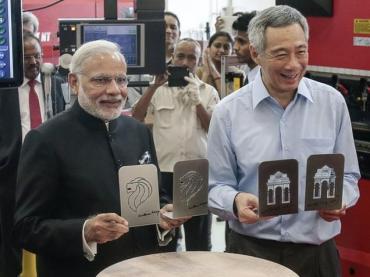
Prime Minister Narendra Modi and Singapore Prime Minister Lee Hsien Loong at the Institute of Technical Education College in Singapore on Tuesday.

Speaking at the India Singapore Economic Convention, Mr. Modi said India is exploring a potential partnership with Singapore’s Changi Airport for developments of two Indian airports and invited companies to join in building smart cities.

“In the last 18 months, the runways for the take-off of the economy have been made. Reforms are happening in a big way. They are now reaching to the last mile. Reform is to transform the system so that they perform. They aim at helping people realise their dreams. It means more charm on the faces and less forms in the offices. Efforts to deepen financial markets have been made,” he said.

‘Most open economy

The Prime Minister said his government began to liberalise FDI laws soon after coming to power last year and the latest round of FDI reforms have made India the “most open economy” in the world.

“We are also conscious of last mile operational issues in such matters and we are fine tuning the norms. Recently, we further eased FDI norms, after which India is the most open economy in terms of FDI,” he added.

While talking about 40 per cent increase in FDI and improvement in rankings like ease of doing business and world competitiveness index, Mr. Modi said, “Perceptions are turning into positive outcomes”.

“We are hopeful to roll out GST regime in 2016. The company law tribunal is being set up. FDI inflows have gone up by 40 per cent compared with previous year’s comparative period. Perceptions are turning into positive outcomes. FDI commitments are translating into reality,” he noted.

Modi also outlined 14 decisive steps taken to address regulatory and taxation concerns and said that India offers tremendous opportunities for investments, ranging from affordable housing to smart cities, railways to renewable energy.

Source: Modi woos investors in Singapore – The Hindu

02/04/2015

India’s IT plans suffer from power cuts, congestion – and monkeys | Reuters

As India launches an $18 billion plan to spread the information revolution to its provinces, the problems it faces are a holdover from the past – electricity shortages, badly planned, jam-packed cities, and monkeys.

The clash between the old world and the new is sharply in focus in the crowded 3,000-year-old holy city of Varanasi, where many devout Hindus come to die in the belief that doing so will give them salvation. Varanasi is also home to hundreds of macaque monkeys that live in its temples and are fed and venerated by devotees.

But the monkeys also feast on the fibre-optic cables that are strung along the banks of the Ganges river.

“We cannot move the temples from here. We cannot modify anything here, everything is built up. The monkeys, they destroy all the wires and eat all the wires,” said communications engineer A.P. Srivastava.

Srivastava, who oversees the expansion of new connections in the local district, said his team had to replace the riverside cables when the monkeys chewed them up less than two months after they were installed.

He said his team is now looking for alternatives, but there are few to be found. The city of over 2 million people is impossibly crowded and laying underground cable is out of the question. Chasing away or trapping the monkeys will outrage residents and temple-goers.

Varanasi is part of the parliamentary constituency of Prime Minister Narendra Modi, a Hindu nationalist leader who came to power last May.

A shortage of electricity is further complicating efforts to set up stable Wi-Fi in public places – daily power cuts can last for hours during the sweltering summer in Varanasi and across much of India.

Modi’s government has pledged to lay 700,000 kms (434,960 miles) of broadband cable to connect India’s 250,000 village clusters within three years, build 100 new “Smart Cities” by 2020 and shift more public services like education and health to electronic platforms to improve access and accountability.

via India’s IT plans suffer from power cuts, congestion – and monkeys | Reuters.

16/09/2014

Give the public a role in Clean Ganga project, says Rajendra Pachauri

India’s holiest river is due for a clean-up, with Prime Minister Narendra Modi taking personal responsibility for restoring the Ganga and ridding the 2,500 km long river of industrial effluents and untreated sewage.

Uma Bharti, Modi’s minister for water resources and Ganges rejuvenation, has said the river would be clean in three years. Earlier this month, India’s Supreme Court asked the government for a roadmap on the project so that the court could monitor it.

Rajendra Pachauri, chairman of the U.N.’s Intergovernmental Panel on Climate Change (IPCC), spoke to Reuters on the Ganga project, the need for transparency and how the public could help.

via India Insight.

11/07/2014

India to Spend $2.2 Billion on Water Supplies, Ganges – Businessweek

Prime Minister Narendra Modi’s new government today pledged 131 billion rupees ($2.2 billion) in spending on water projects to improve supplies and the condition of the Ganges, India’s largest river.

Ganges .. India

Ganges .. India (Photo credit: Nick Kenrick .)

Asia’s third-biggest economy will develop watersheds, build more pumping stations and start to clean the Ganga, blighted by raw sewage along much of its 2,525-kilometer (1,570-mile) route, as India endures a year of “unpredictable” monsoons, Finance Minister Arun Jaitley said.

The government will use 36 billion rupees to improve drinking supplies for about 20,000 villages and small towns affected by arsenic and fluoride contamination, Jaitley told Parliament in the minister’s annual budget speech. About 21.42 billion rupees will be spent on watershed development and 20.37 billion rupees on Ganga upgrades. About 42 billion rupees will go to developing inland waterways in the plan.

via India to Spend $2.2 Billion on Water Supplies, Ganges – Businessweek.

12/05/2014

BBC News – India election: Narendra Modi faces Arvind Kejriwal on final vote day

The final day of voting has begun in India’s general election, with huge crowds turning up in the sacred city of Varanasi, a key election battleground.

Opposition BJP leader Narendra Modi is being challenged in the seat by anti-corruption campaigner Arvind Kejriwal.

Votes are also being cast in 40 other seats in Uttar Pradesh, Bihar and West Bengal states. The first exit polls are expected on Monday evening.

Mr Modi is ahead in all the opinion polls. Votes will be counted on 16 May.

First stop before the polling station for some voters here was the Ganges river, for a dip in its sacred waters.

There’s been a strong early turnout, with many voting early to beat the rising heat.

The battle in this holy city is now being seen as a straight fight between Narendra Modi and his Hindu nationalist BJP and Arvind Kejriwal and his Aam Aadmi Party.

Mr Modi is still expected to win but many have been inspired by Mr Kejriwal’s anti-establishment message and his party’s determined door-to-door campaign.

After being bombarded by all the parties for weeks, it’s hardly surprising that many voters were being coy in admitting who they were choosing.

But there were some signs of nervousness among BJP workers manning a stand near one polling station. At one they were telling people ‘to vote for anybody, just don’t waste it on the Broom’ – short-hand for Mr Kejriwal

India’s marathon election began on 7 April and has been held in nine phases for security and logistical reasons.

With 814 million eligible voters, it is the world’s biggest exercise in democracy and the governing Congress party is battling the opposition Bharatiya Janata Party (BJP) for power.

Varanasi has been the scene of frenzied political campaigning not seen in the ancient city in decades. The city been turned into a virtual fortress with thousands of police and paramilitaries deployed to ensure peaceful polling.

BBC Hindi’s Nitin Srivastava in the city says large crowds, including many women, are turning up at polling stations, after voting began at 07:00 local time (01:30 GMT).

People are walking or taking cycle rickshaws to the booths as traffic restrictions are in place across the city, our correspondent says.

“Varanasi will finally see some change and development. I am glad to have lived for the day,” Ramavati, 93, said.

One woman told the BBC that she had cast her ballot “for the person who will bring development and progress”.

“The main issues are inflation, corruption and unemployment,” she said.

Mr Modi is being given a spirited fight by Mr Kejriwal of the Aam Aadmi Party, whose army of volunteers is engaged in extensive door-to-door campaigning.

There are a total of 42 candidates in the fray in the seat, including the Congress party’s Ajay Rai, a local political leader.

via BBC News – India election: Narendra Modi faces Arvind Kejriwal on final vote day.

Enhanced by Zemanta
21/03/2014

BBC News – Megadams: Battle on the Brahmaputra

China and India have their eye on the energy potential of the vast Brahmaputra river. Will a new wave of “megadams” bring power to the people – or put millions at risk? The BBC World Service environment reporter Navin Singh Khadka reports from Assam, India.

map

On the banks of the Brahmaputra it is hard to get a sense of where the river starts and ends. It begins far away as a Tibetan mountain stream. On the floodplains of Assam, though, its waters spread as far as the eye can see, merging with the horizon and the sky.

From here it continues through north-eastern India into Bangladesh, where it joins with the Ganges to form a mighty river delta.

For centuries the Brahmaputra has nourished the land, and fed and watered the people on its banks.

Today, though, India and China’s growing economies mean the river is increasingly seen as a source of energy. Both countries are planning major dams on long stretches of the river.

In Assam the plans are being greeted with scepticism and some fear.

The fear is that dams upstream could give China great power over their lives. And many in Assam worry whether China has honourable intentions.

Brahmaputra voices: What next for their river?

Brahmaputra stories: The businessman, the activist, the expert and the official

After a landslide in China in 2000, the river was blocked for several days, unknown to those downstream.

When the water forced its way past the blockage Assam faced an oncoming torrent. There was no advance warning. There are concerns this could happen more frequently.

Some also believe that China may divert water to its parched north – as it has done with other southern rivers.

India’s central government says China has given them assurances about the new Tibetan dams.

“Our foreign ministry has checked with China and we have been told that the flow will not be affected, and we will make sure that the people’s lives are not affected by the dams,” Paban Singh Ghatowar, minister for the development of north-eastern India, told the BBC.

By engaging in a race to dam the Brahmaputra as quickly as possible, China and India will cause cumulative environmental impacts beyond the limits of the river’s ecosystem”

Peter Bosshard

International Rivers Network

Do massive dams ever make sense?

Beijing says the dams it is building on the Tibetan stretch of the river will ease power shortages for people in that region.

“All new projects will go through scientific planning and feasibility studies and the impact to both upstream and downstream will be fully considered,” China’s foreign ministry told the BBC.

It said three new dams at Dagu, Jiacha, and Jeixu were small-scale projects: “They will not affect flood control or the ecological environment of downstream areas,” the foreign ministry said.

Despite the statements, there is no official water-sharing deal between India and China – just an agreement to share monsoon flood data.

via BBC News – Megadams: Battle on the Brahmaputra.

Enhanced by Zemanta
Law of Unintended Consequences

continuously updated blog about China & India

ChiaHou's Book Reviews

continuously updated blog about China & India

What's wrong with the world; and its economy

continuously updated blog about China & India