Posts tagged ‘Government of Delhi’

19/08/2016

Why is Kite Flying a Deadly Hobby in India? – India Real Time – WSJ

India’s capital has banned killer kite string after three people died this week from injuries and accidents caused by string that has been fortified for kite fights.

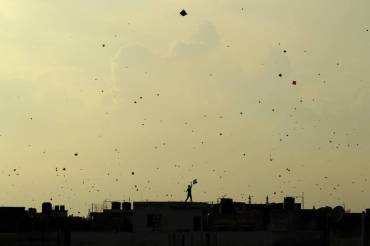
The weeks around India’s Independence Day—Aug. 15—are peak kite flying and fighting season. Kids and adults fly kites high in the air and try to maneuver them so their lines cut those of other kites as part of a traditional and usually harmless competition.

To better their chances of surviving longer and cutting competitors, many people use extra strong string and nylon lines and even lines encrusted with ground glass. When those sharp lines fall across roads they are a hazard to two-wheeler riders who can’t see them. Hitting one of the lines at high speed can knock bikers off their vehicles and slit their throats.

While there are injuries and deaths caused by kite strings every year, this year was particularly tragic as two of the victims were under the age of five.

A three-year-old girl died, while traveling in a car Monday with her head sticking out of the sun roof. She sustained a neck injury and was taken to a hospital where she died, said Vijay Singh, deputy police commissioner for northwest Delhi.

In another incident the same day in west Delhi, a four-year-old boy died also while looking out of a sun roof and becoming entangled with a string hanging from a tree. He was taken to a hospital and died, Pushpendra Kumar, deputy police commissioner for west Delhi said.

Also Monday, a man traveling in west Delhi on a motorbike became entangled with a kite string and crashed his motorbike, sustaining head injuries. He was also declared dead at hospital, Mr. Kumar said.

Chandraker Bharti, Delhi’s secretary of environment and forests, on Tuesday banned the sale, production, storage and supply of kite flying thread “that is sharp or made sharp such as being laced with glass, metal or other sharp objects.”

Source: Why is Kite Flying a Deadly Hobby in India? – India Real Time – WSJ

28/02/2016

Delhi Chief Minister Arvind Kejriwal’s visit to Punjab — Kejriwal vows to curb mining mafia in Punjab – The Hindu

Alleging that a “mining mafia” in Punjab was extorting money from owners of stone crushing units, Aam Aadmi Party chief Arvind Kejriwal on Sunday vowed to put an end to the menace “within 24 hours” if his party comes to power in the 2017 Assembly election.

Delhi Chief Minister Arvind Kejriwal addresses the people at Dhilwan in Punjab on Sunday.

“I am shocked to know that legal crusher owners have to pay ‘goonda tax or jizya’ to the mining mafia in Punjab. I vow that within 24 hours of AAP’s coming into power, this will be curbed in the state,” Mr. Kejriwal, who is on a five-day tour of Punjab to reach out to voters ahead of the Assembly elections, said at a rally here.

Members of the business community, including owners of crushing units, on Sunday met Mr. Kejriwal and alleged that no action was being taken against the extortionists. They also claimed that false cases were being registered against them.

Mr. Kejriwal said once voted to power, AAP would set up a commission to review such cases and take action against officials who had lodged them.

Reacting to reports of a large number of posters which had sprung up in Jalandhar questioning his governance record, the Delhi Chief Minister hit out at the Akali Dal saying they had ruined the state during their 10-year rule.

“People know who has ruined his state for about 10 years and who is a failed CM,” he said.

Mr. Kejriwal also claimed that no government could have achieved in 65 years what his government had accomplished in one year in Delhi.

“What we have done in our one year rule in Delhi, I challenge that no state government could have done in the last 65 years. I am confident if Delhi goes to polls today, other parties will not be able to win even a single seat,” he said.

He also met people from different walks of life, including industrialists, advocates, shopkeepers and members of the Christian community.

Earlier, BJP workers led by district president Suresh Bhatia and Municipal Council president Naresh Mahajan, tried to gherao Mr. Kejriwal at Gandhi Chowk, but were stopped by police who resorted to mild lathi-charge, in which one person was injured.

Around 80 protesters were detained later released after the Delhi Chief Minister left, police said.

Earlier in the day, Mr. Kejriwal visited the Golden Temple and Durgiana Mandir in Amritsar.

Talking to media in Amritsar on Saturday night, he said he met various associations of traders who were not “happy” with the ruling government in Punjab because of “rampant corruption” in government departments. Moreover the state government had failed to “support” traders, he alleged.

Source: Delhi Chief Minister Arvind Kejriwal’s visit to Punjab — Kejriwal vows to curb mining mafia in Punjab – The Hindu

26/05/2015

The Top 10 Misses of Narendra Modi’s First Year – India Real Time – WSJ

While Prime Minister Narendra Modi has had some major wins—including opening new sectors up to more foreign investment and raising India’s global profile as outlined in this accompanying post about Mr. Modi’s triumphs—he has also had some surprising losses.

Here are 10 that stood out:

Delhi Defeat: Mr. Modi’s Bharatiya Janata Party made big bets on the Delhi elections in February and lost almost every seat to the upstart Aam Aadmi Party. The small but high-profile local poll proved that the BJP was not invincible. Sambit Patra, a spokesman for the party admitted that the BJP had misread Delhi voters and has learned from its mistakes.

The War on Tax Terrorism: Mr. Modi came to power promising to stop the tax harassment of corporations. The decisions not to appeal tax cases against Vodafone Group PLC and Royal Dutch Shell PLC were a step in the right direction. Some foreign investors though were then slapped with huge surprise back tax bills making everyone question whether anything has changed. India’s ruling party has said it is working hard to clarify tax laws but it cannot erase cases that had been brought before they came to power.

Minority Concerns: While there has not been anything close to nationwide backlash against minority groups that many had feared, critics say the prime minister has not yet gone far enough to calm the concerns of minority communities. Some worry that people within the BJP and others with Hindu-nationalist leanings seem emboldened by the rise of Mr. Modi’s party, making them more likely to speak out and act out against Muslims, Christians and other non-Hindu communities. Mr. Modi has strongly condemned intolerance and reprimanded BJP members for controversial comments. The party says it represents all Indians and it cannot be responsible for every fringe group that makes trouble. “No one should be scared of anybody, the government supports every community,” said the BJP’s Mr. Patra.

No Big Bang: Two budgets down and still no sign of the big bang economic reforms optimists had expected from Mr. Modi. The changes he has promoted have been more incremental while attempts at some unpopular changes have been blocked in Parliament. He’s unveiled many promising campaigns to do everything from building more toilets and “smart cities” to promoting manufacturing and yoga. However, it’s too early to decide whether his campaigns represent a revolution in thinking or just rhetoric. The BJP spokesman said the party will continue to push for reform.

Paltry Profits: GDP growth has accelerated and inflation has plunged under Mr. Modi, but the Modi magic is not trickling down to the bottom line. For the fiscal year ended Mar. 31, many of India’s largest companies are expected to announce their weakest profit growth in more than five years.

Visa Glitches: On his many trips abroad, Prime Minister Modi expanded the number of countries eligible for so-called visa-on-arrival privileges. Travelers said the new visas ended up causing a lot of confusion forcing the government to rename them, more accurately, e-visas. There was a similar muddle about new rules combining the PIO and OCI visas held by people of Indian origin around the world. The change, which was meant to make it easier for people with Indian heritage to stay in India, ended up causing some angst about whether their right to remain was about to run out.

WTO Battle: One of Mr. Modi’s government’s first global moves was to reject a World Trade Organization agreement set in Bali. India had agreed to abide by the agreement before the BJP came to power but changed its mind, saying it needed more protection for its farmers. With few other countries backing its position, India eventually backed down. The Bali deal, which will simplify customs procedures world-wide, is now moving ahead; both India and the countries that pressured it to accept the agreement claim not to have blinked.

Crackdown: While Mr. Modi has been in charge, India has restricted funding of non-government organizations, including Greenpeace. It blocked the broadcasting of a BBC documentary about the 2012 gang rape of a woman on a Delhi bus. New Delhi also stopped Al-Jazeera from broadcasting in India for five days for mislabeling India’s disputed border with Pakistan.

Government officials said the government was not trying to silence critics. In the case of the non-government organization funding, officials said they were just enforcing foreign exchange laws. A court said the ban on the BBC documentary was to avoid law and order problems. Meanwhile the Al-Jazeera blackout was punishment for showing maps with “parts of Indian territory inside Pakistan,” an official of India’s Information and Broadcasting Ministry said at the time.

This Outfit: When the prime minister greeted U.S. President Barack Obama wearing this dapper suit in January, many applauded his bold choice of subliminal advertising; others called it an embarrassing display of gauche narcissism.

Mr. Modi hugs President Barack Obama while wearing a pinstripe suit with his name in the stitching. AFP/Getty

This Solo: As with most of his international trips, Mr. Modi was not shy about putting on the local attire during a recent visit to Mongolia. He should have considered ending his tryst with Mongolian culture at that though as his attempt at playing an instrument called the Yoochin—for more than two minutes—was painful to watch.

via The Top 10 Misses of Narendra Modi’s First Year – India Real Time – WSJ.

15/12/2014

This Is What India’s Radio Cabs Are Doing to Make Women Safer – India Real Time – WSJ

Indian authorities and radio taxi operators in the national capital have stepped up security measures to ensure passenger safety in the aftermath of an alleged rape of a female passenger by a driver contracted to the international car booking service Uber Technologies.

Transport authorities in New Delhi have ordered radio fleet taxi companies and web-based operators to submit database of their drivers whose credentials need to be checked and have asked them to come up with a revised safety plan to be put in place by early next year, a Delhi police official, who did not wish to be named said Monday.

“A list of around 20,000 drivers has been submitted so far out of which the background details of more than 10,000 still need to be verified,” he said.

Last week, Delhi’s transport department barred Uber from operating its ride-hailing system in the national capital until it got the proper licenses. Uber on Thursday said it would suspend its service in the capital while it reviewed its screening processes. The department had stated that only six registered radio taxi companies would now be allowed to continue operating in New Delhi.

The cab operators in New Delhi, for their part, said they have certain safety rules in mind that they would submit by Dec. 31 to the transport department.

via This Is What India’s Radio Cabs Are Doing to Make Women Safer – India Real Time – WSJ.

Law of Unintended Consequences

continuously updated blog about China & India

ChiaHou's Book Reviews

continuously updated blog about China & India

What's wrong with the world; and its economy

continuously updated blog about China & India