Posts tagged ‘gulf of aden’

25/08/2016

China’s logistic hub in Djibouti to stabilize region, protect interests – Global Times

About 7,700 kilometers away from Beijing, in Djibouti in the Horn of Africa, China’s first overseas installation for naval vessels is under construction.
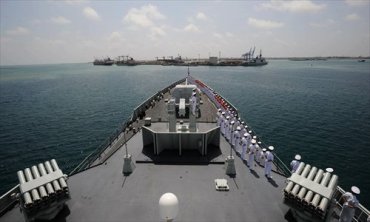
Scheduled to be completed in 2017, the base is set to resupply Chinese warships, according to government statements.

But despite Beijing’s insistence that the facility will simply help with escort missions, peacekeeping and humanitarian rescues in the Gulf of Aden and the waters off Somalia, many have argued this move represents Chinese “military expansion” beyond the Asia-Pacific region.

“Through exaggerating or distorting, they attempt to hype the ‘threat of China’ and tarnish China’s image, so as to suppress China’s efforts to build maritime power,” Li Jie, a Beijing-based maritime expert, told the Global Times.

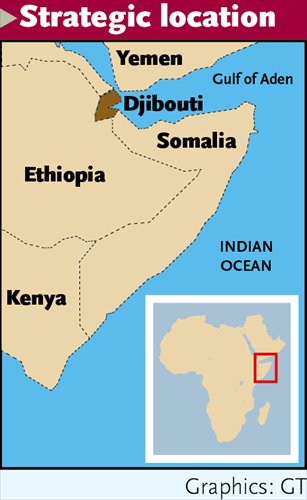
“The base is far less than a military base in its scale and function,” said Zhang Junshe, a researcher from PLA Naval Military Studies Research Institute. “The base will be a logistic hub for Chinese vessels to get replenishment and temporary rest. It differs from US-style military bases, which have become bridgeheads for the country to easily and quickly wield military deterrence or intervention to other territories,” Li noted. The Republic of Djibouti, located in a strategically important position between the Indian Ocean and the Red Sea, hosts the military facilities of several countries, including the US, Japan and France, the country’s former colonial ruler. Italy and Spain also have permanent military installations in the country, according to a recent report by Hong Kong-based Phoenix TV.

These countries have stationed a variety of assets in these bases, including personnel, ships, UAVs and surveillance aircraft which are used for anti-terror and anti-piracy operations in Africa and the Middle East.
International obligations

The news that China will build a “military base” in Djibouti was first revealed in May last year, when Djiboutian President Ismail Omar Guelleh told AFP that “discussions are ongoing,” and China’s presence would be “welcome.

“Since then, it has aroused wide attention and concern. The US even reportedly protested against it. “Washington protested against the China-Djibouti pact and expressed concern over China’s plans to build a military base in the Obock region, but to no avail,” according to an article published in April on foreignaffairs.com, a US-based international affairs news portal.

At a regular press briefing on November 26, 2015, China’s foreign ministry first confirmed that China was negotiating with Djibouti over the construction of a “logistics facility.” Spokesman Hong Lei citied the need to resolve resupply difficulties for Chinese escort vessels, adding “[The facility] will be significant for Chinese army to fulfill its international obligations and safeguard global and regional peace and stability.”

Three months later at a press briefing by Chinese defense ministry on February 25, spokesman Wu Qian told media that China had reached an agreement with Djibouti to build a facility and construction had already begun. According to official figures, China has deployed more than 30,000 personnel on peacekeeping missions, the most of any of the five permanent members of the UN Security Council.Since 2008, China has sent 22 escort fleets, a total of more than 60 vessels, to the Gulf of Aden and Somali waters, escorting more than 6,000 ships from home and abroad.

In March last year, hundreds of Chinese nationals threatened by escalating violence in Yemen were evacuated to Djibouti by their government.

But currently, these fleets need to dock in the ports of other countries to get rest and food supplies. “They need to organize people to purchase food locally. Besides, due to different types of fuels, refueling is also a problem,” Zhang said.

The new base will help China save money. Yang Huawen, a captain from China’s Northern Theater Command who joined a 10-month peacekeeping operation in Mali in 2014, is happy this facility is being built.

“In those tropical areas, the food goes bad quickly. The cost of mending equipment and maintenance is high,” Yang told the Global Times. “Building a logistic hub in the region can provide stable supplies efficiently and economically.”

Djibouti, with a landmass of 23,200 square kilometers of which 90 percent is volcanic desert, is poor in natural resources. Its ability to produce fruits, vegetables, and seafood is limited, according to a Chinese national who has spent time in the country. “Most of its vegetables are imported from its neighbor Ethiopia. Vegetables sell for there as much as five to 10 times what they do on the domestic market in China,” said the person.

Zhang also cited another advantage of the new facility – the Chinese government needn’t conduct diplomatic negotiations with the host country each time its vessels dock in their port.


Source: China’s logistic hub in Djibouti to stabilize region, protect interests – Global Times

19/04/2014

In His First Year, China’s Xi Puts Unprecedented Focus on Africa – Businessweek

A little over a year ago, Xi Jinping embarked on his first foreign trip as China’s president, making stops in Russia and Africa. Over the past 13 months, his administration has focused unprecedented attention on strengthening economic and political ties in Africa, according to a new policy briefing by Brookings Institution scholar Yun Sun.

Chinese President Xi Jinping shakes hands with Namibian Prime Minister Hage Geingob on April 8 in Beijing

While China’s People’s Liberation Army has long maintained what Sun calls a “tacit operating principle of ‘no troops on foreign soil,’” last spring Beijing sent 170 combat troops from the PLA Special Force to accompany the United Nations peacekeeping mission in Mali. In the past, only Chinese engineers and medical personnel had ever been dispatched to foreign soils under a UN mandate.

“China’s choosing Africa to dispatch combat troops for the first time does suggest Beijing’s rising interests,” writes Sun, as well “enhanced commitment and [a] direct role in maintaining [the] peace and security of Africa.” China has also “dispatched a total of 16 fleets and escorted more than 5,300 ships and vessels” around the Gulf of Aden, in effect taking responsibility for maintaining the security of key shipping lanes.

via In His First Year, China’s Xi Puts Unprecedented Focus on Africa – Businessweek.

Enhanced by Zemanta
26/12/2013

Navy lauded for foiling pirates[1]- Chinadaily.com.cn

Commander-in-chief calls missions in gulf a success ahead of anniversary

In his 201-day stint fighting pirates in the Gulf of Aden in 2012, Cheng Wengang said the most intense mission was picking up 26 hostages who were released after being kidnapped for 19 months.

English: Map showing the location of the Gulf ...

English: Map showing the location of the Gulf of Aden, located between Yemen and Somalia. Nearby bodies of water include the Indian Ocean, Red Sea, Arabian Sea, and the Bab-el-Mandeb strait. (Photo credit: Wikipedia)

\”I could see they were terrified from their eyes when we finally met at the beach on the Somali coast,\” said Cheng, a 34-year-old helicopter pilot on the 12th Chinese naval escort flotilla.

\”They were skinny with scraggly beards and long, tousled hair. They were barefoot as the pirates took away their shoes in case they escaped.\”

Most of the hostages burst into tears after they boarded the Chinese frigate. Some of them kneeled down and kissed the deck, said Cheng.

\”Two sailors from Vietnam said, \’Thank you, Chinese navy,\’ again and again in Chinese,\” Cheng said.

What Cheng described is just one accomplishment of the Chinese navy during its five-year escort mission in the Gulf of Aden.

Dec 26 is the fifth anniversary of the Chinese fleets\’ escort mission in the Gulf of Aden.

Since 2008, authorized by the United Nations, the navy of the People\’s Liberation Army has sent 16 escort flotillas, including 42 frigates and destroyers, to the gulf. More than 15,000 soldiers and officers have participated in the missions.

via Navy lauded for foiling pirates[1]- Chinadaily.com.cn.

04/03/2012

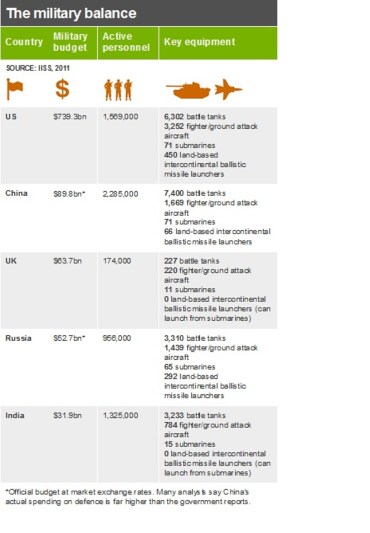
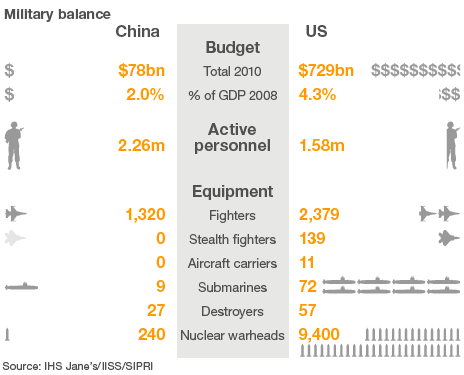
* Chinese defence budget exceeds $100bn (against US budget of over $700bn)


Extract from Xinhua: “China said Sunday it plans to raise its defense budget by 11.2 % to 670 billion yuan (106.4 billion U.S. dollars) in 2012. …

China’s military spending mainly comprises the living expenditures of service people, expenses for training and maintenance, and spending on equipment, he said. The costs for research, experiment, procurement, repair, transport and storage of all weapons and equipment, including new types of weapons, are included in the defense budget that is published every year, the spokesman said.

… Compared to other major countries, China’s military spending is low given its population of 1.3 billion, vast land area and long coastlines, Li said. While China’s military spending amounted to 1.28 % of its GDP in 2011, that of the United States, Britain and other countries all exceed 2 %, said Li. …

By June last year, China had sent a total of 2,044 peace-keeping personnel to 12 peace-keeping zones around the world, and the Chinese navy has sent escort vessels to the Gulf of Aden and waters off the coast of Somalia to protect thousands of commercial vessels from China and other countries, according to Li.”

http://news.xinhuanet.com/english/china/2012-03/04/c_131445012.htm

See also: https://chindia-alert.org/political-factors/geopolitics-chinese/

A significant rise. But still less than 1/7 of US spend, though the latter is expected to halve over the next few years. Also, salary and living expenses for up to 3 million service personnel does cost a pretty penny!


28/02/2012

* Chinese naval escort squads to Somali waters escorted 4,411 vessels in three years

Xinhua: “Chinese naval escort squads to the Gulf of Aden and Somali waters have completed 409 missions and escorted 4,411 Chinese and foreign vessels over the past three years.

To date, the Chinese People’s Liberation Army (PLA) Navy has sent 10 batches of escort fleets with 25 vessels, 22 helicopters and more than 8,400 officers and soldiers to this area, Wu Shengli, commander of the PLA Navy, said at a forum on the escort missions held Wednesday.

The fleets have rescued 40 ships from pirates’ pursuits, taken care of eight vessels that were attacked and released by the pirates, and offered humanitarian aid to foreign vessels four times, Wu said.

The fleets also escorted four ships delivering humanitarian supplies for the World Food Programme and provided adequate protection to the ships and the crewmembers, Wu said.”

http://news.xinhuanet.com/english/china/2012-01/11/c_131355296.htm

China has been a strong contributor to UN forces, mainly in infantry terms. Now it is contributing its share in naval terms. Slowly, but surely, China is taking up its role as the world’s number 2 power.

Only in one area it will stand back, and that is in not interfering in internal affairs or ‘regime change’, despite criticisms from around the world – such as wrt to Syria, Iran, North Korea and Zimbabwe. It wants the world to respect its internal affairs such as Tibet and Xinjiang ; so it practices what it preaches.

Law of Unintended Consequences

continuously updated blog about China & India

ChiaHou's Book Reviews

continuously updated blog about China & India

What's wrong with the world; and its economy

continuously updated blog about China & India