Posts tagged ‘Hainan’

22/06/2016

China’s newest space rocket, Long March 7, ready for blast-off | South China Morning Post

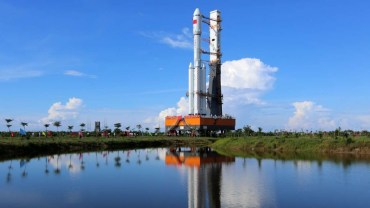
China’s latest Long March rocket arrived on the launch pad on Wednesday morning three days before it is due for blast-off on the maiden launch of both the rocket and the launch site.

At 8am on Wednesday the 600-tonnes Long March 7 rocket began a three-hour rail journey of several kilometres from the assembly complex to the launch site at Wenchang Satellite Launch Centre, China Central Television reported.

The Long March 7 will use new liquid fuel, which is environmentally friendly and costs only a fraction of the fuel used by its predecessor, LM-2.It will be carrying a test model of China’s next-generation manned spacecraft, together with several small satellites.

China’s second space lab to go into orbit this year as part of permanent manned space station by 2022

The rocket’s role in future will be to send up cargo ships to the Chinese space station.

If the weather turns bad on Saturday – which is not uncommon at the nation’s southernmost launch site on the tropical Hainan Island – the launch window will be able to remain open until Wednesday.

This launch will be different from others carried out by China because the public will be able to watch what happens in person on the mainland for the first time.

Eight designated “best spot” viewing areas covering 40 hectares around the launch site, including public parks and a private hotel beach, can accommodate about 25,000 spectators.

“This launch will open a new chapter in the history of Chinese space exploration,” a space scientist involved in the development of the new Long March rockets told the South China Morning Post.

“The blast of flames, rise of vapour, the chest-pounding noise and the trembling of the ground under people’s feet … it will be a life-changing experience for many people [watching],” the scientist said.

Source: China’s newest space rocket, Long March 7, ready for blast-off | South China Morning Post

27/01/2016

India to build satellite tracking station in Vietnam that offers eye on China | Reuters

India will set up a satellite tracking and imaging centre in southern Vietnam that will give Hanoi access to pictures from Indian earth observation satellites that cover the region, including China and the South China Sea, Indian officials said.

The move, which could irritate Beijing, deepens ties between India and Vietnam, who both have long-running territorial disputes with China.

While billed as a civilian facility – earth observation satellites have agricultural, scientific and environmental applications – security experts said improved imaging technology meant the pictures could also be used for military purposes.

Hanoi especially has been looking for advanced intelligence, surveillance and reconnaissance technologies as tensions rise with China over the disputed South China Sea, they said.

“In military terms, this move could be quite significant,” said Collin Koh, a marine security expert at Singapore’s S. Rajaratnam School of International Studies. “It looks like a win-win for both sides, filling significant holes for the Vietnamese and expanding the range for the Indians.”

The state-run Indian Space Research Organisation (ISRO) will fund and set up the satellite tracking and data reception centre in Ho Chi Minh City to monitor Indian satellite launches, the Indian officials said. Indian media put the cost at around $23 million.

India, whose 54-year-old space programme is accelerating, with one satellite launch scheduled every month, has ground stations in the Andaman and Nicobar islands, Brunei, Biak in eastern Indonesia and Mauritius that track its satellites in the initial stages of flight.

The Vietnam facility will bolster those capabilities, said Deviprasad Karnik, an ISRO spokesman.

Source: India to build satellite tracking station in Vietnam that offers eye on China | Reuters

14/02/2015

China must cut pollution by half before environment improves: official | Reuters

China needs to slash emission levels by as much as half before any obvious improvements are made to its environment, a senior government official said on Friday, underscoring the challenges facing the country after three decades of breakneck growth.

A man wearing a mask walks on a street on a hazy day in Beijing in this file photo taken on October 24, 2014. REUTERS/Kim Kyung-Hoon

Zhai Qing, China’s deputy minister of environmental protection, told a briefing that pollutants had been cut by just “a few percentage points” since 2006 and had to drop much further if any progress is to be made.

“According to expert assessments, emissions will have to fall another 30-50 percent below current levels if we are to see noticeable changes in environmental quality,” he said.

China has vowed to close vast swathes of ageing heavy industrial capacity and slash coal consumption in heavily populated eastern coastal regions as part of its war on pollution.

Last November, it imposed draconian restrictions on industry throughout northern China in order to guarantee air quality during the Asia-Pacific Economic Cooperation (APEC) summit held in Beijing. Zhai said emissions in the region fell by more than 50 percent during the meeting.

He said China’s ability to control pollution was still “limited” and its policies still needed to be improved.

Only eight of the 74 cities monitored by the ministry met national pollution standards last year, according to official data published earlier this month.

via China must cut pollution by half before environment improves: official | Reuters.

13/05/2014

2 Million Boxes Sold: China Goes Coconuts for Premier-Approved Candy – China Real Time Report – WSJ

Thanks to one Chinese leader’s sweet tooth, one candy maker is feeling pretty happy.

Over the past month, the Hainan-based Wenchang Chunguang Foodstuff Co. has sold about two million boxes of candies, each respectively comprised of a box of “coconut chips” and a box of “coconut milk roll.” The reason? Chinese premier Li Keqiang recently made a similar purchase at a convenience store during a visit in Haikou, capital city of southern Hainan province.

“The demand has been incredibly intense. At the beginning, no matter how fast we produced them, we still couldn’t meet the consumer demand,” Hainan-based sales manager Wu Sisi told China Real Time.

For those of you who might not be familiar with the contents of the “premier set,” the so-called “coconut milk rolls” are comprised of rolled wafers stuffed with coconut cream, while the “coconut chips” are basically flakes of dried coconut. The Chungang products are made from local Hainan-grown coconut, and have long been seen as a popular souvenir for tourists.

For Mr. Li, the humble purchase (total cost: 19 yuan, or $3) might have been motivated by the desire to seem more in touch with the lives of ordinary Chinese, as gesture that echoes a visit by Xi Jinping to a humble bun shop in Beijing last year, where the Chiense president spent just 21 yuan on a meal of stuffed pork buns, stir-fried liver and greens.

More In retail sales

Top China Stories from WSJ: ‘Frank’ Clinton Talks, Retail Price War, Hong Kong Poll

A Speedbump in China’s Consumption Boom?

Golden Week Shoppers Flood Hong Kong

Either way, the candy manufacturer is celebrating. Total sales of the so-called “premier package” of candy, comprising two boxes of dried coconut and “coconut milk roll,” have added up to about 19 million yuan ($3 million) in revenue between April 11 and May 11. That’s nearly as much as the company sold of the product in all of 2013.

via 2 Million Boxes Sold: China Goes Coconuts for Premier-Approved Candy – China Real Time Report – WSJ.

Enhanced by Zemanta
07/05/2014

Philippines police capture Chinese fishing boat in South China Sea | South China Morning Post

Philippines police seized a Chinese boat near ‘Half Moon Shoal‘ in the South China Sea on Wednesday after it was found to have hauled in 500 turtles. Philippine police confirmed the capture and said the vessel was being towed to southwestern Palawan province.

island_tt_23706979.jpg

China’s official Xinhua news agency earlier reported contact had been lost with 11 fishermen in the South China Sea after they were intercepted by “armed men”.

The fishermen were on board the boat Qiongqionghai 09063, which was “intercepted by an unidentified armed vessel at about 10am in waters off” the Spratly Islands, Xinhua said, citing a fishing association in Qionghai on China’s southern island province of Hainan.

Reporters were not immediately able to reach officials in Hainan for comment. It was also not clear from the report if the fishermen were Chinese nationals.

China claims almost the entire oil- and gas-rich South China Sea, rejecting rival claims to parts or all of it from Vietnam, the Philippines, Taiwan, Malaysia and Brunei.

There are frequent tensions in the South China Sea between China and the other claimant nations, particularly Vietnam and the Philippines, both of which say Beijing has harassed their ships in the waters there.

On Tuesday, China warned Vietnam not to disturb activities of Chinese companies operating near disputed islands in the South China Sea, after Hanoi condemned as illegal the movement of a giant Chinese oil rig into what it says is its territorial water.

via Philippines police capture Chinese fishing boat in South China Sea | South China Morning Post.

Enhanced by Zemanta
18/06/2013

Getting China’s Tower of Babel on Record

WSJ: “Michael Wu, 20, a student at Peking University, grew up in Shanghai. But when he wants to talk to his cousins in Hainan, he needs to bring his mother along to interpret the conversation.

Map_of_sinitic_dialect_-_English_version.svg

The cousins in Hainan speak two kinds of Hainan dialect. “I actually cannot understand either of them,” Wu says. “It’s actually not much good for me to [try to] communicate with them.”

In China, that’s a common problem: The differences in dialects are so vast they amount to different languages—possibly more than 3,000 variations, according to some estimates. It’s one of the reasons that standard Beijing Mandarin has become the lingua franca of schools, businesses and government in China. But that uniformity comes at a cost: the rapid loss of many of these dialects.

Now two Americans have taken on a daunting task: trying to get an audio record of all of the thousands of China’s languages and dialects before they disappear.

Linguists Steve Hansen and Kellen Parker are enlisting volunteers to canvass the country to capture both the languages and the stories of all of China’s 2,862 counties and 34 provincial areas. Phonemica, founded last year, now has about 200 Chinese and Chinese-speaking foreign volunteers lined up to record their friends, parents and grandparents, telling a story in fangyan (regional speech).

“The idea is that we want to record it all,” says Mr. Hansen. “And the only way to do this is through a crowd-sourced approach. We’re trying to get people involved who will go to their hometowns and record friends and relatives.”

“It is absolutely unique,” said Victor Mair, a professor of Chinese language and literature at the University of Pennsylvania, by email. “No one else is attempting to do this for Sinitic” (the languages of China).

Phonemica is nearly out of time. Scholars say that a few generations from now, all of China will speak as a first language standard Mandarin, the Beijing dialect that is taught in schools and used by new migrants to cities as well as businesspeople in every province.

Richard VanNess Simmons, a Rutgers professor of Chinese, says that as China’s economy has taken off over the past 20 years, “Mandarin has become the language that gets you somewhere and the language that parents want their kids to learn.” Even parents who speak regional dialects prefer that their children speak Mandarin at home.

“It’s happening so fast it’s almost too fast to document,” he says.

The Chinese government also has taken on the task of recording the country’s dialects, but its Chinese Language Resource Audio Database (中国语言资源有声数据) is still in the “fieldwork” stage, says Mr. Simmons, and “no results have yet been published as far as I know.””

via Getting China’s Tower of Babel on Record – China Real Time Report – WSJ.

10/12/2012

* As China’s clout grows, sea policy proves unfathomable

This analogy is most interesting. One wonders if it is a sign of “the mess China’s foreign policy is” or something much cleverer: like letting Hainan Province appear to be the instigator. If all goes well, central government ratifies the policy and instead of provincial police boats, Chinese naval vessel enter the fray.  But if the uproar continues and grows in both volume and participation well beyond the South China Sea, central government disavows itself and ‘reprimand’s Hainan Province for over stepping its mandate. We will see within the next few weeks which it will be. But I’m not taking any bets!

Reuters: “Imagine if the U.S. state of Hawaii passed a law allowing harbor police to board and seize foreign boats operating up to 1,000 km (600 miles) from Honolulu.

A Chinese marine surveillance ship is seen offshore of Vietnam's central Phu Yen province May 26, 2011 and released by Petrovietnam in this May 29, 2011 file handout photo. REUTERS-Handout-Files

That, in effect, is what happened in China about a week ago. The tropical province of Hainan, home to beachfront resorts and one of China’s largest naval bases, authorized a unit of the police to interdict foreign vessels operating “illegally” in the island’s waters, which, according to China, include much of the heavily disputed South China Sea.

At a time when the global community is looking to the world’s second-biggest economy and a burgeoning superpower for increasing maturity and leadership on the international stage, China’s opaque and disjointed foreign policy process is causing confusion and escalating tensions throughout its backyard.

Vietnam and the Philippines, which claim sovereignty over swathes of the South China Sea along with Brunei, Malaysia and Taiwan, have issued verbal protests against the Hainan rules.

India, which jointly conducts some oil exploration with Vietnam in the South China Sea, said last week it was prepared to send navy ships to the region to safeguard its interests. And the United States has publicly asked Beijing for clarification as to what, if anything, the new rules mean — thus far to no avail.

“It is really unclear, I think, to most nations (what the regulations mean),” U.S. Ambassador to Beijing Gary Locke told Reuters last week. “Until we really understand what these things are, there is no way to comment. First we need clarification of the extent, the purpose and the reach of these regulations.”

The fact that a provincial government can unilaterally worsen one of China’s most sensitive diplomatic problems highlights the dysfunctionality, and potential danger, of policymaking in this arena, analysts say.

“It shows what a mess Chinese foreign policy is when it comes to the South China Sea,” said a Western diplomat in China, speaking on condition of anonymity.

According to a report by the International Crisis Group (ICG) earlier this year, no fewer than 11 government entities — from the tourism administration to the navy — play a role in the South China Sea. All, the ICG said, have the potential to take action that could cause diplomatic fallout.

via Analysis: As China’s clout grows, sea policy proves unfathomable | Reuters.

10/12/2012

* On the brink of gunboat diplomacy

It is truly ironic that China, the nation who suffered from ‘gunboat diplomacy 170 years ago, is apparently adopting the same measures against its smaller and weaker neighbours. If, as a result, we see a resurgence of Japanese militarism, China will only have itself to blame. What is worrying is that amongst leader Xi’s recent pronouncements since becoming head of the Party is the recurrent term ‘nationalism’.  This can mean something innocent such as resuming China’s global pre-eminence which it had until 200 years ago or something more sinister. Let’s hope it is the former.

Inquirer Opinion (Philippines): “The past four weeks saw the swiftest escalation in recent years of tensions over the territorial disputes between China and its neighbors in the Asia-Pacific.

China Gunboat Diplomacy

The tensions spiraled in late November when the province of Hainan, in the southern coastal region of China, issued an imperial-sounding  edict that its so-called lawmaking body had authorized its police patrol boats to board and search foreign ships of any nationality that illegally enter what it considers Chinese territories in the South China Sea. The plan was announced to take effect on short notice: on Jan. 1.

The edict caused considerable alarm among China’s smaller neighbors, including the Philippines, Vietnam, Malaysia, Brunei, and Taiwan, all of whom have overlapping claims on islands in portions of the South China Sea, which China has claimed as exclusively belonging to it on the strength of ancient maps. It also caused consternation among other world powers such as the United States and India, which do not have territorial claims in the South China Sea, which is the shortest route between the Pacific and Indian Oceans and through  which more than half of the globe’s oil tanker traffic passes. The concern of the United States and India, both of which have powerful navies to challenge China’s aggressive assertion of its hegemonic ambitions, involves freedom of navigation and trade routes in the entire China Sea.

The new rules emanating from Hainan will allow its local police—not China’s navy—to seize control of foreign ships that “illegally enter” Chinese waters and order them to change course. The determination of what is illegal is left entirely in the hands of the Hainan authorities. What has affronted the rest of the world is this arbitrary exercise by China to enforce its territorial claims while intimidating its weaker neighbors with threats of its expanding naval power.

The rules shocked China’s neighbors so powerfully because these were issued, not by a democratic political system, but by a provincial government, and was addressed to rival claimants of disputed territories in both the South China Sea and the East China Sea, most of which are democracies. These rival claimants are the Philippines, Vietnam, Malaysia, Brunei, and Taiwan.

The Hainan decision empowering its border police to intercept foreign ships sailing in waters claimed by China as its territory, which also overlaps territories in the South China Sea, affronts other claimants because it is seen as condescending and treating them as vassal states of the suzerain province.

There are now questions raised over whether the new rules were handed down at the instigation of the central Chinese government in Beijing or were initiated by the Hainan provincial government. Whatever is the source of the initiative, the new rules have galvanized countries affected by it to call for a clarification. The rules have accelerated the spiraling of tensions close to a flashpoint, of armed confrontation between Chinese gunboats and those of smaller countries whose ships are being intercepted even in waters claimed by them.

Under the new rules, Hainanese patrols are to prowl the seas far beyond the “baseline” of China’s 12-nautical-mile zone, which is allowed archipelagic countries. The Philippines has joined other nations in a coalition calling for clarification. A report in the Wall Street Journal said experts were unclear how the rules would be applied in practice. According to the report, Wu Sichun, the director of the foreign affairs office of Hainan province, who is also president of the National Institute for South China Sea, gave a narrow interpretation of the regulations.

He said the main purpose was to deal with Vietnamese fishing boats operating in waters near Yonxing Islands in the Paracels, which China calls the Xisha Island.

Wu said the regulations applied to waters around islands which announced “baselines.” He said the baseline is the low-water line along the coast from which countries measure their territorial waters, according to the UN Convention on the Law of the Sea (Unclos).

Wu also said the rules allowed police to check and expel vessels that will enter, or conduct illegal activity  within, the 12 nautical miles of the islands for which China has announced baselines. It is not clear how this rules apply. The problem is that the Chinese are handing down their set of rules, interpreting these at their own convenience, and enforcing these with their own police patrols.

With their unilateral interventions, they have decreed a new law of the sea without the consent of the users of the sea. What worries us is: What happens when the boats they intercept are our gunboats patrolling our own national territory also claimed by China? That can be an act of war. We are on the brink of gunboat diplomacy.

via On the brink of gunboat diplomacy | Inquirer Opinion.

Related articles

07/12/2012

* India Dips a Toe into the South China Sea Dispute

Thoughtful commentary about why India, who has no territorial claims in he area, is getting involved with the South China Sea disputes.

Geopolitical Monitor: “Although the Xi Jinping administration is now secure enough in its transition to power to put nationalist jingoism back in the box from whence it came, recent events suggest that China will continue to tow a hard line in regards to its military and economic rights in the South China Sea.Joint exercises between the Indian Navy and the US Navy

Earlier this week, Chinese media sources reported that police authorities in Hainan province will be authorized to search and seize foreign vessels operating in Chinese waters starting next year. The announcement prompted an immediate response from the Philippine government, which condemned the move and requested a clarification as to what exactly can be considered ‘Chinese territorial waters.’ ASEAN also chimed in over the announcement, with Secretary General Surin Pitsuwan calling it a move that “raises the level of concern and great anxiety [in the dispute].”

Judging by Chinese official statements on the subject, it seems likely that this expansion of search and seizure powers applies to China’s entire territorial claim, which is essentially most of the South China Sea, extending as far south as Brunei. It can be seen as an initial attempt to leverage China’s growing naval power to buttress an ambitious territorial claim that has, up until now, remained largely rhetorical.

If Beijing goes through with the plan, it will ramp up the volatility in an already precarious region. Whenever hard military assets are being deployed and coming into close contact with one another, the risk of a crisis breaking out is substantially heightened. It wouldn’t take much for a relatively small and seemingly insignificant event, much like the standoff between China and the Philippines earlier this year, to spin out of control and set off a regional conflict.

And make no mistake: there will be no shortage of military ships operating in the South China Sea. On the very same day that China announced its intention for expanded search and seizures, the government of Vietnam announced that it was going to begin military patrols of its own territorial claim. This announcement comes on the heels of an incident earlier this week in which a group of Chinese boats cut the cables of a PetroVietnam survey vessel operating off the Gulf of Tonkin.

But by far one of the most interesting recent developments in the South China Sea dispute is the entrance of India into the fray. Earlier this week, Indian Admiral D.K Joshi publically asserted that India will not back off from protecting its maritime and economic interests in the South China Sea.

Although India doesn’t have any direct territorial claim in the area, the waters are strategically important to New Delhi for three reasons. First, like for any trade-dependent country, the South China Sea represents an important global shipping route and freedom of navigation must be maintained. Second, India’s state-run Oil and Natural Gas Corporation (ONGC) owns a stake in waters claimed by Vietnam. And third, and perhaps most importantly, the South China Sea represents an opportunity for an Indian riposte against China’s ‘string of pearls’ naval encirclement of the Indian subcontinent.”

via India Dips a Toe into the South China Sea Dispute – Geopolitical Monitor.

Law of Unintended Consequences

continuously updated blog about China & India

ChiaHou's Book Reviews

continuously updated blog about China & India

What's wrong with the world; and its economy

continuously updated blog about China & India