Posts tagged ‘HDFC Bank’

02/09/2016

Jobs elusive as India clings to fastest-growing economy tag | Reuters

It’s been two years since India emerged as the world’s fastest-growing major economy, but the rapid expansion has done little to improve the lot of Ashok Kumar.

Parked up and sitting on the kerb, the 25-year-old truck driver is going nowhere fast. He is the sole breadwinner for the 13 people in his extended family and his monthly salary is stuck at $150.

With new, better-paid jobs hard to come by, Kumar lacks options. He fears becoming unemployed like his elder brother, who recently returned to their village in Uttar Pradesh after months of searching in vain for work.

Data out on Wednesday showed India’s economic growth slowed to 7.1 percent in the quarter to June, a 15-month low. That is faster than other major economies, but not fast enough to create enough new jobs to absorb all the one million people who join the workforce every month.

A government survey found that job creation fell by more than two-thirds in 2015. Analysts at HDFC Bank estimate that for every percentage point the economy grows, employment now adds just 0.15 of a percentage point – down from 0.39 in 2000.

It’s a major challenge for Prime Minister Narendra Modi, who has promised to create 250 million jobs over the next decade.

“For one job, there are at least 20 candidates,” said Kumar. “If you want the job, you can’t afford to bargain.”

Nearly two-thirds of India’s 1.3 billion people are under 35 years old. This rising demographic “bulge” will create the largest working-age population in the world. At the same time China, which has long curbed family size, will age as a society.

Whether this so-called demographic dividend will translate into the kind of economic gains seen in Japan and Korea, or lead to upheavals, depends on India’s ability to generate jobs.

Yet, despite average annual growth of 6.5 percent between 1991 and 2013, India added less than half the jobs needed to absorb new job seekers.

MORE WORKERS, FEWER JOBS

Under Modi, India has opened up further to foreign investment, hoping to generate more manufacturing jobs. A loan scheme for small businesses has been set up and there are plans for a $1.5 billion fund for startups.

Modi has also launched a programme to train over 4 million people in different skills in six years.Pronab Sen, country director for the International Growth Centre, a British-backed think tank, said such measures were “laudable”, but they aimed at boosting supply when more demand was needed.

“India has become a demand-starved economy,” Sen said. “If there is no demand, there will be no incentive to produce more which, in turn, will mean no new jobs.”

The level of desperation for work is staggering. In August, nearly half a million people, including post-graduates, applied for 1,778 jobs as sweepers in the city of Kanpur.

This was not a one-off. Last year, in Uttar Pradesh, 2.3 million people sought 368 low-level government jobs that required a primary education and ability to ride a bicycle.

Competition for such jobs has become fiercer as the public sector’s share in formal employment is declining.

Two years of drought has caused distress in farming, while the construction business has suffered a prolonged downturn – making work scarcer in the two sectors that employ the bulk of India’s unskilled workforce.

Satellite cities around the capital, like Greater Noida were, until recently, bustling with construction activity.

Now, Greater Noida’s skyline is dotted with half-built, abandoned, high-rises. Cranes and diggers stand idle.

In Delhi and the surrounding National Capital Region, housing starts fell 41 percent year-on-year in the first half of the year, according to consultancy Knight Frank. Across India, starts were down 9 percent from a year earlier.

Bhuwan Mahato, a contractor who supplies workers to construction projects around Noida, says demand for labour is down by at least 25 percent.

“I wish I hadn’t joined this business,” said Mahato, a 30-year-old migrant from the state of Bihar. “But, truthfully, there are no other opportunities, either.”

Source: Jobs elusive as India clings to fastest-growing economy tag | Reuters
02/06/2016

Bureaucrats at the till | The Economist

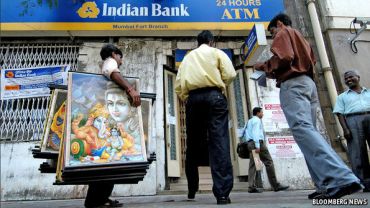
INDIA’S biggest banks tend to have official-sounding names, worthy of a central bank. There is State Bank of India, Union Bank of India, Bank of India and even Central Bank of India (the actual central bank is called the Reserve Bank of India, or RBI). That is because, starting in 1969, the entire financial system was nationalised. Although the government has grudgingly permitted private-sector banks over the past 20 years, the 27 public-sector banks (PSBs), which are listed but majority-owned by the government, still account for 70% of lending. That is a worry, because the PSBs are in terrible shape, having lent freely to companies that cannot pay them back. In response, both the government and the RBI are imposing various reforms—but not the most obvious one.

Indian banks dodged the global financial meltdown in 2008. But they promptly embarked on a frenzy of lending to big companies, sowing the seeds of a home-made crisis. The PSBs gleefully funded infrastructure projects that never got the required permits, mines with an output made much less valuable by slumping commodity prices, and tycoons whose main qualification was friendship with government ministers. PSBs have tried to gloss over the problem for years, but the RBI is now forcing them to admit the true extent of the damage.

The reckoning has been brutal: 3 trillion rupees ($44 billion) of loans have been recognised as “non-performing” by banks in the past two quarters, the vast bulk of them at PSBs; 17% of all loans there have either been written off, provisioned for or categorised as impaired, according to Credit Suisse, a bank. More losses are in the pipeline. The revelations have driven the combined market capitalisation of the 27 PSBs down to that of a single well-run private lender, HDFC Bank, founded in 1994.

Tidying up a mess on this scale is never easy, but it is proving particularly tricky in India. The absence of a bankruptcy law (one was enacted in May but it will take months, if not years, to become operational) leaves bankers powerless in the face of defaults. Indian lenders recover just 25% of their money from delinquent borrowers on average, and only after four years of haggling, compared with 80% in America in half the time. A creaky judicial system piles delays upon delays.

Worse, as quasi-bureaucrats, Indian bankers are loth to do the one thing that would help a recovery, which is to sell iffy loans to outside investors and move on. Such investors exist, albeit in limited numbers, but doing business with them can be treacherous: if the borrower’s fortunes recover after a sale and it pays back the new owner of the loans in full, bankers fear government auditors will accuse them of selling the distressed loans on the cheap. Best for the bankers to do nothing, and hope that the situation somehow improves.

The government wants to change this dynamic. A new “bank board bureau”, headed by an unimpeachable former government auditor, has been created to insulate bankers from government meddling, and so give them cover to sell assets at less than face value. Much of what it suggests is sensible: giving longer terms to PSBs’ bosses, for example, and ensuring they are not judged merely on how quickly they increase the bank’s loan book—part of the reason the PSBs ran into trouble before. The government also wants to halve the number of PSBs through mergers.

Source: Bureaucrats at the till | The Economist

28/11/2014

Indian Stock Exchange Rises Up World Rankings, Catching Up With China – India Real Time – WSJ

Indian shares are on a roll and that’s bringing the country’s stock exchanges onto the global stage.

English: National Stock Exchange of India Русс...

English: National Stock Exchange of India Русский: Национальная фондовая биржа Индии (Photo credit: Wikipedia)

On Friday, the market capitalization, or total value of listed companies, on Mumbai’s BSE exchange reached a new record of 100 trillion rupees ($1.6 trillion.)

The market value of companies listed on Indian stock exchanges has risen by more than 40% over the past year, as investors are betting that Indian companies will benefit from a turn in the local economy and policies expected from the new government that came to power in May.

The BSE stood 10th among the world’s stock exchanges as measured by market value at the end of October, according to data from the World Federation of Exchanges.

It is followed closely by India’s National Stock Exchange, which is ranked 11th.

Industry experts say India’s standing is likely headed higher.

“It is a matter of time before we make it to the top 5,” stock exchanges in the world, said Kalpana Morparia, chief executive of J.P. Morgan India, in a statement Friday.

If the market cap of Indian companies keeps increasing at its recent pace, the BSE and NSE could soon overtake Germany’s Deutsche Borse and China’s Shenzhen Stock Exchange.

via Indian Stock Exchange Rises Up World Rankings, Catching Up With China – India Real Time – WSJ.

Law of Unintended Consequences

continuously updated blog about China & India

ChiaHou's Book Reviews

continuously updated blog about China & India

What's wrong with the world; and its economy

continuously updated blog about China & India