Posts tagged ‘Hong Kong’

19/05/2012

* Hitching his Starwood to China

China Daily: “CEO of one of world’s biggest five-star chains says future is written in Chinese.
When Frits van Paasschen first visited China as a backpacker, staying in basic accommodation and traveling on crowded buses and trains, little did he imagine that two decades later, he would be returning as the boss of a five-star hotel chain. The senior executive retains vivid memories of those days, traveling the length and breadth of the country and leaving via the Karakoram Highway from China to Pakistan, clinging precariously to the roof of a pick-up truck.

Nowadays, van Paasschen flies business class on regular visits to China from his New York head office – and stays in the luxury properties of the St Regis, Westin, Sheraton and Le Mridien hotels that make up the Starwood portfolio.Van Paasschen is president and CEO of Starwood, one of the largest hotel management groups in the world which is adding to its China portfolio at a phenomenal rate: this year alone will see 23 new properties open – roughly one every fortnight – bringing the total to 100.

The country is considered to be so important that last year the boss flew the entire senior management team to China for a months visit; executive meetings were held wherever they happened to be on their grand China tour. “If a picture is worth a thousand words, then a visit is worth ten thousand,” says van Paasschen.  …

“Literally one of the high points was being on the top floor of what will be the St Regis in Shenzhen on the 100th floor of that building, looking out and toward Hong Kong and seeing that the Shenzhen side looks snazzier and more well developed than the New Territories of Hong Kong.

“When I am asked about the future I say I can’t read it, it is written in Chinese!  …

via Hitching his Starwood to China|Last Word|chinadaily.com.cn.

03/05/2012

* Unease Mounting, China and U.S. to Open Military Talks

NY Times: “Limited military talks between China and the United States — an arena in which the two sides view each other with mounting unease — open here on Wednesday as a prelude to a wider-ranging economic and strategic dialogue between Secretary of State Hillary Rodham Clinton and Treasury Secretary Timothy F. Geithner and their Chinese counterparts.

Secretary of State Hillary Clinton and Treasur...

Secretary of State Hillary Clinton and Treasury Secretary Timothy Geithner listen as President Barack Obama addresses the opening session of the first U.S.-China Strategic and Economic Dialogue at the Ronald Reagan Building and International Trade Center in Washington on July 27, 2009. (Photo credit: Wikipedia)

Military talks are a prelude to an economic and strategic dialogue. China is increasingly suspicious of what it views as stepped-up spying by American planes and ships along its coast, and the United States is disquieted by China’s growing array of weaponry, analysts on both sides say. The two nations have been unable to agree on a serious agenda for military talks despite an escalation of tensions as China presses territorial claims in the East and South China Seas and the United States fortifies longstanding alliances from Australia to the Philippines.

The meetings, known as the Strategic and Economic Dialogue, will be limited to a one-day session on Wednesday that will cover two subjects, cyberwarfare and maritime issues, Obama administration officials said.”

via Unease Mounting, China and U.S. to Open Military Talks – NYTimes.com.

29/04/2012

* China’s great leap forward – into the supermarket

The Guardian: “Made in China says everything, economically, about the last decade. Sold in China tells you everything about the next.

Recent output figures from China were greeted with concern after the country reported its lowest GDP growth for three years, although, at 8.1%, its magnificent compared to the UK’s double-dip recession. Still, there is much talk among economists about a “hard landing”, a “property bubble” and “bankrupt banks”. But there is one key fact to remember about the economy in China. It’s that the minimum wage is going up 15% a year, every year, for the next five years. Take a billion workers and give them a 100% pay rise. It changes everything.

Within a generation, China is likely to displace the US as the biggest consumer market in the world. At Tianjin Port, the world’s fifth biggest, container ships used to export Chinese goods to the rest of the world but come back empty. Now they return with the finished and semi-finished goods from the rest of the world to satisfy a ravenous consumer appetite.

In Tianjin’s vast factory zone, across the road from a Foxconn plant making the next wave of Apple iPhones, the Master Kong factory makes more pot noodles than anywhere else in the world. The huge automated production lines, with machine tools imported from Japan and Germany, churn out five billion noodle packets a year – enough to reach to the moon and back. All the raw materials come from China, all of the finished product is consumed in China. Its just one of 23 Master Kong plants on the mainland.

Further south in the “groundscraper” and weirdly Hogwarts-esque Shanghai offices of Ping An, China’s second biggest insurer, 12,000 commission-led telesales agents make one million sales calls every day. It is the largest telemarketing operation on the planet, feeding on the explosive growth of domestic car sales. Last year 14.5m cars were sold in China – or 2m more than in the US, previously the world’s biggest auto market. Nine in 10 were to people who had never bought a car before. Ping An now insures 32m private cars, raking in premiums of £2.2bn 22.3bn renminbi a year. Four years ago, that revenue was below £100m.

Just off outer ring road five in Beijing, a mundane average-income district, the Wu Mart hypermarket is perhaps an early indicator of how domestic consumption will grow.

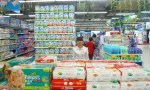
The store bears more resemblance to a Lidl than a Tesco but, unlike the oddly deserted luxury shops in the city centre, it is teeming. It’s instantly apparent that mid-range western brands are phenomenally popular with middle-income Chinese consumers. Shelf after shelf stocks the likes of Colgate toothpaste, Nivea, Quaker Oats and Snickers bars.

Whole aisles are devoted to disposable nappies. China’s one-child policy, rigorously enforced, means that spending on a sole child is proportionately huge. Hong Kong babies use 50% more diapers than those in the west, and mainland China is heading the same way. Want to invest in China? Maybe buy Procter & Gamble (Pampers) or Kimberly-Clark (Huggies) instead.

via Chinas great leap forward – into the supermarket | Money | The Guardian.

14/04/2012

* Police reinvestigate death of Neil Heywood according to law

Xinhua: “Chinese police have set up a team to reinvestigate the case that British citizen Neil Heywood was found dead in Chongqing on Nov. 15, 2011, which was alleged by Wang Lijun who entered, without authorization, the U.S. general consulate in Chengdu on Feb. 6 and stayed there, Xinhua learned from authorities.

Police authorities paid high attention to the case, and set up the team to reinvestigate the case according to law with an attitude to seek truth from facts. According to investigation results, Bogu Kailai, wife of Comrade Bo Xilai, and their son were in good terms with Heywood. However, they had conflict over economic interests, which had been intensified. According to reinvestigation results, the existing evidence indicated that Heywood died of homicide, of which Bogu Kailai and Zhang Xiaojun, an orderly at Bo’s home, are highly suspected. Bogu Kailai and Zhang Xiaojun have been transferred to judicial authorities on suspected crime of intentional homicide.”

via Police reinvestigate death of Neil Heywood according to law – Xinhua | English.news.cn.

Note that Xinhua prefixed Bo to Mme Gu’s surname, which is not usual in mainland China, but common in Hong Kong and elsewhere where the wife has a business profile of her own, but wants to be associated with her husband. One wonders if this is the authorities subtle way of linking Mme Gu to Bo, who is in political disgrace.

Related post: https://chindia-alert.org/2012/04/05/deciphering-chinese-names/

05/04/2012

# Deciphering Chinese names

Chiang Kaishek with Muslim General Ma Fushou a...

There are around 100 common Chinese surnames and, apart from possibly Ma (), there is no religious or regional clustering. The colloquial for ‘the public’ is lao bai xing, which literally means “old hundred surnames”. The surname Ma, more often than not, is used by Muslim Chinese; and is thought to be derived from the Prophet Mohammed.

Traditionally, for many centuries, most Chinese families followed the standard practice of using three mono-syllabic words for their names, such as Sun Yatsen, father of modern China.
Maybe surprisingly, Dr Sun is revered in both the Peoples’ Republic and Taiwan. Both have huge memorials to him. The photo courtesy –
http://hcyip.wordpress.com/tag/nanjing-massacre/ – is of the mainland memorial.

The first, Sun (), is the family or clan name. After all what is most important, your antecedents, of course rather than you yourself – back to the collective mindset of Chinese.

The second, Yat, is the ‘generation name’. It is given by the parents to each of the siblings. So, all of Yatsen’s brothers and sisters would have Yat plus another word as their name. And, indeed, all his paternal first cousins. In some families, the boys and girls may have variants of this name.

If the family is conforming to old traditions, then the middle name (the generation name) is taken from a poem specially composed for the family, with each generation taking a successive word from the poem. Typically, the poem will be about something noble and aspirational, such as: “World peace, national unity; Social harmony, family prosperity”. So, the first generation’s middle name will be world, the next peace and so forth. Of course, in most families, long before they reach the eighth generation, some successor would have thought to create his own couplet to be more modern and so the cycle restarts.

The third, sen, is the personal name and can be any word in the Chinese vocabulary. Having said that, some words are regarded as more masculine and others more feminine.

Just to confuse everyone, some families use the second name as the personal name and third as the generation name. So, for example, Sun Yatsen’s wife Madam Sun was named Soong Chingling and her two sisters were Soong Ailing and Soong Meiling. Although Sun and Soong sound similar, Soong is a differnt name altogether () incidentally, Meiling was Chiang Kaishek‘s wife, Madame Chiang.

Despite being a feudal society until recent times, women kept their names after marriage. So the wife of the disgraced leader Bo


Xilai is Gu Kailai; rarely – but confusingly – called Bogu Kailai.
In places like Singapore and Hong Kong sometimes married women, esp business women, would keep their maiden name along with the husband’s surname, making it four names. Sort of like the British ‘double-

barrelled‘ surnames such as the actress Helene Bonham Carter.

Most Chinese who live in Hong Kong, Singapore, Taiwan and other enclaves of Chinese emigrees tend to keep to the traditional way of naming.

Her Excellency Wu Yi, Vice Premier of the Peop...

But since the revolution in 1949 and especially since the Cultural Revolution in the 70s, many mainland Chinese have stopped using the generation name and use just one name after the surname such as Madame Wu Yi, retired senior leader who led China into the WTO and who managed the SARS crisis of early 2000s.

This causes huge problems for the authorities as, it is not uncommon, at roll call in school, several kids would raise their hands– for example – to Wang Ta (= Wang senior). The authorities are encouraging parents to revert to a middle name when naming their children.

Law of Unintended Consequences

continuously updated blog about China & India

ChiaHou's Book Reviews

continuously updated blog about China & India

What's wrong with the world; and its economy

continuously updated blog about China & India