Posts tagged ‘India’

24/02/2016

China Inc.’s Nuclear-Power Push – China Real Time Report – WSJ

China wants to shift from customer to competitor in the global nuclear industry as it seeks to roll out its first advanced reactor for export, a move that adds new competition for already struggling global firms.

As WSJ’s Brian Spegele reports:

  • Two state-owned firms teamed up to design the advanced indigenous Hualong One reactor with plans to sell overseas. On Tuesday, one of them, China General Nuclear Power Group, hosted dozens of business executives from Kenya, Russia, Indonesia and elsewhere, as well as diplomats and journalists, at its Daya Bay nuclear-power station to promote the Hualong One for export.
  • Asked how much of the global market share for new nuclear reactors CGN wants Hualong One to win, Zheng Dongshan, CGN’s deputy general manager in charge of international business, said: “The more the better.”
  • The move marks a turnaround for China and the nuclear-power industry. For three decades, China served as a big market for nuclear giants including U.S.-based, Japanese-owned Westinghouse Electric Co. and France’s Areva SA. More than 30 reactors have been built across China since the 1990s with reliance on foreign design and technology.

Source: China Inc.’s Nuclear-Power Push – China Real Time Report – WSJ

23/02/2016

Angry victims heckle Haryana CM after Jat riots kill 19 | Reuters

A political ally of Prime Minister Narendra Modi was shouted down on Tuesday by a crowd angered by rioting in Haryana that destroyed businesses, paralysed transport and cut water supplies to metropolitan Delhi.

Photo

The chief minister of Haryana, Manohar Lal Khattar was heckled by local people in the town of Rohtak after they objected to his comments promising that they would receive compensation.

More than a week of unrest involving the Jat rural caste has challenged the authority of Modi, who was elected in 2014 with the largest majority in three decades but has publicly ignored the outburst of anger over a lack of jobs.

Although Jat leaders reached a deal late on Monday to end more than a week of protests that killed 19 people and injured 170, anger was still boiling among the victims whose livelihoods had been ruined.

Live TV pictures showed Khattar giving up his attempt to address angry people on the street. After retreating indoors to give an impromptu news conference, he repeated his promise of compensation only to be shouted down again.

Soon after Modi won national power, Khattar led his nationalist Bharatiya Janata Party to power in Haryana, a state of 25 million people, for the first time.

TRAIL OF DESTRUCTION

There was a trail of destruction through the town, one of several to be hit by Jat agitation to demand more government jobs and college places, with one Hyundai dealership gutted. Traders who staged an earlier sit-down protest said they had lost everything.

“I had two showrooms on the road; both were first looted and then set on fire. I have nothing left now,” Anil Kumar told Reuters Television.

Kumar appealed to Modi and to chief minister Khattar for compensation: “Are we not humans? Don’t our votes count? Why did they not have any mercy on us? Don’t we pay our taxes?”

Modi has remained silent through the worst social unrest of his 20 months in office. A senior government official said he would give a statement in due course to parliament, which convened for its budget session on Tuesday.

Finance Minister Arun Jaitley next week presents his annual budget. He is expected to announce big hikes in public sector pay that would make it hard to free up funds for investment without borrowing more money.

Thousands of troops were deployed to quell the protests, which flared on Monday near Sonipat when a freight train was torched and, according to reports, police shot dead three protesters. Jats also attacked buses in neighbouring Rajasthan.

Disruption has been huge, with at least 850 trains cancelled, 500 factories closed and business losses estimated at as much as $5 billion by one regional lobby group. India’s largest car maker, Maruti Suzuki, shut two factories at the weekend because its supply of components was disrupted.

The army on Monday retook control of a canal that supplies three-fifths of the water to Delhi, a metropolis with a population of over 20 million. A key sluice gate was reopened, but protesters sought to cut the water supply at another place.

“The canal was damaged by protesters and repair work will have to be done,” Delhi’s Water Resources Minister Kapil Mishra said. “The water crisis will continue for a few more days.”

Source: Angry victims heckle Haryana CM after Jat riots kill 19 | Reuters

20/02/2016

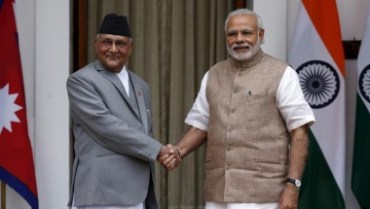
Leaders of Nepal and India mend fences after friction | Reuters

The leaders of Nepal and India have overcome mutual misgivings, India’s foreign secretary said on Saturday, after talks to ease tensions over Nepal’s recently-adopted constitution.

Nepal's Prime Minister Khadga Prasad Sharma Oli (L) shakes hands with his Indian counterpart Narendra Modi during a photo opportunity ahead of their meeting at Hyderabad House in New Delhi, India, February 20, 2016. REUTERS/Adnan Abidi

Prime Minister K.P. Oli visited New Delhi for talks with his Indian counterpart Narendra Modi after a months-long freeze in relations triggered by the grievances of plains dwellers in southern Nepal who have close historical ties to India.

Nepal, which moved from absolute to constitutional monarchy in 1990, made changes to its constitution to ensure greater participation of the Madhesi community in parliament.

But community leaders said the amendments failed to address their central fear that provincial borders would be redrawn in a way that would divide them.

“Our prime minister appreciated the progress made towards consolidation of constitutional democracy in Nepal,” Indian Foreign Secretary Subrahmanyan Jaishankar told a news briefing.

Source: Leaders of Nepal and India mend fences after friction | Reuters

20/02/2016

Pathankot Attack: Pakistan Begins Formal Police Investigation – India Real Time – WSJ

Pakistan has launched a formal police investigation into the alleged involvement of Pakistan-based militants in a deadly attack on an Indian air force base last month, senior government and police officials said Friday.

Six heavily-armed militants attacked the Pathankot air force base on Jan. 2, sparking a battle with Indian forces that lasted more than 40 hours, killed seven Indian security personnel and threatened to dismantle a tentative improvement in relations between Islamabad and New Delhi.

India suspected Pakistan-based Jaish-e-Mohammad, a U.S.-designated foreign terrorist group, was behind the Pathankot attack, and demanded Pakistan take action against the perpetrators.

Source: Pathankot Attack: Pakistan Begins Formal Police Investigation – India Real Time – WSJ

10/02/2016

U.S. and India consider joint patrols in South China Sea – U.S. official | Reuters

The United States and India have held talks about conducting joint naval patrols that a U.S. defence official said could include the disputed South China Sea, a move that would likely anger Beijing, which claims most of the waterway.

An Indian Navy personnel gestures on the deck of the newly built INS Kochi, a guided missile destroyer, during a media tour at the naval dockyard in Mumbai, India September 28, 2015. REUTERS/Shailesh Andrade/Files

Washington wants its regional allies and other Asian nations to take a more united stance against China over the South China Sea, where tensions have spiked in the wake of Beijing’s construction of seven man-made islands in the Spratly archipelago.

India and the United States have ramped up military ties in recent years, holding naval exercises in the Indian Ocean that last year involved the Japanese navy.

But the Indian navy has never carried out joint patrols with another country and a naval spokesman told Reuters there was no change in the government’s policy of only joining an international military effort under the United Nations flag.

He pointed to India’s refusal to be part of anti-piracy missions involving dozens of countries in the Gulf of Aden and instead carrying out its own operations there since 2008.

The U.S. defence official said the two sides had discussed joint patrols, adding that both were hopeful of launching them within the year. The patrols would likely be in the Indian Ocean where the Indian navy is a major player as well as the South China Sea, the official told Reuters in New Delhi on condition of anonymity.

The official gave no details on the scale of the proposed patrols.

There was no immediate comment from China, which is on a week-long holiday for Chinese New Year.

China accused Washington this month of seeking maritime hegemony in the name of freedom of navigation after a U.S. Navy destroyer sailed within 12 nautical miles of a disputed island in the Paracel chain of the South China Sea in late January.

The U.S. Navy conducted a similar exercise in October near one of China’s artificial islands in the Spratlys.

Source: Exclusive: U.S. and India consider joint patrols in South China Sea – U.S. official | Reuters

08/02/2016

GDP data to show economy racing, realities less rosy | Reuters

India will release data on Monday showing it remains one of the fastest growing economies in the world, but economists are struggling to reconcile that rosy picture with ground realities like weak exports, investment, and flat corporate order books.

Labourers works at the construction site of a residential building in Mumbai, India, February 4, 2016. REUTERS/Shailesh Andrade

The median estimate from a Reuters poll of economists put GDP annual growth at 7.3 percent in the quarter through December, just below 7.4 percent in July-September.

If the data comes in line with expectations, it would be faster than 6.8 percent growth posted by China in the same quarter.

However, very few economists are ready to take the official data at face value, reckoning that it overestimates the pace of expansion in Asia’s third-largest economy.

“There are inconsistencies between the picture presented by new GDP series and many other tried and trusted real activity indicators,” said Rupa Rege Nitsure, group chief economist, L&T Finance Holdings, Mumbai.

Until a year ago, India was struggling to break out of the longest stretch of below 5 percent growth in a quarter of a century. But a change made a year ago to the method GDP is calculated transformed the lumbering South Asian giant overnight into one of the fastest growing major economies.

Yet, merchandise exports have been falling for the past 13 months. Rural spending is subdued on weak wage growth and two successive droughts.

Corporate order books are flat. While finished goods inventory to sales ratio is showing no improvement, raw material inventory to sales ratio has worsened.

With factories running nearly 30 percent below their capacity, firms are not in a hurry to invest in new plants and machinery. Festering problem of bad loans, meanwhile, has impeded credit flow and delayed full transmission of interest rate cuts.

There are some encouraging signs, however. Robust growth in indirect tax receipts suggest a nascent revival in manufacturing sector. Foreign direct investment is up. Low inflation, thanks largely to a crash in global commodity prices, has helped bolster urban demand.

Source: GDP data to show economy racing, realities less rosy | Reuters

05/02/2016

‘One family’ not letting Rajya Sabha function, Modi says – The Hindu

Prime Minister Narendra Modi on Friday accused Congress president Sonia Gandhi and her son Rahul Gandhi of disrupting Parliament to avenge defeat in 2014 Lok Sabha polls and hence blocking the passage of Bills aimed at benefitting the poor. Prime Minister Narendra Modi being presented Jaapi, a traditional hat from Assam at a meeting in Sivasagar district on Friday.

Addressing tea garden workers in Assam, Mr. Modi alleged that “one family” was indulging in “negative politics”, as he claimed that there are leaders in opposition parties other than Congress, who want Parliament to function even though they oppose him.

“Those who have lost the election (in 2014) and have come down from 400 to 40 have decided not to allow Modi to work. They have decided to create obstacles and difficulties. The conspiracy for the same is going on,” he said, referring clearly to Congress.

“They have now decided to take revenge from people, from the poor workers for voting the Congress out of power,” Mr. Modi said.

“There are many leaders and parties even in the opposition who oppose Modi, the BJP and the government but they want Parliament to run and carry out is business. But one family is so rigid that they do not allow the Rajya Sabha to function and let the nation’s agenda of development to be taken forward because people of the country have defeated them,” Mr. Modi said.

“The country is not going to benefit from this politics of negativism and obstructionism. There is only one family with such a thinking, which has brought this kind of destruction. Leaders in the other opposition parties are not like this,” the Prime Minister said.

Mr. Modi urged people to give a chance to the BJP to form a government in Assam.

He contended that laws for the welfare of the State can be put in place only when there is a government in Guwahati, which listens to Centre.

Source: ‘One family’ not letting Rajya Sabha function, Modi says – The Hindu

22/01/2016

Prime Minister Narendra Modi flags off Mahanama Express in Varanasi – The Hindu

In his fifth visit to his constituency, Varanasi, after assuming power, Prime Minister Narendra Modi on Friday flagged off a new train, Mahanama Express, connecting the temple town to the national capital through Lucknow. Named after Pandit Madan Mohan Malviya, the founder of the Banaras Hindu University, the train is fully equipped with modern facilities and boasts of bio toilets in every coach and has renovated and refurbished AC-coaches fitted with led screen. The train will run thrice a week and cover the distance from Varanasi to New Delhi in 14 hours.

Prime Minister Narendra Modi interacts with a physically challenged child while distributing assistive devices at a function, in Varanasi on Friday.

Attending the Divyangjan Sashaktikaran Samaroh in Varanasi, Mr. Modi also gave away assisting electronic devices, artificial limbs, tricycles, Braille kits, hearing aids, teaching-learning material kit and other equipment to 9,296 ‘divyangs’ or specially-abled persons.

“When I say let us use the word ‘divyang’ it is about a change in mindset,” Mr. Modi said while reiterating his plea for doing away with the word “viklang” (handicapped) and instead calling the differently-abled as “divyang” (those born with a divine limb/organ).

“Let us not think about what is lacking in a person, let us see what is the extra ordinary quality a person is blessed with,” said Mr. Modi, who personally distributed electronic devices to around a dozen persons.

The PM last visited his constituency in December 2015 along with his Japanese counterpart Shinzo Abe. In his address, Mr. Modi recalled the visit and even praised Mr. Abe for appreciating and mentioning his trip to Varanasi in a speech in Japan. “In one year of this government, 1800 such camps have been held. While in the two decades not even a 100 camps were set up,” Mr. Modi said taking a jibe at previous Congress government’s indifference to the differently-abled. On the way to the function, a bus carrying ‘divyangs’ met an accident injuring around 20 persons. Taking cognizance of the matter, Mr. Modi ordered swift action and officials reached the spot. “Most of the received minor injuries, but some will need to be hospitalized for a few days. The government will make all arrangements for treatment,” Mr. Modi said.

The PM also interacted with ‘divyang’ children who have overcome disabilities relating to speech and hearing with the help of the ADIP (Assistance to Disabled Persons) scheme of the Centre.

“The result of such camps is that middlemen will get eliminated-nut bolts are being tightened and the shops of these middlemen are shutting down. And due to this some people are getting worried but not me. If I am in pained, it is by the plight of the poor in the country,” Mr. Modi said.

Source: Prime Minister Narendra Modi flags off Mahanama Express in Varanasi – The Hindu

06/01/2016

Pathankot attack: Congress asks Modi to ‘fix responsibility’ – The Hindu

Scaling up the offensive against the government over Pathankot terror attack, the Congress on Wednesday asked Prime Minister Narendra Modi to fix responsiblity for the “grave security lapse” and suggested that some heads must roll.

People light candles during a memorial service for the Indian soldiers killed in a militant attack at Pathankot air base, in Mumbai on Tuesday.

“They should realize that it has gone wrong and resignations should happen. If there is a lapse, resignations should happen,” former Home Minister Sushil Kumar Shinde told reporters at the AICC briefing when repeatedly asked whether Congress is demanding resignation of Home Minister Rajnath Singh or Defence Minister Manohar Parrikar into the matter.

“This government has totally failed. It has no system in place to protect the nation,” he added.

AICC Communication Department chairman Randeep Surjewala also said that the Prime Minister should fix the responsibility and take action against the Home and Defence Ministers.

“First responsibility is of the Prime Minister as he is the head of the government. Then Defence Minister and Home Minister are also responsible as they deal with the matter.

The Prime Minister should act decisively and not merely talk. “The Prime Minister should fix responsibility for this negligence and he reaches to the same conclusion that the nation has arrived at that there has been a huge lapse in the nation’s security, he should then take action against the Defence Minister and the Home Minister,” Surjewala said.

The party asked whether the Prime Minister and the BJP government would explain as to who was responsible for the “grave security lapse” as terrorists managed to reach Pathankot Air Base despite advance intelligence alert and reporting of prior incident.

Source: Pathankot attack: Congress asks Modi to ‘fix responsibility’ – The Hindu

02/12/2015

China Road Rage Cases Top 17 Million So Far in 2015 – China Real Time Report – WSJ

Chinese police attributed 80,200 traffic accidents in 2013 to road rage, and the number rose by 2.4% in 2014. Men account for 97% of road rage incidents, official data show.

No Caption Available.

China is a notoriously dangerous place for driving in general. The World Health Organization has estimated that 261,000 people died on China’s roads in 2013. Chinese government data show that last year 1,895 people died in traffic accidents when crossing roads, and 4,180 people died between 2011 and 2014 on public buses that were speeding or overloaded.

Yet when it comes to the surge in road rage, experts point to a range of possible explanations. One is that the rapid development of China’s car market has led the country’s roads to become increasingly crowded, creating frustration and anger on the streets. Sociologists also link road rage to general anxiety and fickleness, one of the side products of China’s rapid economic growth — and its accompanying social pressure — over the past three decades.

In China, the total number of vehicles has increased by more than 18 million cars for each of the past five years. As of the end of October, China had 169 million autos, according to Ministry of Public Security statistics, next only to the U.S.’s 240 million. The number of license-holders has risen even more quickly; since 2010, China has added more than 20 million new drivers each year. Now one in five Chinese has a license.

The country’s infrastructure has struggled to keep up. Data from the Ministry of Public Security show that 35 Chinese cities now have more than one million automobiles. Ten of those cities — including Beijing, Chengdu and Shenzhen – each have more than two million cars on the road. But while the number of China’s motor vehicles and drivers has each risen more than 20-fold since 1987, the country’s road capacity has increased only 3.4 times over the same period.

The rash of new drivers is also posing safety hazards. The official Xinhua News Agency cited a spokesman from the Ministry of Public Security as saying that drivers with less than one year of experience play a large role in traffic accidents. To be sure, China has some safety regulations in place. For example, drivers and front-seat passengers are required to wear seatbelts, and the use of mobile phones while driving is prohibited. But these laws are often ignored in practice. Distracted driving – operating a vehicle while texting, talking on the phone, watching videos, eating or reading – contributed to more than a third of fatal traffic accidents in 2014, causing 21,570 deaths, the Ministry of Public Security said.

Chinese authorities are working to counter the trend. In the past month, the Ministry of Public Security launched a public education campaign on road etiquette after several high-profile cases of road rage violence this year. It advocated against dangerous driving behaviors including street racing, drunk driving, aggressive driving and blocking emergency lanes.

Source: China Road Rage Cases Top 17 Million So Far in 2015 – China Real Time Report – WSJ

Law of Unintended Consequences

continuously updated blog about China & India

ChiaHou's Book Reviews

continuously updated blog about China & India

What's wrong with the world; and its economy

continuously updated blog about China & India