Posts tagged ‘India’

30/11/2015

Smog chokes Chinese, Indian capitals as climate talks begin | Reuters

The capitals of the world’s two most populous nations, China and India, were blanketed in hazardous, choking smog on Monday as climate change talks began in Paris, where leaders of both countries are among the participants.

China’s capital Beijing maintained an “orange” pollution alert, the second-highest level, on Monday, closing highways, halting or suspending construction and prompting a warning to residents to stay indoors.

The choking pollution was caused by the “unfavourable” weather, the Ministry of Environmental Protection said on Sunday. Emissions in northern China soar over winter as urban heating systems are switched on and low wind speeds have meant that polluted air has not been dispersed.

In New Delhi, the U.S. embassy’s monitoring station recorded an air quality index of 372, which puts air pollution levels well into “hazardous” territory. A thick smog blanketed the city and visibility was down to about 200 yards (metres).

Air quality in the city of 16 million is usually bad in winter, when coal fires are lit by the poor to ward off the cold. Traffic fumes, too, are trapped over the city by a temperature inversion and the lack of wind.

However, the government has not raised any alarm over the current air quality and no advisories have been issued to the public. Thirty thousand runners took part in a half marathon at the weekend, when pollution levels were just as high.

In Beijing, a city of 22.5 million, the air quality index in some parts of the city soared to 500, its highest possible level. At levels higher than 300, residents are encouraged to remain indoors, according to government guidelines.

The hazardous air underscores the challenge facing the government as it battles pollution caused by the coal-burning power industry and will raise questions about its ability to clean up its economy at the talks in Paris.

Chinese President Xi Jinping and Indian Prime Minister Narendra Modi are both in Paris and both were scheduled to meet U.S. President Barack Obama on Monday to give momentum to the two-week negotiations.

Source: Smog chokes Chinese, Indian capitals as climate talks begin | Reuters
24/11/2015

Modi woos investors in Singapore – The Hindu

Promising more reforms to make India more attractive for foreign investments, Prime Minister Narendra Modi on Tuesday assured investors that he would “carefully hold” their hands and expressed hope that the GST would be rolled out in 2016.

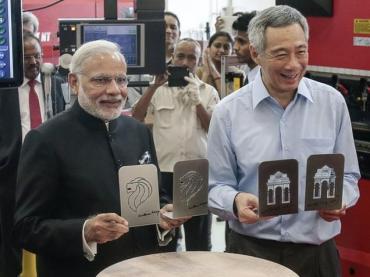
Prime Minister Narendra Modi and Singapore Prime Minister Lee Hsien Loong at the Institute of Technical Education College in Singapore on Tuesday.

Speaking at the India Singapore Economic Convention, Mr. Modi said India is exploring a potential partnership with Singapore’s Changi Airport for developments of two Indian airports and invited companies to join in building smart cities.

“In the last 18 months, the runways for the take-off of the economy have been made. Reforms are happening in a big way. They are now reaching to the last mile. Reform is to transform the system so that they perform. They aim at helping people realise their dreams. It means more charm on the faces and less forms in the offices. Efforts to deepen financial markets have been made,” he said.

‘Most open economy

The Prime Minister said his government began to liberalise FDI laws soon after coming to power last year and the latest round of FDI reforms have made India the “most open economy” in the world.

“We are also conscious of last mile operational issues in such matters and we are fine tuning the norms. Recently, we further eased FDI norms, after which India is the most open economy in terms of FDI,” he added.

While talking about 40 per cent increase in FDI and improvement in rankings like ease of doing business and world competitiveness index, Mr. Modi said, “Perceptions are turning into positive outcomes”.

“We are hopeful to roll out GST regime in 2016. The company law tribunal is being set up. FDI inflows have gone up by 40 per cent compared with previous year’s comparative period. Perceptions are turning into positive outcomes. FDI commitments are translating into reality,” he noted.

Modi also outlined 14 decisive steps taken to address regulatory and taxation concerns and said that India offers tremendous opportunities for investments, ranging from affordable housing to smart cities, railways to renewable energy.

Source: Modi woos investors in Singapore – The Hindu

15/11/2015

How Modi Dealt With Pointed Questions From the British Press – India Real Time – WSJ

Narendra Modi hasn’t given a news conference in India since becoming prime minister last year.

So when he arrived in the U.K. on Thursday and addressed the media with his counterpart, David Cameron, British reporters seized the opportunity to ask a few pointed questions.

Referring to recent incidents of religious violence, BBC correspondent Justin Rowlatt kicked off by asking Mr. Modi: “India is becoming an increasingly intolerant place. Why?”

Mr. Modi answered, in Hindi: “India is the land of Buddha. India is the land of Gandhi. And so, it is in our culture and blood that we don’t accept anything against the basic values of society.”

He continued: “For us, every incident is serious. We don’t tolerate it under any circumstances. Law takes strict action and will continue to do so. India is a vibrant democracy, and its constitution provides for the safety of people from all strata of society. We are committed to protecting freedom of thought.”

A little later in the news conference, Guardian reporter Nicholas Watt asked Mr. Cameron what he felt about the visit. “How comfortable do you feel welcoming Prime Minister Modi to this country given that for the first two years of your premiership he was not permitted to visit this country because of his record as chief minister of Gujarat?”

The U.K. distanced itself from Gujarat and Mr. Modi after religious riots in the state that killed more than 1,000 people, mostly Muslims, in 2002, when Mr. Modi was the state’s top official. Mr. Modi has denied wrongdoing and court investigations have said there isn’t enough evidence to prosecute him.

Mr. Watt then asked about Europe’s migrant crisis and the U.K.’s referendum on European Union membership before turning back to India.

“Prime Minister Modi, can I ask you: Tomorrow night you will obviously have a rapturous reception at Wembley Stadium. But there are a number of protesters out today who are saying—and I am wondering what you say to them—that given your record as chief minister of the state of Gujarat, you do not deserve the respect that would normally be accorded to the leader of the world’s largest democracy.”

Mr. Cameron answered by citing Mr. Modi’s “record and historic majority” in the Indian parliament after the 2014 election. Mr. Modi then said he was never denied entry to the U.K. The U.S. refused him a visa in 2005 based on his response to the riots but issued him one in 2014, after he became prime minister.

“To keep the record straight, I would like to give some information,” Mr. Modi said. “I came here in 2003 and received a big welcome and respect, and participated in several programs. The U.K. has never stopped me from coming here, has never imposed any restrictions. I couldn’t come here due to a lack of time. That’s a different issue. So this is a wrong perception. Please correct it.”

Mr. Modi then spoke on the British referendum and proceeded to take a question on trade and economic cooperation from an Indian reporter. He never directly addressed the last part of Mr. Watt’s question.

Source: How Modi Dealt With Pointed Questions From the British Press – India Real Time – WSJ

12/11/2015

LIVE: PM Modi arrives in UK – The Hindu

Indian Prime Minister Narendra Modi’s Air India aircraft made touchdown this morning at 10 a.m. in Heathrow for his long-awaited bilateral level visit to the United Kingdom — his first since becoming Prime Minister.

Prime Minister Narendra Modi and his British counterpart David Cameron with their delegations during talks at 10, Downing Street in London on Thursday. Photo: PMO

He was met at the airport by Hugo Swire, Minister of State for the Foreign Office, and Priti Patel, Minister for Employment and Diaspora Champion in the David Cameron government. His visit carries expectations for agreements and partnerships worth billions of dollars across defence, security, finance and sectors like education, research and health.

Mr. Modi is accompanied by a high power business delegation that included Cyrus P. Mistry, chairman, Tata Sons, Sunil Bharti Mittal, chairman, Bharti Enterprises Limited and N. Chandrasekaran, CEO and managing director of Tata Consultancy Services.

Mr. Modi will be greeted by a Guard of Honour at Westminster,which will be followed by delegation level talks at 10 Downing Street with Mr. Cameron. The two Prime Ministers will address a joint press conference after which Mr. Modi will deliver his speech in parliament. He will also garland the statue of Mahatma Gandhi in Parliament Square. The evening will see important agreements between the two country delegations finalised at Guildhall, City of London. Mr. Modi will stay the night at the Prime Minister’s country residence at Chequers.

The pomp and ceremony attached to the visit is expected to include a special tricolour flypast by the Red Arrows Royal Air Force (RAF) Aerobatic Team over the Buckingham Palace before the Prime Minister sits down for lunch with Queen Elizabeth II ahead of his mega diaspora address at the iconic Wembley Stadium in north London.

Source: LIVE: PM Modi arrives in UK – The Hindu

07/11/2015

Modi pledges 800 billion rupees in relief and development for Kashmir | Reuters

Prime Minister Narendra Modi pledged 800 billion rupees ($12.10 billion) in funds to bolster development and economic growth in Kashmir, a year after the worst flooding in more than a century destroyed half a million homes there.

Addressing several thousand people in a cricket stadium in the northern state’s capital of Srinagar, Modi said he wanted to go beyond helping flood victims. He promised to create jobs for Kashmiri youth by improving education and promoting industries, including tourism and cashmere wool.

“The biggest task at hand here is to find work for the youth of Kashmir and Ladakh … our youth should get the cheapest and the best education, and of global standards,” he said. Ladakh is another mountainous region in the north.

Saturday’s visit is Modi’s first this year to the disputed territory which has been plagued by militant violence for years. Nuclear-armed rivals India and Pakistan both claim Kashmir in full but rule it in part.

Violence in India’s only Muslim-majority region has eased significantly from levels in the 1990s, when armed revolt against Indian rule erupted.

Kashmiris have been protesting against a lack of central aid for last year’s floods that the state government estimates caused $16 billion of damage.

Security forces in Kashmir detained nearly 400 separatists on Friday to prevent them from holding an anti-government protest march during Modi’s visit.

Hours before Modi’s rally, in footage screened on national television, police detained an independent parliamentarian, Engineer Rashid, for protesting with black flags.

Security was tight with paramilitary forces and sharpshooters deployed, while schools and colleges were shut. Internet services were suspended hours before Modi arrived.

In his 40-minute speech, Modi highlighted progress, promising improved road and rail networks, as well as branches of India’s prestigious management and technology institutes.

“Kashmir has suffered a lot … the dreams of several generations have been shattered, but I have the confidence that my Kashmir will rise again,” he said.

Comparing the devastation from the floods to that in his home state of Gujarat after an earthquake in 2001, Modi said: “thousands died … homes were destroyed … nobody believed we would be able to rebuild so quickly.”

India accuses Pakistan of backing the separatist militants fighting security forces in Indian Kashmir. Pakistan denies that saying it only offers diplomatic support to Kashmir’s suppressed Muslims.

Source: Modi pledges 800 billion rupees in relief and development for Kashmir | Reuters

06/11/2015

Xiaomi’s Big Bet on Indian Internet Revolution Starts to Pay Off – China Real Time Report – WSJ

The sales are a significant rise compared with the three million phones the company said it sold in its first year of business in India.

Xiaomi aims to sell 80 to 100 million smartphones this year and has been valued by investors at $46 billion. But increasing competition at home, from companies who mimic Xiaomi’s business model of selling high-end phones at low prices, will make it tough to meet its sales target. So the five-year-old startup is setting its hopes on growth in India. Xiaomi found success in China by combining razor-thin profit margins on hardware with glitzy product launches that helped build its fanbase.

The closely-held company needs to prove that it can export its business model to other countries to continue to justify its high valuation.

Xiaomi introduced its first model, the Mi 4i, outside China, at a launch in New Delhi in April. In August, it said it would begin assembling its entry-level Redmi 2 Prime in India.

Xiaomi’s recent success in India shows that its model can work there, said the company’s Vice President Hugo Barra. Since January, sales in the South Asian country increased 45% quarter-over-quarter, on average.

The firm’s Indian office is tweaking Xiaomi’s model of Internet flash sales, designed to boost demand and cut costs. During the company’s sale for the Hindu holiday Diwali, items were sold for as little as a rupee. “Some people bought a Mi TV for one rupee,” Mr. Barra said. One rupee is equal to $0.02. The heavily discounted deals meant that Xiaomi spent nothing on marketing. “This is an idea the India team came up with that you will see reused in other markets,” he said. The company still faces challenges in India.

While Xiaomi says it sold three million phones in its first year in India, market leader Micromax Informatics Ltd. says it sells three million phones a month. While the Chinese company relies mostly on online sales to cut costs, the majority of Micromax’s sales are in brick-and-mortar retail outlets, where most Indians still shop.

It remains unclear how much India can help bolster Xiaomi’s balance sheet. While smartphone sales are booming in India, the market is still tiny.

Xiaomi’s Mr. Barra says the company will slowly add to its catalogue of products in India, which currently includes phones and a handful of accessories like headphones and a fitness tracker. In China, Xiaomi sells everything from water purifiers to power strips.

Next up could be the company’s line of Internet routers, Mr. Barra said, which includes a model with six terabytes of storage.

“We are looking at bringing the router family to India,” he said. But don’t expect the smart bathroom scale to show up in India right away, or even the company’s newest gadget: a cut-price Segway-like device. “We carefully select things that will sell in India in good volumes. We have to be thoughtful and plan carefully.”

Source: Xiaomi’s Big Bet on Indian Internet Revolution Starts to Pay Off – China Real Time Report – WSJ

02/11/2015

The power of parity: Advancing women’s equality in India | McKinsey & Company

India has a larger relative economic value at stake from advancing gender equality than any of the ten regions analyzed in a recent McKinsey Global Institute report, The power of parity: How advancing women’s equality can add $12 trillion to global growth.

If all countries were to match the momentum toward gender parity of the fastest-improving countries in their region, $12 trillion a year could be added to global GDP. What’s more, India could add $700 billion of additional GDP in 2025, upping the country’s annual GDP growth by 1.4 percentage points (exhibit).

Our new report, The power of parity: Advancing women’s equality in India, reveals that about 70 percent of this “best in region” potential would come from raising women’s participation in India’s labor force by ten percentage points between now and 2025, bringing 68 million more women into the labor force—70 percent of them in just nine states. This will require bridging both economic and social gender gaps. To determine this, we have created a measure of gender equality for Indian states: the India Female Empowerment Index, or Femdex. Our analysis shows that scores vary widely, and India’s challenge is that the five states with the lowest gender inequality account for just 4 percent of the female working-age population; the five states with the highest inequality account for 32 percent.

Eight priority actions can help accelerate progress, including education and skill-building, job creation in key sectors, corporate policies to promote diversity, and programs to address deep-rooted mind-sets about the role of women in work.

Source: The power of parity: Advancing women’s equality in India | McKinsey & Company

21/10/2015

India’s Bharat Petroleum Wants to Use Gas Stations to Bring E-Commerce to Rural India – India Real Time – WSJ

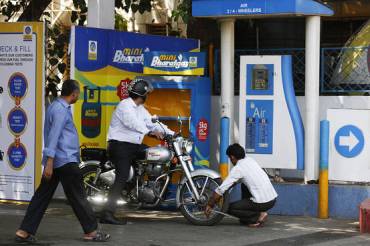
Bharat Petroleum Corp. Ltd., India’s lumbering state-run fuel company, is planning use its nationwide network of 12,800 gas stations to deliver online retail to rural India.

The oil refiner and retailer is hoping it can leverage its outlets and logistical staff across India to succeed as a latecomer to India’s ongoing online retail boom. It is upgrading its technology and logistics network to be able to sell farmers everything from fertilizer to smartphones.

The e-commerce push will begin December, with BPCL’s rural gas and cooking gas distributors starting to accept orders and payments online, said BPCL Chairman and Managing Director S. Varadarajan.  As early as next year, the company is also considering using its urban branches to sell and distribute groceries.

While the early movers in e-commerce in India such as Flipkart Internet Pvt. Ltd.’s flipkart.com, Jasper Infotech Pvt. Ltd.’s snapdeal.com and Amazon Seller Services Pvt. Ltd.’s amazon.in are still struggling to find cost-effective ways to reach the hundreds of millions of Indians who live outside the biggest cities, BPCL already has employees and properties throughout the country.

“About 30% of our retail outlets are in rural India,” Mr. Varadarajan said. Rural customers can shop online then “pick up stuff when they fill fuel at their local gas station.”

India’s state-run oil refiners are desperate to find new sources of revenues as the fall in oil price as well as increased competition from the private sector weigh on their sales.

BPCL’s retail ambitions are “a response to competition by improving margins,” said Deepak Mahurkar, head of PwC’s Oil & Gas Industry practice in India.

Analysts say that while BPCL does theoretically have unique access to much of India’s middle class, which uses its stations to refuel their cars and motorcycles, whether this traditionally slow-moving company can capture a corner of the rapidly-evolving online retail business remains to be seen.

BPCL has prime properties on the main streets and highways across the country, but few of its gas stations have the facilities or the staff to do more than pump gas. Many don’t even have running water in their bathrooms, much less the Internet connections, storage facilities and delivery technology a vibrant e-commerce company would require.

Diving into e-commerce would necessitate a big change in mindset for BPCL which is not used to worrying much about competition or consumers, said Anand Kumar Jaiswal, who heads the Centre for Retailing at IIM Ahmedabad, an Indian management school.

“I am really skeptical about it,” said Vishnu Kumar, an assistant vice president for research at Chennai-based broker Spark Capital Advisors (India) Pvt. Ltd.  “If I am a consumer I am not going to check with BPCL for a microwave.”

Even people within BPCL’s own network doubt the company can pull it off.

Sachin Shah, the manager of a company that delivers BPCL cooking gas cylinders to more than 20,000 customers in the southern city of Hyderabad, said the company will have to radically improve its logistics system to guaranteed delivery if it wants to sell more than gas cylinders and gas stoves

“If Bharat Petroleum doesn’t deliver, I will lose face,” he said.

BPCL’s Mr. Varadarajan said the company is confident it can deliver because it will use its best dealers and a new distribution system to get products to customers.

Source: India’s Bharat Petroleum Wants to Use Gas Stations to Bring E-Commerce to Rural India – India Real Time – WSJ

18/10/2015

Top African leaders to meet PM Modi in his trademark jacket

PM Narendra Modi has not only gained prominence across world for giving a personal touch in his diplomatic efforts but he is also famous for his impeccable dress sense. Prime Minister will take the diplomatic skills to new level when he will host a dinner for top African leaders later this month.

Top African leaders to meet PM Modi in his trademark jacket

According to a report in The Times of India, All of the 42 heads of state and government, who are attending the 3rd India-Africa Forum Summit, from Egyptian President Abdel Fattah el-Sisi to South African counterpart Jacob Zuma, will attend the dinner wearing Modi’s trademark jacket. They are specially designed by government agencies.

The bundi waistcoat that PM Modi made his own accessory will be at the heart of his latest bit of sartorial diplomacy. The sleeveless jackets will be available in several brilliant colours.

The African leaders will also be wearing unique ‘ikkat kurta’ (no pyjamas) being gifted to them by the government during their visit to India.

A senior African diplomat said to TOI that he was really impressed with the attention PM Modi was giving to the summit despite his hectic campaigning for Bihar elections.

Source: Top African leaders to meet PM Modi in his trademark jacket

15/10/2015

Nobel Prize Winner Angus Deaton on the Chinese and Indian Miracles – China Real Time Report – WSJ

Angus Deaton, the economist who won a Nobel Prize this week, has spent much of his career trying to measure poverty and progress in India and China.

He won the Royal Swedish Academy of Sciences award in economics by devising systems to understand consumption and poverty using household surveys and number crunching.

“Deaton’s focus on household surveys has helped transform development economics from a theoretical field based on aggregate data to an empirical field based on detailed individual data,” the academy said.

His decadeslong deep dive into data on the poor, their spending habits and their health gave him a surprisingly upbeat assessment of human progress, largely owed to the great strides that have been made in China and India. His book, “The Great Escape: Health, Wealth, and the Origins of Inequality,” documented why the world is a better place to live than it used to be.

A recent World Bank report suggested that more than one billion people might have been lifted out of extreme poverty already this century. Most of that progress was in China and India.

Here are a few of the things Mr. Deaton said in his book about the massive shifts in China and India that are changing the world.

On what China and India have taught us … “China and India are the success stories; rapid growth in large countries is an engine that can make a colossal dent in world poverty.”

On infant mortality in India and China … “India’s decline in infant mortality has been remarkably steady–not at all responsive to changes in the rate of growth–and the absolute decline from 165 out of every 1,000 babies dying in the early 1950s to 53 in 2005-10, is actually larger in absolute numbers than the decline in China, from 122 to 22.”

On how Chinese and Indian bodies have evolved with the economy… “Indian children are still among the skinniest and shortest on the planet but they are taller and plumper than were their parents or grandparents … Indians too are now growing taller decade by decade, though not as quickly as happened in Europe, or indeed as is now happening in China, where people are growing at about (the now familiar figure of) a centimeter every decade. Yet the Indian escape is only half as fast–about half a centimeter a decade–and that figure is for men; Indian women are growing too, but at a much slower rate, so that it takes them sixty years to grow a centimeter.”

On a better measure showing how China and India have lifted the world … “Although China and India are only two countries, their rapid growth at the end of the century meant that around 40% of the world’s population lived in countries that were growing very rapidly … (Thus) the average country grew at 1.5% a year in the half century after 1960, but the average person lived in a country that was growing at 3%.”

On how long the miracle can continue …  “At least over the past half-century the fast-growing countries in one decade have tended not to repeat their performance in the next or subsequent decades. Japan used to be the place that had perpetually high growth, until it didn’t any more. India, now one of the most rapidly growing countries, seemed capable of only slow growth for much of its existence, not to speak of the half-century that preceded its independence, when there was no growth at all. China is the current long-run superstar, but by historical standards the longevity of its growth spurt is extremely unusual.”

On the difficulty of defining poverty …  “In India, as in any country where a substantial fraction of the population is poor, there are millions of people who are close to poverty, either just above or just below the line … We don’t really know where the line should be, yet its precise position makes a huge difference. To put it more brutally, the truth is that we have little idea what we are doing.”

Source: Nobel Prize Winner Angus Deaton on the Chinese and Indian Miracles – China Real Time Report – WSJ

Law of Unintended Consequences

continuously updated blog about China & India

ChiaHou's Book Reviews

continuously updated blog about China & India

What's wrong with the world; and its economy

continuously updated blog about China & India