Posts tagged ‘India’

05/10/2015

U.K.’s Marks & Spencer Is Aiming to Double India Store Count – India Real Time – WSJ

Marks & Spencer Group PLC said it is on track to double its store count in India in the next 15 months, an ambition that poses both risks and opportunities for the British retailer.

M&S has recently struggled in troubled markets such as Russia, Ukraine and Turkey and was forced to reconfigure its footprint in China, but India has emerged as a relative bright spot. Revenue climbed 23% last fiscal year.

“I think there is an instinctive understanding of M&S in India,” said the company’s head of international business, Patrick Bousquet-Chavanne.

M&S is in 21 cities in India so far, with a focus on large cities such as Mumbai, Delhi and Kolkata. Now, M&S is looking to deepen its exposure to India. It plans to open stores in less-developed cities, such as Vijayawada, Jalandhar and Vizag, during the current fiscal year ending in March, while also beefing up its footprint in larger cities.

The company—which operates in India through a joint venture with Reliance Industries Ltd., one of India’s largest companies—in early October will open its 50th store in India, in Mumbai’s Chhatrapati Shivaji airport.

Source: U.K.’s Marks & Spencer Is Aiming to Double India Store Count – India Real Time – WSJ

29/09/2015

Google’s Sundar Pichai Welcomes India’s Modi to Silicon Valley – India Real Time – WSJ

Before Indian Prime Minister Narendra Modi touches down in Silicon Valley at the weekend, one of his country’s most-successful sons has welcomed him to the U.S. tech hub.

Sundar Pichai, the Indian-born Google CEO, says in a video message that “there is tremendous excitement” about Mr. Modi’s arrival in the valley “among all Googlers” a shorthand for people who work at the search engine giant.

Mr. Modi will meet with Mr. Pichai and other Indian-born CEOs, including Satya Nadella of Microsoft Corp., during his valley visit and tour Google’s headquarters where he will look at inventions in healthcare and smartgrid technology. His visit comes after Chinese President Xi Jinping held a roundtable in Seattle with U.S. and Chinese CEOs including Tim Cook of Apple Inc. and Jeff Bezos of Amazon.com on Wednesday.

“The bond between India and Silicon Valley is strong. India has long been an exporter of talent to tech companies,” Mr. Pichai says in the two minute clip.

Raised in the southern city of Chennai and attending the legendary Indian Institute of Technology, Mr. Pichai became CEO of Google in August having started out at the company in 2004 as a semiconductor engineer after gaining a graduate degree from Stanford University and an M.B.A. from the University of Pennsylvania’s Wharton School. More In Google Who Is Google’s Sundar Pichai? Why Indian Managers Are Succeeding in Tech’s C-Suite Sundar Pichai to Lead Google, Now a Subsidiary of Alphabet, After Restructuring Tech Giants Help Track Nepal Earthquake Survivors as Communications Are Hit Google Executive Dan Fredinburg Killed in Everest Avalanche After Nepal Earthquake

“The products built by Indian graduates from IIT and other institutions have helped to revolutionize the world,” the Google chief adds.

But it is India that is now undergoing its own revolution, he continues. Mr. Pichai touches on Mr. Modi’s plans to digitize India and get 600 million people in remote areas connected to the Internet.

“We at Google as well as many others around the world are passionate about playing our part, there is no more important role for tech companies today than helping to connect the next billion Internet users,” he adds.

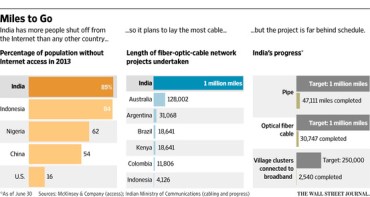
The prime minister’s Digital India plan is stuttering however. Up to June only 1% of the villages in the program had been connected to broadband via fiber optic cables.

The slow pace of the rollout of the Internet in India is among the main subjects raised for Mr. Modi in his upcoming Q&A at Facebook Inc. on Sunday.

Meghna Agarwal has asked how Facebook can help India in reaching remote areas “so that each one of the Indians has a voice of their own thus promoting equality and bridging the gap between the rich and the poor?”

Sumit Dhawan asked what Mr. Modi is doing to bring high speed broadband Internet to India.

In Mr. Pichai’s video, the CEO predicts that in the next few years, 50 million women and 20 million small businesses will get online for the first time. He promises Google will help India with products that work on low bandwidth and even offline as well as with investments in core infrastructure to help the Indians among them.

Source: Google’s Sundar Pichai Welcomes India’s Modi to Silicon Valley – India Real Time – WSJ

23/09/2015

Prime Minister Popularity and Voter Optimism Have Soared in India Under Modi, U.S. Think-Tank Survey Shows – India Real Time – WSJ

In the sixteen months since Prime Minister Narendra Modi won a landslide victory in national elections, he has faced policy setbacks, parliamentary roadblocks and electoral failure. These appear to have had little impact on support for him.

A new report by the U.S.-based think tank Pew Research Center says Mr. Modi remains overwhelmingly popular among Indians. Among those surveyed, 87% said they have a favorable opinion of Mr. Modi. Unpacking that statistic gives Mr. Modi greater reason to celebrate. His popularity is the highest among two crucial demographic groups: 18 to 29 year olds and rural Indians. Nine out of 10 people in each category gave the leader of the world’s largest democracy a thumbs up.

Mr. Modi’s undented approval ratings come at a time when his appeal among investors and analysts has lost some of its sheen. India-watchers complain big policy pronouncements have been few and slow to come, limiting India’s growth potential. Far from sharing that pessimism, a majority of Indians are upbeat about their country’ economic prospects, the survey showed. More than half of the respondents said they were happy with the direction of their country, up from 29% in 2013, toward the end of the Congress party’s decade-long tenure when the economic was stuttering and corruption scandals dogged the government. More than 90% of those surveyed by Pew said they had faith in government, up from 70% two years ago. These findings raise key political questions.

Some strategists wonder why, given his once-in-a-generation mandate, Mr. Modi hasn’t pushed for tougher, more-disruptive measures to accelerate growth. His government recently backtracked on a policy that would have made it easier to acquire land for infrastructure and industry because of protests by opponents in Parliament and fear of a backlash from rural voters.

Others argue Mr. Modi is playing the long game, seeking to build on his popularity to consolidate more political power at state and local levels rather than risking it at an early stage on controversial policies. Leaders of his Bharatiya Janata Party say they are planning for at least two five-year terms under Mr. Modi’s premiership during which they hope their party, whose political authority has grown sporadically since its inception in 1980, will achieve the kind of dominance Congress enjoyed in the decades after India won independence from British colonial rule in 1947.

Such a strategy – and Pew’s data – explains why Mr. Modi is the BJP’s star campaigner. In the state of Bihar where elections are scheduled to begin next month, the BJP has not announced a candidate for chief minister, the person who would run the state if the party won. Instead, posters and hoardings are plastered with Mr. Modi’s face. To be sure, the Bihar polls won’t be easy. Caste allegiances play an important role in the vote and the incumbent regional leader, Nitish Kumar, is seen as an effective leader for development. A recent opinion poll by the Hindi-language ABP News channel and Nielsen showed the BJP and Janata Dal (United)-led alliances are neck and neck.

Source: Prime Minister Popularity and Voter Optimism Have Soared in India Under Modi, U.S. Think-Tank Survey Shows – India Real Time – WSJ

23/09/2015

5 Things Modi Unpacks on Every Foreign Trip – WSJ

1 Be First (Sort Of)

People like to read about folks who come first, and Mr. Modi’s visits often claim this honor. Sometimes, such as his trip to Mongolia, because his visit is the first by an Indian prime minister. But in other cases, the firsts come with footnotes. For instance, Mr. Modi was the first Indian prime minister to visit Canada in 40 years on a “bilateral visit” in April, according to India’s foreign ministry.  Indian prime ministers have visited Canada in the past four decades, but on multi-lateral or other types of visit.  Another twist: Mr. Modi’s time in Australia in November followed a visit of Australia’s then-Prime Minister Tony Abbott to India a few months earlier. The exchange was thus described as the “first time Australian and Indian Prime Ministers have made reciprocal visits in the same year,” according to India’s Press Information Bureau. For his upcoming visit, expect Mr. Modi’s team to point out that he is the first Indian prime minister to visit Silicon Valley, because Mrs. Gandhi only went to Los Angeles.

2 Take Over a Stadium

In countries with a large Indian-origin population, Mr. Modi likes to make a big impression. Usually in a stadium packed with thousands of people and supported by a song-and-dance show. Mr. Modi has taken over such arenas in New York, Sydney and Toronto. In the upcoming visit, the big event will be at the SAP Center in San Jose, which is also nicknamed the “Shark Tank” because it hosts ice hockey team the San Jose Sharks. The SAP Center will host Madonna in October. The event’s organizers say they have received requests for around 45,000 passes, while SAP Center can seat only around 20,000 people.

3 Promise a Visa Freebie

One crowd-pleaser that Mr. Modi uses on trips abroad is to announce India will make it easier for foreigners to visit. In February 2014, before Mr. Modi came to power, India’s government pledged to give visas-on-arrival to people from 180 countries, up from 11 countries previously. The expanded list so far covers people traveling to India from the U.K., U.S. and China among others. Mr. Modi re-announced this step as evidence of India’s efforts to make it easier for people to visit. In New York, it got a lot of applause.  But, when some tourists tried to get a “visa-on-arrival”, they were asked to apply for it 72 hours in advance. This created confusion. In April, the Indian government changed the name to “e-tourist visas”, saying that tourists could apply for it online.

4 Snap a Selfie

During his overseas trips, Mr. Modi’s selfies with other leaders including Li Keqiang, the Chinese premier, have received a lot of attention online. Most recently, Mr. Modi took a selfie with ministers of the United Arab Emirates . From the upcoming trip, look out for selfies with Mark Zuckerberg, chief executive of Facebook Inc. who is meeting Mr. Modi, and other high-profile Silicon Valley execs.

5 Unveil or Visit a Gandhi Tribute

The icing on the cake of a good trip abroad for Mr. Modi is the unveiling of a bust or statue of Indian independence leader Mahatma Gandhi. Mr. Modi unveiled the bust of Gandhi in Hannover, Germany, and in Turkmenistan’s capital Ashgabat . He inaugurated a statue of Gandhi in Brisbane, Australia, and another in Bishkek, Kyrgyzstan. In China, Mr. Modi inaugurated the Center for Gandhian & Indian Studies at Shanghai’s Fudan University.  On his most-recent trip to the U.S. in September 2014, Mr. Modi visited a statue of Gandhi in Washington. Mr. Modi’s  U.S. hosts haven’t included a Gandhi unveiling for the upcoming trip however. The focus of the prime minister’s visit to Silicon Valley will be on technology, startups and innovation, said Khanderao Kand, convener of the Indo American Community of West Coast.

Source: 5 Things Modi Unpacks on Every Foreign Trip – WSJ

17/09/2015

How Modi’s Win Helped Boost India’s Ranks of Millionaires – India Real Time – WSJ

The ranks of the millionaires grew at a faster rate in India than anywhere else around the globe in 2014 thanks to the election of Prime Minister Narendra Modi and falling oil prices, according to a report on worldwide wealth.

After only marginal growth in 2013, India’s tally of high-net-worth individuals increased by 26.3% in 2014 compared with the previous year and with 17.5% in China and 8.2% in the U.S. over the same period, the data from consultants Capgemini and RBC Wealth Management, said.

High-net-worth individuals are defined as those with investible assets of more than $1 million.

The report says that the election of “a popular reform-minded prime minister” in May 2014 “had a positive effect on the economy and equity markets, boosting [high-net-worth-individual] gains.” More In Narendra-Modi

Mr. Modi’s win “helped to boost investor confidence and contributed to strong performance in the stock market,” the report’s authors said.

“Lower oil prices helped reduce the country’s budget deficit and retail inflation fell considerably,” they added. Still, in absolute numbers of very wealthy, India continues to lag behind. It had 1,975,000 people with $1 million to invest in 2014, compared with 4,682,000 in the U.S. and Canada and 8,901,000 in China.

The Asia Pacific region as a whole though, including India and China, had a higher number of millionaires than North America in 2014.

Source: How Modi’s Win Helped Boost India’s Ranks of Millionaires – India Real Time – WSJ

09/09/2015

Modi Tells Nervous Business Leaders the Global Shakeup Is India’s Time to Shine – India Real Time – WSJ

Prime Minister Narendra Modi called Indian business leaders to his official residence Tuesday to discuss how to bulwark the country as China’s slowdown continues to send shock waves through the global economy.

In the three-hour summit, executives and economists ran through a long-standing wish list that includes investing more in infrastructure, expediting government clearances and lowering capital costs. Some executives suggested an interest-rate cut was overdue from the central bank, and that domestic companies should be given more protection from inexpensive imports.

“We have to be cautious, while we take some bold steps on the economy to increase growth,” Rana Kapoor, chief executive of Yes Bank Ltd., told reporters after leaving the meeting. “At the same time, you have to make sure that India has a soft landing after the severe impact of the yuan devaluation.” There has been a jump in foreign direct investment in India this year. But the executives told Mr. Modi that local companies need to see long-delayed improvements in economic management before they can ramp up capital spending. “Domestic investment is at a standstill, and that’s largely because there is no demand,” said Jyotsna Suri, president of the Federation of Indian Chambers of Commerce and Industry.

Mr. Modi reiterated that the world-wide turbulence is an opportunity to highlight India’s resilient growth, vast domestic market and government policies geared toward promoting investment, Finance Minister Arun Jaitley said.

Source: Modi Tells Nervous Business Leaders the Global Shakeup Is India’s Time to Shine – India Real Time – WSJ

07/09/2015

India ranks low on inclusive growth, development in WEF report – The Hindu

Ranked in the bottom half of the 38 countries that make up our lower middle income bracket. India has been ranked very low, mostly in the bottom half, globally on most of the parameters for inclusive growth and development even as it fares much better internationally when it come to business and political ethics. India’s overall place in the Global Competitiveness Index 2014–2015 rankings is 71 out of 144 countries.

Growth and Development Report is the first inclusive report ever by World Economic Forum that assess countries’ efforts to foster economic growth that raises the living standards of entire societies.In a first of its kind global rankings, across different groups of countries in terms of their per capita income levels, the World Economic Forum (WEF) found that most countries are in fact missing major opportunities to reduce income inequality and same is the case with India. WEF said that the new study, which was conducted over the past two years, seeks to identify the various ways policymakers can drive economic growth and equity at the same time and assesses them on their relative success in implementing these measures. “Our message is unequivocally that leaders must pursue economic strategies that are at the same time pro-growth and pro-labour,” said the Geneva-based think tank known for its economic conclaves held in different parts of the world including in Davos, Switzerland and in India. India has mostly been ranked in the bottom half of the 38 countries that make up our lower middle income bracket.

Particularly disappointing is its position in terms of Fiscal Transfers, where it ranks 37th out of 38. It also ranks very low at 32nd for Tax Code and 36th for social protection. WEF said that another area that policymakers in India would need to prioritise improvement would be ‘Asset building and entrepreneurship’, in particular the Small business ownership, where India ranks bottom among its peers at 38th place. However, India does demonstrate ‘leadership’ in some areas, WEF said, while naming areas like corruption and rent where it comes 8th.

For business and political ethics, India ranks 12th, while it ranks 11th on the Financial intermediation of real economy investment pillar, which suggests that money invested in the economy generally gets directed towards productive uses. WEF said its first Inclusive Growth and Development Report present a new framework for assessing countries’ efforts to foster economic growth that raises the living standards of entire societies. “Around the world, no bigger policy challenge preoccupies political leaders than expanding social participation in the process and benefits of economic growth,” WEF said while releasing the report that covers 112 economies.

Source: India ranks low on inclusive growth, development in WEF report – The Hindu

03/09/2015

The Successful Indian Tech Companies You’ve Probably Never Heard Of – India Real Time – WSJ

The lofty valuations of India’s consumer-focused startups like Flipkart and Snapdeal have gotten a lot of limelight lately, but the country’s up and coming software product technology firms are also growing rapidly, says iSpirit Foundation, a Bangalore-based technology lobby group.

An index capturing the 30 most-valuable Indian software product-makers has risen by 28% in eight months since Oct. 30, a report released by iSpirit, which puts together the index, said Thursday. These companies, as estimated by iSpirit, were worth a total of $10 billion at the end of June. “There has been an acceleration since 2010 in the pace of creation of B2B (business-to-business) companies,” the report said.

More In Technology The Successful Indian Tech Companies You’ve Probably Never Heard Of Are You Addicted to the Internet? Take the Test Internet Addiction: How to Help Protect Your Children 5 Things to Know about Foxconn’s Ambitions in India Uber to Invest $1 Billion in India Indian techies and venture capitalists often rue that though Indians occupy top positions in global tech companies like Microsoft Corp.MSFT +3.55% and Oracle ORCL +2.05% Corp, the country hasn’t produced a major software firm up to the caliber of these multinationals.

In December, a Silicon Valley-based entrepreneurship trade body, the Indus Entrepreneurs, launched a program to help grow a select number of Indian product companies to become worth a billion dollars or more each. To help garner attention for software-product makers, iSpirit created its index last year. For this, it considered more than 300 Indian companies that make and sell software or provide applications that support other businesses. The index doesn’t include technology outsourcing firms like Infosys Ltd.500209.BY +3.56% and Tata Consultancy Services Ltd.532540.BY -0.08%, or consumer-oriented technology companies, like Flipkart and ANI Technologies Pvt Ltd.-owned Ola, a taxi-hailing application, which use technology to sell products to individuals. Companies included are firms like Bangalore-based InMobi Technology Services Pvt. Ltd., which competes with Google Inc.GOOGL +2.69% and Facebook Inc.FB +2.96% globally to provide a mobile advertising platform, and Delhi-based Wingify Software Pvt. Ltd, which analyses web-user data to enable companies to create more effective webpages.

Other companies are Capillary Technologies, which creates software that helps retailers manage customer data and counts shoemaker Nike NKE +1.91% and Pizza Hut among its customers, and Druva Software Pvt. Ltd., which provides data backup and other services to companies like Dell Inc. The index also has a few companies which have been around for more than two decades, such as Delhi-based Newgen Software Technologies Ltd, and accounting software-maker Tally Solutions Pvt. Ltd.

These software companies have also caught the eye of international investors in recent years. “There’s a consistent amount of capital going in…I wouldn’t say it’s a flood,” said Dev Khare, managing director of Lightspeed India Partners Advisors LLP, a venture-capital firm. Mr. Khare volunteers with iSpirit and helped put together the report on technology firms. In rupee terms, the 30 most-valuable companies as estimated by iSpirit were worth 655 billion rupees ($10 billion) at the end of June, versus 375 billion rupees at the end of October. The composition of the index has changed, to include some companies whose valuations have grown rapidly since the fall. To be sure, these valuations pale in comparison to that of Indian consumer companies. Flipkart alone was valued at $15 billion in May following a round of capital raising, up from $10 billion in December. Mr. Khare said that though consumer-focused tech companies have gotten a larger share of investor capital in recent years, historically, both consumer and software-product companies have provided good returns to investors. Many of the new Indian software companies are creating products for the tech consumer companies, such as software to manage customers who buy online, or software to manage logistics. Two-thirds of the 30 companies in the iSpirit index are based in India, while others are domiciled in Singapore and Silicon Valley. Most of the companies sell their products to clients globally. “As the conditions become more favorable, more capital will flow into these companies as well,” said Mr. Khare.

Source: The Successful Indian Tech Companies You’ve Probably Never Heard Of – India Real Time – WSJ

27/08/2015

Why India Stands to Benefit From China Slowdown and Global Reaction – India Real Time – WSJ

India’s economy has been insulated from the turmoil in emerging markets by a long-standing handicap: It isn’t an export powerhouse. For years, growth in India has been fueled more by domestic demand—not, as in China, by manufacturing goods for sale abroad. Now India’s resilient consumer spending is an advantage as demand decelerates almost everywhere else. It is luring companies to produce in India and, the government hopes, can help spark a belated industrial revolution in the country of 1.2 billion.

Jayant Sinha, India’s minister of state for finance, said this week the Chinese slowdown and its world-wide fallout could provide a chance for India to “take the baton of global growth.” Mumbai’s benchmark stock index ended Wednesday down 1.2%, having slid 8.5% in total since the People’s Bank of China moved to devalue the yuan on Aug. 11. The rupee has lost 3.4% since then. India hasn’t been rattled as badly as Brazil, Russia or South Africa. Its international reserves are ample, and it isn’t highly dependent on foreign capital to fund imports.

Source: Why India Stands to Benefit From China Slowdown and Global Reaction – India Real Time – WSJ

27/08/2015

India’s Hard-Working Expat Army – The Numbers – WSJ

Compared with expatriates from other countries, expats from India are younger, better-educated, harder-working and much more likely to be male. A new survey of people working far from home by the expat social group InterNations also suggests Indian expats are much more likely to pick a partner from home and less likely to settle in the country in which they currently work. While there is debate about exactly how expats differ from other migrant workers, any definition would have to include many of the millions of Indians who help run companies, build software and erect buildings across the globe. Indians have proven to be the highest ranked group of migrants to the U.S., in terms of education and pay. Indian-born leaders now run everything from Microsoft Corp. to Google Inc.

The InterNations survey of 14,400  self-declared expats living in 64 countries  offers some interesting insights into what India’s world-wide web of non-resident road warriors looks like. Here are a few numbers from the survey.

80% Around 80%, or four out of five, Indian expatriates who responded to the InterNations survey are male. That’s really lopsided. The average for all countries combined in the survey was about 47% male.

36.5 years Indians that took part in the survey were 36.5 years old on average. That is younger to the broader expat populace, which had an average age of 40.9 years. 45.2 hours Indian expats said they worked an average of

45.2 hours a week. While that is probably not enough overtime to get you to the top of Google like Sunder Pichai, it’s 3.2 hours more than the average expat.

92% More than 90% of those surveyed had a college degree or higher. On average only 83% of the world’s expats graduated from university. Data on Indians enrolled in U.S. schools show they are often more likely to go for advanced degrees. The education of globe-trotting Indians is also seen in their language abilities.

Close to half (48%) of the people surveyed said they could speak four or more languages. 9 out of 10 Compared with other expatriates,

Indians were much more likely to pick a partner from home. Around 89% of Indians in the survey said they were with someone from their home country. On average, expatriates around the world are usually more likely not to choose someone from home. Only 43% of those surveyed said they had a partner from their countries of origin.

12% Nearly a quarter of expats say they would consider settling in the country where they are currently working. For Indian expatriate workers, however, the number is just around one in eight.

Source: India’s Hard-Working Expat Army – The Numbers – WSJ

Law of Unintended Consequences

continuously updated blog about China & India

ChiaHou's Book Reviews

continuously updated blog about China & India

What's wrong with the world; and its economy

continuously updated blog about China & India