Posts tagged ‘India’

16/06/2016

Why an Indian Hindu Group Wants a Ministry of Cows – India Real Time – WSJ

Cows have long held a sacred place in India’s society, revered as holy by the country’s predominantly Hindu population. If one group gets its way they might soon have a government department devoted to their interests too.

The cow-protection unit of the right-wing Hindu group Vishva Hindu Parishad (World Hindu Council) is urging Prime Minister Narendra Modi to form a dedicated ministry for the preservation and protection of cows.

“Gou mata (mother cow) is the symbol of life, soul of our culture. She is not being given enough importance,” an official at the Bharatiya Govansh Rakshan Samvardhan Parishad (Indian Cattle Protection and Promotion Council), who didn’t wish to be named, said.

He said the “whole idea is to save the cows from getting killed.” Rearing cows will also increase milk production in the country, he added.

Slaughter of bovines has long been a fraught issue in India, but a renewed push to protect the animals came after a Hindu mob killed a Muslim man in the town of Dadri, 31 miles from New Delhi last September over rumors that he butchered a cow. The murder unleashed a wave of violence and sparked a debate over religious intolerance in the country.

There is no central law on cattle slaughter in India, though various states have introduced their own rules since Mr. Modi took power. A number of states have also tightened restrictions on the consumption of beef.

Minority groups, including around 170 million Muslims, have expressed concern over the clampdown.

The official from the Indian Cattle Protection and Promotion Council said members of his organization plan to meet ministers and members of Mr. Modi’s ruling Bharatiya Janata Party to ask them to take up the issue of a separate cow ministry in the upcoming monsoon session of Parliament, which begins in July.

“Our goal is to restore cows of bharatiya (Hindu) breed back to the country’s economy,” he added.Despite the various bans, India is the world’s largest exporter of beef, according to the U.S. Department of Agriculture. India exported 2.4 million tons of beef last year, compared with 2 million tons by Brazil. India alone accounts for nearly 24% of global beef exports.

India has also ranked first among the world’s milk-producing nations since 1998, according to India’s department of animal husbandry, dairying and fisheries. Milk production in India during the period has gone up from 17 million tons in 1950 to 146.3 million tons till last year, it said.

Source: Why an Indian Hindu Group Wants a Ministry of Cows – India Real Time – WSJ

16/06/2016

India Is Making Progress on Reducing Malnutrition But Now Has a Diabetes Problem – India Real Time – WSJ

While India has dramatically reduced its rate of child malnutrition, a new report points to the increasing burden of diabetes in the world’s second most populous country.

According to the 2016 Global Nutrition Report released Tuesday, India is reducing childhood stunting at double the rate it was a decade ago. Stunting, or low height for age, is caused by insufficient nutrient intake and frequent infections.

“That is highly significant given that India is home to more than one-third of the world’s stunting children,” the study said.

However, the country is facing a new health issue. India has a 9.5% prevalence of diabetes, putting it ahead of the U.K., with 7.8%, and the U.S., with 8.4%, the report showed.

Experts say the high sugar and trans-fat diet Indians consume are a key cause of the growing occurrence of diabetes, which is caused by a deficiency or inability of the body to effectively use insulin. Genetic factors and environmental influences exacerbate the issue.

In April, the WHO said that in India, more men die from diabetes than in any other country. The condition accounted for 2% of all deaths across age groups in India.

As a region, Asia has the highest prevalence of the condition, according to the Global Nutrition Report. Globally, one in 12 people have type 2 diabetes, the report said.“We must stem and tide,” Corinna Hawkes, co-chair of the Global Nutrition Report’s independent expert group said in a statement.

India also has a way to go to reduce stunting. India has the 18th highest prevalence, 38.7% among children under five, of 137 countries included in the Global Nutrition Report. That rate is down from 47.9% recorded a year earlier.

Indian states must set specific targets to help them meet global nutrition goals, while the federal government should devote $6 billion a year to combat nutrition, 13% more than it currently does, the report said.“At current rates of decline, India will achieve the current stunting rates of Ghana or Togo by 2030 and that of China by 2055,” the report said.

Source: India Is Making Progress on Reducing Malnutrition But Now Has a Diabetes Problem – India Real Time – WSJ

15/06/2016

India Police Probe Trade in Human Organs – India Real Time – WSJ

Police in India’s capital Delhi have uncovered a complex network illegally trading in kidneys. Suryatapa Bhattacharya report.

Earlier this month, a woman marched into a police station in India’s capital to file a domestic-abuse complaint and then made another allegation: that her husband was involved in illegal organ-trafficking.

Police said that accusation sparked a probe that had yielded 12 arrests as of Tuesday after authorities said they uncovered a complex nationwide network that was illegally trading in kidneys.

Donors, mostly poor residents of rural areas, were paid about $6,000 to give their kidneys to wealthier people in need of transplants, police said. The recipients paid more than $37,000. Traffickers produced counterfeit documents to make it appear as though the donors and recipients were related, police said. A 1994 law outlawed organ sales but permitted donations between family members.

The suspects—including five middlemen and four people who allegedly sold their own kidneys—were held on suspicion of trafficking in human organs and forgery, police said. They were in custody and couldn’t be reached for comment. It was unclear if they had legal representation.

Most countries prohibit organ selling, in part because of fears the poor and sick will be exploited by unscrupulous brokers.

Source: India Police Probe Trade in Human Organs – India Real Time – WSJ

12/06/2016

Electronics Maker Automates as China Costs Rise – China Real Time Report – WSJ

Regardless of the assurances, I am concerned that we have started down a very slippery slope and in a generation or two we will have personless factories and maybe personless offices.  When that happens where will humans be earning salaries and hence, are going to be buying the stuff the factories will be churning out and who will pay for the offices; and – indeed – what will be done in those offices?

Is anyone in government, whether Chinese, Swedish, Japanese or American, putting their minds to this frightening future?

“A new generation of machines is gradually transforming this electronics factory in China’s manufacturing hub.Inside the sprawling factory, owned by Jabil Circuit Inc.—the world’s third-largest contract manufacturer for companies such as Apple Inc. and Electrolux SA—robotic arms assemble circuit boards as driverless components-laden carts glide nearby. Machines also are starting to replace workers in checking circuit-board assemblies for errors.

“This is the past,” said David Choonseng Tan, an operations director at Jabil, pointing to a line of workers hunched over the assembly line. “And this,” he said, gesturing to a line of machines next to them, “is the future.”

Rapidly changing product models make it challenging for electronics companies like Jabil to automate all aspects of the assembly process, according to John Dulchinos, a vice president at the company. Still, Jabil has increasingly embraced automation and advanced technology, a shift encouraged by the Chinese government as the world’s second-largest economy grapples with labor shortages and high costs that are making neighboring countries like Vietnam increasingly competitive for mass production.

Manufacturers elsewhere in the world are also investing in automation and robotics in an effort to wean themselves off “chasing the needle”—moving to ever-lower-cost countries in pursuit of cheap labor.

In Stockholm, Sweden, roughly 8,000 miles away from China, fuel-cell maker myFC has built a 2,000 square-foot smart factory that will eventually have five robots doing the work of 20 full-time humans. The robots assemble power cards used for portable electronic devices while 3D printers churn out prototypes of new designs.

“We are building one cell, then we can export that to any country, any customer,” says Bjorn Westerholm, chief executive of myFC.

Jabil says that it’s hoping that a key piece of its automation—a boxy white platform it calls Flexi-Auto Cell—can also be redeployed at factories elsewhere in the world. The idea, according to Jabil, is for technology to be able to emulate the worker’s flexibility in switching from one task to another.

Jabil’s vision of manufacturing, however, isn’t one in which machines will replace workers completely, but rather one in which they’re freed up to focus on less-tedious tasks.

“We are not going for a lights-off factory,” says KC Ong, a senior vice president of operations for Jabil. In the factory of the future, “we’ll still have a lot of people.””

Source: Electronics Maker Automates as China Costs Rise – China Real Time Report – WSJ

10/06/2016

Is China Rattled By the India-U.S. Love-In? – India Real Time – WSJ

Indian Prime Minister Narendra Modi has made strengthening ties with the U.S. one of his key foreign-policy objectives, as the two countries seek to counterbalance China’s growing footprint in Asia.

In a speech to a joint meeting of the U.S. Congress Wednesday, the conclusion of a three-day trip to the country, Mr. Modi didn’t directly mention China, but said: “In Asia, the absence of an agreed security architecture creates uncertainty.

”A strong India-U.S. partnership can “help ensure security of the sea lanes of commerce and freedom of navigation on seas,” he added.

So is the beefed-up alliance between the two countries making Beijing uncomfortable? The country’s press provides some clues.

Source: Is China Rattled By the India-U.S. Love-In? – India Real Time – WSJ

10/06/2016

17 People Die on India’s Roads Every Hour, Report Says – India Real Time – WSJ

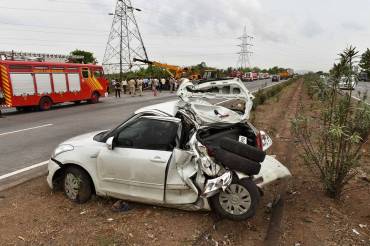
India’s roads are getting more dangerous, with 17 people dying in accidents every hour, a new government report shows.

“Much more needs to be done,” to make India’s roads safe, Sanjay Mitra, secretary of the Ministry of Roads and Transport said in the report.

The data is pretty damning. The total number of road accidents in India increased 2.5% in 2015, to 501,423. The number of people killed climbed 4.6% to 146,133. Injuries rose by 1.4%.

Road accidents also got more severe. The total number of people killed per 100 accidents was up 2.1% at 29.1 in 2015.

The Ministry of Roads and Transport said it had identified 700 “black spots” on roads, where more than five people died in the past year, and that it has earmarked 6 billion rupees ($89.9 million) to fix defects.

Source: 17 People Die on India’s Roads Every Hour, Report Says – India Real Time – WSJ

09/06/2016

China leads resistance to India joining nuclear export club | Reuters

China is leading opposition to a push by the United States and other major powers for India to join the main club of countries controlling access to sensitive nuclear technology, diplomats said on Thursday as the group discussed India’s membership bid.

Other countries opposing Indian membership of the Nuclear Suppliers Group (NSG) include New Zealand, Ireland, Turkey, South Africa and Austria, diplomats said.

The 48-nation NSG aims to prevent the proliferation of nuclear weapons by restricting the sale of items that can be used to make those arms.

India already enjoys most of the benefits of membership under a 2008 exemption to NSG rules granted to support its nuclear cooperation deal with Washington, even though India has developed atomic weapons and never signed the nuclear Non-Proliferation Treaty (NPT), the main global arms control pact.

Opponents argue that granting it membership would further undermine efforts to prevent proliferation. It would also infuriate India’s rival Pakistan, which responded to India’s membership bid with one of its own and has the backing of its close ally China.

“By bringing India on board, it’s a slap in the face of the entire non-proliferation regime,” a diplomatic source from one of a handful of countries resisting India’s push said on condition of anonymity.

A decision on Indian membership is not expected before an NSG plenary meeting in Seoul on June 20, but diplomats said Washington had been pressuring hold-outs, and Thursday’s closed-door meeting was a chance to see how strong opposition is.U.S. Secretary of State John Kerry wrote to members asking them “not to block consensus on Indian admission to the NSG” in a letter seen by Reuters and dated Friday.

China, however, showed no sign of backing down from its opposition to India joining unless Pakistan becomes a member. That would be unacceptable to many, given Pakistan’s track record — the father of its nuclear weapons program sold nuclear secrets to countries including North Korea and Iran.

“China, if anything, is hardening (its position),” another diplomat said.

Most of the hold-outs oppose the idea of admitting a non-NPT state such as India and argue that if it is to be admitted, it should be under criteria that apply equally to all states rather than under a “tailor-made” solution for a U.S. ally.

Mexico’s president said on Wednesday his country supports India’s membership bid, but one Vienna-based diplomat said it still opposed the idea of it joining under conditions that did not apply equally to all.

Source: China leads resistance to India joining nuclear export club | Reuters

08/06/2016

In boost to Paris climate pact, India says it aims to join this year | Reuters

India has agreed to work toward joining the Paris Agreement on climate change this year, India and the United States said on Tuesday, giving a jolt of momentum to the international fight to curb global warming.

At a time of heightened tensions in Asia over China’s assertive pursuit of territory, the two countries also pledged to expand military cooperation and outlined principles for cooperation on cyber issues.

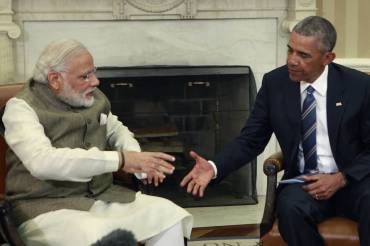
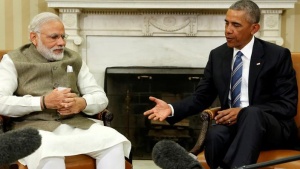
President Barack Obama welcomed Indian Prime Minister Narendra Modi to the White House for their seventh meeting since Modi took office in 2014, underscoring the warm relationship between the leaders and the world’s two largest democracies. Modi is to address the U.S. Congress on Wednesday.

“We discussed how we can, as quickly as possible, bring the Paris Agreement into force,” Obama told reporters. Climate change is a legacy issue for the U.S. president who leaves office in January.

India’s potential entrance into the agreement this year would help accelerate its enactment, perhaps years ahead of schedule. India is the world’s third-largest greenhouse gas emitter after China and the United States.

The two countries also welcomed preparations that could lead to the building of six nuclear reactors in India by U.S.-based Westinghouse, in what would be the culmination of some 10 years of work to resolve civil-nuclear issues.

The joint statement said India and the U.S. Export-Import Bank were working to complete a financing package for the project and that the Nuclear Power Corporation of India and Westinghouse had confirmed engineering and site design work would begin immediately.It said Westinghouse and the Nuclear Power Corporation of India would work toward finalizing the contract by June 2017 – a year later than Westinghouse’s chief executive, Daniel Roderick, said he hoped for in an interview with Reuters in late March.

Modi told an event organized by the U.S. India Business Council that relations between India and the United States were “closer than ever.” He said the planned reactor purchases would mark new era in nuclear and scientific cooperation.Modi’s address to a joint session of Congress will be a significant personal step. Although this has become a tradition for Indian prime ministers, he was once banned from the United States over massacres of Muslims.

More than 1,000 people, mostly Muslims, were killed in sectarian riots in Gujarat in 2002 when Modi had just become the state’s chief minister. Modi has denied any wrongdoing, and India’s Supreme Court in 2010 ruled there was no case.In the joint statement, the United States said it now recognized India as a “Major Defense Partner” and would work on technology sharing “to a level commensurate with that of its closest allies and partners.

“The text of a logistics agreement, which will allow the countries’ militaries to use each other’s land, air and naval bases, would be signed soon, a U.S. official said.

Tensions between the United States and Pakistan as well as regional concerns about China have served as a backdrop to increased security cooperation.Senator John McCain, chairman of the U.S. Senate Armed Services Committee, said the address to Congress was “entirely appropriate” given the new partnership.”

There’s no doubt there are significant tensions and challenges in the region, which argues for closer coordination between our militaries,” he said.While Modi is generally popular with U.S. lawmakers, they criticize what they see as lingering unfriendliness to U.S. firms and a stifling bureaucracy, in spite of Modi’s pro-business image. They also question New Delhi’s record on human rights.Modi got a boost on Tuesday when Amazon Inc AMZN.O Chief Executive Jeff Bezos said his company would invest an additional $3 billion in India, boosting its committed investment in the country to over $5 billion.

Source: In boost to Paris climate pact, India says it aims to join this year | Reuters

08/06/2016

Amazon Plans $3 Billion Investment in India – India Real Time – WSJ

Amazon.com Inc. plans to invest an additional $3 billion into India, which is emerging as a critical area of growth for the e-commerce giant.

Chief Executive Jeff Bezos announced the plan at a meeting of business leaders Tuesday with the Indian Prime Minister Narendra Modi in Washington. Amazon sees “huge potential in the Indian economy,” Mr. Bezos said in a statement.

The announcement brings Amazon’s total planned investment in India to $5 billion, since it announced a $2 billion infusion in 2014. An Amazon spokesman declined to provide details such as how the new funds would be allocated or over what period.

Amazon operates a pure marketplace in India, due to local rules, selling only goods offered through its website by third parties. It nonetheless has warehouse and delivery technologies there that are particularly attuned to the local market, where internet connectivity can be spotty or nonexistent and many consumers don’t have credit cards.

Source: Amazon Plans $3 Billion Investment in India – India Real Time – WSJ

07/06/2016

Here’s How Indians Are Rating Narendra Modi’s Programs – India Real Time – WSJ

Two years into his five-year term, Indian Prime Minister Narendra Modi is asking his countrymen to rate a series of initiatives undertaken by his government.

Among the top scorers so far: an effort expand and modernize the railways and a program to build more roads. Toward the bottom of the favorability rankings: Mr. Modi’s Clean India campaign, which, among other things, aims to get people to use toilets instead of defecating outside.

Mr. Modi has become known for introducing a series of high-profile initiatives, from Make in India, which seeks to promote manufacturing, to pledges to build scores of so-called smart cities across the country.Of 21,770 respondents who had participated in the online survey on the government’s mygov.in website as of Tuesday morning, 70% gave a five-star rating to the government’s efforts to upgrade the rail system. People are asked to grade programs on a scale of one to five.

In the latest federal budget, the government earmarked $17 billion to improve the state-run railroad. Wi-Fi services are being rolled out at stations. And late last year, a deal was struck with Japan to help build India’s first high-speed rail line between Mumbai and Ahmedabad.

The government’s efforts to build more highways and improve the condition of roadways have also been popular with the people. More than 65% of the respondents to the survey gave these initiatives a five-star rating. The target this year is to build 9,300 miles of highways.People taking the survey also seemed satisfied by the government’s attempts to make electricity more accessible.

One of the worst performing programs, according to the current results of the survey, which is ongoing, is Swachh Bharat Abhiyaan, or the Clean India Mission. Only 33% of the respondents gave it a five-star rating. About 16% gave it score of one or two.

India’s Competitiveness and Prosperity Rankings Rise Under ModiIn October, a year into the program, another national survey also hinted at the public’s disappointment with its impact. More the 70% of those polled in that survey said the availability of public toilets hadn’t improved and their cities hadn’t become cleaner.

Mr. Modi is no stranger to crowdsourcing. He regularly encourages Indians to submit their thoughts for his weekly radio show. Prior to delivering his speech on India’s Independence Day last year, he asked citizens to submit their suggestions on what they’d like to hear him speak about. And they did, in hordes.

Source: Here’s How Indians Are Rating Narendra Modi’s Programs – India Real Time – WSJ

Law of Unintended Consequences

continuously updated blog about China & India

ChiaHou's Book Reviews

continuously updated blog about China & India

What's wrong with the world; and its economy

continuously updated blog about China & India