Posts tagged ‘Indian National Congress’

07/08/2014

The BJP’s real opposition turns out to be a far-Left-far-Right combination

When the final results of the general election were tallied up, it was hard not to marvel at the sheer size of the Bharatiya Janata Party’s victory and the unprecedented defeated delivered to the Indian National Congress. With the BJP emerging not just as the single largest party but also the first since 1984 to cross the halfway mark by itself and the Congress not even having enough seats to automatically be given the Leader of the Opposition post, there were genuine concerns about unbridled majoritarianism. Where would the opposition to the BJP come from?
Since the Congress continues to occupy the muddled middle and has pinned all its hopes on  Rajya Sabha numbers, where it has more seats than the BJP, the answer actually turns out to be an unusual combination of players both to the right and the left of the BJP. From labour law reform to the introduction of further foreign direct investment in insurance, it is BJP-affiliated organisations making common cause with pro-labour and Leftist outfits that have caused the most headaches for the new government.

With the Left and Right managing to converge on swadeshi issues, those who fall more in the pro-market camp within the BJP — many of whom were seen as the intellectual leaders of the campaign that brought Prime Minister Narendra Modi to power — are starting to get disconcerted with  government’s actions.

FDI in insurance

This appears to be the new government’s first big legislative battle, as the opposition parties have attempted to use their superior numbers in the Rajya Sabha to stand in the way of an attempt to increase the foreign direct investment cap in insurance from 26% to 49%. The government can resort to a joint sitting of the houses to bulldoze its legislation through the Parliament, but it is the reaction from trade unions and state insurance companies that has got the BJP concerned.

Crucially, the Bharatiya Mazdoor Sangh, the BJP-affiliated organisation that counts itself as the largest centrally organised trade union in the country, has joined forces with an array of other labour organisations as well as employees of state insurance corporations in threatening to strike if the cap is raised. The communist parties have always been staunch opponents of additional foreign investment. They have now come together with outfits like the BMS to prevent a move that finance minister Arun Jaitley has said is crucial to help reinvigorate economic activity.

Genetically modified crops

Shortly after representatives of the Swadeshi Jagran Manch and the Bharatiya Kisan Sangh met with environment minister Prakash Javadekar, he announced that the government was putting field trials of the genetically modified crops on hold. The news prompted loud howls from many who believe GM crops are important for Indian agriculture to take its next step forward. But it was welcomed by both the Sangh Parivar organisations that had met Javadekar as well as by many on the Left who have sought to halt GM crops for years now.

Swadeshi education

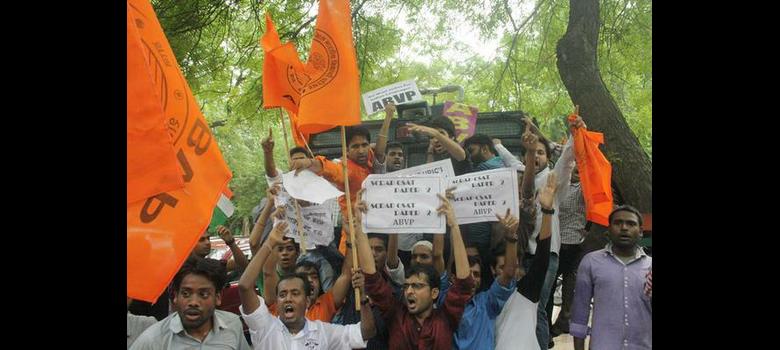
The Akhil Bharatiya Vidya Parishad, the BJP’s Youth Wing, sensed during last year’s Delhi University Student Union elections that opposition to the new Four Year Undergraduate Programme could be a key plank in remaining popular on campus. Incidentally, the FYUP had been opposed by the more left-wing organisations on campus from the very get-go, so the ABVP joined up with them to call for a roll-back of the four-year programme. The agitation quickly became a national issue, and eventually the FYUP was rolled back.

This ABVP-Left combine has now re-emerged in the agitation against the Union Public Service Commission’s Common Scholastic Aptitude Test, which is being fought on grounds that it is biased towards urban students. Yet again, the combined forces have managed to extract a concession from the government — despite opposition from the more reformist sections of the BJP.

Labour law reforms

Trade unions from across the country are meeting this week to try and decide how to approach the issue of labour law reforms, after the Rajasthan government last month passed legislation that made it easier for companies to retrench employees. These unions include both those on the Left, including the Communist Party of India (Marxist)-backed Centre of Indian Trade Unions  as well as the BJP-affiliated Bharatiya Mazdoor Sangh. Any decision to strike or launch a nationwide campaign by these groups could have a significant impact on a government that has insisted it is working primarily for the poor.

Foreign relations

The Modi government’s decision to vote against Israel at a United Nations forum shocked many supporters, who believe that India must be stand with Tel Aviv and remain steadfast against Islamic terrorism. It came as a pleasant surprise to those on the Left, however, who have always pushed India to speak up for those who live under Israeli occupation in Gaza and the West Bank.

The foreign relations convergence of the Left and Right was given a bigger boost after the Modi government decided to stand in the way of the World Trade Organisation’s Bali Package. Although the two factions here are unlikely to work together in pressuring the government to make decisions, particularly in the neighbourhood, the pressure to keep India relatively insulated from the West is likely to gain purchase from both sides.

via Scroll.in – News. Politics. Culture..

06/06/2014

Modi’s Big Chance to Fix India – Businessweek

After five weeks of staggered voting, more than 550 million ballots cast, and almost $5 billion spent, the world’s largest democracy finally has a new leader. Yet the question that has loomed over India’s long campaign remains: What kind of leader is Narendra Modi going to be?

Narendra Modi speaks to supporters in Vadodara, India, on May 16

Modi fought an impressive campaign focused mostly on the right issues. He successfully cast the election as a referendum on who could better deliver jobs, government services, and economic growth: himself or Rahul Gandhi, the ruling Congress party’s heir apparent. The landslide victory of Modi and his Bharatiya Janata Party—the biggest for any party since 1984—testifies to Indians’ hunger for decisiveness and efficiency after years of policy drift and corruption scandals.

Yet voters have little idea how Modi will govern. He has given no sign of how far he’ll challenge his own supporters on economic and social policies. Investors expecting miracles are in for a letdown, because India’s political system is bound to intervene. According to JPMorgan Chase (JPM), about 70 percent to 80 percent of regulatory and other roadblocks impeding big industrial projects aren’t within Modi’s power to remove. Even so, he needs to make progress where he can.

via Modi’s Big Chance to Fix India – Businessweek.

Enhanced by Zemanta
24/05/2014

Modi’s Big Chance to Fix India – Businessweek

After five weeks of staggered voting, more than 550 million ballots cast, and almost $5 billion spent, the world’s largest democracy finally has a new leader. Yet the question that has loomed over India’s long campaign remains: What kind of leader is Narendra Modi going to be?

Narendra Modi speaks to supporters in Vadodara, India, on May 16

Modi fought an impressive campaign focused mostly on the right issues. He successfully cast the election as a referendum on who could better deliver jobs, government services, and economic growth: himself or Rahul Gandhi, the ruling Congress party’s heir apparent. The landslide victory of Modi and his Bharatiya Janata Party—the biggest for any party since 1984—testifies to Indians’ hunger for decisiveness and efficiency after years of policy drift and corruption scandals.

Yet voters have little idea how Modi will govern. He has given no sign of how far he’ll challenge his own supporters on economic and social policies. Investors expecting miracles are in for a letdown, because India’s political system is bound to intervene. According to JPMorgan Chase (JPM), about 70 percent to 80 percent of regulatory and other roadblocks impeding big industrial projects aren’t within Modi’s power to remove. Even so, he needs to make progress where he can.

A good place to start would be to keep an election promise to introduce a combined goods and services tax—something Modi’s own party has long opposed, because it would force revenue losses on state governments. (Modi could offset some of the losses using central revenues.) He should move to phase out petroleum subsidies. He should give state and local governments greater flexibility in regulating labor markets, land sales, and more. Economic competition among the states is key.

Above all, India’s new leader must also reach out to the country’s Muslims—assuring them that he recognizes they are full and valued citizens entitled to an equal measure of security, trust, and respect. Modi’s campaign was based in part on a simple point: India can no longer afford to muddle through, endlessly avoiding difficult decisions. Now it’s time to deliver.

via Modi’s Big Chance to Fix India – Businessweek.

Enhanced by Zemanta
19/05/2014

Modi’s Next Move – India Real Time – WSJ

The simplest way to understand the enormity of the Bharatiya Janata Party’s victory Friday in India’s election is to place it in historical context.

For the first time since 1984, India’s voters have given a single party rather than a ragtag coalition a majority in Parliament. The BJP won 282 seats, 10 more than the 272 needed to reach the halfway mark in the 543-seat lower house of Parliament. The BJP-led National Democratic Alliance coalition snagged 336 seats.

For the first time ever, India’s traditionally left-leaning politics has moved decisively to the right. Even when it won more seats than the left-of-center Congress Party in three elections in the late 1990s, the BJP always lagged its rival in share of the popular vote. This time the BJP snagged nearly one third of the national vote, while Congress claimed less than a fifth. The BJP also made inroads into southern and eastern India, outside its traditional strongholds in the north and west.

The rightward swing is all the more notable because incoming Prime Minister Narendra Modi belongs to the conservative wing of India’s conservative party. Unlike the last BJP prime minister, Atal Bihari Vajpayee (1998-2004), Mr. Modi cut his teeth in politics battling Congress when it briefly suspended democracy in the mid-1970s, not admiring Jawaharlal Nehru’s parliamentary eloquence in defense of socialist policies in the 1950s.

Congress itself has been reduced to a rump. The 44 seats it won is less than half of its previous low of 114 seats in 1999. Congress has proved naysayers wrong before by bouncing back. Still, for the first time talk of the possible extinction of a party that has ruled India for all but 13 years since independence in 1947 seems plausible. And the two main communist parties, which have traditionally wielded influence both inside and outside Parliament and helped set the tone for much anti-capitalist and anti-Western discourse, have been reduced to a footnote. Together they hold a meager 10 seats.

via Modi’s Next Move – India Real Time – WSJ.

Enhanced by Zemanta
17/05/2014

India’s Modi gets hero’s welcome as he brings new era to New Delhi | Reuters

Hundreds of Indians thronged the leafy streets of New Delhi on Saturday to greet Narendra Modi‘s triumphant march into the capital after he decimated the Nehru-Gandhi dynasty and the ruling Congress party in the biggest election victory the country has seen in 30 years.

Hindu nationalist Narendra Modi, the prime ministerial candidate for India's Bharatiya Janata Party (BJP), gestures towards his supporters from his car during a road show upon his arrival at the airport in New Delhi May 17, 2014. REUTERS/Adnan Abidi

Modi leaned far out of his car, waving a victory sign to jubilant supporters, in a drive from the airport to the headquarters of his Bharatiya Janata Party (BJP) in the center of town.

A Hindu nationalist who critics fear will be divisive and autocratic, Modi toned down religious issues in his pitch to India’s 815 million voters and won the world’s biggest ever election with promises of economic development for all.

The three-times chief minister of the western state of Gujarat is an outsider to Delhi’s power circle. The low-caste son of a tea stall-owner, his rise to power signals the end of an era dominated by the descendants of India’s first prime minister, independence hero Jawaharlal Nehru.

“Four to five generations have been wasted since 1952, this victory has been achieved after that,” Modi said, in a jibe at the Nehru-Gandhi family and the Congress it dominates.

Describing himself as a “worker”, he hailed grass-roots campaigners who showered him with pink rose petals as he arrived at party headquarters. There he met other party leaders and was expected to start discussions about forming a cabinet. Modi will not formally take office until after Tuesday, the party said.

Modi has given India its first parliamentary majority after 25 years of coalition governments, with his party winning more than six times the seats garnered by Congress.

With almost all 543 seats declared by Saturday morning, Modi’s BJP looked set to win 282 seats, 10 more than the majority required to rule. With its allied parties, it was heading for a comfortable tally of around 337 – the clearest result since the 1984 assassination of prime minister Indira Gandhi propelled her son Rajiv to office.

During the campaign Modi was explicit about wanting to end the dominance of the Nehru-Gandhi family on Indian politics. He may have achieved the goal, with Congress reduced to just 44 seats, less than half of its previous worst showing.

Modi’s landslide win gives him ample room to advance reforms started 23 years ago by current Prime Minister Manmohan Singh but which have stalled in recent years.

Despite his party’s pasting, 81-year-old Singh was magnanimous in his final address to the nation on Saturday, wishing the incoming government success. Later, he tendered his resignation.

“I am confident about the future of India,” he said in his televised message. “I firmly believe that the emergence of India as a major powerhouse of the evolving global economy is an idea whose time has come.”

Unlike Singh and his predecessors, Modi will not have to deal with unruly partners to implement reform. That could usher in profound economic changes, with some supporters imagining him as India’s answer to former British leader Margaret Thatcher.

via India’s Modi gets hero’s welcome as he brings new era to New Delhi | Reuters.

Enhanced by Zemanta
09/05/2014

India’s Women’s Vote Becomes More Independent – Businessweek

To avoid upsetting her husband, Urmila Devi told him she’ll heed his request to vote for India’s ruling Congress party when their village of 50 families participates in national elections. Once inside the polling booth, she plans to ignore his suggestion. “I’ll vote for a different party,” Devi, 26, says outside her one-room house in Galanodhan Purwa village in Uttar Pradesh state, where she cares for her two children. “I’m concerned about women’s safety. It should be the government’s top priority.”

India's Women's Vote Becomes More Independent

A growing number of women are defying traditional gender roles in India and asserting their voice in elections that began on April 7 and end on May 16. Prompting the change: Higher literacy rates, greater financial independence, and a desire to stem violence against women, which became a highly visible issue after the gang rape and murder of a student in New Delhi in December 2012.

“Over the years, we’ve asked women if they voted on their own or if they voted for whoever their husbands or fathers asked them to,” says Sanjay Kumar, New Delhi-based director of the Centre for the Study of Developing Societies, which conducts opinion polls. “Women were reluctant to tell us earlier, but increasingly they’re saying they’re voting on their own, no matter what the men say.”

via India’s Women’s Vote Becomes More Independent – Businessweek.

Enhanced by Zemanta
08/05/2014

The Reluctant Prince of India’s Political Dynasty and His Anticampaign – Businessweek

Whither the House of Gandhi?

Congress vice president Rahul Gandhi at the district collector's office on April 12 in Amethi, India

The Nehru-Gandhi family has dominated Indian politics since the nation’s independence in 1947, but it now faces a walloping at the polls, possibly its worst ever. While voting in national elections won’t be finished until next month, every indication is the Congress Party—for which a Gandhi presides as president and vice president—will lose the prime minister’s seat and watch its share of parliament thin considerably.

The face of that probable political calamity is Rahul Gandhi, a 43-year-old, good-looking Cambridge man who speaks of the need for a more inclusive political process. And as I’ve heard more than one liberal, middle-class Indian acknowledge with regret in their voices, he’s not much of a public politician.

via The Reluctant Prince of India’s Political Dynasty and His Anticampaign – Businessweek.

Enhanced by Zemanta
09/04/2014

India’s Election Choice: Growth Economy or Welfare State – Businessweek

Indian elections aren’t known for their clarity. Messy, cacophonous affairs, they stretch across months and almost invariably result in fragmented verdicts. Political groupings are opportunistic, driven by personality rather than issues; competing party platforms are often indistinguishable.

A shopkeeper displays water sprinklers with portraits of Rahul Gandhi and Narendra Modi in Chennai, India<br />

This year’s parliamentary elections—the nation’s 16th since independence, running from April 7 to May 12—are proving an exception. The distinctions between India’s leading parties are unusually sharp; the race is shaping up as a genuine battle of ideas, a real debate over the direction of the nation.

India’s two main parties are led by men who in many ways couldn’t be more different. Rahul Gandhi, the standard-bearer for the ruling Indian National Congress party, is the scion of a distinguished family that includes three former prime ministers. At 43, he’s also the candidate of youth. Narendra Modi, the leader of the Bharatiya Janata Party (BJP), which is ahead in most polls, is 63, a self-made man, and an experienced administrator who has served for more than 12 years as the chief minister of the state of Gujarat. Gandhi espouses a brand of secular, inclusive politics; Modi is viewed with suspicion by many for a series of bloody communal riots that took place under his watch in Gujarat. (The Indian courts exonerated him of personal involvement.)

via India’s Election Choice: Growth Economy or Welfare State – Businessweek.

Enhanced by Zemanta
07/04/2014

Two Visions for India’s Economy, Sort Of – India Real Time – WSJ

India’s national election, which kicked off Monday, is a contest of old-fashioned socialism versus market liberalism, of handouts to the poor versus pro-growth reforms that will benefit all. Right?

Sort of. At least judging by the two main contenders’ official platforms.

The Bharatiya Janata Party — out of power for a decade — looks set to win big this year, helped by its popular prime ministerial candidate Narendra Modi, who promises to reboot India’s economy with a combination of smart policy and able administration.

But now that the BJP has at last released its election manifesto after multiple delays, it’s easier to see where exactly its economic policy ideas differ from the incumbent Congress party’s – and, perhaps more interestingly, where they don’t.

Both parties promise to revitalize India’s manufacturing sector, long a laggard amid the country’s economic rise. Both say they will implement a national goods and services tax, known elsewhere as a value-added tax. Both want to create a “single-window system” to expedite land, environmental, power and other approvals for investors. Both back the current system of food subsidies, though the BJP highlights that the program should be efficient and corruption-free.

And both parties want to build high-speed rail, stem inflation, modernize infrastructure, make housing affordable, create jobs, expand cities and make taxation more predictable. (Though the BJP wins style points for referring to retroactive taxes as “tax terrorism.”) The BJP even matches the splashiest item in Congress’s manifesto — a commitment to providing “universal and quality health care for all Indians” — with its own call for universal health care.

All of that said, the manifestos alone do give the BJP an edge in terms of structural reforms that many economists, businesses and investors have long craved from India’s government.

The party’s manifesto speaks of addressing “over-regulation” in business and “bottlenecks” in the delivery of public services. Its section on developing agriculture focuses more on investing in productivity-enhancing technology than on increasing government subsidies, which the Congress manifesto notes as a major achievement of its decade in office.

The BJP says it will “rationalize and simplify the tax regime,” which the party calls “currently repulsive for honest taxpayers.” The Congress manifesto merely reiterates its support for the Direct Tax Code, an earlier legislative effort to eliminate tax distortions and improve compliance that has stalled in Parliament’s lower house.

The BJP also says it will review India’s creaking labor laws, which it decries as “outdated, complicated and even contradictory.” The Congress manifesto, meanwhile, “recognizes the need for creating flexibilities in the labor market” while redoubling its commitment to “protecting the interests of labor through more progressive labor laws.” The World Bank said in a report last year that India’s “cumbersome and complex” labor policies “have unambiguously negative effects on economic efficiency.”

via Two Visions for India’s Economy, Sort Of – India Real Time – WSJ.

Enhanced by Zemanta
26/03/2014

Congress Bets on Welfare Programs – India Real Time – WSJ

India’s Congress party is doubling down on welfare.

Facing what is shaping up to be a steep uphill battle to win a third term in office, Congress on Wednesday outlined a policy agenda that would expand healthcare, housing and other benefits for the poor and disadvantaged.

Rahul Gandhi, who is leading Congress’s campaign in the voting that begins in April, also said a new Congress government would invest $1 trillion in infrastructure projects and remove hurdles to business.

For India’s poor to thrive, he said, “we need to unleash business.”

Still, Congress’s tone is sharply different than the one adopted by the opposition Bharatiya Janata Party and its standard bearer, Narendra Modi, who emphasizes pro-business policies and infrastructure building – while saying government also needs to help the poor.

During the Congress-led government’s most recent decade in office, subsidy spending has soared, from 459 billion rupees in the year ended March 31, 2005, to an estimated 2.55 trillion in the 12 months ending March 31 of this year.

By sticking with and expanding such programs, Congress is hoping it will appeal to its base in India’s impoverished countryside.

Congress President Sonia Gandhi said if re-elected, Indians would get improved healthcare, an expansion of housing benefits for the landless and a boost in social security hand-outs for the elderly and disabled people.

These promises echo themes that have run through the party’s history and have dominated the political careers of Mrs. Gandhi and her son, Rahul, who is leading Congress’s election campaign.

The central Congress belief: A government must engineer economic equality and inclusive growth, even as it celebrates free markets.

“The future of India is the poor people of India, those are the people the Congress party works for,” Mr. Gandhi said. “The biggest problem I have with the BJP is that the India of the BJP’s dreams is an India where a few people run this country.”

Mr. Gandhi, the party’s vice president who took charge this year, has tried to frame the electoral campaign as a choice between these two approaches.

He has gone after the BJP’s prime ministerial candidate Narendra Modi for what he calls an exclusive focus on building roads and airports without addressing the question of who gets access to them.

Mr. Modi’s message, however, is striking a chord with many Indians, who are fed up with government inefficiency, corruption allegations and a slowing economy. Many young voters – even those in rural India who through technology and migration are influenced by urban sentiment – are frustrated with a lack of jobs and strong leadership and are drawn to the BJP’s promise of development.

Opinion polls show widespread dissatisfaction with the current situation in India and Mr. Modi is widely considered the frontrunner for the premiership.

via Congress Bets on Welfare Programs – India Real Time – WSJ.

Enhanced by Zemanta
Law of Unintended Consequences

continuously updated blog about China & India

ChiaHou's Book Reviews

continuously updated blog about China & India

What's wrong with the world; and its economy

continuously updated blog about China & India