Posts tagged ‘indian navy’

23/09/2016

Guns and ghee | The Economist

TO MANY Indians, their country’s strategic position looks alarming. Its two biggest neighbours are China and Pakistan. It has fought wars with both, and border issues still fester. Both are nuclear-armed, and are allies with one another to boot. China, a rising superpower with five times India’s GDP, is quietly encroaching on India’s traditional sphere of influence, tying a “string of pearls” of alliances around the subcontinent. Relatively weak but safe behind its nuclear shield, Pakistan harbours Islamist guerrillas who have repeatedly struck Indian targets; regional security wonks have long feared that another such incident might spark a conflagration.

So when four heavily armed infiltrators attacked an Indian army base on September 18th, killing 18 soldiers before being shot dead themselves, jitters inevitably spread. The base nestles in mountains close to the “line of control”, as the border between the Indian and Pakistani-administered parts of the disputed territory of Kashmir is known. Indian officials reflexively blamed Pakistan; politicians and pundits vied in demanding a punchy response. “Every Pakistan post through which infiltration takes place should be reduced to rubble by artillery fire,” blustered a retired brigadier who now mans a think-tank in New Delhi, India’s capital.

Yet despite electoral promises to be tough on Pakistan, the Hindu-nationalist government of Narendra Modi has trodden as softly as its predecessors. On September 21st it summoned Pakistan’s envoy for a wrist-slap, citing evidence that the attackers had indeed slipped across the border, and noting that India has stopped 17 such incursions since the beginning of the year. Much to the chagrin of India’s armchair warriors, such polite reprimands are likely to be the limit of India’s response.

There are good reasons for this. India gains diplomatic stature by behaving more responsibly than Pakistan. It is keenly aware of the danger of nuclear escalation, and of the risks of brinkmanship to its economy. Indian intelligence agencies also understand that they face an unusual adversary in Pakistan: such is its political frailty that any Indian belligerence tends to strengthen exactly the elements in Pakistan’s power structure that are most inimical to India’s own interests.

But there is another, less obvious reason for reticence. India is not as strong militarily as the numbers might suggest. Puzzlingly, given how its international ambitions are growing along with its economy, and how alarming its strategic position looks, India has proved strangely unable to build serious military muscle.

India’s armed forces look good on paper. It fields the world’s second-biggest standing army, after China, with long fighting experience in a variety of terrains and situations (see chart).
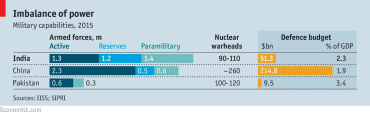
It has topped the list of global arms importers since 2010, sucking in a formidable array of top-of-the-line weaponry, including Russian warplanes, Israeli missiles, American transport aircraft and French submarines. State-owned Indian firms churn out some impressive gear, too, including fighter jets, cruise missiles and the 40,000-tonne aircraft-carrier under construction in a shipyard in Kochi, in the south of the country.

Yet there are serious chinks in India’s armour. Much of its weaponry is, in fact, outdated or ill maintained. “Our air defence is in a shocking state,” says Ajai Shukla, a commentator on military affairs. “What’s in place is mostly 1970s vintage, and it may take ten years to install the fancy new gear.” On paper, India’s air force is the world’s fourth largest, with around 2,000 aircraft in service. But an internal report seen in 2014 by IHS Jane’s, a defence publication, revealed that only 60% were typically fit to fly. A report earlier this year by a government accounting agency estimated that the “serviceability” of the 45 MiG 29K jets that are the pride of the Indian navy’s air arm ranged between 16% and 38%. They were intended to fly from the carrier currently under construction, which was ordered more than 15 years ago and was meant to have been launched in 2010. According to the government’s auditors the ship, after some 1,150 modifications, now looks unlikely to sail before 2023.

Such delays are far from unusual. India’s army, for instance, has been seeking a new standard assault rifle since 1982; torn between demands for local production and the temptation of fancy imports, and between doctrines calling for heavier firepower or more versatility, it has flip-flopped ever since. India’s air force has spent 16 years perusing fighter aircraft to replace ageing Soviet-era models. By demanding over-ambitious specifications, bargain prices, hard-to-meet local-content quotas and so on, it has left foreign manufacturers “banging heads against the wall”, in the words of one Indian military analyst. Four years ago France appeared to have clinched a deal to sell 126 of its Rafale fighters. The order has since been whittled to 36, but is at least about to be finalised.

India’s military is also scandal-prone. Corruption has been a problem in the past, and observers rightly wonder how guerrillas manage to penetrate heavily guarded bases repeatedly. Lately the Indian public has been treated to legal battles between generals over promotions, loud disputes over pay and orders for officers to lose weight. In July a military transport plane vanished into the Bay of Bengal with 29 people aboard; no trace of it has been found. In August an Australian newspaper leaked extensive technical details of India’s new French submarines.

The deeper problem with India’s military is structural. The three services are each reasonably competent, say security experts; the trouble is that they function as separate fiefdoms. “No service talks to the others, and the civilians in the Ministry of Defence don’t talk to them,” says Mr Shukla. Bizarrely, there are no military men inside the ministry at all. Like India’s other ministries, defence is run by rotating civil servants and political appointees more focused on ballot boxes than ballistics. “They seem to think a general practitioner can perform surgery,” says Abhijit Iyer-Mitra, who has worked as a consultant for the ministry. Despite their growing brawn, India’s armed forces still lack a brain.

Source: Guns and ghee | The Economist

29/07/2016

Why India Is Spending $1 Billion on Boeing Jets – The Short Answer – WSJ

India is beefing up its maritime patrol and anti-submarine warfare capabilities with an order for four Boeing Co.-made P-8I aircraft.

The order is the latest evidence of booming defense ties between India and the U.S. The South Asian nation’s arms imports from the U.S. in the five years through 2015 were 11 times the amount in the previous five years, according to the Stockholm International Peace Research Institute.

India imported 14% of its weapons from the U.S. in the same period, although its longstanding supplier Russia continued to dominate its defense market with a 70% share, according to the think tank.

India spent how much?

India will pay about $1 billion for the four P-8I planes. That is about half the amount the country spent in 2009 for eight of the aircraft. That order had an option for India to acquire four more jets at the 2009 price, something it is exercising now.

What can the planes do?

The P-8I—a military variant of Boeing 737-800 commercial jetliner—is fitted with state-of-the-art sensors and radars for maritime surveillance and reconnaissance, and to snoop on submarines. It can also be fitted with the Harpoon all-weather anti-ship missiles made by Boeing.

The aircraft–a variant of the U.S. navy’s P-8A Poseidon plane–can also be used for anti-piracy and other intelligence operations. It was deployed in 2014 when India joined the multinational search for the missing Malaysia Airlines Flight 370. It is currently being used in the search for an Indian air force AN-32 aircraft that went missing on Friday over the Bay of Bengal.

Why does India want the jets?

The latest acquisition of the P-8I is a milestone in India’s strategy to replace its aging equipment, much of which was bought from Russia during the Soviet era. The twin-engine jet has a range of about 2,222 kilometers, or more than 1,200 nautical miles, which allows the Indian navy to monitor the country’s vast coastline.

Has this got anything to do with China?

India’s expansion of the P-8I fleet comes as China increases its naval presence in the Indian Ocean, alarming New Delhi.

In recent years, China has been improving its submarine power with a nuclear-powered sub travelling all the way to the Persian Gulf via Sri Lanka. China and India are also locked in a long-running land-border dispute.

The new planes will bolster India’s capabilities to keep an eye on movement on Chinese warships and submarines in the region.

What else is on the shopping list?

India’s government, led by Prime Minister Narendra Modi, has promised to upgrade the country’s military capabilities. But a long-delayed deal to buy 36 Rafale fighter jets from Dassault Aviation S.A. of France is still being negotiated–more than a year after it was announced.

India also has plans to buy howitzers, warships, submarines, as well as to acquire fighter jets.

Source: Why India Is Spending $1 Billion on Boeing Jets – The Short Answer – WSJ

10/02/2016

U.S. and India consider joint patrols in South China Sea – U.S. official | Reuters

The United States and India have held talks about conducting joint naval patrols that a U.S. defence official said could include the disputed South China Sea, a move that would likely anger Beijing, which claims most of the waterway.

An Indian Navy personnel gestures on the deck of the newly built INS Kochi, a guided missile destroyer, during a media tour at the naval dockyard in Mumbai, India September 28, 2015. REUTERS/Shailesh Andrade/Files

Washington wants its regional allies and other Asian nations to take a more united stance against China over the South China Sea, where tensions have spiked in the wake of Beijing’s construction of seven man-made islands in the Spratly archipelago.

India and the United States have ramped up military ties in recent years, holding naval exercises in the Indian Ocean that last year involved the Japanese navy.

But the Indian navy has never carried out joint patrols with another country and a naval spokesman told Reuters there was no change in the government’s policy of only joining an international military effort under the United Nations flag.

He pointed to India’s refusal to be part of anti-piracy missions involving dozens of countries in the Gulf of Aden and instead carrying out its own operations there since 2008.

The U.S. defence official said the two sides had discussed joint patrols, adding that both were hopeful of launching them within the year. The patrols would likely be in the Indian Ocean where the Indian navy is a major player as well as the South China Sea, the official told Reuters in New Delhi on condition of anonymity.

The official gave no details on the scale of the proposed patrols.

There was no immediate comment from China, which is on a week-long holiday for Chinese New Year.

China accused Washington this month of seeking maritime hegemony in the name of freedom of navigation after a U.S. Navy destroyer sailed within 12 nautical miles of a disputed island in the Paracel chain of the South China Sea in late January.

The U.S. Navy conducted a similar exercise in October near one of China’s artificial islands in the Spratlys.

Source: Exclusive: U.S. and India consider joint patrols in South China Sea – U.S. official | Reuters

26/01/2015

Five firsts at Republic Day 2015 – The Hindu

The 66th Republic Day saw many firsts. Here are a few:

1. All-women contingents of the Army, Navy and Air Force march through Rajpath for the first time

The Army contingent, led by Captain Divya Ajith from Chennai, wants to serve in combat roles. “We believe we are equal and second to none. We have already marched for the first time on the Army Day and now another first would be the Republic Day parade. So, yes, we do wish to be in the combat force,” she said.

2. The first time that a U.S. President is Chief Guest for the parade

“This Republic Day, we hope to have a friend over…invited President Obama to be the 1st US President to grace the occasion as Chief Guest,” Narendra Modi tweeted in November last year.

3. The President and the chief guest arrived in different motorcades, a departure from the standard practice of arriving together

4. CRPF shows off Commando Battalion for Resolute Action (CoBRA) used in anti-Naxal operations

5. The long-range advanced MiG-29K fighter jet on display

via Five firsts at Republic Day 2015 – The Hindu.

07/11/2014

India’s Aging Military Equipment Claims Another Life – India Real Time – WSJ

Indian warships and aircraft are continuing to scour the seas off the country’s southeastern coast in search of four sailors who went missing after a torpedo recovery vessel sank on Thursday evening claiming the life of one sailor.

A navy official said the A 72 vessel, that is over 30 years old, sank while on a mission to “recover practice torpedoes fired by fleet ships during a routine exercise, when she experienced flooding in one of her compartments”.

Soon after the incident, navy ships rescued 23 of the 28 sailors on board, he said.

“Nine ships and some aircraft have been deployed to look for” the missing sailors,” the official said.

Despite the increased focus on safety, India’s armed forces, particularly the navy, have been hit by a series of accidents recently, some of them deadly.

In March, a naval commander died during a gas leak in destroyer that was under-construction in a shipyard in Mumbai.

On Feb. 26,  after a fire on INS Sindhuratna—a Soviet-built submarine–left two submariners dead, India’s naval chief, Admiral D.K. Joshi, resigned taking “moral responsibility” for a series of fatal naval accidents under his watch.

The most devastating took place in August last year when 18 sailors died after explosions and a fire rocked a Russian-built sub, INS Sindhurakshak, in a Mumbai dockyard.

The incidents cast a shadow over the South Asian country’s efforts to modernize its military mainly by replacing Soviet-era equipment.

Prompted in part by the rapid modernization of the Chinese navy and buildup of China’s naval presence in the Indian Ocean, Prime Minister Narendra Modi’s government is increasing its focus on maritime security.

via India’s Aging Military Equipment Claims Another Life – India Real Time – WSJ.

22/08/2014

India to Unveil First Warship to Deter Chinese Submarines – Businessweek

India will unveil its first home-built anti-submarine warship tomorrow in a move to deter China from conducting underwater patrols near its shores.

CHINA-MILITARY-NAVY-ANNIVER

Defense Minister Arun Jaitley will commission the 3,300-ton INS Kamorta at the southeastern Vishakapatnam port. The move comes a week after Prime Minister Narendra Modi introduced the largest indigenously built guided-missile destroyer and vowed to bolster the country’s defenses so “no one dares to cast an evil glance at India.”

India is playing catch-up to China, which built 20 such warships in the past two years and sent a nuclear submarine to the Indian Ocean in December for a two-month anti-piracy patrol. The waters are home to shipping lanes carrying about 80 percent of the world’s seaborne oil, mostly headed to China and Japan.

“As China grows into a naval, maritime power, it will be more and more active in the Indian Ocean,” Taylor Fravel, a professor at Massachusetts Institute of Technology who studies China’s ties with its neighbors, said by phone. “Of course, it will not be due to some hostility or targeted at India, but because of its economic interests in the Indian Ocean, as a lot of trade passes through. Such a presence will certainly raise questions in India, but it need not necessarily be a cause of major conflict.”

Warship Plans

India has lacked anti-submarine corvettes in its 135-warship fleet for more than a decade now, with the decommissioning of the last of the 10-ship Petya-class of 1960s-vintage Soviet corvettes in December 2003. It plans to build 42 more warships, including three more anti-submarine corvettes, over the next decade, according to Rear Admiral A.B. Singh, an Indian navy official.

About 90 percent of Kamorta’s components are local, with the hull developed by Steel Authority of India Ltd., medium-range guns by Bharat Heavy Electricals Ltd. (BHEL) and torpedo launchers by Larsen & Toubro Ltd, India’s largest engineering company. The ship is two years behind schedule, according to Commodore B.B. Nagpal, the navy’s principal director for naval design.

via India to Unveil First Warship to Deter Chinese Submarines – Businessweek.

12/06/2014

First Scorpene submarine to be ready by Sept 2016: Admiral Dhowan – The Hindu

Chief of the Naval Staff Admiral Robin Dhowan has said that the construction of French-origin Scorpene submarines at Mazagon Dock is progressing well, with the first submarine now scheduled to be delivered by September, 2016.

Chief of Naval Staff, Admiral R.K. Dhowan (R) being welcomed by Flag Officer Commanding in Chief, Southern Naval Command, Vice Admiral Satish Soni (L) at Southern Naval Command in Kochi on Thursday.

Speaking to The Hindu on the sidelines of a Naval Investiture Ceremony on Thursday, Admiral Dhowan said while the Navy intended to take delivery of the first Scorpene diesel-electric submarine, built under Project 75, in September 2016, it would also ensure that the intervening period between delivery of the remaining five was minimised.

Asked about the arrest of two people in an LTC documents forgery case involving 30 navy officials by the Central Bureau of Investigation (CBI), Admiral Dhowan said whenever such instances came to the Navy’s notice, it carried out thorough investigation and took decisions based on their outcome.

On the proposed government move to ramp up foreign direct investment (FDI) in the defence sector, he said it was the government’s call and the force would follow “whatever decision taken by the government”.

He said the Navy would host Prime Minister Narendra Modi on board the newly-inducted aircraft carrier INS Vikramaditya on Saturday. “We intend to take the PM on board the carrier and showcase various operational activities undertaken by it.”

Admiral Dhowan said the carrier was fully operational and its integral fleet of MiG 29 K fighter jets flown by Indian naval pilots fully integrated to the platform.

The Admiral said operating at sea was not an easy job, but despite the harsh working conditions, navy personnel always wore a smile on their faces. “We are proud of our officers and men.”

At the investiture ceremony earlier in the day, he stressed the importance of team work and training in operating complex platforms in multi-dimensional force.

via First Scorpene submarine to be ready by Sept 2016: Admiral Dhowan – The Hindu.

28/02/2014

India, the Best Customer for America’s Defense Industry – Businessweek

Once again, Indians are mourning after a tragedy aboard one of the navy’s submarines. After an accident on the INS Sindhuratna filled the vessel with smoke yesterday, two officers with severe burns died and seven other sailors suffering from smoke inhalation had to be flown to safety. Last year, an explosion aboard another Indian sub left 18 sailors dead. Shortly after Wednesday’s incident, Indian Navy Chief of Staff D.K. Joshi resigned, effective immediately.

Indian commandos from the Jammu and Kashmir Armed Police (JKAP) at the Sheeri training center, near Srinagar, on Feb. 24

Wednesday’s accident comes at a bad time for India’s embattled government. Indian Prime Minister Manmohan Singh’s Congress Party, facing a string of corruption scandals as well as a lackluster economy, will probably lose in the upcoming national elections due by May. The leader of the largest opposition party, Gujarat Chief Minister Narendra Modi, is a Hindu nationalist who argues that Singh hasn’t been tough enough, especially toward the country’s assertive neighbor to the north—China.

In his first major speech as the Bharatiya Janata Party’s leader last September, he accused the Congress-led government of not doing enough to protect India’s borders. “Unless there is a capable government, patriotic government, there cannot be any guarantee of security,” Modi said. Over the weekend, Modi criticized what he called China’s “expansionary mindset.”

via India, the Best Customer for America’s Defense Industry – Businessweek.

Enhanced by Zemanta
04/12/2013

Indian Army recruitment done on caste, region, religion lines, SC told – The Hindu

Grouping of people from a particular region in an Army regiment is unconstitutional and amounts to discrimination on caste, region and religion basis, a petitioner challenging the recruitment policy told the Supreme Court.

In an affidavit filed in the apex court countering the assertion of the Army which had justified the policy for administrative convenience and operational requirements, the petitioner pleaded that such policy should be dismantled as it is also not followed by Indian Navy and Air Force.

Earlier, the Army told the Supreme Court that it does not recruit on the basis of caste, region and religion but justified grouping of people coming from a region in a regiment for administrative convenience and operational requirements.

Countering the stand taken by the Army, the petitioner, I.S. Yadav, a doctor from Rewari in Haryana, said, “The respondent (Army) has justified the recruitment in Indian Navy and Air Force which is not based on caste/region and religion basis because of the operational requirements of these forces. But in the same breath, it justifies the caste/region/religion-based recruitment giving the same excuse of operational and administrative requirements.

via Army recruitment done on caste, region, religion lines, SC told – The Hindu.

19/11/2013

India buys third aircraft carrier amid rivalry with China | World news | theguardian.com

India has heightened its rivalry with China by taking possession of its third aircraft carrier, a refurbished Soviet-era vessel.

The Indian Navy's aircraft carrier Viraat is reaching the end of its service

The £1.4bn ($2.3bn) aircraft carrier, handed over on Saturday at a north Russian shipyard, will help India to counterbalance the expansion of the Chinese navy.

The 45,000-tonne ship, built in the final years of the Soviet Union and named the Admiral Gorshkov, will be escorted by warships to India on a two-month voyage from Russia\’s northern coast. It has been renamed INS Vikramaditya.

A recent upgrade means the carrier, originally designed to carry Yak-38 vertical take-off aircraft, has been re-equipped to carry Mig-29K fighter jets. It can carry up to 30 aircraft and will have a crew of around 2,000.

China and India, the world\’s most populous countries, co-existed peacefully for centuries but relations became strained after the Communist party won the Chinese civil war in 1948. There were three conflicts between the neighbours in the second half of the 20th century, although since 1987, Sino-Indian trade has grown rapidly. India views China\’s relations with Pakistan with suspicion and China is concerned over Indian activity in the South China Sea. In March this year, tensions between troops were defused after a three-week standoff along their disputed border.

India signed the deal to buy the carrier in 2004 after a decade of negotiations. Its reconditioning was to be finished in 2009, but the price was increased and delivery postponed until 2012 under a new agreement, according to the Indian navy.

The handover was later delayed by another year.

India\’s first, British-built, aircraft carrier was bought in the 1960s and was decommissioned in 1997. Another ex-British carrier, the INS Viraat, is reaching the end of its service.

In August, India launched its first home-built carrier. The 37,500-tonne INS Vikrant is expected to undergo extensive trials in 2016 before being inducted into the navy by 2018.

India is the world\’s largest arms buyer and Russia\’s biggest arms customer, buying about 60% of its arms needs from there. But it has started to look for new suppliers and aims to build more hardware itself as part of plans to spend $100bn in the next 10 years on modernising its military. It has recently rolled out new military purchase rules to attract local companies into the sector.

The INS Vikramaditya was commissioned into the Indian navy at the Sevmash shipyard in Severodvinsk, on the White Sea, in a ceremony attended by the Russian deputy prime minister, Dmitry Rogozin, and Indian defence minister, AK Antony.

China put its first-ever aircraft carrier, another retooled Soviet-made craft called the Liaoning, into service in 2011 amid tensions with Japan over contested islands and a show of strength in the South China Sea.

In the past year China has been involved in a series of territorial spats with Japan over islets in the East China Sea; and with the Philippines, Vietnam and others over the South China Sea, the location of essential shipping lanes and important natural resources, including oil and gas.

via India buys third aircraft carrier amid rivalry with China | World news | theguardian.com.

Law of Unintended Consequences

continuously updated blog about China & India

ChiaHou's Book Reviews

continuously updated blog about China & India

What's wrong with the world; and its economy

continuously updated blog about China & India