Posts tagged ‘Indira Gandhi’

19/04/2015

Entrepreneurship in India: Ready, steady, go | The Economist

IN 2013, when foreign capital suddenly rushed out of emerging markets, India was one of the worst-affected countries. There were plenty of reasons for investors to panic. GDP growth had slumped. The public finances were a mess. And inflation was hovering around 10%. A year earlier a power cut had plunged hundreds of millions of Indians into darkness.

It is a testament to the country’s enduring promise that within a year investors were once again scrambling for a stake in its future—this time tempted by the pro-growth promises of Narendra Modi, who won a resounding victory in elections last May. India’s population rivals China’s in size, but has a far younger complexion. That India is so much poorer in most other regards seems only to add to its allure. Those who missed out on China’s boom might still catch the wave in India.

“Restart” by Mihir Sharma, a columnist for the Delhi-based Business Standard, is a reliable and readable guide to India’s stop-start economy. It is admirably clear on what has to change if India is to taste the high living standards enjoyed in other parts of Asia. Each year 13m Indians join the workforce. Jobs must be found for them. But the giant factories that hummed with baby-boomers in other places are scarce in India, because it is so difficult to do business there.

Mr Sharma applies regular doses of rueful humour as he explains why some of the toughest job-protection laws in the world have ensured that there are few decent jobs in India. The jokes are a necessary feature in a book that contains as many unpalatable truths as this one. They are also a mask for the author’s anger at India’s poverty, at the nation’s failure to match the development of its Asian neighbours and at the self-delusion of its policymakers. “It’s almost as if we genuinely believe all the lies about ourselves we tell foreign investors,” he writes.

Mr Sharma is at his funniest (or angriest) when listing the ludicrous regulations that business must adhere to. Complying with them all is impossible, so officials routinely extort bribes for breaches. Businesses are required, among many other things, to keep an abstract of the 1948 Factories Act to hand. Pass it to a visiting labour inspector, allow him a moment to reflect and “he will find a violation”, notes Mr Sharma. The wisecrack has a painful sting. To avoid a shakedown, businesses stay tiny and inefficient. And India remains poor and woefully short of decent jobs.

Where did India go wrong? Mr Sharma picks the leftward lurch in 1969—when Indira Gandhi nationalised banks to outflank opponents in her own party—as a moment when things shifted. Manmohan Singh’s famed budget of July 1991 was badly flawed because the reforms it contained were incomplete. Mr Singh opened up goods markets to competition but did nothing to free markets for land, labour and capital. A ban on selling farmland to industry remains; labour inspectors can still prey on factory owners; and without a bankruptcy law, capital stays trapped in dying firms. New factories could not readily spring up to compete with imports, and manufacturing has been in relative decline since the mid-1990s.

Mr Sharma thinks factories can still be India’s salvation. But manufacturing-led growth has become harder to pull off. Modern factories use more machinery and less labour than in the past. While India was making half-hearted reforms, China was securing its position in global supply chains. It is now tougher for aspiring nations such as India to break in. It is perhaps for this reason that others look for hope in India’s vibrant services sector. Hindol Sengupta is one such author. His “Recasting India” is a paean to the commercial flair of millions of hawkers and small shopkeepers plying for trade in India. Yet the small-scale service enterprises celebrated by Mr Sengupta are a developmental dead end. They are a sign of economic weakness and not vitality, as Mr Sharma rightly argues. Small traders seem less impressive in other countries only because the best entrepreneurs have been able to grow bigger.

via Entrepreneurship in India: Ready, steady, go | The Economist.

25/11/2014

Mrs. Modi, This Is What You’re Entitled to as Wife of India’s PM – India Real Time – WSJ

Narendra Modi’s wife wants to know what privileges she is entitled to as the spouse of India’s prime minister.

Six months into the role, Jashodaben Chiman Modi has asked police why she must use the bus when her security detail travels in a government car and what perks she should be getting as the wife of the country’s most-powerful man.

“I am the wife of the prime minister and as per formal procedure, I want to know what other services am I supposed to get,” Mrs. Modi wrote in a submission under India’s right to information law, according to a spokeswoman at the police station where the document was received.

An odd request for such a person to make you might think but here’s the thing.

Until he filed election nomination papers in April ahead of national polls, Mr. Modi had never mentioned his wife publicly.

The pair had an arranged marriage in their teens and Mr. Modi left her soon after the ceremony. The couple have lived apart since though they are not divorced.

But, after Mr. Modi swept to power in May, his wife, a retired school teacher, was allotted 24-hour protection from five security commandos by the Gujarat police.

In the RTI application submitted Monday, Mrs. Modi stated that “I want to know under which legal clauses/provisions and acts of [Indian] Constitution have I been given the security cover,” according to the police spokeswoman. Mrs. Modi could not be reached for comment. A spokesman for the prime minister was not immediately available for comment.

Referring to the assassination of former prime minister of Indira Gandhi by her security guards in 1984, Mrs. Modi said she “is frightened by the presence” of the commandos and “asked for all the details of her personal bodyguards,” the spokeswoman said.

Besides, she also asked for information about the “other honors and benefits” she is authorized to receive as the prime minister’s wife.

via Mrs. Modi, This Is What You’re Entitled to as Wife of India’s PM – India Real Time – WSJ.

04/10/2014

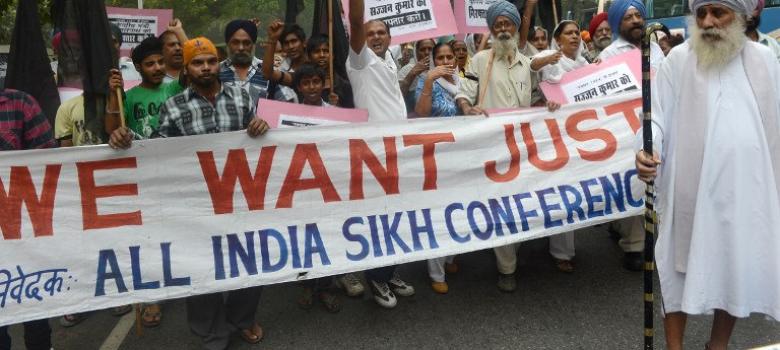
1984 anti-Sikh riots were an organised massacre, says ‘Caravan’ article

Avtar Singh Gill, the former petroleum secretary, alleged that Rajiv Gandhi aide Arun Nehru had sanctioned the violence.

Did disparate groups of rioters act spontaneously during the anti-Sikh riots of 1984, or was the violence orchestrated at the behest of the top leadership of the Congress? This question has dogged Congress governments since Delhi’s Sikh comunity was devastated by one the bloodiest bouts of communal carnage after Independence. The Congress has long maintained that the violence was an unplanned response to the assassination of Prime Minister Indira Gandhi by two Sikh bodyguards on October 31, 1984. The riots continued until November 3.

Now, a recent statement by a senior government official of the time has added credence to the allegation that the violence was indeed orchestrated, and that the clearance came from the top. Avtar Singh Gill, the former petroleum secretary, has told Caravan magazine that Arun Nehru, a cousin and confidant of Rajiv Gandhi, had given clearance for Sikhs to be attacked and killed in Delhi.

In an article by the magazine’s political editor Hartosh Singh Bal in the latest issue, Gill is quoted as saying that on November 1, 1984, “Lalit Suri of Lalit Hotels, who used to come and see me often, dropped by. He was the errand boy for Rajiv Gandhi, and since he often needed some work done, he was close to me. He came to me in the ministry and said, ‘Clearance has been given by Arun Nehru for the killings in Delhi and the killings have started.  The strategy is to catch Sikh youth, fling a tyre over their heads, douse them with kerosene and set them on fire. This will calm the anger of the Hindus.”

Gurudwara lists

Gill is also quoted as saying that Suri “told me that I should be careful even though my name is not in the voters’ list, the Delhi Gurdwara voters’ list. ‘They [the rioters] have been provided this list. This will last for three days. It has started today, it will end on the third [of November].’”

Gill’s revelations also appear to put to rest the long-term speculation about Arun Nehru’s role in the violence. “That Arun Nehru had a role in the violence has long been widely rumoured, but Gill’s statement marks the first time a senior government official has put the accusation on record,” writes Bal. “His story offers the first coherent explanation for the nature of the violence in Delhi,”

Gill and Nehru

Gill’s revelations have greater significance because he was often consulted by Arun Nehru on Punjab and Sikh issues. “As one of the few Sikhs in a senior position in the government – even though I was clean shaven, he [Nehru] wanted to know my views,” the former petroleum secretary is quoted as saying.

Gill’s also explains – again for the first time – how rioters could easily identify Sikh houses. Lawyer HS Phoolka, who is leading the legal battle to secure justice for the victims of the 1984 riots, is quoted in the article saying “the ease with which Sikh houses were identified would make sense if Gurdwara voters’ lists were available”.

Gurdwara voter lists contain the names of people eligible to vote in the elections to the Delhi Sikh Gurdwara Management Committee. That these lists were already available to “people in the higher ranks” is made clear by another contention Phoolka makes in this article.

via 1984 anti-Sikh riots were an organised massacre, says ‘Caravan’ article.

05/09/2014

Modi’s first 100 days looked more like Manmohan’s than Vajpayee’s

The new prime minister hasn’t faced a major crisis or unveiled a startlingly new policy.

For the last week, Indian newspapers, channels and websites have been plastered with evaluations of Narendra Modi’s first 100 days. From dedicating entire editions to the 100-day landmark to building complex timelines describing every policy announcement over the last three months (and even comparing what has been achieved to the Bharatiya Janata Party’s campaign promises), there has been so much content that it’s hard to arrive at a conclusion about whether Modi’s Prime Ministership has been good or bad.

That might be expected, considering the scale of the challenge that the new government has set for itself. Alternatively, it might also be surprising: many expected Modi Sarkar to be a hate-it-or-love-it administration, rather than one that would leave people with lukewarm feelings.

Another way to approach the question might be to try and figure out how Modi’s first 100 days will be remembered. The first few months of new governments can often set the tone for what is to come. In hindsight, the trends picked up in the first days are then grafted on to narratives that are applied to entire tenures.

A look back at previous prime ministers might give us an inkling of how this will play out.

via Scroll.in – News. Politics. Culture..

22/08/2014

India’s Government Blocks Release of Film About Sikh Assassins Who Killed Prime Minister Indira Gandhi – India Real Time – WSJ

India’s government has blocked the release of a film about the Sikh assassins who killed the late Prime Minister Indira Gandhi in 1984, saying it could pose a threat to law and order.

Theaters across northern India and select cities elsewhere were set to start showing the Punjabi-language movie, “Kaum De Heere,” which translates as “Diamonds of the Community,” on Friday.

The film tracks the transformation of Mrs. Gandhi’s killers – anointed as martyrs last year by Sikh religious authorities — from dependable bodyguards to assassins.

Mrs. Gandhi’s death sparked large-scale anti-Sikh riots, one of the worst episodes of communal violence in Indian history. Around 7,000 people, mostly Sikhs, are believed to have died in the rioting.

Leela Samson, chairwoman of India’s Central Board of Film Certification, said the movie “rakes up very old and strong sentiments” and sends a “wrong message to the youth that a particular ideology comes above the nation’s interests and that taking the law into your hands is permissible.”

She said that after officials from the Home Ministry, Information and Broadcasting Ministry and film review board watched the film Thursday, film regulators decided to withdraw their earlier approval for it to be shown in theaters.

In an interview with The Wall Street Journal Thursday, the film’s producer, Satish Katyal, said the film was about the lives of the two assassins and the difficulties faced by their families.

“Nobody has been shown as being good or bad. There are no biases,” he said.

Mr. Katyal said it was unfair for the film board to reverse course just hours before the film’s release. If the government had any objections, he said, there was “ample opportunity to raise them before.”

The film opens with the assassination of Mrs. Gandhi, the daughter of independent India’s first prime minister, Jawaharlal Nehru. Mrs. Gandhi, like her father, led the Congress party.

While she was premier, Indian security forces attacked alleged Sikh militants inside the Golden Temple, Sikhism’s holiest site, in a raid dubbed Operation Blue Star. Hundreds of people were killed.

Soon after, Mrs. Gandhi was killed by two Sikh bodyguards, touching off a spasm of religious violence. Senior Congress politicians have faced trials, some of which are ongoing, for inciting mobs and fueling the conflict.

“There will never be any justification for the attack on the sanctity of Sikhs and the targeting of an entire community,” said Avtar Singh, head of the Shiromani Gurdwara Prabandhak Committee, Sikhism’s highest authority.

The party has attempted to reconcile with the Sikh community. Former Prime Minister Manmohan Singh, himself a Sikh, apologized for the riots when he came to power.

via India’s Government Blocks Release of Film About Sikh Assassins Who Killed Prime Minister Indira Gandhi – India Real Time – WSJ.

06/06/2014

Timeline: Indian Prime Minister Visits to the U.S. – India Real Time – WSJ

Indian Prime Minister Narendra Modi, who took office just last month, has accepted an invitation from President Barack Obama to visit Washington D.C. in September.

If the visit happens as scheduled, he will be the latest leader of the world’s largest democracy to visit the world’s second largest democracy.

The relationship goes both ways. U.S. Presidents going back to Dwight D. Eisenhower have made visits to India. Click here to see the list of U.S. presidents who have made the trek to South Asia.

While most Indian Prime Ministers had official visits to the United States, six Indian premiers–including Lal Bahadur Shastri and H.D. Deve Gowda–did not visit the states while they were in office.

Here is a list of some of the trips made by prime ministers according to the U.S. Department of State.

Jawaharlal Nehru: The first prime minister of independent India went to the U.S. in 1949 and then in 1956 at which time he visited Washington D.C. and Pennsylvania.

Indira Gandhi:  Ms. Gandhi visited the U.S. three times during her years in office. Her first visit was in 1966 when Lyndon B. Johnson was the president. Her second visit came in 1971 and her final visit was in 1982.

Indira Gandhi, left, stood next to Richard Nixon during an official ceremony during her visit to the U.S. in November 1971. Agence France-Presse/Getty Images

Morarji Desai: Mr. Desai went to the U.S. in 1978 visiting New York, San Francisco and Omaha.

Morarji Desai. Keystone/Hulton Archive/Getty Images

Rajiv Gandhi: Mr. Gandhi visited the U.S. two times in 1985 and once in 1987. He was assassinated two months after his 1987 visit.

Rajiv Gandhi addressed a crowd during election campaign rally at Faizabad in Uttar Pradesh. Agence France-Presse/Getty Images

P.V. Narasimha Rao: Mr. Rao–who is credited for starting to open India’s economy– visited the U.S. twice during his four years in office. He met President George H.W. Bush during a U.N. Security Council Summit in New York in 1992.  He visited again two years later to address a joint meeting of the U.S. Congress.

P.V. Narasimha Rao, left, with Hillary Clinton. Douglas E. Curra/Agence France-Presse/Getty Images

Inder Kumar Gujral:  Though Mr. Gujral served as India’s prime minister for less than a year, he found time to visit New York where he met President Bill Clinton at the U.N. General Assembly in 1997.

Inder Kumar Gujral. Sena Vidanagama/Agence France-Presse/Getty Images

Atal Bihari Vajpayee: Mr. Vajpayee—the last prime minister from Mr. Modi’s Bharatiya Janata party–visited the U.S. four times during his five years in office, twice in 2001 and once each in 2002 and 2003.

Atal Bihari Vajpayee, right, posed for photographs with George W. Bush in New York, Sept. 24, 2003. Luke Frazza/Agence France-Presse/Getty Images

Manmohan Singh: Mr. Singh was the prime minister for close to ten years until last month. He visited the U.S. on no less than seven occasions.

via Timeline: Indian Prime Minister Visits to the U.S. – India Real Time – WSJ.

Enhanced by Zemanta
14/01/2014

Ready for whatever Congress wants me to do: Rahul Gandhi – The Hindu

Ahead of the AICC meeting on Friday when he is expected to be named the Congress Prime Ministerial candidate, Rahul Gandhi on Tuesday appeared ready to take up the responsibility.

“None of my family members ever worked for the sake of power. Neither my father nor my grandmother,

“I am a sepoy of Congress. I will obey whatever order is given to me. I will do whatever Congress wants me to do… Decisions are taken in our party by senior leaders,” he told Hindi daily ‘Dainik Bhaskar’ in an interview.

“Earlier also some decisions were taken…Power is poison ….does not mean that I am not keen to take responsibility. There is no word of reluctance in my life…Congress has never been specific. Whatever task the Congress wanted me to accomplish, I have done that,” Mr. Gandhi said when asked whether he was ready to take up the post of Prime Minister and about perceptions of him being reluctant.

Mr. Gandhi’s remarks at the party’s Chintan Shivir in Jaipur in January 2013, that his mother Sonia Gandhi had told him that power is poison had led to speculation as well Opposition attack that the Congress vice-president was not willing to take up responsibility.

Explaining his remarks, he said, “Power is poison is an observation that when power comes, one should know how to deal with the associated dangers that come with it. This is it. Power is poison means use power for the welfare of people and do not use it to make oneself bigger or more powerful.”

To a direct question on whether he will accept any such responsibility, Mr. Gandhi said, “None of my family members ever worked for the sake of power. Neither my father nor my grandmother.”

Mr. Gandhi’s father Rajiv Gandhi and grandmother Indira Gandhi were both Prime Ministers of the country.

via Ready for whatever Congress wants me to do: Rahul Gandhi – The Hindu.

Enhanced by Zemanta
31/12/2013

BBC News – India country profile – Overview

The world\’s largest democracy and second most populous country emerged as a major power in the 1990s. It is militarily strong, has major cultural influence and a fast-growing and powerful economy.

Map of India

A nuclear-armed state, it carried out tests in the 1970s and again in the 1990s in defiance of world opinion. However, India is still tackling huge social, economic and environmental problems.

The vast and diverse Indian sub-continent – from the mountainous Afghan frontier to the jungles of Burma – was under foreign rule from the early 1800s until the demise of the British Raj in 1947.

The subsequent partition of the sub-continent – into present-day India and Pakistan – sowed the seeds for future conflict. There have been three wars between India and its arch-rival Pakistan since 1947, two of them over the disputed territory of Kashmir.

A peace process, which started in 2004, stayed on track despite tension over Kashmir and several high-profile bombings until the Mumbai attacks of November 2008, carried out by Islamist militants overwhelmingly from Pakistan and organised by the Pakistani movement Lashkar-e-Taiba. India announced that the process was on pause the following month.

Communal strife

With its many languages, cultures and religions, India is highly diverse. This is also reflected in its federal political system, whereby power is shared between the central government and 28 states.

However, communal, caste and regional tensions continue to haunt Indian politics, sometimes threatening its long-standing democratic and secular ethos.

In 1984 Prime Minister Indira Gandhi was gunned down by her Sikh bodyguards after ordering troops to flush out Sikh militants from the Golden Temple in Amritsar.

And in 1992, widespread Hindu-Muslim violence erupted after Hindu extremists demolished the Babri mosque at Ayodhya.

Economic progress

Independent India\’s first prime minister, Jawaharlal Nehru, dreamed of a socialist society and created a vast public infrastructure, much of which became a burden on the state.

From the late 1980s India began to open up to the outside world, encouraging economic reform and foreign investment. It is now courted by the world\’s leading economic and political powers, including its one-time foe China.

The country has a burgeoning urban middle class and has made great strides in fields such as information technology. Its large, skilled workforce makes it a popular choice for international companies seeking to outsource work.

But the vast mass of the rural population remains impoverished.

Their lives continue to be influenced by the ancient Hindu caste system, which assigns each person a place in the social hierarchy. Discrimination on the basis of caste is now illegal and various measures have been introduced to empower disadvantaged groups and give them easier access to opportunities – such as education and work.

Poverty alleviation and literacy campaigns are ongoing.

Nuclear tests carried out by India in May 1998 and similar tests by Pakistan just weeks later provoked international condemnation and concern over the stability of the region.

The US quickly imposed sanctions on India, but more recently the two countries have improved their ties, and even agreed to share nuclear technology.

India launches its own satellites and in 2008 sent its first spacecraft to the moon. It also boasts a massive cinema industry, the products of which are among the most widely-watched films in the world.

via BBC News – India country profile – Overview.

See also: https://chindia-alert.org/2013/12/31/bbc-news-china-country-profile-overview/

20/11/2013

Indian women in business: has the glass ceiling been shattered? – The New Silk Road, Stephenson Harwood

From: The New Silk Road, Nov 13 to Jan 14; Stephenson Harwood

http://f.datasrvr.com/fr1/413/26346/NSRissue17-interactivePDF-v15.pdf

India is a country of acute contrasts; and perhaps nowhere is the divide more pronounced than in the status of women. In terms of the big milestones, the country has a reputation for leapfrogging others – Indira Gandhi became the world’s second ever female prime minister way back in 1966 (pipped to post by Sirimavo Bandaranaike of Sri Lanka), and women have since served in multiple senior political roles.

They’ve also stormed ahead in the professions (notably medicine and law) and in the international corporate world. One might cite Indra Nooyi, who beat all comers to secure the top job at Pepsi-Co; ot her aptly named Padmasree Warrior, chief technology and strategy officer at Cisco Systems. Meanwhile, a generation of newly-empowered and highly-educated young women are going out to work in larger numbers than before.

Set against these achievements, however, is the increasingly troubling situation facing Indian women more broadly. A recent Reuters Trustlaw investigation – examining a wide variety of measures from male-to-female pay disparity, through female foeticide, to deaths in dowry disputes – ranked India  as the worst country in the G20 to be born female.

Assushma Kapoor, South Asia deputy director for UN Women sums up: “There are two Indias: one where we can see more equality and prosperity for women, but another where the vast majority of women are living with no choice, voice, or rights.”

Although more than two decades of economic liberalisation has opened up opportunities in progressive cities such as New Delhi, Kolkata and Bangalore, large parts of the country – particularly in the north – remain entrenched in feudalism. The upshot, according to The Economist, is that just 29 per cent of Indian women are currently in the workforce, compared with two-thirds of women in China.If deep-rooted changes in social attitudes are needed, who better to lead them than India’s companies? The willingness with which multinational companies (especially in the IT sector) have embraced the female graduates of India’s management schools is surely indicative of their quality. As well as Vanitha Narayan of IBM (profiled overleaf) the managing directors of both CapGemini India and Hewlett-Packard India are women. Female representation at the top of the banking profession is also much higher in India than many other countries.

The sectors in which women are currently thriving at senior levels – FMCG, retail, IT and retail banking – tend to be consumer-centric, says headhunter Ronesh Puri of Executive Access: reflecting the fact that household buying decisions are usually made by women and companies feel the need to ‘connect’. In more labour-intensive industries like mining, oil and gas, and aviation, women are still under-represented – as they are in the west – though that is beginning to change.

Indeed, demand for female directors at Indian companies across the board is growing at an estimated rate of about 10 per cent each year. That’s partly the result of new legislation mandating at least one board for certain classes of companies. But it’s also a response to the growing body of research suggesting a link between business growth and profitability, and gender diversity.Many women in corporate India might protest that there’s a long way to go. But the same is true in virtually every other developed nation. And one thing India is not short of is distinguished role models. Here we profile four inspirational women, who’ve made their mark across very different sectors.

Shubhalakshmi Panse

Chairman and managing director, Allahabad Bank

When Shubhalakshmi Panse’s became the first woman to lead India’s oldest bank last year, it marked the culmination of a near 40-year career at the financial coal-face. It almost never happened. Panse, 59, was pursuing a doctorate in embryology at Pune University when she stumbled across a recruitment advert from the state-owned Bank of Maharashtra. She took the qualifying exams “just for fun”. Having successfully climbed the professional ladder, Panse made the most of a sabbatical in the US in the early 1990s, completing a three-year MBA in twelve months flat before returning to India. The sizeable challenge she was hired to tackle at Allahabad Bank was to turn round the struggling institution in a year, ahead of her retirement next January. Panse admits “networking” isn’t her forte. She credits her success to her work ethic (“my commitment has always been 200 per cent”); and her parents. “We were raised as independent individuals. My mother would say ‘you can do it’.

Ishita Swarup

Founder, Orion Dialog and 99.labels.com

Ishita Swarup knew from an early age that she wanted to do “something of my own” rather than get stuck in “the cog in the wheel syndrome”. After completing her MBA, she joined Cadbury’s Indian brand management team, but stayed in the corporate cocoon just three years before starting the online phone marketing firm, Orion Dialog, in 1994 aged 27. The firm, which numbered Citibank among early clients, caught the rising tide of business process outsourcing. In 2004, Swarup exited in style: selling out to Aegis BPO (part of the Essar group). Still, she’s had much a choppier time with her second big venture, the ecommerce outfit 99.labels.com. Launched in 2009, the site was India’s first ‘flash sales’ shopping portal. But a proliferation of ‘me too’ competition and profitability concerns have dogged the firm and, in May, a big investor pulled out. Swarup hasn’t given up. She’s rejigging the business model and looking for new backers. “Seeing a venture take shape from idea to reality, and then taking it to a growth level, motivates me,” she says. “Making mistakes is part of that process.”

Kiran Mazumdar-Shaw

Founder, Biocon

India’s wealthiest self-made woman started Biocon aged 25 in 1978, out of the garage of a rented house with the bare minimum of capital because she could not get financial backing. The decision to strike out on her own – becoming India’s first biotech entrepreneur – was taken almost by default. She had hoped to get a job at Vijay Mallya’s United Breweries, but was shocked to hear that male colleagues wouldn’t accept her. “That’s when the hard fact hit me. There is a gender bias.” Biocon began life as an enzyme specialist, before moving whole sale into the lucrative bio-pharma sector in the late 1990s, ahead of the great ‘off patent’ bonanza. IN 2004, Mazumdar-Shaw too the company public, Now 60 and worth US$625 million, according to Forbes, she lives in an estate outside Bangalore. “You could be in California”, she said last year. “Then you step outside and see poverty. That’s not a nice feeling.” She has pledged to five away three-quarters of her wealth.

Vanitha Narayanan

Managing director, IBM India

In contrast, one woman who has thrived on corporate life is Vanitha Narayanan, an IBM ‘lifer’ who became responsible this year for all Big Blue’s operations in India and South Asia – one of the company’s fastest-growing regions. With 150,000 people on the payroll, IBM is the largest multinational employer in India. Naraythan, a graduate of the University of Madras, cheerfully admits that, apart from a brief stint in a department store, “IBM is my only job”. She joined the company’s US telecoms group as a trainee after taking an MBA at the University of Houston, and made her name working with just one client, the Southwestern Bell Telephone Company. “It helped me lay a foundation – you respect the industry of your client, and sometimes the client is your best teacher.” That certainly proved true in her case. She went on to become a global vice-president of IBM’s telecom solutions, and in 2006 moved to China to run the Asia Pacific Unit. At 54, Narayanan is modest about her achievements, preferring the word “influence” to power. “She’s no pushover,” says a colleague. “But she can build trust very easily”.

See also:

and:

28/07/2013

Lok Sabha elections will repeat 1977 verdict: BJP

Times of India: “The BJP on Sunday said that next year’s Lok Sabha elections will be a watershed for the party and claimed that a 1977-like mood will dislodge the UPA dispensation.

Flag of the Bharatiya Janata Party (BJP), a na...

Flag of the Bharatiya Janata Party (BJP), a national political party in India. (Photo credit: Wikipedia)

Ananth Kumar, national general secretary of the BJP, also claimed that his party will get an absolute majority in the elections.

“The mood in India is like that of 1977 when the country faced the elections after the imposition of emergency… Voters wanted Indira Gandhi to go and did not give a fractured mandate but a clear majority to Janata Party that was unprecedented in many ways since Independence,” he said.

“We will get an absolute majority,” he said, adding that the BJP’s slogan in the ensuing election will be Congress Muktha Bharat (Free India from Congress).”

via Lok Sabha elections will repeat 1977 verdict: BJP – The Times of India.

Law of Unintended Consequences

continuously updated blog about China & India

ChiaHou's Book Reviews

continuously updated blog about China & India

What's wrong with the world; and its economy

continuously updated blog about China & India