Posts tagged ‘Information technology’

24/01/2016

Well-wishing | The Economist

SINCE he took over as China’s leader in 2012, Xi Jinping has been a busy globetrotter. Last year he visited more countries than Barack Obama, America’s president (14 against 11).

Heedless of whether his hosts are powerful, puny or pariahs, he has flown everywhere from America to the Maldives and Zimbabwe. Mr Xi wants to project China’s rising power—and his role in promoting that—to foreign and domestic audiences. But until this week, he had not set a presidential foot in the Middle East.

The trip, under way as The Economist went to press, began in Saudi Arabia (whose king, Salman bin Abdul Aziz, is pictured with Mr Xi). He then visited Egypt and was due to finish his tour in Iran. No Chinese president had toured the region since 2009. China’s leaders had worried about getting embroiled in the region’s intractable disputes. But China has a big stake in the Middle East. It is the world’s largest oil importer and gets more than half of its crude from the region (see chart). Mr Xi’s much ballyhooed “new Silk Route”, aimed at linking China and Europe with the help of Chinese-funded infrastructure, runs across the Middle East. Chinese companies are already building expressways and harbours there. In this section Divorce: a love story Well-wishing Reprints Related topics Middle East Politics Government and politics World politics Asia-Pacific politics

The timing of Mr Xi’s tour is tricky. Tensions between Saudi Arabia and Iran are particularly high after Saudi Arabia executed a Shia cleric earlier this month and angry Iranians responded by storming the Saudi embassy in Tehran. But the lifting of Western sanctions on Iran on January 16th (see article) allowed Mr Xi to display even-handedness by visiting both countries, without upsetting Western powers. Mr Xi, like his predecessors, likes to present China as a non-interfering champion of peace. (Xinhua, China’s state-run news agency, said this week that the West’s “meddling hands” were “more of a mortal poison than of a magic potion” in the Middle East.) But Mr Xi is not keen to play a central role as peacemaker. China’s first “Arab Policy Paper”, released on January 13th, is a vague, waffly document. It talks of “building a new type of international relations”, but is devoid of new ideas.

Zhang Ming, a vice-foreign minister, said this week that economic development was the “ultimate way out” of conflict in the region. By expanding its trade and investment links with the Middle East, China hopes discontent and conflict there will gradually dissipate. In addition to crushing dissent, it is trying a similar approach in Xinjiang, a province in western China with a large Muslim population—so far without success.

In the long run, China may find it hard to avoid taking sides. To some extent it has already done so in Syria: it talks to representatives from both the Syrian government and the opposition, but by vetoing UN resolutions on intervention it tilts, in effect, in the government’s favour. The presence of a growing number of Chinese citizens in the Middle East may challenge China’s non-interventionist approach. After a Chinese national was executed by Islamic State in November, China promised to strengthen protection of its citizens abroad. Its new rules of Middle Eastern diplomacy could end up resembling familiar Western meddling

Source: Well-wishing | The Economist
22/01/2016

Chinese president offers remedies for Mideast predicaments, aid to Arab development – Xinhua | English.news.cn

Out-of-the box thinking.  Hope other major powers start to subscribe to this point of view. The current ones  of taking sides and partisan fighting isn’t working.

“Visiting Chinese President Xi Jinping on Thursday prescribed his remedies to restore peace in the Middle East and promote development in the Arab world.

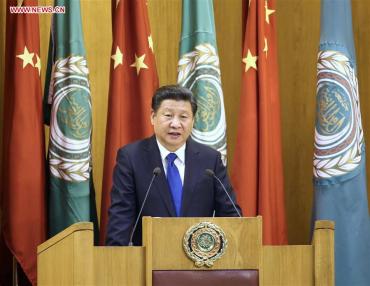
EGYPT-CAIRO-CHINA-XI JINPING-VISIT

While delivering a speech at the headquarters of the Arab League, Xi described the Middle East region, which in many’s eyes is almost an equivalent to wars and tumult, as a “land of abundance.”

PATH TO PEACE

The Chinese leader concluded in the remarks that dialogues and development are the key factors that can help bring peace and stability back in this part of the world.

He said use of force offers no solution to problems, neither will zero-sum mentality bring enduring peace, adding that for the success of talks, there is need for utmost patience and flexibility.

Speaking of the Syrian crisis, he said there will be no winner out of a conflict, and to address the hot-spots, what is the most urgent, is to bring about cease-fire and start political talks.

Xi also believed that turmoil in the Middle East stems from the lack of development, while the ultimate solution will depend on development, saying that only when young people are able to live a fulfilled life with dignity can hope prevail in their heart. Only then will they voluntarily reject violence, extremist ideologies and terrorism.

Mahmoud Allam, former Egyptian ambassador to China, admitted that many of the deep-rooted problems the Arab world is grappling with have been the result of failures to achieve a successful development model, saying development is no doubt the most viable path of mobilizing people toward achieving their common interests and overcoming disagreements.

TANGIBLE HELP

Also in his speech, the Chinese president introduced a host of fresh moves including loans, financial aid and common investment fund to help improve livelihood, fight terrorism and promote development in the Arab world.

The Chinese government has decided to pledge 50 million RMB (7.53 million U.S. dollars) to help improve the lives of the Palestinians and 230 million RMB (about 35 million dollars) for Syria, Jordan, Lebanon, Libya and Yemen as humanitarian assistance, said Xi.

Beijing also wants to promote the industrialization in the Middle East. To achieve that end, China is going to hand out a number of loan programs, including a 15-billion exclusive loan, a 10-billion business lending, and 10 billion concessional loans so as to facilitate production capacity cooperation between China and the regional countries, according to the president.

Meanwhile, China also prepares to work with the United Arab Emirates and Qatar to set up a common investment fund worth 20 billion dollars that focuses on traditional sources of energy in the Middle East, infrastructure, and high-end manufacturing.

Xi also offered in his speech 300 million dollars for law enforcement cooperation, police training so as to help build up the abilities of the regional countries to maintain stability.China also planned to provide 1,000 training opportunities for young Arab leaders, and strengthen exchanges among their think tanks, experts and scholars.

CHINA’S DOS AND DON’TS IN MIDEAST

The Chinese leader also said his country will neither look for proxies nor try to fill any “vacuum” in the Middle East, adding that Beijing has no intention of building any sphere of influence in the region.

“Instead of looking for a proxy in the Middle East, we promote peace talks; instead of seeking any sphere of influence, we call on all parties to join the circle of friends for the Belt and Road Initiative; instead of attempting to fill the ‘vacuum’, we build a cooperative partnership network for win-win outcomes,” he said.

Meanwhile, Xi promised that China will not link terrorism with any specific ethnic group or religion, as doing so will only create ethnic and religious tensions, adding that there should be no double standards in battling terrorism.

Also, he said the Middle East is the meeting place of ancient human civilizations and home to diverse and splendid cultures. China will continue to unswervingly support Middle East and Arab states in preserving their ethnic and cultural traditions, and oppose all forms of discrimination and prejudice against specific ethnic group and religion.”

Source: Chinese president offers remedies for Mideast predicaments, aid to Arab development – Xinhua | English.news.cn

08/01/2016

Three political questions looming over China’s leadership in 2016 – WSJ China Real Time

From: http://blogs.wsj.com/chinarealtime/2016/01/08/three-political-questions-looming-over-chinas-leadership-in-2016/?mod=djemChinaRTR_h

Last year saw more attention to Chinese President Xi Jinping as China’s paramount leader, including what many observers have seen as a cult of personality. The economy may eclipse politics as a concern for Beijing in 2016, but in China the two are always closely intertwined. Here are the three major political questions that will loom over the Xi leadership in the months to come.

  1. Is it time for thelong-running anticorruption campaignto shift its focus?

In laying out a vision for his anti-corruption drive in 2013, Xi Jinping vowed to go after both high-ranking “tigers” and low-level “flies.” So far the campaign has been fueled by the takedowns of a procession of big cats – but there are signs that a change is in the offing.

There’s upside to an increased focus on local cadres and others at the insect level. For one, it would send a signal to doubters that the anti-graft campaign is genuine, not just a way to purge Xi’s political enemies. It would also help Xi score points with regular citizens and reform-minded officials outraged at the pervasiveness of corruption in China.

But there’s also a political risk. Already, the current crusade has compelled many officials to hunker down and sit on their hands to avoid attracting attention – a phenomenon that has slowed policymaking. Likewise, many developers remain wary of starting new projects that might aid an ailing economy because they’re still not sure what’s permissible in the new environment.

Broadening the anti-graft campaign could handcuff policymaking even further, because cadres will spend time looking over their shoulders, and entrepreneurs, wondering about political support, will wait until the dust settles before embarking on new commercial initiatives.

  1. What sort of politics does China want to practice?

Xi Jinping and Chinese Premier Li Keqiang agree on a great deal, but they have distinctive notions about how to build a better China.

Xi believes that China’s political future rests on a reassertion of the party’s rule, preventing potential challenges from social groups, and convincing citizens and cadres alike that the government stands for something more than just nationalism — that socialism is still relevant but needs to be recast in ways that appeal to society.

Li appears to see his political mission differently. In his eyes, ideological renovation is far less crucial to the country than administrative restructuring and being a more efficient and approachable government. It’s innovation, not rectification, Li argues, that will secure the Party’s legitimacy. From experimenting with new ways to measure China’s actual economic performance to making bureaucratic requirements easier for citizens to meet, Li has created a profile for himself that challenges the prevailing political course being set by Xi.

While Xi wants more control over society, Li argues for less oversight and regulation in China’s economy and bureaucracy–making it easier for businesses to start up and succeed as a way of preventing social pressure from becoming a political threat.

Thus far, the policy divide between Xi and Li hasn’t resulted in political warfare. But some lower-level cadres are increasingly perplexed about which template to follow: They’ve been quietly pressing for clarification about whether they should be focusing on being better Communists, or on building a more efficient and responsive government. It’s not clear how they can accomplish both, especially when they’re under the anticorruption microscope.

The economy could catalyze conflict here. If slower growth turns into a tailspin, Li and his allies will surely press to have their agenda for change adopted more widely, and argue that the current strategy of “politics before economics” championed by Xi isn’t working. Xi and his comrades won’t concede the political high-ground they currently occupy without a fight.

Xi and Li have been doing a fine job of sharing responsibility up to now, but the divide in their approaches is getting wider, and the challenges China faces will very likely compel one model to be adopted at the expense of the other.

  1. What happens if resistance to Xi’s reforms becomes active political opposition?

Xi’s efforts to centralize party control over the economy and society have been ruthless. Even the hint of organized opposition to party policies has brought out the truncheon swingers, with censorship or jail awaiting those who propose an alternative political path for China.

Observers who see Xi’s main opposition as coming from the Chinese street are looking down a now-empty avenue. They should be paying attention to disquiet within the ranks of officialdom.

The boldness and breadth of Xi’s reforms have led some in the party ranks to wonder privately about—and even openly question—whether his handling of China’s challenges has always been correct. For example, there are some who contend that the anticorruption campaign has placed too much power in the hands of discipline inspectors and unnecessarily disrupted the status quo (in Chinese).

Some of that scrutiny concerns Xi’s efforts to reinsert the Party more fully into economic and social life, a move that risks stoking discontent in a populace that has grown used to a certain level of leeway in recent decades. There are also those within the political apparatus who see Xi’s recent restructuring of China’s military as courageous but more aimed at quelling dissent from the armed forces than rejuvenating strategy and doctrine. Even Xi himself has noted in a recently released collection of internal speeches (in Chinese) that not everything he has been doing has been met with universal acclaim within the Communist party. Murmurs of discord have reached a level in recent months where a number of officials have been punished for “improper discussion” of Party policies.

Thus far, the angst, anxiety and antagonism within the government to Xi’s reforms remain unorganized. That’s because no one has proposed an alternative strategy for dealing with the nation’s many challenges that would unify the disaffected to act against Beijing. Social activists have little political support from above; annoyed cadres are afraid that any move to form a coalition could plunge the country into civil unrest.

Xi and his allies have been as determined as they’ve been daring in following their own reform path—and their success in getting their way politically has been remarkable thus far. The most pressing question for this new year is whether what has worked thus far will continue to do so—or whether the disaffected in China start believing that their leadership may have begun to run out of answers.


21/12/2015

Successor to Saab announces $12 billion China electric car deal | Reuters

If this initiative gathers momentum, China will do more for electric cars (and for climate change) than the rest of the world put together!

“The China-focussed consortium that bought bankrupt Swedish automaker Saab – and bet on going all electric – unveiled its first major deal on Thursday, a mammoth $12 billion (8 billion pounds) order for electric cars for a Chinese leasing company.

NEVS electric car

The single order for 250,000 electric vehicles, including 150,000 cars based on the Saab 9-3 sedan, appeared to be all but unprecedented. There were just 665,000 electric cars in the world and 83,000 in China as of the end of 2014, according to the International Energy Agency.

National Electric Vehicle Sweden (Nevs) said it would swiftly hire hundreds of workers in Sweden to start building cars for Panda New Energy, a Chinese firm it said leases zero-emission vehicles to chauffeur-driven fleets.

Those based on the Saab 9-3 compact sedan will have a new chassis for electric drive, with bodies built and painted in Sweden and sent to China for final assembly. No details were given about the other 100,000 but a company spokesman said they would primarily be built in China.

Nevs bought the assets of the bankrupt 70-year-old Swedish automaker in 2012 with the aim of transforming it into a leading global producer of electric cars. It exited corporate reorganisation procedures in April.

“This is a strategic collaboration for Nevs not only in terms of the numbers of vehicles, but it is also an important step to implement our vision and new business plan,” Nevs Vice Chairman Stefan Tilk said in a statement.

“Cooperating with many chauffeured car service platforms in China, Panda aims to become one of the biggest electric vehicle leasing companies in the world,” Nevs said of its customer.

Nevs, which was created in 2012, has so far sold only a limited number of gasoline-powered cars based on Saab’s latest model. The deal is the first it has signed in line with its plans to go electric.

“It will be a huge challenge to produce that many cars. Their around 800 suppliers will make up a substantial part of that challenge,” said Skovde University business administration professor Mikael Wickelgren.

Nevs is co-owned by a holding company called National Modern Energy Holdings, as well as the Beijing State Research Information Technology Co. (SRIT) and Chinese industrial park Tianjin Binhai Hi-tech industrial Development Area (THT).

Nevs said at the time of the purchase of Saab’s assets that it would convert the Saab 9-3 to electric power, while simultaneously developing an all-new model to produce in Sweden for the European market and in China for the Chinese market.

($1 = 6.4822 Chinese yuan renminbi)”

Source: Successor to Saab announces $12 billion China electric car deal | Reuters

28/12/2013

China’s IT sector to gross 12.5 trillion yuan – Chinadaily.com.cn

The sales revenue of China\’s information technology sector will hit 12.5 trillion yuan (about $2.04 trillion) this year, a Ministry of Industry and Information Technology official has forecast.

English: Logo Information Technology

English: Logo Information Technology (Photo credit: Wikipedia)

In the first nine months of 2013, the sector\’s sales revenue reached 8.98 trillion yuan, up 14 percent year on year, said Ding Wenwu, chief of the ministry\’s electronics and information department, at the 13th China Tianjin Information Technology Exposition, which opened in Tianjin on Thursday.

China\’s information technology sector has maintained stable growth in the past three years, with its output of mobile phones, computers and color TV sets world leading, according to Ding.

With new developments such as the Internet of Things, cloud computing and big data, the information technology sector faces new growth opportunities, he said.

The ministry will underscore innovations in the sector to enhance its core competitiveness and promote the consumption of information products and services, and deep integration between industrialization and informationization, the official added.

China aims to boost the consumption of information products and services and make the sector a new engine for domestic demand and economic growth.

via China’s IT sector to gross 12.5 trillion yuan – Chinadaily.com.cn.

16/04/2013

* India, Known for Outsourcing, Now Wants to Make Its Own Chips

NY Times: “The government of India, home to many of the world’s leading software outsourcing companies, wants to replicate that success by creating a homegrown industry for computer hardware. But unlike software, which requires little infrastructure, building electronics is a far more demanding business. Chip makers need vast quantities of clean water and reliable electricity. Computer and tablet assemblers depend on economies of scale and easy access to cheap parts, which China has spent many years building up.

So the Indian government is trying a new, carrot-and-stick approach.

In October, it quietly began mandating that at least half of all laptops, computers, tablets and dot-matrix printers procured by government agencies come from domestic sources, according to Dr. Ajay Kumar, joint secretary of the Department of Electronics and Information Technology, which devised the policy.

At the same time, it is dangling as much as $2.75 billion in incentives in front of chip makers to entice them to build India’s first semiconductor manufacturing plant, an important step in building a domestic hardware industry.

But like so much of India’s economic policy, it’s doubtful that either initiative will have the impact the government is intending.”

via India, Known for Outsourcing, Now Wants to Make Its Own Chips – NYTimes.com.

18/02/2013

* Outsourcers turn to China to plug India’s skills gap

The Times: “India is running out of the skilled engineers needed to man its giant software industry, forcing companies to hire staff overseas, especially from China, one of the industry’s pioneers has warned.

An Indian employee at a call centre provides service support to international customers

Kris Gopalakrishnan, the co-founder and executive chairman of Infosys, said that the outsourcing sector was facing a manpower shortage. India, he said, was not producing enough properly trained engineering graduates to meet expanding global demand for its services.

The country may have a population of more than 1.2 billion people, but the dearth of trained graduates is driving up salaries in its IT industry by 15 per cent a year. That, in turn, is eroding the sub-continent’s global competitiveness and forcing companies such as Infosys, Tata Consulting Services and Wipro to invest in finding foreign workers.

“A lot of the tertiary education in India is done by private colleges and there are significant quality issues there,” Mr Gopalakrishnan said.

India produces about 700,000 engineering graduates every year, but of these only about 25 per cent are sufficiently well trained to be considered for a job in IT, Mr Gopalakrishnan said.

Infosys — whose customers include BP, GlaxoSmithKline and Tesco — was planning to treble its workforce in China from 3,500 to more than 10,000 to help cope with constraints at home, where most of its 155,000 staff work.

“Apart from China, there are not many countries in the world where we can recruit large enough numbers,” Mr Gopalakrishnan added. Infosys, which generated revenues of $7 billion last year, already operates large software development and outsourcing operations in Shanghai, Dalian, Beijing, Hangzhou and Jiaxing. The wages in China are higher than in India but are rising at a more modest pace of about 10 per cent annually.

Infosys has also been expanding its overseas presence in other low-cost countries, such as the Philippines, and has explored opportunities in Egypt.

In expanding fields such as data analytics, there are only about 50,000 engineers in India with the right programming skills. Demand is at least five times that number, according to Heidrick & Struggles, a recruitment company.

India’s software and outsourcing industry employs about three million people directly, an increase of 188,000 from a year ago. It generated $75.8 billion in exports in 2012-13, making it India’s largest single export industry, and is continuing to grow at more than 10 per cent a year even as India’s overall rate of economic growth has nearly halved over the past three years, to just over 5 per cent.

Mr Gopalakrishnan said that as well as hiring overseas, Infosys was trying to improve the quality of education in India by funding teacher training programmes at 350 engineering colleges. The group has also built a private campus in the southern city of Mysore capable of training 14,000 students.

“We will have to continue to invest heavily in education and training,” he said.”

via Outsourcers turn to China to plug India’s skills gap | The Times.

See also: https://chindia-alert.org/economic-factors/information-technology/

Law of Unintended Consequences

continuously updated blog about China & India

ChiaHou's Book Reviews

continuously updated blog about China & India

What's wrong with the world; and its economy

continuously updated blog about China & India