Posts tagged ‘iran’

10/06/2016

Is China Rattled By the India-U.S. Love-In? – India Real Time – WSJ

Indian Prime Minister Narendra Modi has made strengthening ties with the U.S. one of his key foreign-policy objectives, as the two countries seek to counterbalance China’s growing footprint in Asia.

In a speech to a joint meeting of the U.S. Congress Wednesday, the conclusion of a three-day trip to the country, Mr. Modi didn’t directly mention China, but said: “In Asia, the absence of an agreed security architecture creates uncertainty.

”A strong India-U.S. partnership can “help ensure security of the sea lanes of commerce and freedom of navigation on seas,” he added.

So is the beefed-up alliance between the two countries making Beijing uncomfortable? The country’s press provides some clues.

Source: Is China Rattled By the India-U.S. Love-In? – India Real Time – WSJ

08/06/2016

In boost to Paris climate pact, India says it aims to join this year | Reuters

India has agreed to work toward joining the Paris Agreement on climate change this year, India and the United States said on Tuesday, giving a jolt of momentum to the international fight to curb global warming.

At a time of heightened tensions in Asia over China’s assertive pursuit of territory, the two countries also pledged to expand military cooperation and outlined principles for cooperation on cyber issues.

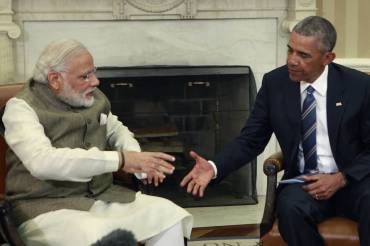
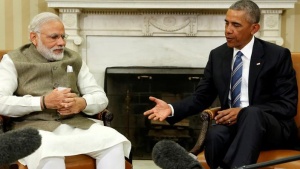
President Barack Obama welcomed Indian Prime Minister Narendra Modi to the White House for their seventh meeting since Modi took office in 2014, underscoring the warm relationship between the leaders and the world’s two largest democracies. Modi is to address the U.S. Congress on Wednesday.

“We discussed how we can, as quickly as possible, bring the Paris Agreement into force,” Obama told reporters. Climate change is a legacy issue for the U.S. president who leaves office in January.

India’s potential entrance into the agreement this year would help accelerate its enactment, perhaps years ahead of schedule. India is the world’s third-largest greenhouse gas emitter after China and the United States.

The two countries also welcomed preparations that could lead to the building of six nuclear reactors in India by U.S.-based Westinghouse, in what would be the culmination of some 10 years of work to resolve civil-nuclear issues.

The joint statement said India and the U.S. Export-Import Bank were working to complete a financing package for the project and that the Nuclear Power Corporation of India and Westinghouse had confirmed engineering and site design work would begin immediately.It said Westinghouse and the Nuclear Power Corporation of India would work toward finalizing the contract by June 2017 – a year later than Westinghouse’s chief executive, Daniel Roderick, said he hoped for in an interview with Reuters in late March.

Modi told an event organized by the U.S. India Business Council that relations between India and the United States were “closer than ever.” He said the planned reactor purchases would mark new era in nuclear and scientific cooperation.Modi’s address to a joint session of Congress will be a significant personal step. Although this has become a tradition for Indian prime ministers, he was once banned from the United States over massacres of Muslims.

More than 1,000 people, mostly Muslims, were killed in sectarian riots in Gujarat in 2002 when Modi had just become the state’s chief minister. Modi has denied any wrongdoing, and India’s Supreme Court in 2010 ruled there was no case.In the joint statement, the United States said it now recognized India as a “Major Defense Partner” and would work on technology sharing “to a level commensurate with that of its closest allies and partners.

“The text of a logistics agreement, which will allow the countries’ militaries to use each other’s land, air and naval bases, would be signed soon, a U.S. official said.

Tensions between the United States and Pakistan as well as regional concerns about China have served as a backdrop to increased security cooperation.Senator John McCain, chairman of the U.S. Senate Armed Services Committee, said the address to Congress was “entirely appropriate” given the new partnership.”

There’s no doubt there are significant tensions and challenges in the region, which argues for closer coordination between our militaries,” he said.While Modi is generally popular with U.S. lawmakers, they criticize what they see as lingering unfriendliness to U.S. firms and a stifling bureaucracy, in spite of Modi’s pro-business image. They also question New Delhi’s record on human rights.Modi got a boost on Tuesday when Amazon Inc AMZN.O Chief Executive Jeff Bezos said his company would invest an additional $3 billion in India, boosting its committed investment in the country to over $5 billion.

Source: In boost to Paris climate pact, India says it aims to join this year | Reuters

07/06/2016

Here’s How Indians Are Rating Narendra Modi’s Programs – India Real Time – WSJ

Two years into his five-year term, Indian Prime Minister Narendra Modi is asking his countrymen to rate a series of initiatives undertaken by his government.

Among the top scorers so far: an effort expand and modernize the railways and a program to build more roads. Toward the bottom of the favorability rankings: Mr. Modi’s Clean India campaign, which, among other things, aims to get people to use toilets instead of defecating outside.

Mr. Modi has become known for introducing a series of high-profile initiatives, from Make in India, which seeks to promote manufacturing, to pledges to build scores of so-called smart cities across the country.Of 21,770 respondents who had participated in the online survey on the government’s mygov.in website as of Tuesday morning, 70% gave a five-star rating to the government’s efforts to upgrade the rail system. People are asked to grade programs on a scale of one to five.

In the latest federal budget, the government earmarked $17 billion to improve the state-run railroad. Wi-Fi services are being rolled out at stations. And late last year, a deal was struck with Japan to help build India’s first high-speed rail line between Mumbai and Ahmedabad.

The government’s efforts to build more highways and improve the condition of roadways have also been popular with the people. More than 65% of the respondents to the survey gave these initiatives a five-star rating. The target this year is to build 9,300 miles of highways.People taking the survey also seemed satisfied by the government’s attempts to make electricity more accessible.

One of the worst performing programs, according to the current results of the survey, which is ongoing, is Swachh Bharat Abhiyaan, or the Clean India Mission. Only 33% of the respondents gave it a five-star rating. About 16% gave it score of one or two.

India’s Competitiveness and Prosperity Rankings Rise Under ModiIn October, a year into the program, another national survey also hinted at the public’s disappointment with its impact. More the 70% of those polled in that survey said the availability of public toilets hadn’t improved and their cities hadn’t become cleaner.

Mr. Modi is no stranger to crowdsourcing. He regularly encourages Indians to submit their thoughts for his weekly radio show. Prior to delivering his speech on India’s Independence Day last year, he asked citizens to submit their suggestions on what they’d like to hear him speak about. And they did, in hordes.

Source: Here’s How Indians Are Rating Narendra Modi’s Programs – India Real Time – WSJ

04/06/2016

Dam completion signifies growing Indian influence in Afghanistan | Reuters

Prime Minister Narendra Modi visited Afghanistan on Saturday to mark the completion of a nearly $300 million hydroelectric dam project, the latest symbol of Indian investment in its South Asian neighbour.

The dam, originally built in western Herat province in 1976 before being damaged during the civil wars of the 1990s, was rebuilt by some 1,500 Indian and Afghan engineers, according to the Indian Ministry of External Affairs.

“It is symbol of our friendship and would usher in hope, light up homes, nourish the fertile fields of Heart and bring prosperity to the people of the region,” Modi said in a social media post as he departed for Afghanistan, the first stop on a five-country trip.

Afghan President Ashraf Ghani has nurtured closer ties with India in the past year as relations with Pakistan have deteriorated in the face of continued insurgent attacks and border tensions.

Afghanistan has walked a fine line as it accepts Indian aid, with Pakistan historically wary of any Indian influence in Afghanistan.

Salma Dam is another big step in deepening and broadening the relationship between Afghanistan and India,” Ghani said in a post on Twitter.

At more than 100 metres (330 feet) high and 540 metres (1,770 feet) wide, the dam is designed to generate 42 megawatts of power and help irrigate 75,000 hectares of land, according to Modi.

India has poured more than $1 billion into Afghanistan reconstruction projects and humanitarian aid, making it one of the largest donors to the war-torn country.

A new national assembly building in Kabul and major power line and road construction have been among the main projects funded by India.

Source: Dam completion signifies growing Indian influence in Afghanistan | Reuters

31/05/2016

ONGC Videsh, Azerbaijan’s SOCAR look to jointly sell oil | Reuters

ONGC Videsh has signed a preliminary agreement with the trading arm of Azerbaijan’s state energy company SOCAR to look at jointly marketing crude oil, the company said in a statement on Tuesday.

OVL, the overseas assets acquisition arm of the country’s biggest explorer, Oil and Natural Gas Corp (ONGC), wants to leverage the experience of SOCAR Trading SA in oil marketing, it said.

Reuters had reported about the deal on Monday.

Source: ONGC Videsh, Azerbaijan’s SOCAR look to jointly sell oil | Reuters

27/05/2016

Southern comfort | The Economist

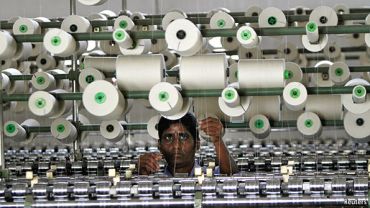
MAHATMA GANDHI would not have enjoyed Texfair 2016 in Coimbatore in the southern state of Tamil Nadu. The man hated machines and factories, and promoted Indian independence by urging every household to spin its own cotton yarn. But on display at the textile fair were bobbins, rollers, waste balers, quality-control sensors and much, much more.

Indeed, India is vying with China to be the world’s biggest producer of yarn, with over 45m spindles twirling around the clock. But what is striking about the trade fair is how so much of the modern wizardry on show is made not in better-known industrial centres around the world but in Coimbatore itself, a city of just 1.6m some 500 kilometres (310 miles) south-west of Chennai, the Tamil Nadu capital. In this section Pull the other one Taliban reshuffled Southern comfort Reprints Related topics Bharatiya Janata Party Tamil Nadu Kerala India

The fast-growing city is an inelegant sprawl stretching into groves of coconut palms. It teems with technical institutes, bustling factories and civic spirit. Earnest and ambitious, Coimbatore evokes the American Midwest of a century ago. A regional manufacturers’ group that was founded in 1933 during Gandhi’s homespun campaign has now designed, built and marketed a hand-held, battery-operated cotton picker that it claims is six times more efficient than human fingers.

Gandhi would have been appalled. But the gadget says something about the quiet success of parts of India’s deep south. Mill owners worry that with day wages in Tamil Nadu and neighbouring Kerala to the west now far higher than those in northern India, local cotton may grow uncompetitive. Tea planters in the hills west of Coimbatore are already squeezed. One landowner, in Kerala’s Wayanad region, where silver oaks shade trim ranks of tea bushes, says that his pickers get 300 rupees (about $4.50) a day, nearly three times the wage in Darjeeling in India’s north.

It may not sound like much, but it is also more than the average Indian earns. And as a whole, GDP per person in Tamil Nadu and Kerala is 68% and 41% higher respectively than the national average of $1,390 a year. With the south’s booming new industries, better education and higher wages contrasted with declining industries in the north and east, India is undergoing a shift a bit like the American one from the rustbelt to the sunbelt in the 1980s. Kerala shares in this new industrialisation less than Tamil Nadu, but that is balanced by another source of prosperity: remittances from abroad. As many as one in ten of Kerala’s 35m people work in the rich Arab countries of the Persian Gulf. Their remittances boost local incomes, property prices and demand for better schools. Kerala, under leftist governments for the past six decades, already has India’s best state education and its highest literacy rate. Its school district has again topped nationwide exams for 17-year-olds, followed by Chennai region, covering the rest of southern India.

Yet India’s deep south has not transmuted growing prosperity into greater political clout. It remains largely aloof from broader political trends, including a slugging match between the Bharatiya Janata Party (BJP), in office nationally under Narendra Modi, the prime minister, and Congress, the once-dominant centre-left party that worships Gandhi. In elections across four Indian states that wrapped up on May 19th, attention elsewhere focused largely on the fortunes of those two parties. The BJP’s capture from Congress of Assam in the north-east was seen as a big boost for Mr Modi. Congress’s failure to take any state was seen as a sign of decay.

Source: Southern comfort | The Economist

16/02/2016

First train from China to Iran stimulates Silk Road revival – Xinhua | English.news.cn

First cargo train from China to Iran arrived in Tehran on Monday, indicating a milestone in reviving the “Silk Road,” which has opened a new chapter of win-win cooperation between China and Iran.

English: the Silk Road in Central Asia

English: the Silk Road in Central Asia (Photo credit: Wikipedia)

silk road

The train, also referred to as Silk Road train, has passed through Kazakhstan and Turkmenistan to Iran, travelling a distance of 10,399 kilometers. It had left Yiwu city in east China’s Zhejiang Province on January 28.

This train was carrying dozens of cargo containers, according to the deputy of Iran’s Road and Urbanism Minister, Mohsen Pour-Aqaei, who made a welcome speech after the arrival of the cargo train at Tehran Train Station on Monday.

As known to all, ancient Silk Road trade route had served as an important bridge for East-West trade and brought a close link between the Chinese and Persian civilizations.

The “Belt and Road” initiative was raised by Chinese President Xi Jinping in 2013, which refers to the New Silk Road Economic Belt, linking China with Europe through Central and Western Asia, and the 21st Century Maritime Silk Road, connecting China with Southeast Asian countries, Africa and Europe.

“To revive the Silk Road Economic Belt, the launch of the train is an important move, since about 700 kilometers of trip has been done per day,” said Pour-Aqaei, who was present at the welcome ceremony of the train in Tehran’s Railway Station.

“Compared to the sea voyage of the cargo ships from China’s Shanghai city to Iran’s Bandar Abbas port city, the travel time of the train was 30 days shorter,” he said.

Pour-Aqaei, also the Managing Director of Iran’s Railway Company, added that according to the plan, there would be one such a trip from China to Iran every month.

The travel of cargo train from China to Iran is part of a Chinese initiative to revive the ancient Silk Road used by the traders to commute between Europe and East Asia.

Tehran will not be the final destination of these kinds of trains from China, the Iranian deputy minister said, adding that in the future, the train will reach Europe.

This will benefit Iran as the transit course for the cargo trains from the east Asia to Europe, he said.

Chinese ambassador to Iran Pang Sen told Xinhua that as one of the cooperation projects after Chinese President Xi Jinping’s state visit to Iran, the cargo train is playing a important role to promote construction of the “Belt and Road” initiative.

Meanwhile, the railway line from Yiwu to Tehran provides the two countries an express and efficient cargo trade transportation method, Pang said, adding that the countries along the railway line will furthur upgrade rail technology with the aim to make its transportation ability faster and better.

Source: First train from China to Iran stimulates Silk Road revival – Xinhua | English.news.cn

14/12/2015

Japan, India agree on rail, nuclear deal | The Japan Times

Tokyo and New Delhi agreed to major deals Saturday, including the introduction of Japan’s bullet train technology to India and an agreement on nuclear cooperation.

The bilateral accord was reached during talks in New Delhi between Prime Minister Shinzo Abe and his Indian counterpart, Narendra Modi. “This enterprise will launch a revolution in Indian railways and speed up India’s journey into the future. It will become an engine of economic transformation in India,” Modi said after the talks, referring to the introduction of Japanese shinkansen technology in building a high-speed railway in India. “This project befits the start of a new era for (ties between) Japan and India,” Abe said.

The two countries also agreed on a civil nuclear cooperation pact. Sensitive negotiations had continued for five years on exporting Japan’s nuclear power plant technology to India, with one of the sticking points being whether Japan could ensure that its nuclear technology would not be diverted for military use. India, despite being a de facto nuclear weapons state, has not joined the Nuclear Non-Proliferation Treaty. “Japan is promoting (nuclear) nonproliferation, given the history of Nagasaki and Hiroshima, while India is outside the NPT framework but wants to cooperate on nuclear power generation,” one Japanese official said while noting Japan is the only country to have suffered atomic bombings.

Deputy Chief Cabinet Secretary Koichi Hagiuda, who accompanied Abe on the visit, told reporters after the talks that Japan’s cooperation under the bilateral civil nuclear pact will stop if India conducts a nuclear test. The two projects were the main points of focus of Abe’s three-day visit to India, which began Friday. Japan is keen to tap into India, with its 1.2 billion population, and forge closer ties in light of China’s growing political and economic clout in the region. Under a policy to elevate bilateral ties to what they now call a “Special Strategic and Global Partnership,”

Abe and Modi plan to boost security cooperation between the two nations and exchange views on regional issues such as the situation in the South China Sea, Japanese officials said. While Japan and India are not directly involved in the tensions in the South China sea, a key shipping route for oil and other imports, they are both concerned over the freedom of navigation in international waters. China claims almost the entire South China Sea and has competing territorial claims with Vietnam, the Philippines, Brunei, Malaysia and Taiwan. Beijing’s fast-paced and massive land reclamation work has made the smaller Asian claimants uneasy. Seeing India’s potential value to Japan, both on the economic and political fronts, Abe has touted the importance of strengthening bilateral ties to help maintain peace and stability in Asia. Abe’s latest trip to India is his third visit as prime minister. The shinkansen technology will be applied to a planned 500-km-long high-speed railway that will link Mumbai and Ahmedabad in western India and take roughly two hours.

Japan, which is seeking to spur its economy through infrastructure exports to Asia, is looking to play catch-up after losing out to China in its bid to secure a key high-speed railway contract in Indonesia in October. Construction of the Indian railway project, which is estimated to cost 980 billion rupees ($14.6 billion), will begin in 2017, with the aim of starting operations in 2023. Japan has sounded out India about a plan for Tokyo to provide yen loans on the premise that the railway contract will be given to a consortium of Japanese firms, a Japanese government source said.

The two leaders also signed others pacts, including one that allows the transfer of defense equipment to India and another on data protection, which allows the exchange of defense-related information. The moves reflect Tokyo’s desire to forge closer ties with New Delhi due to China’s muscle-flexing.

When Modi visited Japan last year, Abe vowed to extend ¥3.5 trillion in public and private investment and financing to India over five years for development. Japan also pledged a ¥50 billion loan to India for a public-private partnership infrastructure project.

Source: Japan, India agree on rail, nuclear deal | The Japan Times

21/08/2015

China’s love for Chariot’s Of Fire hero Eric Liddell

A clutch of elderly Chinese pensioners, three Canadian women in their 70s and 80s and a British film star gathered in the courtyard of a school in the obscure industrial town of Weifang on Monday to witness the unveiling of a statue of a running man.

Statue of Scottish Olympic running hero Eric Liddel

The athlete immortalised in bronze in China is Eric Liddell, the legendary Olympian whose achievements were marked in the 1981 fi lm Chariots Of Fire.

The Canadians were there because Liddell was their father and the presence of the actor, Joseph Fiennes, was because he plays the Scottish sprinter in The Last Race, a new movie about his life to be released in March.

But why would the Chinese authorities be interested in venerating such a man? The truth is that Liddell is as much Chinese as he is Scottish.

Born in Tianjin in 1902 he went on to spend more than half his life in the country as an evangelical Christian missionary. And so while he is known as the Flying Scotsman in the UK in China he is remembered as the country’s first Olympic champion.

It is rare indeed that a person has the good fortune to meet a saint but he came as close to it as anyone I have ever known

Eight years before Beijing sent its first team to the Olympics, Liddell won a memorable gold medal in the 400m as part of the British team in the Paris Games of 1924. His victory was all the more poignant because he had been forced to pull out of his best event the 100m as soon as the timetable for the Games was announced.

Liddell, the son of Scottish missionaries, was such a devout Christian that he would not countenance breaking the Sabbath to take part in heats held on a Sunday. Aware this meant he wouldn’t be able to participate in the qualifying rounds for the sprint Liddell devoted all his energy to training for the 400m.

As he took to the starting blocks for the final a masseur with the American Olympic team is said to have slipped a piece of paper into his hand with the Book Of Samuel quotation: “Those who honour me I will honour.”

The fates were certainly on Liddell’s side that day.

He not only won but broke the existing Olympic and world records with a time of 47.6 seconds.

His sporting success did not divert him from his chosen course however and within a year he travelled to China to take up a posting as a missionary teacher in Tianjin’s Anglo-Chinese College, a school popular with the local elite.

The missionaries believed that by teaching Christian values to the children of the wealthy they might promote them later when they reached positions of influence.

Liddell also got involved in the sporting curriculum and even advised on the construction of Tianjin’s Minyuan Stadium.

He proposed an exact copy of the then football ground of Chelsea FC, said to have been his favourite running venue in the UK. He met and married a Canadian woman called Florence, also a child of missionaries, and they had daughters Patricia and Heather.

When Florence was pregnant with their third, war broke out and, with the Imperial Japanese Army sweeping through China, Liddell insisted she and the girls leave for Canada .

Typically Liddell refused to leave his beloved China in its hour of need and was interned and placed in a camp in Weifang, where he dedicated himself to the welfare of fellow inmates.

One of these, Langdon Gilkey, a 19-year-old American who went on to became a prominent theologian, said of Liddell: “Often I would see him bent over a chessboard or a model boat or directing some sort of square dance – absorbed, weary and interested, pouring all of himself into this effort to capture the imagination of penned-up youths.

“He was overflowing with good humour and love for life with enthusiasm and charm.

“It is rare indeed that a person has the good fortune to meet a saint but he came as close to it as anyone I have ever known.”

Liddell even turned down the opportunity to return to Britain after the prime minister Winston Churchill brokered a deal for his release. True to form Liddell arranged for a pregnant woman from the camp to take his place. His tireless efforts on behalf of both the children of the camp and the older generation took its toll to such an extent that in early 1945 he had to be admitted to the camp hospital.

A few days later he sat up in bed and wrote to his wife in Canada: “… was carrying too much responsibility… had slight nervous breakdown… much better after a month in hospital. Special love to you and the children, Eric”.

But in fact he was not much better. He had a brain tumour and within an hour of writing the note he was gone.

His friend and colleague Anne Buchan reported that he uttered the words, “It’s full surrender”, before lapsing into a coma from which he would never recover. He was just 43.

via China’s love for Chariot’s Of Fire hero Eric Liddell | History | News | Daily Express.

09/06/2015

China Headlines: How is the Chinese Dream changing the world? – Xinhua | English.news.cn

On the way toward the renaissance of its ancient glory, China is inspiring its people and the world with a new concept: the Chinese Dream.

Put forward by Xi Jinping, general secretary of the Communist Party of China (CPC) Central Committee, in November 2012, the Chinese Dream of Great Renewal has not only struck a chord with the Chinese people, but been, believe it or not, changing the world.

PROFOUND CHANGES IN CHINA, WORLD

The ancient Chinese civilization had a broad influence on the world. Now China is “coming back” as it is reemerging as a great power.

For this reason, many people began to read “Xi Jinping: The Governance of China”, a book that outlines the full political ideas of the top Chinese leadership.

Xi’s book has sold 4.5 million copies worldwide, with an overseas circulation of some 400,000, a record for any Chinese leader’s publication in nearly four decades.

It is becoming increasingly easy to pin down a definition of the Chinese Dream. On cabs and billboards, the Chinese Dream is described as “a prosperous country, a revitalized nation and a happy people”.

The Dream is also elaborated on as “two centenary goals” — to double the 2010GDPand per capita income of urban and rural residents and complete the building of a moderately prosperous society by 2020; and to build a modern socialist country that is prosperous, strong, democratic, culturally advanced and harmonious by the middle of this century.

If the development plan comes true, it will be one of the most earth-shaking developments since the First Opium War (1840-1842), not only for China but also for global history.

In a report published last year, London-based advertising company WPP said the Chinese Dream “enjoys a much higher level of awareness than the American Dream or British Dream.”

DREAMS OF 1.3 BILLION PEOPLE

China’s population outnumbers that of theUnited States, theEuropean UnionandJapancombined, accounting for about one fifth of the world’s total.

It is unprecedented in the history of human civilization for a country of such a scale to rejuvenate.

The Chinese Dream is the dream for every Chinese individual. In the Three Gorges reservoir region in central China’s Hubei Province, 35-year-old farmer Zhou Xingliang’s dream is quite ordinary: he wants his son to grow up healthy and go to a good college, and for he and his wife to be able to take good care of their parents.

Several hundred kilometers away, in Danjiangkou City, chicken farmer Tan Yong has different aspirations. Dreaming of inventing, the 44-year-old man made a two-tonne submarine with a red star painted on the cabin door. The sub can dive 10 meters below the water surface.

For the entrepreneurial Cantonese Zhang Qinwei, his dream of a “gold rush” in Dubai came true. In 12 years, Zhang expanded his business from a four-square meter shop to a wholesale mall of Chinese products.

As president of the Guangdong Chamber of Commerce in the United Arab Emirates, Zhang now dreams of helping more Chinese companies do businesses there.

via China Headlines: How is the Chinese Dream changing the world? – Xinhua | English.news.cn.

Law of Unintended Consequences

continuously updated blog about China & India

ChiaHou's Book Reviews

continuously updated blog about China & India

What's wrong with the world; and its economy

continuously updated blog about China & India