Posts tagged ‘Japan’

17/09/2014

Is China Ready to Step Up and Invest in India? – India Real Time – WSJ

While Chinese companies have been great at peddling their products in India, they have been surprisingly reluctant to invest here. China has invested less in India than even Poland, Malaysia or Canada have.

President Xi Jinping’s three-day visit to India starting Wednesday is likely to include some massive pledges to try to remedy this imbalance.

When Prime Minister Narendra Modi visited Japan recently, Japan pledged to invest $35 billion in India. President Xi is expected to try to eclipse Japan’s promises, possibly pledging $100 billion in investment according to some local reports. His meetings with Mr. Modi are predicted to lay the groundwork for a wave of Chinese money to build industrial parks and bullet trains.

Annual trade between India and China has galloped to $66 billion from $3 billion 14 years ago, something that underscores the rise of Beijing as the global manufacturing hub and India’s growing appetite for everything from phones to machinery from China.

While the trade relationship between the two countries has bloomed, foreign direct investment from China has not. According to Indian government statistics, the country has received a total of around $400 million from China in investment in the last 14 years. Even if you add the $1.2 billion of direct investment India received from Hong Kong, China is still well behind the $22 billion in foreign direct investment from the United Kingdom, $17 billion from Japan, $13 billion from the Netherlands and $1.9 billion from Spain.

It’s not that China doesn’t invest abroad. According to data from United Nations Conference on Trade and Development, China was the third biggest source of foreign direct investment last year, having invested more than $100 billion in other countries. In the seven years to 2012, it invested more than $25 billion in the 10 members of the Association of Southeast Asian Nations alone.

Chinese investment has tended to focus on the resources sector to power its economy. Much of it has gone into getting control of oil, natural gas and coal in Africa, Australia, Indonesia and elsewhere. India has not attracted much of this investment as it is a net importer of resources and has a heavily regulated energy sector, said Rajiv Biswas, economist for IHS.

“China wants to increase investment in India and wants Chinese companies on the ground there,” Mr. Biswas said. “Most of it will be in manufacturing and infrastructure space.”

Chinese companies may also be looking to move some of their manufacturing to India as they struggle with rising wages at home, said Ajay Sahai, director general and chief executive at Federation of India Export Organization.

If India can’t find better ways to fix its trade imbalance with China, New Delhi may want to increase taxes on some imports such as auto-components and pharmaceuticals to encourage Chinese companies to set up factories in India, he said.

“This will not only raise Chinese investment in India but also help in fixing the trade imbalance,” said Mr. Sahai.

via Is China Ready to Step Up and Invest in India? – India Real Time – WSJ.

17/09/2014

5 Things to Look Out for During Xi Jinping’s Visit to India – WSJ

Manan Vatsyayana/Agence France-Presse/Getty Images

1 INFRASTRUCTURE

Prime Minister Narendra Modi is looking for foreign capital and expertise to build “smart cities”, high-speed trains and modern airports of the kind that China has built for itself in the past decade. The two leaders are expected to sign a deal to bring bullet trains to India and may also reach an agreement for the building of world-class railway stations and airports.

2 INDUSTRIAL PARKS

The two countries laid the groundwork for Chinese investment in industrial parks in India when Indian Vice-President Hamid Ansari visited Beijing in June. Indian officials say they expect to ink deals worth $5 billion for two parks – one in the western state of Gujarat, Mr. Modi’s home state, and the other in Maharashtra. The idea is to make it easier for Chinese companies to set up shop in India.

3 BORDER TROUBLES

Territorial disputes that have long dogged Sino-Indian ties aren’t the focus of this visit, but are sure to come up. Two reports this week – one about an alleged incursion by Chinese troops in Ladakh and another about protests by Chinese civilians and troops against the construction of an Indian canal along the disputed border – have highlighted the unresolved issues. Even after 17 rounds of talks, no solution has emerged – don’t expect one during this visit either.

4 COMPETITION WITH JAPAN

Indian newspapers have been filled with anticipation about whether China will outdo its Asian rival, Japan, in promising investments for India. Earlier this month, Japan pledged to pour $35 billion into India over five years; China is expected to go further. Expect reams of analysis of Mr. Xi’s rapport with Mr. Modi. When Japanese Premier Shinzo Abe met Mr. Modi, they bear hugged.

5 BREAKING OUT OF THE MOLD

Officials have raised hopes of a “directional change” and an “orbital jump” in Sino-Indian ties, which have long been bogged down by bureaucratic mistrust. Trade relations have flourished in the past decade, but are skewed in China’s favor– and investments have remained very low. Experts are hoping Mr. Modi – who worked with Chinese as chief minister of Gujarat – will adopt a pragmatic approach to push for Chinese money. If he succeeds, the visit may set the stage for an era of economic collaboration between the two Asian giants.

via 5 Things to Look Out for During Xi Jinping’s Visit to India – WSJ.

17/09/2014

Will Chinese President Xi be able to compete with Japan’s Abe for India’s affections?

Any adjustments in the India-China-Japan triangle will have an impact all across Asia.

East Asia has eagerly set out to court New Delhi’s new government. That’s obvious from the spate of state visits that have taken place of late between India, China and Japan. Earlier this fortnight, Prime Minister Narendra Modi visited Japan. Today, Chinese President Xi Jinping’s begins his first official state visit to India. Trade, investment and infrastructure are the buzzwords on the road towards deepening ties.

The complexities of the India-China-Japan triangle are far too intricate to be spelt out in a simplistic fashion. Will trade and investment become the motive force that will fashion ties, more so at the cost of pressing strategic realities that appear conflicting at times? Going by the school of interdependent liberalism, states will be propelled to adopt a cooperative framework by economic symbiosis and the web of multilateral international institutions and frameworks.

In the case of China, India and Japan, while investments  have taken precedence, the competitive race is far too obvious. Last fortnight, Japanese Prime Minister Shinzo Abe announced that this country’s private and public investment in India will double to $34 billion over the next five years. Within a fortnight comes Xi Jinping with his administration’s plans to invest around $500 billion overseas in the next five years, with big-ticket investments coming India’s way likely to exceed $200 billion. It is being suggested that China could spend $35 billion merely on power and highway projects ‒ almost the same amount as Japan’s total investment in India.

Growing trade deficit

It is apparent that cooperation through economic considerations has its share of hidden problems. India continues to be hurt by  the growing trade deficit with China, which stood at a record $ 36 billion in 2013-’14. In fact, China accounted for more than 50% of India’s current account deficit in 2012-’13. Indian exports to its neighbour fell nearly 10% during that period.

By seeking economic and military clout, could China reject the liberal regional order and seek to replace it with its own Sino-centric Asian order? China’s much-debated rise is always under scrutiny, given its role as Asia’s largest economy and the fact that it is the No. 1 trading partner for almost 120 economies around the world.

More so, in the strategic sphere, are Asian nations, including India and Japan, prepared to recognise such an order? So profound is the presence, rise and status of the People’s Republic of China that one is often confronted with a debate whether a potential Asian century could actually become a Chinese century.

The Chinese government chose to downplay Modi’s earlier indirect reference to China during his visit to Japan, where he took a swipe at the “18th century expansionist mindset of some countries”. But the reaction of state-controlled Chinese media over Modi’s remark was noticeably irate. Chinese media fervently cautioned against any attempt by Tokyo to structure a united front against Beijing with New Delhi as its pivot. All this very palpably falls into the realist paradigm of international relations, which posits that states often find themselves in a zero-sum contest for power and influence, where the prevailing international power balance remains a key determinant of the region’s future stability and strategic order.

Geo-strategic realities

Realignments in any part of the India-China-Japan security triangle will have far-reaching impact all across Asia. It should be remembered that Xi Jinping’s address at the 18th Party Congress of the Chinese Communist Party in 2012 contained a reference to “rejuvenating China”, which has been interpreted as an oblique reference to “reclaiming lost historical territories”. This approach could well have a direct bearing on Japan and India, with whom China contests territories and borders.

On another level, the camaraderie between Modi and Shinzo Abe speaks volumes. Systemic conditions present a favourable platform for the duo to guide their countries to “… the dawn of a new era in India-Japan relations”, as they agreed to in the Tokyo Declaration last fortnight. Moreover, providing cement for this approach, Modi underlined the significance of India and Japan being democracies, which affords them a solid basis to converge at various levels on the Asian stage. As for the ties between China and Japan, there could not have been a worse time for relations between them, with the bitter contest over the East China Sea amidst a rising tide of nationalist sentiment against one another in both countries.

Whether Xi Jinping will manage to find success in making inroads into Delhi and buying a sizeable share of Indian attention is too early to say. However, one thing is for sure ‒ it will not happen at the cost of Japan.

via Scroll.in – News. Politics. Culture..

16/09/2014

Xi’s India visit highlights changing power dynamic – Businessweek

Chinese President Xi Jinping’s trip to India this week highlights subtle shifts in the regional power dynamic that are bringing warmer ties between the two Asian giants, challenging China’s traditional relationship with Pakistan, and opening a new chapter in Beijing’s ongoing competition for influence with arch-rival Japan.

Xi is due in New Delhi on Wednesday for a three-day visit focused on trade, investment and the resolution of decades-old border disputes. With the world’s second-largest economy and a proven track record at building highways, railways, and industrial zones, China has much to offer India as it seeks to upgrade its creaky infrastructure.

The visit is the latest sign of easing suspicions between the two huge countries — which between them have 2.6 billion people — dating from a month-long border war in 1962 that left around 2,000 soldiers dead. That conflict ended in a standoff with both sides accusing the other of occupying its territory.

Xi’s visit “will definitely enhance the bilateral political mutual trust,” Chinese Assistant Foreign Minister Liu Jianchao told reporters in Beijing last week.

While ties have been steadily growing for years, they’ve been given a major boost under new Indian Prime Minister Narendra Modi, who’s signaled he wishes to pursue a more vigorous foreign policy. Xi is the first Chinese head of state to visit in eight years, while the country’s prime minister, Li Keqiang, made India his first overseas visit shortly after taking office last year.

“Good relations with India are a key part of China’s regional strategy and Xi’s visit creates the opportunity for direct face-to-face communication on the problems that still exist, such as the border issue,” said Zhao Gancheng, Director of the Asia-Pacific Center of the Shanghai Institute for International Studies.

via Xi’s India visit highlights changing power dynamic – Businessweek.

11/09/2014

India and China in wary dance as Xi Jinping prepares for South Asia trip | South China Morning Post

Xi Jinping will start his first South Asia tour with a visit to Beijing’s latest investment in Sri Lanka, a US$1.4-billion port city development to include a marina and a Formula One track – all just 250km from India’s coast.

japan_denmark_tok332_45418663.jpg

The president’s trip to the site, next to a major Chinese-funded commercial port, will provide a vivid reminder of Beijing’s growing economic clout in India’s backyard ahead of his maiden visit to New Delhi next week.

Despite his hardline nationalist reputation, India’s Prime Minister Narendra Modi moved quickly to engage with traditional rival China after taking office in May, inviting Xi to India.

But he has also sought to stop India’s neighbours falling further into China’s embrace, choosing Bhutan and Nepal for his first foreign trips as prime minister and extending an olive branch of peace to arch-rival Pakistan.

That may not worry China too much. Modi’s close relationship with Tokyo, on the other hand, is likely to raise alarm bells in Beijing that analysts say he may be able to use to his advantage.

Indian Prime Minister Narendra Modi pictured in New Delhi earlier this month. Photo: EPA

Modi enjoys a particularly warm friendship with his Japanese counterpart Shinzo Abe, who welcomed him even as he was shunned by Western powers over claims he failed to stop deadly religious riots in Gujarat, the state he used to run.

Both India and Japan are wary of what many see as Beijing’s growing territorial assertiveness, and Washington is eager for them to step up their cooperation by way of counterweight to China.

“China is looking at India under Modi as a serious and credible partner as well as potential adversary.” POLITICAL ANALYST SHYAM SARAN

“China is concerned that we would get closer to Japan and to the US under Modi. They don’t want that to happen,” said Jayadeva Ranade, president of the Centre for China Analysis and Strategy in New Delhi.

via India and China in wary dance as Xi Jinping prepares for South Asia trip | South China Morning Post.

05/09/2014

Australia to sign uranium export deal with India – Businessweek


Embed from Getty Images

Australia’s Prime Minister Tony Abbott met with his Indian counterpart Friday on a two-day state visit during which they are expected to sign a deal to allow the export of Australian uranium to India for use in power generation.

The agreement is expected to be signed Friday evening. Australia, which has almost a third of the world’s known uranium reserves, imposes strict conditions on uranium exports and India’s failure to sign the Nuclear Non-proliferation Treaty had long been a barrier to a trade deal.

Australia and India have been negotiating a nuclear safeguards agreement with verification mechanisms since 2012, when a former Australian government agreed on civil nuclear energy cooperation with India that would eventually allow the export of Australian uranium to the energy-starved South Asian nation.

India faces chronic shortages of electricity and about 65 percent of its installed power generation capacity comes from burning fossil fuels including oil, coal and natural gas. India is eager to expand its nuclear power capacity.

Australia’s decision to sell uranium to India follows a civil nuclear agreement with the United States. The deal with the U.S. was signed in 2008 and allowed Washington to sell nuclear fuel and technology to India without it giving up its military nuclear program.

India is seeking a similar agreement with Japan. The two sides have claimed “significant progress” but failed to reach a last-minute agreement on safeguards sought by Tokyo when the Indian Prime Minister Narendra Modi was in Japan earlier this month.

via Australia to sign uranium export deal with India – Businessweek.

05/09/2014

Modi’s first 100 days looked more like Manmohan’s than Vajpayee’s

The new prime minister hasn’t faced a major crisis or unveiled a startlingly new policy.

For the last week, Indian newspapers, channels and websites have been plastered with evaluations of Narendra Modi’s first 100 days. From dedicating entire editions to the 100-day landmark to building complex timelines describing every policy announcement over the last three months (and even comparing what has been achieved to the Bharatiya Janata Party’s campaign promises), there has been so much content that it’s hard to arrive at a conclusion about whether Modi’s Prime Ministership has been good or bad.

That might be expected, considering the scale of the challenge that the new government has set for itself. Alternatively, it might also be surprising: many expected Modi Sarkar to be a hate-it-or-love-it administration, rather than one that would leave people with lukewarm feelings.

Another way to approach the question might be to try and figure out how Modi’s first 100 days will be remembered. The first few months of new governments can often set the tone for what is to come. In hindsight, the trends picked up in the first days are then grafted on to narratives that are applied to entire tenures.

A look back at previous prime ministers might give us an inkling of how this will play out.

via Scroll.in – News. Politics. Culture..

04/09/2014

India and Japan Are a Perfect Fit – India Real Time – WSJ

Indian Prime Minister Narendra Modi’s visit to Japan will generate headlines for the big deals that he does (or doesn’t) conclude with his Japanese counterpart Shinzo Abe. These include civil nuclear cooperation, high-speed rail construction and defense ties.

However, the bilateral relationship ultimately depends on thousands of smaller commercial deals. If the two leaders set the tone and clear away obstacles, the India-Japan partnership can become the driver of Asia’s growth. Mr Modi said on this visit that Japan and India bear a ‘huge responsibility’ to define the path of Asian growth in the 21st century.

The two powers are complementary on several levels, but primarily in the economic realm. Japan has the largest growth problem in the world while India has the largest development problem.

There is no clearer example of this than India’s need for new roads, railways and ports. The Reserve Bank of India has defined India’s key economic problem as a supply-side deficit; demand is abundant, at times rampant, but supply responses are reduced by the unavailability and cost of capital, alongside logistics bottlenecks. The result is higher inflation and lower growth.

Japan can provide the solution in the form of capital and technology. Tokyo is a partner in the $90 billion Delhi-Mumbai Industrial Corridor which will create new “smart cities,” seven of which have started construction. Some 100 more are planned nationwide. This initiative has already yielded the Delhi Metro, built under budget and within schedule with Japanese loans and rolling stock.

via India and Japan Are a Perfect Fit – India Real Time – WSJ.

04/09/2014

Japan PM Abe appoints China-friendly lawmakers to key posts | Reuters

Japanese Prime Minister Shinzo Abe picked two veteran lawmakers with friendly ties to China for top party posts on Wednesday in an apparent signal of hope for a thaw in chilly ties with Beijing and a summit with Chinese leader Xi Jinping.

Japan's Prime Minister Shinzo Abe walks into the Prime Minister's official residence in Tokyo September 3, 2014.  REUTERS/Yuya Shino

The change in executives in Abe’s Liberal Democratic Party (LDP) is part of a broad leadership rejig, including a cabinet reshuffle, aimed at strengthening party unity and polishing Abe’s image 20 months after he surged back to office.

In a move welcomed by Tokyo stock market players, Abe drafted Yasuhisa Shiozaki, 63, a proponent of an overhaul of Japan’s Government Pension Investment Fund (GPIF), to head the ministry of labor, health and welfare, which oversees GPIF.

The fund is finalizing plans to boost the weighting of domestic stocks in its portfolio.

Abe also gave women almost a third of the posts in his 18-minister cabinet to show his commitment to promoting women as part of his “Abenomics” growth strategy.

But he retained core cabinet members such as Chief Cabinet Secretary Yoshihide Suga, Finance Minister Taro Aso, 73, Economics Minister Akira Amari, 65, and Foreign Minister Fumio Kishida, 57, signaling policy continuity.

Abe’s new line-up faces a number of challenges, including how to repair ties with China that have been frayed by rows over disputed territory and Japan’s wartime history, and whether to go ahead with a planned sales tax rise next year despite signs the economy is faltering.

via Japan PM Abe appoints China-friendly lawmakers to key posts | Reuters.

03/09/2014

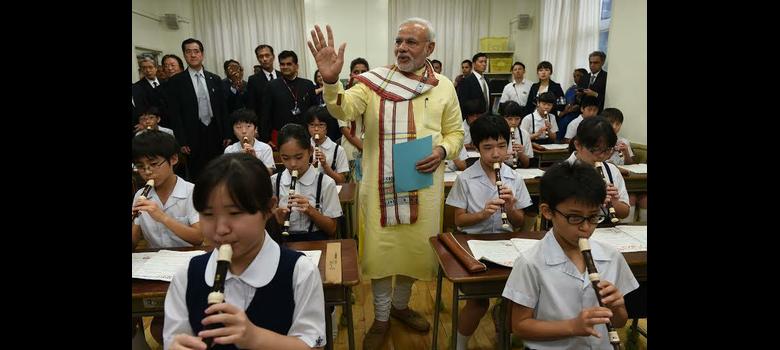
These photos show what Modi did in Japan when he wasn’t attending to business

All prime ministers enjoy spending time abroad, especially if it is while visiting a particularly friendly ally.

Prime Minister Narendra Modi isn’t exactly the jovial type. Sure, he peppers his speeches with a bit of light humour occasionally, but he doesn’t seem like the kind of person who would enjoy a comedy night on television. So what could possibly make him really happy? The same thing that makes heads of states happy all over the world: leaving their own countries to visit friendly allies.

And by any measure, it seems like Modi managed to have a blast in Japan (even if no nuclear deal was signed). Since he also happens to be the Selfie Era Prime Minister, every moment of this fun journey was documented and promptly tweeted by the prime minister’s official twitter account.

more photos from:  http://scroll.in/article/677092/These-photos-show-what-Modi-did-in-Japan-when-he-wasn’t-attending-to-business

Law of Unintended Consequences

continuously updated blog about China & India

ChiaHou's Book Reviews

continuously updated blog about China & India

What's wrong with the world; and its economy

continuously updated blog about China & India