Posts tagged ‘Kathmandu’

14/12/2016

Pop-Up Restaurant at Everest Base Camp Aims for Peak of Fine Dining – India Real Time – WSJ

Chefs are trekking thousands of feet to prepare fancy food in the cold

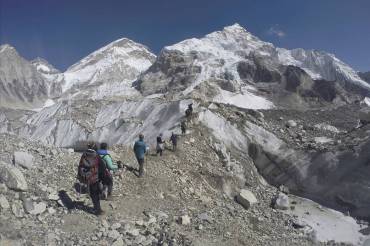
Trekkers pass through a glacier at the Mount Everest base camp, Nepal.

The peaks of fine dining just keep getting higher and higher.

A caravan of roving chefs and their 15 guests is currently making its way up the Himalayas toward the base camp at Mount Everest, where, 17,500 feet above sea level and amid the lashing winds and bone-penetrating chill of the Nepalese winter, food will be served.

The One Star House Party, as the project has been dubbed, is preparing 16 more such destination dining experiences, one a month, through 2018, though not all of the destinations are so extreme. Among the chefs involved is James Sharman, a onetime chef de partie at Noma, the influential, soon-to-close restaurant that put Copenhagen on the global culinary map.

The Nepal journey is costing its participants $1,050 each. Down jackets and sleeping bags are included. The group didn’t immediately respond to a request for the menu.

Everest Base Camp is, literally, a trek. Not a quick one, either. The group first flew from Nepal’s capital of Kathmandu to the tiny airstrip at Lukla, undertaking one of the most treacherous landings on the planet. From there they are walking, helped by porters, who are presumably carrying more than the usual amount of kitchen gear on their backs. Most travelers are advised to spend more than a week making their way up to base camp, to allow their bodies to adjust to the altitude.

On the way, the chefs have been collecting local flora for their mountaintop pantry.

Everest Base Camp is no stranger to haute cuisine. Adventurers scaling the great mountain with some of the more full-service expedition companies can enjoy sushi, pork chops and Peking duck alongside their protein bars and instant noodles. A few years ago Glenfiddich sponsored a whiskey tasting there, billed as the world’s highest, that was broadcast live online.

For more earthbound eaters in South Asia, there will be at least one more chance to join the One Star House Party. Their next destination, slated for January, is Mumbai. Reservations aren’t yet being taken.

Source: Pop-Up Restaurant at Everest Base Camp Aims for Peak of Fine Dining – India Real Time – WSJ

20/02/2016

Leaders of Nepal and India mend fences after friction | Reuters

The leaders of Nepal and India have overcome mutual misgivings, India’s foreign secretary said on Saturday, after talks to ease tensions over Nepal’s recently-adopted constitution.

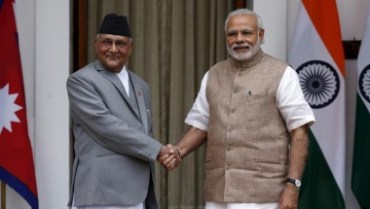
Nepal's Prime Minister Khadga Prasad Sharma Oli (L) shakes hands with his Indian counterpart Narendra Modi during a photo opportunity ahead of their meeting at Hyderabad House in New Delhi, India, February 20, 2016. REUTERS/Adnan Abidi

Prime Minister K.P. Oli visited New Delhi for talks with his Indian counterpart Narendra Modi after a months-long freeze in relations triggered by the grievances of plains dwellers in southern Nepal who have close historical ties to India.

Nepal, which moved from absolute to constitutional monarchy in 1990, made changes to its constitution to ensure greater participation of the Madhesi community in parliament.

But community leaders said the amendments failed to address their central fear that provincial borders would be redrawn in a way that would divide them.

“Our prime minister appreciated the progress made towards consolidation of constitutional democracy in Nepal,” Indian Foreign Secretary Subrahmanyan Jaishankar told a news briefing.

Source: Leaders of Nepal and India mend fences after friction | Reuters

21/05/2015

Watch Indian Fighter Jet Land on Highway to Taj Mahal – India Real Time – WSJ

The Indian Air Force on Thursday landed a fighter jet on an expressway for the first time to showcase its ability to use national highways as runways in case of conflict.

The Mirage-2000 jet landed on a cordoned-off stretch of the Yamuna Expressway that leads to Agra, the home of the Taj Mahal.

Test landing of a Mirage 2000 fighter jet of the Indian Air force on the Yamuna Expressway near Delhi on Wednesday. India’s Ministry of Defence

The single-engine, single-seater combat plane is produced by Dassault Aviation SA of France. It can reach a top speed of 2,495 kilometers, or 1,550 miles an hour.

The jet took off from an undisclosed air base in central India. Facilities such as a makeshift air traffic control center, safety services, rescue vehicles, bird clearance parties were set up in coordination with local agencies for its landing.

The air force has “plans to activate more such stretches on highways in the future,” the Ministry of Defence said in a statement.

The Mirage-2000 strike aircraft is a critical part of India’s fighter jet fleet. Its flying qualities and maneuverability came into prominence during the bombing of Pakistani positions in the Himalayas during the Kargil war in 1999.

India’s air force fleet however comprises mainly Russian-origin aircraft such as the Sukhoi and MiG planes.

via Watch Indian Fighter Jet Land on Highway to Taj Mahal – India Real Time – WSJ.

15/12/2014

China Breaks India Monopoly on Nepal Economy as Investment Grows – Businessweek

In the dusty outskirts of Kathmandu, south of the Himalayan mountain range that holds the world’s highest peaks, Chinese engineers in orange hard hats oversee construction of Nepal’s first eight-lane highway.

Highway Construction

The $45 million upgrade of a road circling the Nepalese capital is one of dozens of projects helping China challenge India’s dominance in a country that is sandwiched between them. Until recently, the Himalayas served as a natural barrier that prompted Nepal to trade more across its flat border with India.

“China is growing in importance,” Ram Sharan Mahat, Nepal’s Finance Minister, said in a Dec. 4 interview in Kathmandu. “Because of new trade horizons and the cheap pricing of Chinese goods, Chinese trade vis-a-vis Nepal is growing.”

via China Breaks India Monopoly on Nepal Economy as Investment Grows – Businessweek.

02/12/2014

South Asia’s hydro-politics: Water in them hills | The Economist

IT IS a thrill trekking beside the upper Marsyangdi river in northern Nepal. On view are spectacular waterfalls and cliffs, snowy Himalayan peaks, exotic birds and butterflies. But just where tourists and villagers delight in nature, hydropower engineers and economists have long been frustrated; in such torrents they see an opportunity that for too long has been allowed to drain away.

Himalayan rivers, fed by glacial meltwater and monsoon rain, offer an immense resource. They could spin turbines to light up swathes of energy-starved South Asia. Exports of electricity and power for Nepal’s own homes and factories could invigorate the dirt-poor economy. National income per person in Nepal was just $692 last year, below half the level for South Asia as a whole.

Walk uphill for a few hours with staff from GMR, an Indian firm that builds and runs hydropower stations, and the river’s potential becomes clear. An engineer points to grey gneiss and impossibly steep cliffs, describing plans for an 11.2km (7-mile) tunnel, 6 metres wide, to be blasted through the mountain. The river will flow through it, before tumbling 627 metres down a steel-lined pipe. The resulting jet—210 cubic metres of water each second—will run turbines that at their peak will generate 600MW of electricity.

The project would take five years and cost $1.2 billion. It could run for over a century—and produce nearly as much as all Nepal’s installed hydropower. Trek on and more hydro plants, micro to mighty, appear on the Marsyangdi. Downstream, China’s Sinohydro is building a 50MW plant; blasting its own 5km-long tunnel to channel water to drive it. Nearby is a new German-built one. Upstream, rival Indian firms plan more. They expect to share a transmission line to ill-lit cities in India.

GMR officials in Delhi are most excited by another river, the Upper Karnali in west Nepal, which is due to get a 900MW plant. In September the firm and Nepal’s government agreed to build it for $1.4 billion, the biggest private investment Nepal has seen.

Relations between India and Nepal are improving. Narendra Modi helped in August as the first Indian prime minister in 17 years to bother with a bilateral visit. Urged by him, the countries also agreed in September to regulate power-trade over the border, which is crucial if commercial and other lenders are to fund a hydropower boom. Mr Modi was back in Kathmandu for a summit of the South Asian Association for Regional Co-operation, on November 26th and 27th. Governments think the normally rudderless body could find a purpose in energy integration—though the talks were poisoned by poor relations between Pakistan and India. Another big Indian hydro firm agreed with Nepal’s government, on November 25th, to build a 900MW hydro scheme, in east Nepal, known as Arun 3. Research done for Britain’s Department for International Development suggests four big hydro projects could earn Nepal a total of $17 billion in the next 30 years—not bad considering its GDP last year was a mere $19 billion.

All Nepal’s rivers, if tapped, could feasibly produce about 40GW of clean energy—a sixth of India’s total installed capacity today. Add the rivers of Pakistan, Bhutan and north India (see map) and the total trebles.  Bhutan has made progress: 3GW of hydro plants are to be built to produce electricity exports. The three already generating produce 1GW out of a total of 1.5GW from hydro. These rely on Indian loans, expertise and labour.

Why a Himalayan cross-border hydropower rush now? In Nepal projects were once scuppered by local politics, a ten-year civil war, suspicion of India and a lack of regulation that put off creditors. Slowly, such problems are being tackled. The war ended in 2006. It helps, too, that the terms of the projects look generous to the host. For Upper Karnali, GMR will set aside 12% of electricity production, free, for Nepali consumers. It will also give Nepal a 27% stake in the venture. After 25 years of operation the plant will be handed to Nepal.

A second reason, says Raghuveer Sharma of the International Finance Corporation (part of the World Bank), was radical change that opened India’s domestic power market a decade ago. Big private firms now generate and trade electricity there and look abroad for projects. India’s government also presses for energy connections over borders, partly for the sake of diplomacy. There has even been talk of exporting 1GW to Lahore, in Pakistan—but fraught relations between the two countries make that a distant dream.

via South Asia’s hydro-politics: Water in them hills | The Economist.

28/11/2014

Narendra Modi woos Saarc nations, pledges slew of investments to counter China – The Times of India

India pledged a slew of regional investments at Saarc summit this week, seeking to counter China’s growing economic inroads into its backyard as it remains embroiled in bitter rivalry with Pakistan.

Prime Minister Narendra Modi said South Asia‘s largest economy would fund regional infrastructure, health facilities and even a communications satellite, and promised to free up its markets to exporters in smaller countries in the region.

Modi, who won a landslide election victory in May, has made clear that boosting India’s influence in its immediate neighbourhood is a key strategic priority for his government.

Critics say the previous Congress party government began to take relationships for granted, allowing economic giant China — which shares a border with four of India’s neighbours — to step into the breach.

But the failure of the South Asian Association for Regional Cooperation (Saarc) to make any significant progress during a two-day meeting underscored the scale of the challenge New Delhi faces.

Cross-border trade among the eight Saarc nations — Afghanistan, Bangladesh, Bhutan, India, Nepal, the Maldives, Pakistan and Sri Lanka — still accounts for less than five percent of total commerce in the region.

“Indians want to keep South Asia as their exclusive sphere of influence,” said Sreeram Chaulia, dean of the Jindal School of International Affairs in Delhi.

“To do that… we need to play the economic game and we need to play the connectivity game better. We have been protectionist, and that is not good,” he said, welcoming Modi’s pledge to help smaller nations reduce their trade deficits with India.

Leaders signed just one agreement, on energy cooperation, at a summit that was overshadowed by the rivalries between India and Pakistan, leading host country Nepal’s Prime Minister Sushil Koirala to say that Saarc had fallen short of expectations.

Nepal, long under the political influence of New Delhi, has benefited hugely from China’s bounty over the last decade, getting much-needed new roads and other infrastructure. Even the venue where the leaders met was built with Chinese money.

It is among several Saarc nations including Pakistan and Sri Lanka that reportedly support full membership for China, which currently enjoys observer status in the regional grouping.

India has resisted promoting its regional rival to full membership status, which comes with the power to veto agreements.

Frustrated by the slow pace of progress towards regional cooperation, it has also sought to woo its neighbours outside the Saarc framework.

via Narendra Modi woos Saarc nations, pledges slew of investments to counter China – The Times of India.

27/11/2014

South Asia Summit Nearing Failure as India, Pakistan Bicker – Businessweek

South Asian leaders overseeing a quarter of the world’s people struggled to agree on how to ease trade barriers in the region as India and Pakistan continued a decades-long row over a disputed border.

Pakistani Prime Minister Nawaz Sharif

Indian Prime Minister Narendra Modi was scheduled to meet every regional leader except Pakistani Prime Minister Nawaz Sharif for a one-on-one meeting during a gathering in Nepal starting today. Leaders of the South Asian Association for Regional Cooperation, or SAARC, last held a summit in 2011.

Failure to agree on cross-border travel and electricity supply would risk derailing Modi’s plan to turn the bloc into a regional force that can counter China’s growing influence. Chinese leaders have promised to invest part of a $40 billion Silk Road fund on infrastructure in South Asia.

via South Asia Summit Nearing Failure as India, Pakistan Bicker – Businessweek.

27/11/2014

China looms over South Asian summit in the Himalayas | Reuters

When eight South Asian leaders gather for a summit in Kathmandu on Wednesday, they will meet in a conference center donated by China to its cash-strapped Himalayan neighbor Nepal 27 years ago.

Prime Minister Narendra Modi watches a guard of honour upon his arrival for the 18th South Asian Association for Regional Cooperation (SAARC) summit in Kathmandu November 25, 2014. REUTERS/Navesh Chitrakar

In the decades since it built the modernist brick and glass hall, China has massively stepped up its presence in South Asia, supplying ports, power stations and weapons.

China’s advance has been aided by bickering between India and Pakistan that stymies almost all attempts at integration in a region that is home to a fifth of the world’s population but has barely any shared roads, fuel pipes or power lines.

India’s Prime Minister Narendra Modi has not welcomed Beijing’s renewed suggestion its status be raised from “observer” in the South Asian Association for Regional Cooperation (SAARC), in which India is presently the only major power.

SAARC summits bring together leaders from Afghanistan, Bangladesh, Bhutan, India, the Maldives, Nepal, Pakistan and Sri Lanka.

Modi’s hope of using the group as a counterweight to China is unlikely to gain traction at the two-day Kathmandu meeting, with officials saying Pakistan is blocking deals to increase transport and energy connections.

Pakistan mooted the idea of upgrading China’s and South Korea’s status in the organization at a meeting of SAARC foreign ministers on Tuesday. It was quickly rebuffed by India.

via China looms over South Asian summit in the Himalayas | Reuters.

25/11/2014

Nepal to ink India power deal during Modi visit – Businessweek

Nepal’s government is signing an agreement Tuesday with an Indian company to build a hydroelectricity plant that will export power to India and also boost supplies in the energy starved Himalayan nation.

The inking of the deal with Indian company Satluj Jal Vidyut Nigam Ltd. to build the 900 megawatt Arun III hydropower station will coincide with Indian Prime Minister Narendra Modi‘s visit to Nepal for a South Asian regional summit.

The $1.04 billion project is expected to begin producing electricity in 2020. More than three quarters of its output will be exported to India, said Ghanashyam Ojha, external affairs official at the Investment Board Nepal.

The Arun III agreement, which was endorsed by Nepal’s Cabinet late Monday, comes just two months after a similar deal with another Indian company.

They are the two biggest private foreign investments in Nepal, and put India ahead of neighboring China, which has long shown interest in developing Nepal’s power industry.

In September, Nepal signed an agreement with Indian company GMR to build the $1.15 billion Upper Karnali Hydro power plant.

via Nepal to ink India power deal during Modi visit – Businessweek.

14/04/2013

* China Makes Inroads in Nepal, Stemming Tibetan Presence

NY Times: “The wind-scoured desert valley here, just south of Tibet, was once a famed transit point for the Tibetan yak caravans laden with salt that lumbered over the icy ramparts of the Himalayas. In the 1960s, it became a base for Tibetan guerrillas trained by the C.I.A. to attack Chinese troops occupying their homeland.

Prayer wheels at a temple in the Mustang area of Nepal. The Chinese are trying to restrain the flow of disaffected Tibetans fleeing to Nepal and to enlist the help of the Nepalese authorities.

These days, it is the Chinese who are showing up in this far tip of the Buddhist kingdom of Mustang, northwest of Katmandu, Nepal. Chinese officials are seeking to stem the flow of disaffected Tibetans fleeing to Nepal and to enlist the help of the Nepalese authorities in cracking down on the political activities of the 20,000 Tibetans already here.

China is exerting its influence across Nepal in a variety of ways, mostly involving financial incentives. In Mustang, China is providing $50,000 in annual food aid and sending military officials across the border to discuss with local Nepalese what the ceremonial prince of Mustang calls “border security.”

Their efforts across the country have borne fruit. The Nepalese police regularly detain Tibetans during anti-China protests in Katmandu, and they have even curbed celebrations of the birthday of the Dalai Lama, the Tibetan spiritual leader, according to Tibetans living in Nepal.

via China Makes Inroads in Nepal, Stemming Tibetan Presence – NYTimes.com.

Law of Unintended Consequences

continuously updated blog about China & India

ChiaHou's Book Reviews

continuously updated blog about China & India

What's wrong with the world; and its economy

continuously updated blog about China & India