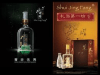
IN THE the heart of old Shanghai is a magnificent villa that serves as the workplace of Guo Jingming, a provocative young film-maker. “Tiny Times”, his recent blockbuster, follows the travails of some fashionable college girls (pictured, in the walk-in closet of one of them). Its depictions of the high life, rarely shown in Chinese films, have set social networks ablaze; they have also been attacked by the People’s Daily for “unconditional hedonism”. Mr Guo says: “So what? Materialism is neutral, neither positive nor negative.” After all, he goes on, China’s cosmopolitans know at any given moment what movies are playing in New York and what fashions are on the Paris runways.

China’s once-drab and Mao-suited interior is not so far behind. In Mianyang, a middling city in the province of Sichuan, an enormous billboard featuring Miranda Kerr, an Australian supermodel, draped in Swarovski crystals welcomes shoppers to the Parkson shopping mall. It is one of half a dozen high-end malls in town. Luxury sales are exploding there. Local Audi and BMW dealers sell more than 100 cars each a month; Land Rover, Jaguar and Cadillac have just muscled in on the market.
Thirty kilometres (20 miles) away in Luxi, a town of 57,000 people, online shopping is hot. The first express-delivery office opened only three years ago, and handled perhaps ten packages a day; today, there are five, each handling 100 packages a day. Even 60km away, in rural Santai county where farm-workers are the customers, one modern shopping mall has sprung up and another is being built. “Customers are evolving very quickly from the low-end market to the middle and high-end,” says Yang Shuiying, proud general manager of the Zizhou shopping centre.
In the 1950s and 1960s the world economy was transformed by the emergence of the American consumer. Now China seems poised to become the next consumption superpower. In all likelihood, it has just overtaken Japan to become the world’s second-biggest consumer economy. Its roughly $3.3 trillion in private consumption is about 8% of the world total, and it has only just begun.
“The future of the world will be profoundly shaped by China’s rush toward consumerism,” says Karl Gerth, an expert on Chinese consumption at the University of California, San Diego. Although investment made the biggest contribution to China’s growth last year, and although private consumption’s share of output, now at 36%, fell between 2000 and 2010, that trend is unlikely to last, for several reasons.
First, boosting the people’s desire to consume is a stated goal of China’s leaders. Higher government spending on health care and pensions may encourage households to save less for such things. Higher interest rates may, paradoxically, discourage thrift if people reach their savings goals faster. Rising wages and an ageing population will also shift the balance towards consumption rather than saving. And although household debt is growing fast, China still has relatively little.
Besides, consumption has not fallen in absolute terms. It has, in fact, grown briskly—just not quite as quickly as the economy overall. In dollar terms, China contributed more than any other country to the growth in global consumption in 2011-13, according to Andy Rothman of CLSA, a broker. Moreover, China’s official statistics understate some consumption—spending on housing, for example.
A massive push to urbanise is also under way, which should produce tens of millions of richer citizens seeking retail therapy. McKinsey, a consultancy, forecasts that consumption by urban Chinese households will increase from 10 trillion yuan in 2012 to nearly 27 trillion yuan in 2022
via Chinese consumers: Doing it their way | The Economist.





 CHINDIA ALERT: You'll be living in their world, very soon