Posts tagged ‘Line of Actual Control’

23/03/2015

India and China Talk About Their Disputed Border – India Real Time – WSJ

Indian and Chinese officials are meeting in New Delhi this week for talks on a border dispute that has for decades strained relations between the neighbors — the first such negotiations since Indian Prime Minister Narendra Modi took office last year.

The two Asian countries are separated by a nearly 2,200-mile border whose exact location is a subject of bitter dispute. China claims India’s northeastern state of Arunachal Pradesh, which it calls southern Tibet. India claims a Chinese-controlled region it calls Aksai Chin as part of its northernmost state of Jammu and Kashmir.

India periodically accuses Chinese troops of “transgressions” across the two countries’ ill-defined boundary, known as the Line of Actual Control. Officials on both sides say such incidents are likely to continue – and perhaps escalate as India further develops its border lands – until the boundary is properly marked and settled.

The dispute cast a shadow over Chinese President Xi Jinping’s visit to India last year – and on Mr. Modi’s efforts to improve relations with China. As Mr. Xi held his first official talks with Mr. Modi in September last year, their countries’ armies were locked in a tense face-off in the Himalayan region of Ladakh. Roughly 1,000 troops were called in on both sides, making it the biggest border confrontation between the two nations in decades.

Such episodes have interfered with the two countries’ efforts to deepen commercial relations as India seeks foreign investment to modernize its infrastructure. Mr. Modi is scheduled to visit China in May as part of those efforts.

Talks this week between China’s representative on the boundary question, Yang Jiechi, and India’s national security advisor, Ajit Doval, are aimed at giving momentum to the border talks.

Indian analysts say China may be more willing to negotiate given Mr. Modi’s steps to strengthen India’s ties with the United States. Mr. Modi visited the White House last year and U.S. President Barack Obama traveled to India to review a symbolically important military parade in January, signaling a willingness on India’s part to move closer to Washington.

But, Indian officials said, it won’t be easy. “It is an incredibly difficult problem if you look at the amount of real estate at stake and the length of the border,” said a senior official at the foreign ministry, who declined to be named.  The Indian government’s approach, the official said, is “let’s not let it drift.”

via India and China Talk About Their Disputed Border – India Real Time – WSJ.
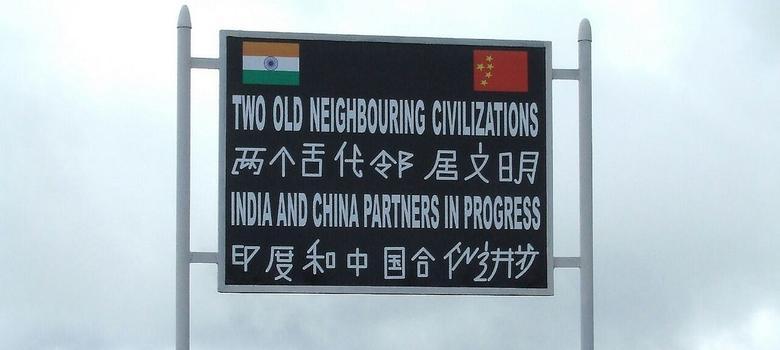
30/09/2014

Stand-off continues, Chinese army refuses to withdraw from Chumar


The standoff between the Indian Army and their Chinese counterparts continued on Monday at the Chumar sector in eastern Ladakh, along the Line of Actual Control. At one of the eight spots in the Chumar sector, the Indian Army made a tactical retreat in the face of a heavy Chinese presence. Despite diplomatic interventions on Monday, both sides continue to hold their tactical positions against each other. The standoff has continued primarily because of China’s unwillingness to stop its road-building exercise to the Line of Actual Control and India’s refusal to demolish structures built in the area to shelter troops.

via Scroll.in – News. Politics. Culture..

20/09/2014

To engage with China, India must stop peddling myths about the Line of Actual Control

Nehru’s hubris about his own statesmanship, coupled with a refusal to discuss the matter reasonably since 1962, has led us to the present tangle.

Political commentators have been gushing over the possibilities of strengthened economic and strategic relations between China and India, but the unresolved border dispute remains alive and can always play spoiler in the future. A border is, after all, more than a line on the map or a series of military posts on the ground; it is a reflection of how the political elite of a nation-state thinks about its security.

Chinese-controlled Aksai Chin is claimed by India as part of Jammu and Kashmir, and Indian-controlled Arunachal Pradesh is claimed by China. The only feasible solution is to accept the status quo and transform the Line of Actual Control into an international boundary. There have been several rounds of talks since the 1990s, but a resolution remains distant. Despite its parliamentary majority, Prime Minister Narendra Modi’s government will be unable to sell a permanent boundary settlement without being accused of ceding territory in Aksai Chin, though in reality it will only be giving up its claim over a territory India never controlled.

This raises a pertinent question: what precisely is the border upon which India and China cannot agree?

New neighbours

Through history, China and India have not been neighbours. The current de facto border has its genesis in a line drawn on a map by Henry McMahon during a secret treaty between Britain and Tibet in March 1914. Both entities, British India and Tibet, are no more: one has been transformed into postcolonial India and the other was occupied and colonised by communist China. Yet India and China, both of whom have overthrown the mantle of Western imperialism, are jostling over the same imperialists’ line – and have completely militarised and destroyed the traditional zone of contact that the border regions were.

The border is a legacy of a few dynamics, including the expansionist policies of the British in the Himalayan regions of India, the disappearance of the traditional Tibetan state, which had political and sacral hegemony over much of the region, and the modern nationalisms in postcolonial India and revolutionary China, which are keen on implementing a rigid notion of sovereignty in the border regions and legitimising the primacy of militarised security over the religious, cultural and human rights of the people inhabiting the region.

Stuck in the middle

The primary loser in the dispute is neither India nor China but Tibet. China has occupied most of Tibetan territory, while India has occupied the Tawang tract, which was historically part of Tibet. The Tibetan state had given up the Tawang region to British India in 1914 on the understanding that they would get friendship and assistance to protect their independence from China. When China went on to occupy Tibet in 1949-’50, India reneged on that understanding, preferring the diplomatically attractive Hindi-Chini-bhai-bhai rhetoric over a strategically sound and morally defensible Indo-Tibetan friendship.

Despite reluctantly hosting the Tibetan exile community today, India did not offer any tangible help to the Tibetans in their struggle for independence. Today, as Modi and Xi plan collaborations on various fronts, Tibetans are reminded that in this world of realpolitik, morality and human rights are subservient. Tibetans are perceived as strategic assets or liabilities in bargaining with China, not people of an occupied land for whom India should raise its voice. For India, it is the border matters, not the border inhabitants.

Myths peddled by India

The popular as well as strategic approach of many in India towards the border dispute is jaundiced by the myths the Indian state peddled about the humiliating war of 1962. After the 1962 defeat, there was no credible reflection at the policy level in India. Indians accepted as real the myths that Indian territorial claims were legitimate and sacrosanct, and that the Chinese were duplicitous and stabbed gullible India in the back. The reality could not be further from this. The first Survey of India Map in 1950 showed the boundary as undefined in Aksai Chin and as undemarcated in the north east. It was only in the summer of 1954 that Jawaharlal Nehru gave personal orders for all old maps to be withdrawn and destroyed and to remove qualifiers and show the McMahon Line in bold, as if that was the de jure boundary.

Nehru later claimed innocence, insisting that there was no boundary disagreement and that Chinese claims were surprising. Since 1959, India rejected all the diplomatic overtures of Zhou Enlai and said negotiations could only take place if China withdrew from Aksai Chin, though India would not offer anything in return. Since 1961, the Indian military followed a “forward policy” in the border regions that was not only provocative but based on the assumption that China would not retaliate.

A great unresolved mystery from the time is why the best Indian minds working in intelligence, military and diplomacy accepted this assumption without a murmur of protest. It can be explained by Nehru’s hubris in his own capacity as a statesperson, bureaucracies subservient to him, and the inability of the civilian and military elite to be independent-minded. Macho posturing was the order of the day. The Indianisation of the top brass in the military occurred only after independence in 1947, so they were inexperienced as leaders. Faced with an army that had its genesis in revolutionary wars, the Indian army, which had been servant to an imperial power, failed to perform its basic duty of protecting the country.

via Scroll.in – News. Politics. Culture..

18/09/2014

After Modi-Xi meeting, China agrees to quickly settle border dispute, demarcate LAC – Hindustan Times

Prime Minister Narendra Modi and Chinese President Xi Jinping on Thursday agreed to quickly resolve the border dispute and demarcate the Line of Actual Control to improve peace and cooperation between both countries.

Addressing the media after the conclusion of one-on-one meeting with visiting Chinese President Xi Jinping, Modi said India is concerned about the frequent incursions along the border. The Line of Actual Control should be demarcated soon to ensure peace and tranquility in the area, he said.

President Xi, in response, said that China will work to settle the border issue at the earliest date. Since the border is not demarcated there will be some incidents, but both countries are capable of settling it at various levels without causing a bigger impact, he said.

President Xi said both countries would be respectful and sensitive to each others concerns. “We also have the sincerity to work with India to maintain peace and tranquility in the border areas before we are finally able to settle the border question,”he said.

The latest incident India was referring to was the  fresh incursion by the Chinese army in Chumar area, even as talks were on between both the leaders.

via After Modi-Xi meeting, China agrees to quickly settle border dispute, demarcate LAC – Hindustan Times.

15/07/2014

In First Meeting, Modi and Xi Discuss Decades-Long Border Disputes – India Real Time – WSJ

In their first one-on-one meeting, Chinese President Xi Jinping and Indian Prime Minister Narendra Modi spoke about finding a resolution to the long-standing boundary dispute between the Asian neighbors, a goal that has eluded the two countries for decades.

In talks lasting 80 minutes, Mr. Modi told Mr. Xi that “it is necessary to resolve the boundary question,” Syed Akbaruddin, a spokesman for India’s foreign ministry, said in a televised interview after the meeting in Brazil on the sidelines of a summit of BRICS countries. Pending that, Mr. Modi said, “peace and tranquility need to be maintained on the border,” according to Mr. Akbaruddin.

Mr. Xi called for “negotiated solutions” to the dispute at an early date, China’s official Xinhua News Agency reported. He also said the two countries “should join hands in setting global rules so as to raise the voice of developing countries,” Xinhua said.

China has reached out to the new Indian administration, led by Mr. Modi, at a time when its ties with other Asian countries including Japan and the Philippines have soured over territorial disputes. The Chinese foreign minister visited New Delhi last month, and Beijing’s premier was the first foreign leader to talk to Mr. Modi after his swearing-in as prime minister earlier this year, following national elections.

Ties between India and China have long been characterized by mistrust, and the sentiment appears to linger. More than seven in 10 Indians are concerned that territorial disputes between China and its neighbors will lead to military conflict, according a Pew Research Center survey published Monday.

Nearly half of all Indians think China’s growing economy is a bad thing for their country, and only 31% of Indians had a favorable view of China, the survey showed. By comparison, 55% of Indians had a favorable view of the U.S. and 43% had a favorable view of Japan.

Tensions between India and China boiled over into a brief war in 1962, following which China gained control of a 14,600-square-mile territory known as Aksai Chin. China claims another 35,000 square miles in Arunachal Pradesh, a state in India’s northeast. Relations worsened last year when India alleged that Chinese troops had crossed into Indian-held territory in the Himalayan region of Ladakh, triggering a weekslong standoff.

On the campaign trail during national elections earlier this year, Mr. Modi promised to be tough on security issues. In a speech in February he warned China against having an “expansionist mindset.” In Mr. Modi’s first few weeks in office, his government has taken steps to boost infrastructure and connectivity on the Chinese border.

Mr. Modi’s China policy remains unclear, as does his ability and willingness to negotiate a border settlement, a process that has gone on for three decades. Special representatives appointed to work out a solution have so far held 17 rounds of talks.

The two countries signed an agreement last October aimed at easing hostilities on the disputed and ill-defined border, known as the Line of Actual Control, including commitments to ensure that patrols don’t escalate into military confrontations. But the agreement failed to impress security analysts in India, who said it was little more than a statement of intentions.

India is also worried about China’s growing influence in South Asia where New Delhi sees itself as the regional power. Mr. Modi has moved to revitalize India’s neighborhood ties, inviting South Asian leaders to his swearing-in and choosing Bhutan for his first foreign visit.  The government is also pushing to close India’s $40 billion trade deficit with China.

via In First Meeting, Modi and Xi Discuss Decades-Long Border Disputes – India Real Time – WSJ.

13/06/2014

Defence projects along LAC to get quick green nod – The Times of India

The ponderous elephant will now try to catch up with the fleet-footed dragon. The Narendra Modi government has decided to fast-track clearances for roads and other military infrastructure projects along the 4,057-km Line of Actual Control (LAC) with China, signalling that environmental clearances will not needlessly hamper national security objectives.

Pangong Lake - Ladakh

Pangong Lake – Ladakh (Photo credit: -AX-)

“Construction of roads within 100-km of LAC will be given fast-track approvals under the new policy being formulated,” environment minister Prakash Javadekar said after meeting defence secretary R K Mathur and other top officials on Thursday.

“Delays in defence projects were happening due to the case-to-case decision-making process. We are evolving policy-based solutions. The new policy will ensure faster clearances without compromising environmental issues,” he added.

via Defence projects along LAC to get quick green nod – The Times of India.

20/10/2013

India, China near pact aimed at keeping lid on border tension | Reuters

India and China are close to an agreement to stop tension on their contested border touching off confrontation while they try to figure out a way to break decades-old stalemate on overlapping claims to long stretches of the Himalayas.

Chinese Premier Li Keqiang (L) speaks with the media as India's Prime Minister Manmohan Singh looks on during the signing of agreements ceremony in New Delhi May 20, 2013. REUTERS/Adnan Abidi

The border defense cooperation pact that diplomats are racing to finalize ahead of Prime Minister Manmohan Singh‘s visit to China next week is a small step forward in a complicated relationship marked by booming economic ties but also growing distrust.

In May, the two armies ended a three-week standoff in the western Himalayas after Chinese troops set up a camp at least 10 km (6 miles) inside territory claimed by India, triggering a public outcry and calls that India should stand up to its powerful neighbor.

China denied that troops had crossed into Indian territory.

Under the new agreement, the two nuclear-armed sides will give notice of patrols along the ill-defined border. They will ensure that patrols do not “tail” each other to reduce the chance of confrontation.

The two armies, strung out along the 4,000-km (2,500-mile) border from the high altitude Ladakh plateau in the west to the jungles of Arunachal Pradesh in the east, have also agreed to set up a hotline between top ranking officers, in addition to existing brigade-level contacts.

“The key issue is maintaining peace and tranquility on the border,” said an Indian government official.

The border defense cooperation agreement is built on existing confidence-building measures and is designed to ensure that patrolling along the Line of Actual Control, as the unsettled border is called, does not escalate into an unintended skirmish, he said.

“Barring last minute problems, there should be an agreement. It’s a question of crossing the Ts and dotting the Is,” the officer said, speaking on condition of anonymity because of the sensitivity of the issue.

India and China fought a brief border war in 1962 and since then ties have been mired in distrust. China lays claims to more than 90,000 square km (35,000 sq miles) of land in the eastern sector. India disputes that and instead says China occupies 38,000 sq km (14,600 sq miles) of territory on the Aksai Chin plateau in the west.

A Chinese airline last week blocked two Indian archers from disputed Arunachal Pradesh from travelling to China, souring the mood in India just days before Singh travels to Beijing.

“The fundamental problem they are not tackling is defining the Line of Actual Control and then a settlement of the border,” said Srikanth Kondapalli, a China expert at New Delhi’s Jawaharlal Nehru University.

BEEFING UP DEFENCES

One reason tension has risen is that both countries are upgrading civil and military infrastructure on either side of the frontier.

China has vastly improved its roads and is building or extending airfields on its side of the border in Tibet. It has placed nuclear-capable intermediate missiles in the area and deployed about 300,000 troops across the Tibetan plateau, according to a 2010 Pentagon report.

India has also woken up and is in the midst of a 10-year plan to scale up its side of the border with a network of roads and airfields. In July, the cabinet cleared the raising of a new mountain corps comprising about 50,000 troops to be deployed on the Chinese border.

“China has developed the border infrastructure so intricately that its roads and tracks even in high mountainous regions look like fingers running down your spine,” said retired Lieutenant General Prakash Katoch who commanded the Indian army’s Special Forces wing.

Chinese nuclear and missile assistance to Pakistan as well as a widening trade deficit in China’s favor have added to Indian fear about encirclement. China, on the other hand, is concerned about Tibetan activists using India as a base to further their separatist aims.

“It strikes me that many of the usual grievances have grown in prominence over the past several months: Chinese incursions on the border, the issuance of irregular visas, continued Chinese support for Pakistan\’s nuclear program, and so on,” said Shashank Joshi, a fellow at the Royal United Services Institute in London.

“It also seems that India is eager to keep these grievances in check.”

via India, China near pact aimed at keeping lid on border tension | Reuters.

See also: https://chindia-alert.org/2013/10/20/six-wars-china-is-sure-to-fight-in-the-next-50-years-stratrisks/

26/07/2013

India, China trying to develop mechanism to prevent face-off: AK Antony

Daulat Beg Oldi is in northernmost Ladakh.

Daulat Beg Oldi is in northernmost Ladakh. (Photo credit: Wikipedia)

Times of India: “NEW DELHI: India and China are trying to develop effective mechanisms to prevent the “embarrassing” face-offs between their troops along the “disputed” points of the Line of Actual Control, defence minister AK Antony said here on Friday.


Terming the 21-day stand-off between the two sides in Depsang valley in Daulat Beg Oldi area as an “unusual” incident, the defence minister said the two countries will meet soon in Beijing to discuss issues and try to find a solution for such “unpleasant incidents”.

“Till the final settlement of the border issue, we are trying to find out more effective mechanisms to prevent occasional incidents. There are many points in the LAC that are disputed and they are patrolled by both sides. So, sometimes it leads to some face-off,” he told reporters on the 14th anniversary of Kargil Vijay Diwas.”

via India, China trying to develop mechanism to prevent face-off: AK Antony – The Times of India.

19/07/2013

Strike Force Would Allow ‘War on Two Fronts’

WSJ: “The Indian government this week reportedly paved the way for the creation of a new military corps of 50,000 troops near its border with China. If correct, analysts say this is a sign that New Delhi, which has been largely focused on its frontier with Pakistan, is now shifting its attention to the long, disputed Sino-Indian boundary.

Government sources were quoted by the Press Trust of India as saying a new mountain strike corps costing nearly $11 billion over seven years, was approved by India’s cabinet committee on security Wednesday. The committee is headed by India’s Prime Minister Manmohan Singh.

The force will be headquartered at Panagarh, in the eastern state of West Bengal, the news agency reported. Attempts to confirm these reports with India’s ministries of defense and external affairs were not successful.

The creation of a strike corps would give India thousands of war-ready soldiers, trained and equipped to respond rapidly to a military threat, stationed close to the border between India and China, known as the Line of Actual Control.

Analysts say it would take five to seven years for such a force to be formed fully, as large numbers of soldiers would need to be recruited and trained for combat at high altitudes and in mountainous terrains.

“The process will be incremental,” said Srikanth Kondapalli, a professor in Chinese studies at the New-Delhi based Jawaharlal Nehru University. “There won’t be large-scale training, because there is no immediate threat.”

For decades, relations between India and China have been characterized by mistrust. The tensions boiled over into a war between the two in 1962, which China won by gaining control over a large swathe of Indian territory known as Aksai China.

Beijing is still in control of the 38,000 square kilometers of land, but Indian maps show Aksai Chin as a part of Jammu and Kashmir, it’s northernmost state. China also claims 90,000 square kilometers of land in Arunachal Pradesh, a state in India’s northeast.

Neither nation has shown any inclination to return to armed conflict since, but India’s decision to create a strike corps – which analysts say has been in the offing for over two years – reflects New Delhi’s growing concern that Beijing is becoming increasingly assertive in its territorial claims.

via Strike Force Would Allow ‘War on Two Fronts’ – India Real Time – WSJ.

07/05/2013

* Thunder out of China

It is most confusing for this state of affairs when the country continues to declare at every opportunioy that it has peaceful intentions and wants to co-exist peacefully with everyone, especially its neighbours.

The Economist: “FOR an emerging power that makes much of the peacefulness of its rise, China is engaged in what looks suspiciously like aggression on an alarming number of fronts. India says Chinese soldiers have set up camp 19km (12 miles) on its side of the “line of actual control” (LAC) that separates Ladakh in its state of Jammu & Kashmir from China, in the absence of an agreed border. Japan reports that Chinese maritime surveillance vessels are every day circling the disputed Senkaku or Diaoyu islands in the East China Sea. And on April 26th China demanded that the Philippines “withdraw all its nationals and facilities” from a number of islands and reefs in the South China Sea, where they have been, in some cases, for decades. In all these cases China can with some justification claim it is responding to provocation. That, however, is scant comfort to its increasingly anxious neighbours.

Of the three territorial disputes it is the rekindling of the one with India that comes most as a surprise. Two long sectors of the border are contested. In the east, China briefly occupied part of what is now the state of Arunachal Pradesh, south of Tibet, in a bloody punitive war in 1962. In the west, the Aksai Chin, a high plateau the size of Switzerland, is occupied by China but claimed by India as part of Ladakh. In both sectors, patrols from each side often stray into what the other sees as its territory. They do not, however, pitch tents, as China’s soldiers have in this incursion. It is the most serious confrontation on either end of the border since 1986. After that stand-off, the two countries agreed to set the quarrel to one side, in an endless negotiation on the demarcation of the LAC, as they concentrated on building trade and other ties. A drive a decade ago to reach a political settlement soon ran into the sand. But neither side has an interest in forcing the issue.

Now above all, when China is embroiled in the other disputes, and the region is tense because of North Korea’s erratic bellicosity, it seems incomprehensible that China should want to resurrect yet another squabble. China of course denies it has done anything of the kind, insisting its soldiers are on its side of the LAC. It may, however, feel provoked. Ajai Shukla, an Indian defence analyst, has pointed out that the Indian army has been undertaking what he calls its “third surge towards the Sino-Indian border”. The previous two were in the late 1950s—leading to the 1962 war—and in 1986, leading to the present stalemate. Now, once again, says Mr Shukla, India has been “thickening” its presence in Arunachal Pradesh and in Aksai Chin, with more soldiers, weaponry and infrastructure.

So China may feel India is exploiting both the inexperience of its new leaders who took over last November, and the pressure China is under on other fronts. It may harbour similar suspicions about Japan and its “provocations” over what China calls the Diaoyu islands. Its patrols near the islands were prompted by Japan’s ignoring its warnings not to “nationalise” three of the islands by buying them from their private owner last September.

More recently—in late April—ten Japanese boats carrying about 80 right-wing activists sailed towards the islands. And members of the cabinet of Japan’s prime minister, Shinzo Abe, angered China by visiting the Yasukuni shrine—where high-ranking war criminals are among the enshrined war-dead. Part of China’s response was to reiterate that the Diaoyus are one of its “core interests”—the issues, like Taiwan and Tibet, over which it might go to war. In a joint communiqué signed by Barack Obama in 2009, America and China promised to respect each other’s core interests.

The demand directed at the Philippines, that it withdraw from disputed islands, was also a reaction—to the Philippines’ taking its dispute with China to the International Tribunal on the Law of the Sea. China rightly points out that, although the law of the sea sets rules about the waters and exclusive economic zones around islands, it says nothing about sovereignty over them.

On that question, China seems intent on imposing its own view. In addition to verbal attacks on the Philippines, it this week started tourist cruises around the Paracel archipelago (Xisha in Chinese). This is still claimed by Vietnam, which was evicted by China from the islands in 1974. China’s rows with the Philippines and Vietnam have been the most active of its many disputes in the sea. But in late March it also antagonised Brunei and Malaysia, by sending a naval flotilla where those two nations have claims, at the southern tip of China’s expansive “nine-dashed line”, a vague cartographic claim dating from the 1930s.

Individually, China’s actions can be seen as pragmatic reactions to different pressures. But, taken together, they bring two dangers. First, they make China seem embarked on a concerted campaign to establish new “facts on the ground” (or water) to strengthen its position in future negotiations or conflicts. More likely, they show almost the opposite: that China’s foreign-policy chiefs lack the clout to impose a co-ordinated, calibrated response to coincidental provocations. Rather than picking off its adversaries one by one, China is taking them all on at once. The impression of an aggressive rising power is hard to shake off.”

via Banyan: Thunder out of China | The Economist.

Law of Unintended Consequences

continuously updated blog about China & India

ChiaHou's Book Reviews

continuously updated blog about China & India

What's wrong with the world; and its economy

continuously updated blog about China & India