Posts tagged ‘Lok Sabha’

06/08/2014

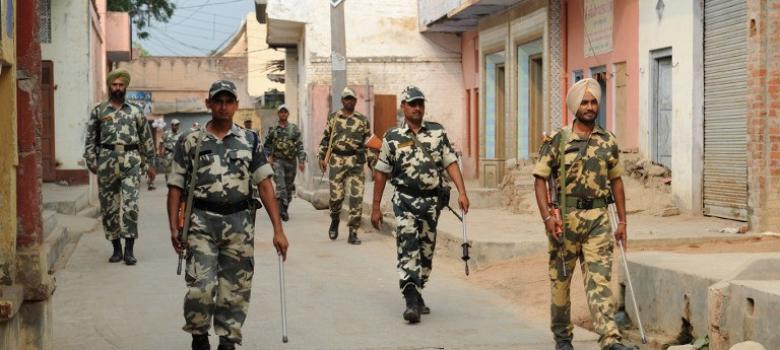
Scramble for Dalit votes is sparking increased communal violence in UP

The key force driving the increasing communal polarisation in Uttar Pradesh is the scramble for Dalit votes in an attempt to weaken the Bahujan Samaj Party and deter Muslims from rallying behind it.

This strategy was evolved, and implemented, during the last Lok Sabha elections. But the competition to woo Dalits has gathered momentum ahead of bypolls to 12 assembly seats, five of which are in the western section of the state, which is often billed as the “wild west” of the Hindi heartland.

As the Indian Express reported, more than 600 incidents of communal violence have taken place in the state since May.

The Bharatiya Janata Party’s stake in the bypolls, which have yet to be scheduled, is enormous. Eleven of the 12 constituencies here had BJP MLAs, all of whom were elected to the Lok Sabha, as was the party’s ally, Apna Dal leader Anupriya Patel. The results will help measure the durability of the Modi wave, and its possible impact on the UP assembly elections in early 2017.  The verdict from UP could well determine the chances of Prime Minister Narendra Modi winning a second successive term in the 2019 polls.

The need to cobble together an electoral majority is driving political parties to resort to communal mobilisation. Local disputes over land, civic amenities, and exploitative gender relations have been given a communal hue and magnified to portray a monolith Hindu community arrayed against the Muslims.

via Scroll.in – News. Politics. Culture..

08/07/2014

Congress to Parliament: Please Don’t Oppose Our Opposition – India Real Time – WSJ

India’s new session of Parliament has begun, and the Congress Party has a request: Make us the official “leader of the opposition.”

It turns out, that may be asking too much.

The Congress Party — which has governed India for most of the country’s modern history — lost so badly this time, it might not qualify for the right to name the official opposition leader, according to the parliamentary rulebook.

This isn’t a surprise: It’s well known that Congress’s drubbing in the election this year left it with less than 10% of the seats in the lower house of Parliament, the Lok Sabha. So, even though it’s the second-largest party in Parliament, behind the triumphant Bharatiya Janata Party, its share of seats is too small to qualify as official opposition leader.

Nevertheless, Congress has started pressing the issue. “We are the single largest party and we have a pre-poll alliance,” Congress party president Sonia Gandhi said during a televised press conference Monday, as Parliament’s budget session commenced. “We are entitled to get the post.”

Congress spokesman Randeep Surjewala said the post of the leader of opposition is a “constitutional right” of the Congress party. “The Lok Sabha cannot function without the opposition leader.”

Under Indian parliamentary procedural rules, the post of the leader of opposition has the rank of a cabinet minister. It goes to the second-largest party in the Lok Sabha, unless that party fails to win 10% of the seats, or 55, in the 545-member Lok Sabha. Congress has 44 members.

The job comes with some significant responsibilities. The leader of the opposition is part of a panel that selects members of the Central Vigilance Commission; members of the anti-graft national ombudsman, known as the Lokpal; and head of the Central Bureau of Investigation, the country’s federal investigative agency.

Subhash C. Kashyap, historian and former secretary-general of the Lok Sabha, said the Congress party should “stop hankering” for the post. “All its claims are unnecessary, unfounded and without any legal basis.”

via Congress to Parliament: Please Don’t Oppose Our Opposition – India Real Time – WSJ.

11/04/2014

Young professionals in Bangalore favour Modi’s promise, shrug off riots | India Insight

As far as Vinod Hegde is concerned, Indian prime minister candidate Narendra Modi bears no responsibility for the 2002 Gujarat riots. More to the point, Hegde doesn’t care.

Hegde, a 26-year-old stockbroker in Bangalore, said that for people like him, the Gujarat chief minister is the only choice to lead India after countrywide parliamentary elections that began this week.

Allegations that Modi failed to stop or even allowed deadly riots in 2002 don’t sway his vote, Hegde said. And if the ruling Congress party’s candidate is Rahul Gandhi, the choice becomes even clearer.

“Even assuming Modi has been responsible for XYZ, we don’t see an alternative,” Hegde said. Referencing a Twitter post by music director Vishal Dadlani, he said, “If I had to choose between a moron and a murderer, I’d probably choose the murderer.”

Not everyone states their case for supporting Modi in such blunt terms, but interviews with young professionals in Bangalore, the information technology hub known as India’s Silicon Valley reveals a calculation in favour of Modi and the Bharatiya Janata Party (BJP) that omits the riots from the equation.

For many people in Bangalore’s highly educated workforce, Modi is a welcome alternative to what is seen as an ineffective and corruption-tainted Congress party. They are part of what some media organizations have called a “Modi wave” that opinion polls, however unreliable, say could bring the BJP to power and push out the Gandhi-Nehru family’s Congress party.

Many BJP supporters see Rahul Gandhi, the party’s leader and the Gandhi family’s heir apparent, as ill suited for the job of running a country that is trying to revive its slowing economic growth and to provide opportunities for prosperity to its burgeoning middle class. (A note for people unfamiliar with this round of Lok Sabha elections: Indians will vote for members of Parliament in their local constituencies, and the winning party’s leadership names its ministers when it forms a new government.)

via Young professionals in Bangalore favour Modi’s promise, shrug off riots | India Insight.

Enhanced by Zemanta
07/04/2014

Facts and figures for India’s 2014 general election | India Insight

Voting in the 2014 election begins on April 7. More than 814 million people — a number larger than the population of Europe — will be eligible to vote in the world’s biggest democratic exercise.

Voting will be held in nine stages, which will be staggered until May 12, and results are due to be announced on May 16. Elections to state assemblies in Andhra Pradesh, Odisha and Sikkim will be held simultaneously.

Around 930,000 polling stations will be set up for the month-long election using electronic voting machines, first introduced in 2004.

Uttar Pradesh has the most eligible voters (134 million); Sikkim the lowest (about 362,000). Male voters constitute 52.4 percent of the electorate but women voters outnumber men in eight regions — Puducherry, Kerala, Manipur, Mizoram, Daman & Diu, Meghalaya, Goa and Arunachal Pradesh.

About 23 million eligible voters have been enrolled in the 18 to 19 age group, nearly 3 percent of India’s voters.

Of India’s 814.5 million eligible voters, 28,314 identify themselves as transgender and their gender is listed as “other”. There are 11,844 non-resident Indians registered to vote in the election this year.

Since introducing photo voter ID cards and electoral rolls in 2009, 98 percent of India’s eligible voters have the former, 96 percent have the latter.

Electronic voting machine security includes: transported under armed escort and stored in strong rooms, with a double lock system and guarded 24×7 by armed police, and CCTV coverage. Also, parties/candidates allowed to keep a watch on them.

Nearly 10 million officials (including police for security) will be deployed.

Uttar Pradesh has the most Lok Sabha seats (80) while the states of Nagaland, Sikkim, Mizoram and the union territories have one seat each.

A candidate can spend up to 7 million rupees ($116,350) for his election campaign in Delhi and all states except Arunachal Pradesh, Goa and Sikkim. For these states and other union territories, the limit is 5.4 million rupees ($90,000).

A candidate for the Lok Sabha makes a deposit of 25,000 rupees ($415) at the time of filing the nomination. If the candidate fails to get a sixth of the total valid votes polled, this amount is forfeited. Nearly 85 percent of the candidates lost their security deposit in the 2009 election.

In the 15th Lok Sabha, around 78 percent of the members have a graduate, post-graduate degree or a doctorate.

Malkajgiri in Andhra Pradesh is the biggest Indian constituency in terms of voters with around 2.95 million electors; Lakshadweep is the smallest with 47,972 voters. In Lower Dibang Valley district of Arunachal Pradesh, Hukani polling station has 22 registered voters. Officials travel 22 km on foot to get there.

In the 2009 election, 363 political parties took part. The Bahujan Samaj Party contested the maximum number of seats (500 out of 543), followed by the Congress (440) and the Bharatiya Janata Party (433).

The last general election had a voter turnout of over 58 percent. Nagaland (89.99 percent) had the highest turnout while Jammu & Kashmir (39.68 percent) saw the lowest.

Namo Narain of the Congress party beat his BJP rival by 317 votes in Rajasthan’s Tonk Sawai Madhopur constituency — the smallest margin of victory in the 2009 election.

“Basic Minimum Facilities” for polling stations include drinking water, shed, toilet, ramp for disabled voters.

Voters will have a “None of the Above” option on voting machines.

The indelible election ink that is applied while electors cast their votes is manufactured by Mysore Paints & Varnish Limited, a Karnataka government undertaking.

Narendra Modi of the Bharatiya Janata Party has emerged as the favourite in opinion polls, which reflect waning support for Rahul Gandhi’s Congress party that wrested power from the BJP in 2004.

Modi, the chief minister of Gujarat, will also be challenged by a clutch of regional parties that are vying for power as part of a “third front” opposed to both the Congress and the BJP.

Also in the race is Arvind Kejriwal’s Aam Aadmi Party, which made a stunning debut in Delhi elections last year and is now eyeing a national presence on the anti-corruption plank.

via Facts and figures for India’s 2014 general election | India Insight.

Enhanced by Zemanta
21/03/2014

AAP Ousts Two Members on Corruption Concerns – India Real Time – WSJ

The political party created to combat corruption, the Aam Aadmi Party, moved quickly to protect its squeaky-clean image Friday, kicking out two party members amid allegations of bribery.

The two party workers have been accused of demanding bribes from wannabe politicians who were trying to get AAP tickets or nomination papers to run on behalf of the party for the Lok Sabha elections.

The Aam Aadmi, or common man, Party said it discovered demands had been made though no deal was done.

“The transactions did not take place but promises were made,” said Arvind Kejriwal, anti-corruption crusader and leader of the AAP, at a news conference on Friday.

One of the workers that was pushed out of the party, Aruna Singh, was an organizer for the party in the Awadh region of Uttar Pradesh and said she was not sure what she was being accused of. She had heard there was some recording of her allegedly involved in some kind of political transaction.

“This decision about me has been taken in haste,” Ms. Singh told The Wall Street Journal. “I didn’t get an opportunity to defend myself. If there is any recording of any transaction, they should have asked me if I was involved.”

Ashok Kumar, the other party member that was ousted, was a treasurer for the party in the Hardoi district of Uttar Pradesh. He could not be reached for comment Friday.

via AAP Ousts Two Members on Corruption Concerns – India Real Time – WSJ.

Enhanced by Zemanta
05/03/2014

BBC News – India names general election dates

India’s general election will take place in nine phases in April and May, the Election Commission has announced.

A BJP rally in Assam, India

Polling to elect a new Lok Sabha, or lower house, will be held from 7 April to 12 May. Votes will be counted on 16 May.

With some 814 million eligible voters, India’s election will be the largest the world has seen.

The ruling Congress party and the main opposition Bharatiya Janata Party will be battling a host of smaller parties.

Leaders of 11 regional parties have formed a Third Front against the Congress and the BJP.

A new anti-corruption Aam Aadmi (Common Man’s) Party (AAP), which made a spectacular debut in recent polls in the capital Delhi, will also contest the elections.

Continue reading the main story

POLLING DAYS

7 April – 2 states, 6 constituencies

9 April – 5 states, 7 constituencies

10 April – 14 states, 92 constituencies

12 April – 3 states, 5 constituencies

17 April – 13 states, 142 constituencies

24 April – 12 states, 117 constituencies

30 April – 9 states, 89 constituencies

7 May – 7 states, 64 constituencies

12 May – 3 states, 41 constituencies

Counting of votes – 16 May

Election Commission of India

If no single party wins a clear majority, smaller parties could play a crucial role.

India’s lower house has 543 elected seats and any party or a coalition needs a minimum of 272 MPs to form a government.

via BBC News – India names general election dates.

Enhanced by Zemanta
30/01/2014

* AAP to contest over 350 LS seats, will fight tainted leaders – The Times of India

Aam Aadmi Party on Thursday said it will contest over 350 Lok Sabha seats (total 543 seats) and vowed to take on tainted candidates and political leaders who have become \”symbols\” of corruption and criminalization of politics.

English: Chamber graphic for the Lok Sabha aft...

English: Chamber graphic for the Lok Sabha after the 1999 General Election (Photo credit: Wikipedia)

The fledgling party, which made a stunning debut in the recent Delhi assembly polls, said it would contest elections against 14 Union ministers as well as A Raja allegedly involved in the 2G spectrum scam.

\”We have received reports from our state conveners and looking at the response from different seats, it has been decided that the Aam Aadmi Party will contest more than 350 seats in the Lok Sabha elections,\” senior party leader and political affairs committee (PAC) member Sanjay Singh told reporters.

via AAP to contest over 350 LS seats, will fight tainted leaders – The Times of India.

Enhanced by Zemanta
13/01/2014

* The Year Lokpal Comes of Age – India Real Time – WSJ

This post is a commentary.

In 1965, L.M. Singhvi addressed India’s lower house of parliament and told parliamentarians that the need for an anticorruption ombudsman was overdue.

“It is for the sake of securing justice and for cleansing the public life of the Augean stable of corruption, real and imaginary, that such an institution must be brought into existence,” he told lawmakers at the time.

Almost half a century later, on Jan. 1, the Lokpal and Lokayuktas Act, to create a corruption watchdog, became the first law made in 2014.

It gives Lokpal, or the “caretaker of the people”, jurisdiction to investigate allegations of corruption made against government officials up to the rank of prime minister. Even nongovernmental organizations with foreign donations above one million rupees ($16,252)  annually will fall within its purview.

The new anti-corruption machinery involves the services of federal investigators — the Central Bureau of Investigation — and the Central Vigilance Commission, which have both been made more robust and independent for the purpose.

via Inside Law: The Year Lokpal Comes of Age – India Real Time – WSJ.

Enhanced by Zemanta
10/01/2014

AAP kicks off nationwide membership drive – The Hindu

“Main bhi aam aadmi” campaign aims to enroll at least 1 crore members by January 26, 2014

Delhi Chief Minister and AAP convenor Arvind Kejriwal and party leader Gopal Rai launch the party's nationwide membership drive in New Delhi on Friday. Photo Rajeev Bhatt

Buoyed by its spectacular success in the Delhi Assembly polls, the Aam Aadmi Party on Friday kicked off a nationwide membership drive with an aim to enroll at least 1 crore members by January 26, 2014 to strengthen the party ahead of the Lok Sabha elections.

AAP leader and Delhi Chief Minister Arvind Kejriwal said under the Main bhi aam aadmi campaign, any citizen can enroll as member of the party without paying any fee.

“Our target is to include 1 crore members in the party by January 26. But the membership drive will continue after that as well,” he said addressing a press conference.

He said the party had decided to waive the Rs. 10 membership fee as it was found out that many people could not afford it. “The decision to waive off the membership fee was taken at the national executive meeting last week,” he said.

Party leader Gopal Rai, who has been tasked to oversee the special membership drive, said over 3 lakh people have registered online as party members after the Delhi elections.

“This is perhaps the first time in the history of India that membership to a party is being opened to public like this. This is our biggest country—wide drive to connect with people before the Lok Sabha polls,” Mr. Rai told PTI.

“Success of this campaign is one of our major strategies before the Lok Sabha polls,” he said.

Mr. Rai said the whole campaign will check the “ground reality” of the party’s prospects in the Lok Sabha polls to a certain level.

“A lot will depend on this campaign. We will get to know how much response is coming and from which areas,” he said.

Mr. Kejriwal said any citizen can give a missed call on mobile number 07798220033 to enrol as a party member. They can also send SMS of their name, STD code and Vidhan Sabha name after which they will get their membership number.

The citizens will also have an option of filling an online form on the Aam Aadmi Party website aamaadmiparty.org to become a member.

“Those who do not have mobile phones have to use their voter identification number and register at our website after January 17,” Mr. Rai said.

He said one mobile number holder can only have one membership.

Mr. Rai said all AAP members are being urged to bring in as many people as possible into the party fold.

via AAP kicks off nationwide membership drive – The Hindu.

Enhanced by Zemanta
09/01/2014

Modi mocks PM at NRI meet, says ‘good days ahead’ after LS polls – The Times of India

BJP leader Narendra Modi on Thursday chose a global NRI meet to hit out at Prime Minister Manmohan Singh who had said that \”we are set for better times\”.

English: Image of Narendra Modi at the World E...

English: Image of Narendra Modi at the World Economic Forum in India (Photo credit: Wikipedia)

\”I agree with the Prime Minister. Good days are ahead for India. I don\’t want to say anything more. We should wait for four to six months. But good days are coming,\” the BJP\’s prime ministerial candidate said, indicating that his party would form the next government at the Centre after the Lok Sabha polls.

Modi\’s jibe at Singh came a day after the Prime Minister sought to dispel apprehensions among the Indian diaspora on the state of the economy, saying that the country was heading towards \”better times\” and there was no reason to despair about its present or worry about the future.

Addressing a press conference last week, the Prime Minister had said that \”we are set for better times\” as the cycle of global economic growth is turning for the better.

This is the first verbal attack on the Prime Minister by Modi after Singh said that \”it will be disastrous for the country to have Narendra Modi as the Prime Minister.\”

via Modi mocks PM at NRI meet, says ‘good days ahead’ after LS polls – The Times of India.

Enhanced by Zemanta
Law of Unintended Consequences

continuously updated blog about China & India

ChiaHou's Book Reviews

continuously updated blog about China & India

What's wrong with the world; and its economy

continuously updated blog about China & India