Posts tagged ‘Ma Ying-jeou’

01/01/2016

‘The Miraculous History of China’s Two Palace Museums’ – China Real Time Report – WSJ

In late 1948 and early 1949, toward the end of the Chinese civil war, Nationalist leader Chiang Kai-shek transported across the Taiwan Strait hundreds of thousands of valuable Chinese artifacts which are now stored in Taipei’s National Palace Museum. Along with its Palace Museum counterpart in Beijing – more famous as the Forbidden City – the museums serve as one of the most poignant reminders of the division of China.
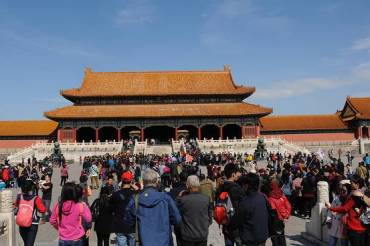
Beijing’s Palace Museum, which celebrated its 90th anniversary in October, was established shortly after the last Chinese emperor, Pu Yi, was forced from his palace, where he had been allowed to stay even after the Chinese republic was founded in 1911.

Intellectuals at the time wanted to set up a Chinese museum along the lines of the great museums in Europe.

Today, millions visit both museums each year, crowding around artifacts such as the Jadeite Cabbage and the Meat-Shaped Stone in Taipei.

Among the visitors are huge tour groups of mainland Chinese tourists, as the Taipei government continues to liberalize travel policies for its neighbor amid a broader detente.

This week, a branch of the National Palace Museum housing exhibits from around Asia was inaugurated in the southern Taiwanese city of Chiayi.

In his book “The Miraculous History of China’s Two Palace Museums,” Hong Kong-based writer Mark O’Neill details the treacherous history of how some of China’s most precious artifacts were rescued from the invading Japanese imperial army in the 1930s and later transported to Taiwan, and the powerful symbolism of the museums.

Source: Writing China: Mark O’Neill, ‘The Miraculous History of China’s Two Palace Museums’ – China Real Time Report – WSJ

07/11/2015

Oppose Taiwan independence, China’s Xi says at historic meeting | Reuters

China and Taiwan must not let proponents of Taiwan’s independence split them, China’s President Xi Jinping told Taiwan’s president on Saturday at the first meeting between leaders of the two sides since China’s civil war ended in 1949.

Ma Ying-jeou, president of self-ruled, democratic Taiwan, where anti-Beijing sentiment has been rising ahead of elections, called for mutual respect for each other’s systems and said Taiwan people were concerned about mainland missiles pointing their way.

The talks, at a luxury hotel in the neutral venue of Singapore, lasted less than an hour but were heavy with symbolism.

The two leaders shook hands and smiled in front of a mass of journalists when they met, with Xi wearing a red tie, the color of the Communist Party, and Ma a blue one, the color of his Nationalist Party.

Moving into a meeting room, Xi, speaking first and sitting opposite Ma, said Chinese people on the two sides of the Taiwan Strait had the ability and wisdom to solve their own problems.

“No force can pull us apart because we are brothers who are still connected by our flesh even if our bones are broken, we are a family in which blood is thicker than water,” Xi said.

In response, Ma said he was determined to promote peace across the Taiwan Strait and that relations should be based on sincerity, wisdom and patience.

Ma also asked Xi indirectly to respect Taiwan’s democracy.

“Both sides should respect each other’s values and way of life to ensure mutual benefit and a win-win situation across the straits,” he said.

China’s Nationalists, also known as the Kuomintang (KMT), retreated to Taiwan after losing the civil war to the Communists, who are still in charge in Beijing.

The mainland has never renounced the use of force to bring what it considers a breakaway province under its control.

Speaking to reporters after the talks, Ma said he hoped Xi could pay attention to China’s missile deployment – the island has long fretted about batteries pointed its way – to which Xi replied that was not an issue about Taiwan, he said.

“I at least raised the issue, and told him that the Taiwanese people have questions and concerns about it, and hope he will treat it with importance,” Ma said.

Zhang Zhijun, the head of China’s Taiwan Affairs Office, said Xi told Ma that the biggest threat to the peaceful development of relations was pro-independence forces. “The compatriots on both sides should unite and firmly oppose it,” Zhang said.

Source: Oppose Taiwan independence, China’s Xi says at historic meeting | Reuters

26/05/2015

Taiwan offers South China Sea peace plan | Reuters

Taiwan proposed a peace initiative on Tuesday to resolve territorial disputes in the South China Sea that it says will reduce tensions that have put Beijing at odds with its neighbors and the United States.

Taiwan President Ma Ying-jeou arrives at Taiwan's Mainland Affairs Council in Taipei, Taiwan, April 29, 2015. REUTERS/Pichi Chuang

The South China Sea Peace Initiative announced by President Ma Ying-jeou called on claimants to temporarily shelve their disagreements to enable negotiations on sharing resources.

Ma’s plan is similar to a 2012 proposal for the East China Sea, which allowed Taiwan and Japan to jointly fish in the contested waters.

However it appeared unlikely the plan would be accepted by China, which claims most of the South China Sea and has rebuffed earlier attempts at multilateral negotiations.

“We believe Chinese people on both sides of the Strait have a duty to jointly protect China’s territorial sovereignty and maritime rights and interests and safeguard the stability of the South China Sea region,” said Hua Chunying, a spokeswoman for China’s Foreign Ministry, when asked about the plan on Tuesday.

China views self-governed Taiwan as a renegade province.

Taiwan has so far played a marginal role in disputes between China and its neighbors in the South China Sea, through which $5 trillion in ship-borne trade passes every year.

China, the Philippines, Vietnam, Malaysia, Taiwan and Brunei all have overlapping claims in the South China Sea. China said on Monday it had lodged a complaint with the United States over a U.S. spy plane that flew over parts of the disputed sea.

Ma’s remarks in a keynote speech at an international law conference in Taipei were the most public comments by Taiwan since the United States, its biggest ally, raised concerns over the speed and breadth of China’s land reclamation in the area.

“We demand that freedom of navigation and overflight be respected in the South China Sea,” said Ma, who urged a peaceful resolution “before a major conflict breaks out”.

Taiwan normally maintains a low-key approach to such issues but has coast guard and military facilities in the area, including an airstrip and soon-to-be-completed port on Taiping Island, also known as Itu Abu, the largest natural land mass in the disputed Spratlys archipelago.

“I believe the mainland side understands the spirit and principle of our South China Sea peace initiative,” Taiwan Foreign Minister David Lin told reporters after Ma’s speech.

The rival claims by Taiwan and China go back to before they split in a civil war in 1949 after the defeated Nationalists fled to the island from the Communists.

via Taiwan offers South China Sea peace plan | Reuters.

07/04/2014

Taiwan anti-China protest exposes island’s nationalist divide | Reuters

A chaotic sit-in to protest against a trade deal with China has shut down Taiwan’s parliament and exposed deep divisions over the island’s identity after seven decades of living apart from its vast, undemocratic rival across the strait.

A protester sits in front of a pile of chairs used to block the door, inside Taiwan's Legislative Yuan, Taiwan's parliament, during protest to oppose the controversial trade pact with mainland China, in Taipei April 5, 2014. REUTERS/Pichi Chuang

The mainly student protesters, who proffer sunflowers as a symbol of hope, denounce the pact as an arrangement suiting Taiwan’s wealthy. They say it will lead to mass encroachment by China, and its one-party mindset, on the island’s cherished democratic values and institutions.

Its advocates, including Taiwan’s president and his government, say it is a vital step to normalizing relations with Beijing and will provide jobs and improve living standards.

Protesters demand the repeal of the trade deal, which was only one step away from parliamentary ratification before the sit-in began.

They also demand lawmakers pass an oversight mechanism of trade pacts with the mainland before they pass the current trade deal – a move the government has agreed to in principle and could potentially pave the way toward an end to the stalemate.

“The government has fallen into the palm of big money here in Taiwan,” said Miles Lin, 25, the main protest leader. “That, combined with pressure from Beijing, drove them to ram this pact through the legislature.”

via Taiwan anti-China protest exposes island’s nationalist divide | Reuters.

Enhanced by Zemanta
17/02/2014

China says keen on meeting with Taiwan president, but no rush | Reuters

China said on Monday it was keen on a meeting between President Xi Jinping and Taiwan President Ma Ying-jeou, but signaled it was in no rush to set a venue or timeframe for what would be a historic get-together.

Taiwan's Mainland Affairs Minister Wang Yu-chi (2nd R) and Vice Minister Wu Mei-hung (R) pay their respect to the statue of party founder Sun Yat-sen during their visit at Sun Yat-sen mausoleum in Nanjing, Jiangsu province, February 12, 2014. REUTERS/Stringer

Since taking office in 2008, Ma has signed a series of landmark trade and economic agreements with China, cementing China’s position as Taiwan’s largest trading partner.

But Taiwan said last week that China had rebuffed as “inappropriate” a request for the two men to meet at an Asia-Pacific Economic Cooperation (APEC) summit in Beijing.

Fan Liqing, spokeswoman of China’s Taiwan Affairs Office, told reporters the subject of a Xi-Ma summit was “not a topic for discussion” during last week’s landmark meeting between top Chinese and Taiwan government officials.

That meeting was an important step in pushing overall cross-Strait relations, she said, adding that further steps would follow, promising to benefit people on both sides of the Taiwan Strait.

“As for a meeting between the leaders on both sides of the Strait, we have said many times that this is something we have upheld for many years, and we have always had an open, positive attitude towards it,” Fan said.

via China says keen on meeting with Taiwan president, but no rush | Reuters.

See also: https://chindia-alert.org/2014/02/14/china-dashes-taiwans-hope-of-meeting-between-leaders-at-apec-reuters/

Enhanced by Zemanta
14/02/2014

China dashes Taiwan’s hope of meeting between leaders at APEC | Reuters

China has rebuffed a request by Taiwan for Chinese President Xi Jinping and Taiwan President Ma Ying-jeou to meet at an Asia-Pacific Economic Cooperation (APEC) summit in Beijing, saying it was “inappropriate”, a Taiwan official said on Friday.

Taiwan's Mainland Affairs Chief Wang Yu-chi (C) is surrounded by microphones and recorders as he talks to journalists at the Shanghai Media Group headquarters in Shanghai, February 13, 2014. REUTERS-China Daily

China and Taiwan have been ruled separately since Nationalist forces, defeated by the Communists, fled to the island at the end of the Chinese civil war in 1949. China considers Taiwan a renegade province and has never ruled out the use of force to bring it under its control.

But over recent years the two sides have built up extensive economic ties, and this week, they held their first direct, government-to-government talks, a big step towards expanding cross-strait dialogue beyond trade.

At the talks in the mainland city of Nanjing, Taiwan’s Mainland Affairs Minister Wang Yu-chi said Zhang Zhijun, head of China’s Taiwan Affairs Office, brought up the subject of a meeting this year between their leaders.

Wang said he responded by proposing the APEC summit later in the year as “the only choice for us”, but Zhang resisted the request.

“I told Zhang that Taiwan hopes Ma and Xi can meet in the upcoming APEC meeting,” Wang told a news conference in Taipei after returning from his four-day visit to China.

“However, Zhang said that is not acceptable. China doesn’t see APEC as appropriate,” Wang said, without elaborating.

via China dashes Taiwan’s hope of meeting between leaders at APEC | Reuters.

Enhanced by Zemanta
11/02/2014

BBC News – China and Taiwan in first government talks

China and Taiwan have held their first high-level talks since the end of the Chinese civil war in 1949.

Wang Yu-chi and Zhang Zhijun, the top cross-strait officials from each side, attended the four-day talks in Nanjing.

No official agenda was released for the talks, which are widely seen as a confidence-building exercise.

China regards Taiwan as part of its territory. In the past, all talks have gone via quasi-official organisations.

The fact that talks are taking place in Nanjing is a nod to history – the city, at times, served as the capital when the Nationalists were in power more than 60 years ago.

Neither side is talking of any breakthrough during this week’s talks – their differences remain stark.

Beijing considers Taiwan part of its territory, insisting that it must be reunited with the mainland – by force, if necessary.

But since the election of Taiwan’s President Ma Ying-jeou in 2008, relations between the sides have warmed considerably.

For Taiwan, there is no ignoring China – the world’s second largest economy.

And China perhaps sees these talks as a useful opportunity to forge closer ties with Taiwan while a relatively pro-Beijing president remains in power on the island.

Mr Zhang, head of mainland China’s Taiwan Affairs Office, said: “It’s impossible to imagine in the past that we could sit here and meet.”

“We must have some imagination if [we want to] resolve some difficulties, not just for such a meeting, we should also have a bigger imagination for cross-strait future development,” he added.

Mr Wang, head of Taiwan’s Mainland Affairs Council, described the meeting as “a new chapter for cross-strait relations”.

“For us to simply sit at the same table, sit down to discuss issues, is already not an easy thing.”

via BBC News – China and Taiwan in first government talks.

Enhanced by Zemanta
27/01/2014

* First Chinese-Taiwan Government Meeting Set, Daily Reports – Bloomberg

China and Taiwan officials set a date for talks next month, the United Daily News reported today, paving the way for the first official government-to-government meetings since a civil war six decades ago.

The head of Taiwan’s Mainland Affairs Council, Wang Yu-chi, will meet with the head of China’s Taiwan Affairs Office, Zhang Zhijun, on Feb. 16 in the mainland city of Nanjing, the Taipei-based newspaper reported, citing an unidentified person. Nanjing was China’s capital before the civil war forced Chiang Kai-shek’s Kuomintang Party to flee to Taiwan in 1949, ceding power to Mao Zedong’s Communists. Taiwan and the mainland have been governed separately since then, with the island’s constitution retaining the Republic of China’s name and territorial claims.

“The meeting is a considerable breakthrough because this is the first time that two government officials are going to meet in their formal capacities, representing a certain level of mutual recognition,” said Joseph Cheng, a political science professor at the City University of Hong Kong.

President Ma Ying-Jeou, speaking on an official visit to Honduras, said the meeting is an “inevitable” step in cross-strait relations, the Central News Agency reported yesterday.

via First Chinese-Taiwan Government Meeting Set, Daily Reports – Bloomberg.

Enhanced by Zemanta
02/01/2014

Taiwan’s Ma says ending China standoff a must for the economy | Reuters

Ending Taiwan\’s political standoff with mainland China is necessary to boost Taiwan\’s sagging economy and to help it integrate more effectively with the region, the island\’s president, Ma Ying-jeou, said.

Taiwan's President Ma Ying-jeou speaks during a meeting with journalists in a hotel in Asuncion August 14, 2013. REUTERS/Jorge Adorno

China considers Taiwan a renegade province and has not ruled out the use of force to bring the island under its control. Economic ties, however, have grown considerably in recent years, especially since Ma took office in 2008.

In October, Chinese President Xi Jinping said a political solution to the standoff could not be postponed forever. But Ma later said he saw no urgency for political talks and wanted to focus on trade.

\”I fully understand that if the Taiwan economy is to expand further, we need to end the cross-strait standoff,\” Ma was quoted as saying in a statement posted on the Presidential Office\’s website.

The statement did not explain what concrete steps would be taken to end an impasse that has existed since Chiang Kai-shek and his ruling Nationalist Party fled from the mainland to Taiwan at the end of China\’s civil war in 1949.

Ma opened Taiwan to trade with China when he took office in 2008 and they have since signed economic agreements that have made mainland China Taiwan\’s largest trading partner.

But booming trade has not led to progress on political reconciliation or a lessening of military readiness on both sides.

via Taiwan’s Ma says ending China standoff a must for the economy | Reuters.

09/05/2013

* China and Taiwan cross-strait representative offices: One offensive, the other defensive

Another illustration of the Chinese pragmatism. Why let ‘politics and dogma’ stand in the way of good mutual trade relationship?

See also: https://chindia-alert.org/social-cultural-diff/chinese-mindset/

Law of Unintended Consequences

continuously updated blog about China & India

ChiaHou's Book Reviews

continuously updated blog about China & India

What's wrong with the world; and its economy

continuously updated blog about China & India