19/04/2014
Indians cast ballots Thursday on the biggest day of voting in the country’s weekslong general election, streaming into polling stations even in areas where leftist rebels threatened violence over the plight of India’s marginalized and poor.
Nationwide voting began April 7 and runs through May 12, with results for the 543-seat lower house of Parliament to be announced four days later. Among the 13 key states voting Thursday was Chhattisgarh, now the center of a four-decade Maoist insurgency that has affected more than a dozen of India’s 28 states.
With roadside bombings, jungle ambushes and hit-and-run raids, the rebels aim for nothing short of sparking a full-blown peasant revolt as they accuse the government and corporations of plundering resources and stomping on the rights of the poor.
via India struggles with rebel threats during election – Businessweek.
Posted in Economics, India alert, Inequalities, Instability, Insurgency, Politics, terrorism |
Leave a Comment »
11/04/2014
The results of national elections in India, expected to be announced on May 12, could mean good news for Japan and not such good news for China. Narendra Modi, the leader of the Hindu nationalist opposition party, has long been a favorite of Japanese Prime Minister Shinzo Abe, who would like to foster military and economic ties with India. Modi, the front-runner in the contest to be India’s prime minister, and Abe also share an antagonism for China. Modi has criticized the government of Prime Minister Manmohan Singh for being too accommodating toward China and has pledged to take a tougher line on issues such as the border dispute between the two countries that has festered for decades.

Abe has clashed with China in a dispute over the ownership of several islands in the East China Sea. When it comes to the Chinese, “the Japanese are extremely apprehensive,” says P.K. Ghosh, senior fellow at the Observer Research Foundation, a New Delhi think tank. “It doesn’t take a genius to say India can be the largest friend of the Japanese.”
Abe has long treated Modi as a kindred spirit. Even after the George W. Bush administration put Modi on a travel blacklist for his alleged role in the 2002 riots that killed about 1,100 people, mostly Muslims, in Gujarat state, Abe welcomed Modi to Japan. The Indian politician, who was exonerated by the Indian courts, visited in 2007 during Abe’s first term as prime minister and then again when Abe was opposition leader in 2012. “Japan has worked very hard to improve relations with India,” says retired Indian General Vinod Saighal, author of Revitalising Indian Democracy. With a Modi victory, he says, relations “will get a boost, certainly.”
via India Under Narendra Modi Could Be Japan’s Best Friend – Businessweek.
Posted in Economics, India alert, Internal politics, Politics |
Leave a Comment »
15/03/2014
IN THE early hours of February 20th 2010 Uday Vir Singh, an Indian forestry officer, bluffed his way past a private militia guarding a dusty port called Belekeri. For months suspicious-looking convoys of trucks had been thundering across India to the port’s quays on the country’s west coast, just south of the Goan beach where the super-spy mayhem which opened “The Bourne Supremacy” was filmed.

Mr Singh is no more a Jason Bourne than the next entomologist—he has a doctorate on metamorphosis in insects—and the infiltration he mounted with a few colleagues led to no gunplay. But it did uncover a massive scam, with hundreds of officials and politicians in the state of Karnataka in the pockets of an illegal mining mafia that, over five years, had made profits of $2 billion or more shipping illegal iron ore to China.
Such scandals have rocked Asia’s third-largest economy in the past decade. A lot of transactions that put public resources into private hands—allocations of radio spectrum, for example, and of credit from state banks—have come under suspicion. Of the ten biggest family firms by sales, seven have faced controversies. The brash new tycoons who came of age during the boom years of 2003-10 are under a cloud, too. Before he became boss of the central bank last year, Raghuram Rajan worried publicly that India could start looking like an oligarchy along the lines seen in Russia: “too many people have got too rich based on their proximity to the government.”
via Fighting corruption in India: A bad boom | The Economist.
Posted in corruption, Economics, India alert, Politics, Social & cultural |
1 Comment »
04/03/2014
Indian Prime Minister Manmohan Singh addressed state leaders from South and South East Asia in Myanmar today to emphasize the need to improve trade ties by building highways connecting India and its neighbors.

Mr. Singh is on a two-day visit to the neighboring country for an economic meeting called the Bay of Bengal Initiative for Multi-Sectoral Technical and Economic Cooperation [BIMSTEC] Summit.
Addressing an audience including the leaders of Myanmar, Bangladesh, Sri Lanka, Bhutan, Nepal and Thailand, Mr. Singh said he would like to “improve physical connectivity” with a highway that will connect India to Myanmar and Thailand and with more maritime links with Myanmar. “And even as we develop physical infrastructure, we should simultaneously start developing the supporting architecture of rules and regulations to facilitate cross-country movements,” he said. He arrived yesterday in Myanmar’s capital, Nay Pyi Taw.
via Singh to Neighbors: To Boost Trade, Build More Highways to India – India Real Time – WSJ.
Posted in Economics, GeoPolitics, India alert, Politics, Transport |
Leave a Comment »
02/03/2014
India’s IT services companies are tops in outsourcing, with Tata Consultancy Services (TCS:IN) and Infosys (INFY) competing globally with IBM (IBM) and Accenture (ACN). The cities of Bangalore and Hyderabad are well established as research centers for such multinationals as Microsoft (MSFT), General Electric (GE), and Intel (INTC).

But when it comes to hardware, India is behind. In 2013 it imported $33.5 billion worth of electronics, from semiconductors to smartphones. That’s more than it spent on any imports except oil and gold. With India’s large and growing middle class buying more digital devices, the reliance on imported semiconductors and other hardware is likely to increase. By next year, according to market analysts Frost & Sullivan, such imports will top $42 billion. “Our manufacturing has not kept pace with our consumption,” says PVG Menon, president of the Indian Electronic & Semiconductor Association. India does some assembly of TVs, mobile phones, computers, and set-top boxes.
The government of Prime Minister Manmohan Singh is trying to address this technology gap. The Indian cabinet on Feb. 14 approved plans for two semiconductor manufacturing projects, requiring an investment of $10.2 billion, with IBM, Geneva-based STMicroelectronics (STM:FP), and Israel’s Tower Semiconductor (TSEM:IT) taking part.
via India Wants to Build Its Own Chips to Satisfy Electronics Demand – Businessweek.
Posted in Economics, India alert, Manufacturing, Technology |
Leave a Comment »
28/02/2014
Once again, Indians are mourning after a tragedy aboard one of the navy’s submarines. After an accident on the INS Sindhuratna filled the vessel with smoke yesterday, two officers with severe burns died and seven other sailors suffering from smoke inhalation had to be flown to safety. Last year, an explosion aboard another Indian sub left 18 sailors dead. Shortly after Wednesday’s incident, Indian Navy Chief of Staff D.K. Joshi resigned, effective immediately.

Wednesday’s accident comes at a bad time for India’s embattled government. Indian Prime Minister Manmohan Singh’s Congress Party, facing a string of corruption scandals as well as a lackluster economy, will probably lose in the upcoming national elections due by May. The leader of the largest opposition party, Gujarat Chief Minister Narendra Modi, is a Hindu nationalist who argues that Singh hasn’t been tough enough, especially toward the country’s assertive neighbor to the north—China.
In his first major speech as the Bharatiya Janata Party’s leader last September, he accused the Congress-led government of not doing enough to protect India’s borders. “Unless there is a capable government, patriotic government, there cannot be any guarantee of security,” Modi said. Over the weekend, Modi criticized what he called China’s “expansionary mindset.”
via India, the Best Customer for America’s Defense Industry – Businessweek.
Posted in India alert, Military, Politics |
Leave a Comment »
20/02/2014
Government on Thursday cleared a plan to create new forest cover and improve the quality of existing forests with an expenditure of Rs. 13,000 crore in the 12th Plan.

Besides the two components, which are to be implemented through various measures including decentralisation of forest governance, the proposed National Mission for a Green India (GIM) as a Centrally Sponsored Scheme will also strive to achieve increased forest-based livelihood income of households living in and around the forests.
The Cabinet Committee on Economic Affairs chaired by Prime Minister Manmohan Singh on Thursday approved the proposal of the Ministry of Environment and Forests.
The objectives of the Mission during 12th Plan period includes increased forest/tree cover and improved quality of forest cover in two to eight million hectares, along with improved ecosystem services including biodiversity, hydrological services, increased forest-based livelihood income of households, living in and around the forests, and enhanced annual CO2 sequestration (process of capture and long term storage of CO2).
via Govt clears plan to create new forest cover – The Hindu.
Posted in Economics, forestry, India alert |
Leave a Comment »
01/02/2014
India and Japan have signed agreements on cooperation in the energy and telecom sectors during Japanese Prime Minister Shinzo Abe\’s visit to New Delhi.
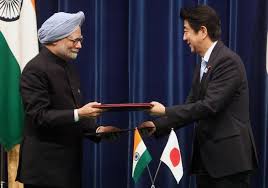 Indian Prime Minister Manmohan Singh held talks with Abe on Saturday and said India was taking steps to facilitate Japan\’s links with India\’s growing economy.
Singh said that India also was discussing with Japan the possibility of buying an amphibian aircraft called the US-2 and its co-production in India. \”More broadly, we are working toward increasing our cooperation in the area of advanced technologies.\”
The two agreed to hold regular consultations between their national security councils on security issues. India invited Japan\’s Maritime Self-Defense Force to participate in this year\’s India-U.S. naval exercises off India\’s western coast, according to a joint statement issued after the official talks.
The Indo-U.S. exercises, launched in 2006, include air operations and sea control missions aimed at preventing piracy and countering terrorism at sea.
Abe arrived in New Delhi on Saturday for a three-day visit. He was the chief guest at India\’s Republic Day celebrations on Sunday.
via India, Japan to cooperate in energy, telecoms – Businessweek.
Posted in Economics, GeoPolitics, India alert, Politics |
Leave a Comment »
26/01/2014
Multi-hued images of India’s rich cultural heritage, its achievements in diverse fields and military prowess were on majestic display at the magnificent Rajpath, the ceremonial boulevard, in Delhi on Sunday, as the nation celebrated its 65th Republic Day amid tight security.

Marching down from the seat of power at Raisina Hills to Red Fort, the parade showcased India’s ‘unity in diversity’ and defence capability as thousands of spectators along the 8-km-long route cheered the contingents and the mechanised columns.
The well-turned out and synchronised military and police contingents led by General Officer Commanding (Delhi), Lt General Subroto Mitra, marched proudly to the lilting tunes of bands through Rajpath where President Pranab Mukherjee took the salute.
The march past was watched by Japanese Prime Minister Shinzo Abe, the chief guest of the Republic Day celebration, Vice-President Hamid Ansari, Prime Minister Manmohan Singh, UPA chairperson Sonia Gandhi and the country’s top political and military brass, besides the diplomatic community.
via Colourful Republic Day parade dazzles Rajpath – The Hindu.
Posted in India alert, Politics |
Leave a Comment »
25/01/2014

With economics as the bedrock of a growing partnership, India and Japan are ready to move to the next level. When Japanese Premier Shinzo Abe meets Prime Minister Manmohan Singh on Saturday, the two sides are likely to kick off a top-level political-security dialogue between the two national security advisers, Shivshankar Menon and Shotaro Yachi.
Coming on the heels of the visit of the Japanese Emperor and Empress in December, the Abe visit will send a whole new set of signals to many in Asia and beyond – particularly the elephant in the room, China. Abe will not only be the first Japanese prime minister to be India\’s Republic Day chief guest, his presence at India\’s annual civil-military parade, an integral part of Indian life, will signal that the a pacifist Japan can be comfortable with a show of military strength.
The two sides are expected to announce more maritime exercises even though there will be no agreement on civil nuclear energy. Discussions on that have been stuck on non-proliferation commitments, finding a happy medium between the Japanese and Indian positions. India and Japan have started negotiations for the purchase of Japan\’s amphibian aircraft, US-2, which Japan plans to sell to India as a civilian aircraft, though it has military uses as well. The first set of discussions took place in the end of December, a second meeting is scheduled in the coming weeks.
The stepping up of defence and security cooperation between India and Japan has increased even as Japan\’s relationship with China and South Korea has plummeted in recent months. In what is being seen as an unprecedented war of words, Chinese and Japanese envoys around the world are waging a battle on the op-ed columns of newspapers regarding bilateral tensions on the Senkaku/Diaoyu islands.
via Shinzo Abe’s visit a signal to China, others – The Times of India.
Posted in Economics, GeoPolitics, India alert, Politics |
Leave a Comment »


 CHINDIA ALERT: You'll be living in their world, very soon