Posts tagged ‘Mao Zedong’

12/09/2015

China’s top graft-buster breaks taboo by discussing Communist Party’s ‘legitimacy’ | South China Morning Post

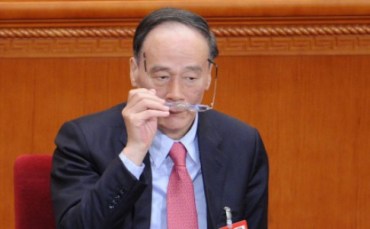
Open discussion by top graft-buster Wang Qishan about the legitimacy of the ruling Communist Party – a topic long deemed unquestionable – has raised the eyebrows of some commentators. Graft-buster Wang Qishan has raised some eyebrows with his comments on the Communist Party's 'legitimacy'. Photo: AFP

“The legitimacy of the Communist Party of China derives from history, and depends on whether it is supported by the will of the people; it is the people’s choice,” Wang said when meeting some 60 overseas attendants of the Party and World Dialogue 2015 in Beijing on Wednesday. ADVERTISING Analysts said the aberration was a step forward but some disagreed with Wang’s interpretation of “legitimacy”.

Zhang Lifan, a Beijing-based commentator, said Wang’s remarks reflected a shift of attitude in the party as a result of intensified social conflicts and increasing pressure from an underperforming economy.

“In the past, the issue was not allowed to be discussed, because the [party] thinks [its rule] is justified unquestionably. As the old saying goes, ‘political power grows out of the barrel of a gun’. They fought their way into the ruling position, instead of being elected into it,” Zhang said. [The Communist Party’s] legitimacy was maintained by relying on economic growth, but now economic growth is facing problemsZHANG LIFAN, COMMENTATOR

“Its legitimacy was maintained by relying on economic growth, but now economic growth is facing problems. In the past people thought [the party] could continue governing and did not have strong opposition to it because they still had money in their pocket. Now the size of their pockets have shrunk,” he said.

Zhang Ming , a political scientist with Renmin University, applauded Wang’s courage, but disagreed with his use of “legitimacy”. “You can’t talk about legitimacy merely from a historical perspective. How to let the people express their approval or disapproval [of the government]? The ballots are the most obvious way,” he said.

Steve Tsang, a senior fellow at the China Policy Institute of the University of Nottingham, said the “legitimacy” Wang mentioned did not mean democratic accountability.

“The will of the people, in China’s political reality, is collected and reorganised into something in line with what the party wants,” he said.

“Then [it] uses the powerful propaganda machinery to ensure the people embrace the newly reformulated views as their own.”

Source: China’s top graft-buster breaks taboo by discussing Communist Party’s ‘legitimacy’ | South China Morning Post

28/07/2015

Confucius says, Xi does | The Economist

TWO emerging cults are on display in Qufu, a city in eastern China where Confucius was born. One surrounds the ancient sage himself. At a temple in his honour, visitors take turns to bow and prostrate themselves before a large statue of Confucius seated on a throne. For each obeisance, a master of ceremonies chants a wish, such as for “success in exams” or “peace of the country”. On the other side of the city the tomb of Confucius is the scene of similar adoration—flowers adorn it as if he were a loved one recently lost.

The other cult in Qufu surrounds the country’s president, Xi Jinping. People still recall with excitement the trip he made to the city in 2013. It was the first by a Communist Party chief in more than two decades; in fact, though Mr Xi has visited Qufu he has not, since becoming China’s leader, paid respects at the birthplace of Mao Zedong at Shaoshan in Hunan province. Today plates decorated with Mr Xi’s image are for sale in Qufu’s trinket shops. His beaming face is on display on a large billboard outside the Confucius Research Institute, together with a quotation from the modern sage: “In the spread of Confucianism around the world, China must fully protect its right to speak up,” it begins.

Since he came to power in 2012, Mr Xi has sought to elevate Confucius—whom Mao vilified—as the grand progenitor of Chinese culture. He did not go so far as to pay homage at the Confucius temple in Qufu, where Mao’s Red Guard mobs once wrought havoc (one of their slogans, “Revolution is not a crime”, still survives daubed on a stone tablet). Neither did his few published remarks include explicit praise for Confucian philosophy, which still raises hackles among party hacks brought up to regard it as the underpinning of “feudal” rule in premodern China.

To emperors, who were regular visitors to Qufu, Confucianism was practically a state religion. “Uncle Xi”, for all the mini-cult surrounding him, does not seem keen to be viewed as a latter-day emperor. But like leaders of old, he evidently sees Confucianism as a powerful ideological tool, with its stress on order, hierarchy, and duty to ruler and to family. Unlike the party’s imported, indigestible Marxist dogma, Confucianism has the advantage of being home-grown. It appeals to a yearning for ancient values among those unsettled by China’s blistering pace of change.

Though the party has quietly been rehabilitating Confucius for some time, under Mr Xi the pace has quickened. In February 2014 he convened a “collective study” session of the ruling Politburo at which he said that traditional culture should act as a “wellspring” nourishing the party’s values. Official accounts of the session made no mention of Confucius, but party literature made it clear that the values Mr Xi spoke of—such as benevolence, honesty and righteousness—were those espoused by the philosopher. In September Mr Xi became the first party chief to attend a birthday party for Confucius (who turned 2,565). China, he told assembled scholars from around the world, had always been peace-loving—a trait, he said, that had “very deep origins in Confucian thinking”. In May state media reported that the link between Marxism and Confucianism, which some might consider rather tenuous, was the “hottest topic” in the study of humanities in 2014.

Add plenty of sage

Under Mr Xi the party has tweaked its ideological mantras to sound more Confucian. At the party congress in 2012 that marked Mr Xi’s assumption of power, slogans about “core socialist values” were distilled into 12 words, each formed by two Chinese characters and plastered all over Beijing and other cities. The ideas are a hotch-potch. Some are strikingly Western, such as democracy, freedom and equality. There is a nod to socialism with “dedication to work”. Others, such as harmony and sincerity, look more Confucian. Zhang Yiwu of Peking University notes a similarity with the “shared values” adopted by Singapore’s government in 1991. Authoritarian Singapore, where officials hold Confucianism in high regard, has been an inspiration to China, Mr Zhang says.

via Confucius says, Xi does | The Economist.

01/06/2015

Beijing public smoking ban begins – BBC News

Public smoking in China‘s capital, Beijing, is now banned after the introduction of a new law.


Embed from Getty Images

China has over 300 million smokers and more than a million Chinese die from smoking-related illnesses every year.

Smoking bans already existed in China, but have largely failed to crack down on the habit.

These tougher regulations, enforced by thousands of inspectors, ban lighting up in restaurants, offices and on public transport in Beijing.

Analysis: Martin Patience, BBC News, Beijing

Smoking in China often seems like a national pastime. The country consumes a third of the world’s cigarettes. More than half of men smoke. It’s seen by many as a masculine trait – women, in contrast, rarely smoke.

A common greeting among men is to offer a cigarette – the more expensive, the better. A carton of cigarettes also remains a popular gift.

Anti-tobacco campaigners say many smokers are simply unaware of the health risks of their habit. They accuse the authorities of being addicted to the tax revenues generated by cigarette sales and therefore not warning smokers about the dangers.

But now there are signs the government has changed its mind. In the past, China’s leaders such as Chairman Mao and his successor Deng Xiaoping were rarely seen without a cigarette in hand. But the current President Xi Jinping has bucked the trend: he’s quit. And he’s also banned officials from smoking in public in order to set an example.

via Beijing public smoking ban begins – BBC News.

11/03/2015

China’s Risky Mao-Style Focus on the Personal Life of President Xi Jinping – China Real Time Report – WSJ

Chinese media’s relentless focus on the achievements and personal life of President Xi Jinping represents a sharp break with recent leadership practice in China, which has studiously avoided the personality cult that surrounded Mao Zedong. WSJ’s Andrew Browne traveled to Liangjiahe, the cave village in northern China where Mr. Xi was banished during the Cultural Revolution, to answer a question: Is it all about personal aggrandizement? Or is it a media-driven effort by the troubled Communist Party to capitalize on an immensely popular president?

It may be both. Just over two years into his term, three major anthologies of Mr. Xi’s speeches and writings have rolled off the official printing presses. The Chinese characters for “China Dream,” Mr. Xi’s catchphrase for national rejuvenation, are plastered across subway stations, bus stops and billboards. Party newspapers extol the “Spirit of Xi Jinping.”

There’s an irony, of course, in Mr. Xi taking a leaf from Mao, who persecuted his father. But Mr. Xi’s main goal is to save the Party. That means preserving Mao as a symbol of Communist rule.

via China’s Risky Mao-Style Focus on the Personal Life of President Xi Jinping – China Real Time Report – WSJ.

25/02/2015

Xi Jinping Hopes to Count in Chinese Political History With ‘Four Comprehensives’ – China Real Time Report – WSJ

Connoisseurs of Chinese political numerology can finally take a breath: After more than two years in office, Chinese President Xi Jinping has uncorked his own ordinal political philosophy.

In the past, Chinese leaders have tended to fall into two camps when expounding their theories of development: those who favor numbered lists, and those who opt for more conventional proclamations. Late Premier Zhou Enlai and former President Jiang Zemin were in the former camp, pushing the “Four Modernizations” and “Three Represents,” respectively. Meanwhile, Deng Xiaoping (“Reform and Opening Up”) and former President Hu Jintao (“Scientific Outlook on Development”) opted to eschew the integers.

Questions have loomed about what slogan Mr. Xi, who replaced Mr. Hu at the helm of the Communist Party in November 2012, would use to represent himself in the party’s theoretical pantheon. For a time, some thought he might follow his non-numeric predecessor and go with the “Chinese Dream” of national rejuvenation, a notion he put forward shortly after taking power.  It now appears he has decided otherwise.

On Wednesday, the Communist Party’s flagship newspaper People’s Daily and other Chinese media gave blanket coverage to what Mr. Xi has taken to calling the “Four Comprehensives,” a set of principles emphasizing the need to “comprehensively build a moderately prosperous society, comprehensively deepen reform, comprehensively govern the nation according to law and comprehensively be strict in governing the party.”

Aside from the idea of a moderately prosperous society — a Confucian ideal revived and popularized under Mr. Hu — the other catch-phrases are all closely associated with Mr. Xi, who has cracked down hard on corruption in Communist Party ranks while pushing for legal reforms and warning of the need to be resolute about reforms in general.

It wasn’t the first mention of “Four Comprehensives” in the Chinese press. Mr. Xi introduced the idea during an inspection tour in eastern China’s Jiangsu province in mid-December, according to People’s Daily, and the phrase made a few scattered appearances on Chinese-language news websites earlier this month. But Wednesday was the first time the theory was propagated on a wide scale, suggesting that it had earned widespread acceptance at the top of the party.

via Xi Jinping Hopes to Count in Chinese Political History With ‘Four Comprehensives’ – China Real Time Report – WSJ.

26/01/2015

China’s Xi Builds Support for Big Move: Putting Politics Ahead of the Economy – China Real Time Report – WSJ

Many observers—including U.S. President Barack Obama – claim that Chinese leader Xi Jinping has already consolidated his political power and now commands more authority at a far earlier point than his predecessors did when they ruled China.

On the surface, there seems to be ample evidence for this conclusion. In his first two years at the helm, Xi has taken out powerful political rivals, become a ubiquitous presence in the party media and put himself in a position to dominate policy making.

There’s also been unusual attention in the press to Xi’s experiences as an adolescence and his early days as a Communist party member, which praise Xi’s stamina as a sent-down youth (in Chinese) and his problem-solving talents as a cadre (in Chinese). Chinese media refer to China’s president colloquially as “Big Daddy Xi” and extol his visits and musings as major events. And last week, a series of oil paintings were unveiled on the website of the Ministry of Defense depicting Xi in his role as China’s paramount leader.

This hagiography seems to suggest Xi’s unassailable status.But there’s a better explanation for this relentless publicity: Because Xi’s embarking on a very different path for China, he needs all the positive promotion he can get.

Xi knows as well as anyone that governance in China has shifted. The move away from a Maoist-style dictatorship to a collective leadership means that only by enacting and implementing reforms can a Chinese leader stay upright and ahead politically. It’s authority over policy decisions–not power for its own sake–that drives China’s leaders.

For much of the last half-century, changing China through economic reform seemed to make far better sense than transforming the country through political revolution.

Deng Xiaoping, the chief architect of China’s economic transformation, changed the national focus to getting rich and kept conservative critics at bay; his successor, Jiang Zemin, extended Deng’s achievements by bringing businessmen into the Communist Party and ushering China further into the international economic order. Hu Jintao, who followed Jiang, concentrated on the parts of China’s population left behind by a booming economy—and worked to underwrite those officials who agreed with that approach.

Then along came Xi, looking to invert this equation—to put politics back in command of economics.

In Xi’s view, China’s economic boom hasn’t always enhanced the party’s image, because it’s also offered opportunities for government officials to engage in graft. The Communist Party’s previous emphasis on economics wasn’t the cure so much as part of a larger disease that made too many officials more concerned with growing their bank accounts instead of developing the country. The state of China’s GDP may be a major concern for some, but Xi’s focus on getting the party rectified first indicates that he disagrees. For Xi, only by pushing economics aside and focusing on politics—specifically, ideology–can party rule be protected.

In recent days, Xi and his supporters have been advertising ideology to supplant economics more ardently.

For example, instead of asking China’s universities to become engines of innovation that might invigorate economic growth, Xi and his comrades are seeking to enforce the Party’s control over the classroom.

Xinhua summarized a recent proposal to tighten ideological oversight, quoting a document instructing administrators, that “higher education is a forward battlefield in ideological work, and shoulders the important tasks of studying, researching and spreading Marxism, along with nurturing and carrying forward socialist values.”

The party main theoretical journal, Qiushi, jumped in with a widely-reprinted essay (in Chinese) that slammed those professors who “as part of some new fashion, use their positions of authority to discredit China.” These instructors, the commentary contended, “present views that are not part of the social mainstream.”

Others are also under pressure to bend to politics.

The China Law Society was told last week, according to one report, to “improve its decision-making advisory service to establish itself as a key think tank [by placing] more emphasis on collective thoughts rather than individual thinking.”

That’s a signal to institutions that are largely under party oversight to forego suggestions that hint at dissent and get back in line.

And a few days earlier, People’s Daily, the party’s flagship newspaper, sounded the same refrain of increasing ideological oversight of officials who might be still skeptical of Xi’s changes, devoting an entire page of its Tuesday edition to the need for “political discipline,” with one essay stating emphatically (in Chinese) that “without rules, there are no standards; without standards, a political party cannot exist.”

That sort of talk inspires politically conservative cadres who enjoy their reform in the shape of smackdowns. And building a high public profile is Xi’s way of saying to cadres and citizens alike that he’s the best man to prove that China needs politics to push economics.

via China’s Xi Builds Support for Big Move: Putting Politics Ahead of the Economy – China Real Time Report – WSJ.

20/01/2015

Tapping China’s ‘Silver Hair Industry’ – China Real Time Report – WSJ

Researchers at Abbott Laboratories in Shanghai are busy testing flavors of nutritional drinks for China’s senior citizens. Kimberly-Clark Corp. has launched television ads for its Depend adult diapers and expanded distribution online. Local e-commerce companies like Alibaba Group Holding Ltd. and JD.com Inc. are rolling out senior-focused marketing pushes.

The companies are after the growing ranks of people born during a Mao Zedong-inspired baby boom that took the country’s population to nearly one billion people in 1980 from 542,000 in 1949. China’s birthrate dropped sharply during the 1970s and 1980s as the government reversed course and implemented a one-child policy.

The boomers are now hitting old age: China’s over-65 population is projected to soar to 210 million in 2030 from 110 million, and by 2050 will account for a quarter of China’s total population, according to United Nations data. By then, the U.N. says, China’s elderly population may exceed the entire U.S. population.

“What has us interested…is that half a billion people over the age of 60 will be living in China over the next 35 years,” said Scott White, president of Abbott’s international nutrition division.

via Tapping China’s ‘Silver Hair Industry’ – China Real Time Report – WSJ.

14/12/2014

China Has a ‘New Normal’ Too – Businessweek

China’s Communist Party leaders are known for their turgid jargon, much of it dating back decades to when Mao Zedong still dominated dogma. But sometimes, apparently, they feel the need to borrow from less hoary, more capitalistic sources.

A technology and manufacturing facility in Shenzhen, China

That is what Xi Jinping has done with his “new normal” theory of the Chinese economy, now getting lots of play in the state media. The phrase, first popularized by Pacific Investment Management Co., or Pimco, the giant Newport Beach (Calif) bond fund manager, referred of course to the lackluster economic growth following the global financial crisis.

Earlier this year Xi used the then-already tired cliché while on a May inspection trip to Henan, the province southwest of the Chinese capital. Then it got a real airing during a speech he gave at the Asia-Pacific Economic Cooperation Forum last month. “A new normal of China’s economy has emerged with several notable features,” Xi said, speaking before more than 1,500 global business executives in Beijing, reported the Party-owned Global Times on Nov. 10.

“First, the economy has shifted gear from the previous high speed to a medium-to-high-speed growth. Second, the economic structure is constantly improved and upgraded. Third, the economy is increasingly driven by innovation instead of input and investment,” the paper wrote, paraphrasing Xi.

Translation: Yes, the economy will not grow at the hyper rates all of you had gotten used to—still, no need for alarm. We are making the transition to a healthier, more sustainable version, this one driven more by consumption, services, and, oh yes, innovation. “The ‘new normal’ theory elaborated by Chinese President Xi Jinping would be one of the hallmarks to be engraved in history,” the Global Times ambitiously predicted.

“We must understand the new normal, adjust to the new normal, and develop under the new normal—coming to terms with the new normal will be the ‘main logic’ for economic growth for some time,” the official Xinhua News Agency wrote today, in a report on the three-day, high-level Central Economic Work Conference that closed Thursday. “The new normal has not changed the strategic importance of a period that will see great achievements,” it promised.

via China Has a ‘New Normal’ Too – Businessweek.

12/12/2014

China opens key section of massive water project | Reuters

China on Friday opened a key section of a massive and ambitious plan to transport water from wetter central and southern parts of the country up to its arid north, including the capital Beijing, state media reported.


Embed from Getty Images

The $62 billion undertaking – dreamed up by former Communist Party leader Mao Zedong in the 1950s – is designed to supply China’s parched and pollution-ridden north, home to more than 300 million people and countless water-intensive businesses.

The latest section opened begins at Danjiangkou reservoir in central China’s Hubei province and runs for 1,432 km (890 miles), the official Xinhua news agency reported.

It can supply on average 9.5 billion cubic meters of water annually for about 100 million people in places like Beijing, Tianjin and the nearby provinces of Henan and Hebei, Xinhua said.

Some provinces in northern China have less freshwater per person than the desert countries of the Middle East. Of the country’s total, water-intensive industries such as clothing and electronics manufacturing consume a quarter – a share the think-tank 2030 Water Resources Group expects to grow to a third by 2030.

The first stage of China’s south-to-north transfer brought water to the industry-heavy northeast, but it was barely useable when it reached Tianjin because it picked up pollutants and sediment while flowing north through polluted soil.

That has raised concerns about the latest phase – a decade in the making – bringing water via a different, less polluted route.

Some experts have also voiced concern that the project’s extensive tapping of water from the Yangtze River and its tributaries may damage one of China’s most important water ways.

via China opens key section of massive water project | Reuters.

03/12/2014

China’s Left-Behind Children are Lonely, Underperforming, and Sad – Businessweek

China has an estimated 61 million “left-behind children”—youths in the countryside who grow up separated from migrant worker parents. A survey has just detailed the problems facing an alienated generation whose members are usually raised by relatives, educated in rural boarding schools, or even forced by circumstance to live alone.

China's Left-Behind Children Are Lonely, Underperforming, and Sad

Without proper attention, many regularly suffer injuries, says a report released on Nov. 30 by the China Youth & Children Research Center. Almost half of the group’s members (known in Chinese as liushou ertong) has been injured in accidents involving cuts, burns, animal bites, traffic accidents, and electric shocks. That was 5.3 percent higher than the rate of injury experienced by other children, the study said.

With most attending underfunded, overcrowded rural schools—or even dropping out—the academic problems facing left-behind children are particularly severe. More than four-fifths reported problems with declining scholastic performance, and 43.8 percent were not interested in studying.

Just under 70 percent of left-behind children reported being unable to understand their class lessons. About one-half had problems finishing homework, 40 percent were late for classes, and 5.5 percent were often absent—all higher rates than those experienced by children raised by their parents.

Without access to adequate social support, many reported experiencing negative feelings. Almost one-half were irritable, while around 40 percent said they were unhappy. One-fifth said they had problems losing their temper without good reason.

Left-behind girls were even more vulnerable than boys, repording higher rates of problems in each of these areas, as well as a lower sense of self-worth than their male counterparts. As for loneliness—a problem experienced by all the left-behind children— girls again suffered more: Some 42.9 percent of left-behind girls said they often feel lonely. That’s 6.2 percent higher than their male counterparts reported, and it’s 6.7 percent higher than girls who live with their parents.

via China’s Left-Behind Children are Lonely, Underperforming, and Sad – Businessweek.

Law of Unintended Consequences

continuously updated blog about China & India

ChiaHou's Book Reviews

continuously updated blog about China & India

What's wrong with the world; and its economy

continuously updated blog about China & India