Posts tagged ‘Modi’

20/09/2014

Modi Uses Another International Visit to Raise His Local Profile – India Real Time – WSJ

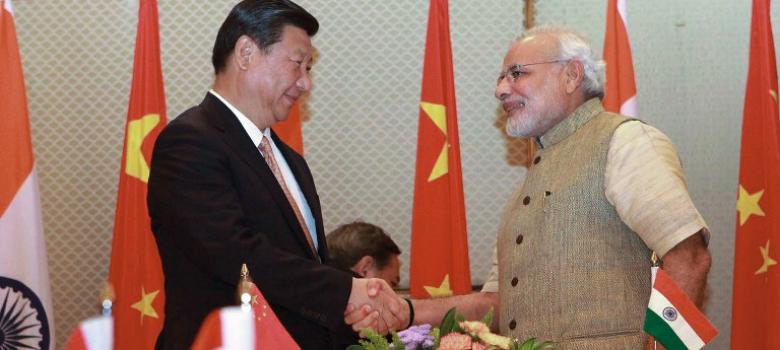
Prime Minister Narendra Modi’s meetings with Chinese President Xi Jinping this week once again showed that Mr. Modi is a master of media management.

The summit of the heads of the world’s two most-populous countries produced mixed results. A lot of agreements were signed, but the $100 billion in Chinese investment pledges that some local media had predicted did not materialize. And just as the leaders were shaking hands, there was an embarrassing faceoff between Chinese and Indian troops along the countries’ disputed boundary.

That didn’t stop India’s prime minister from again using photo opportunities and body language to broadcast his confidence, an impression that is likely to remain long after local media stop discussing the border tension and whether China had promised enough money.

Indians watching the visit wouldn’t have missed some of the symbolism. Mr. Xi flew into Mr. Modi’s home state, on the Indian prime minister’s birthday. Mr. Xi wore an  Indian vest that Mr. Modi gave him. Video of the two showed Mr. Modi walking in front of Mr. Xi at one event and swinging on a swing with him. At one point it even looked like Mr. Xi was carrying an umbrella for Mr. Modi.

Reuters Xi Jinping looked like he was carrying an umbrella for Narendra Modi during a recent visit to Gujarat.

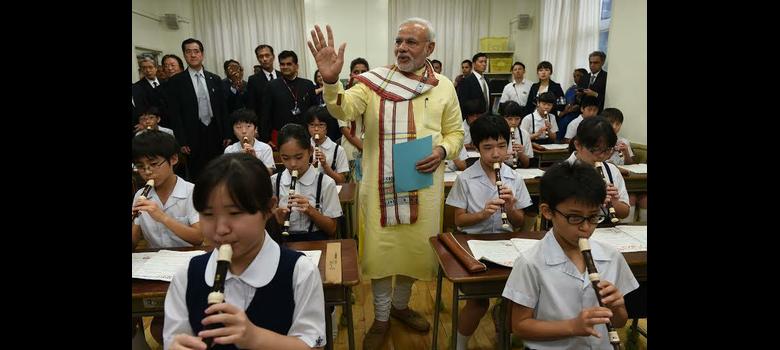
The Indian prime minister has used the same charisma in photo ops during other international summits, most recently in Japan where he gave Prime Minister Shinzo Abe a big bear hug and later performed a solo on traditional Japanese drums.

All of this has been beamed into Indian homes and marks a major change from the demeanor of the country’s previous prime minister, Manmohan Singh, who was soft- spoken and slow-moving.

Mr. Modi’s multimedia skills are one of the things that made him prime minister.  Whether it is his controversial selfies, the sight of hundreds of supporters wearing Modi masks, campaign speeches delivered through hologram, his stylish outfits or his willingness to put on almost any kind of regional headwear, Mr. Modi knows how to make an impression.

via Modi Uses Another International Visit to Raise His Local Profile – India Real Time – WSJ.

18/09/2014

Despite the Xi-Modi bromance, Indians and Chinese don’t actually like each other

One in two Indians thinks China is a major threat.

In the last two days alone, Chinese President Xi Jinping has called India an ancient, magic, enchanting, and beautiful land. And Indian Prime Minister Narendra Modi has reciprocated with syrupy adjectives, reminding visiting journalists how ancient Chinese technology was responsible for sugar being called cheeni in India.

The pictures of the two leaders’ bonhomie on Wednesday went even further. By the time you get to the sight of Modi and Xi sitting on a swing by the Sabarmati, most would imagine that India and China are steadfast allies who support each other through thick and thin.

Which is why it might be worth pointing out that we don’t actually like each other very much, and that Indians and Chinese people have very different intentions for the bilateral relationship. And it’s not just about the trade deficit and the border disputes. Ordinary Indians and Chinese people simply aren’t sure whether they like each other.

via Scroll.in – News. Politics. Culture..

17/09/2014

5 Things to Look Out for During Xi Jinping’s Visit to India – WSJ

Manan Vatsyayana/Agence France-Presse/Getty Images

1 INFRASTRUCTURE

Prime Minister Narendra Modi is looking for foreign capital and expertise to build “smart cities”, high-speed trains and modern airports of the kind that China has built for itself in the past decade. The two leaders are expected to sign a deal to bring bullet trains to India and may also reach an agreement for the building of world-class railway stations and airports.

2 INDUSTRIAL PARKS

The two countries laid the groundwork for Chinese investment in industrial parks in India when Indian Vice-President Hamid Ansari visited Beijing in June. Indian officials say they expect to ink deals worth $5 billion for two parks – one in the western state of Gujarat, Mr. Modi’s home state, and the other in Maharashtra. The idea is to make it easier for Chinese companies to set up shop in India.

3 BORDER TROUBLES

Territorial disputes that have long dogged Sino-Indian ties aren’t the focus of this visit, but are sure to come up. Two reports this week – one about an alleged incursion by Chinese troops in Ladakh and another about protests by Chinese civilians and troops against the construction of an Indian canal along the disputed border – have highlighted the unresolved issues. Even after 17 rounds of talks, no solution has emerged – don’t expect one during this visit either.

4 COMPETITION WITH JAPAN

Indian newspapers have been filled with anticipation about whether China will outdo its Asian rival, Japan, in promising investments for India. Earlier this month, Japan pledged to pour $35 billion into India over five years; China is expected to go further. Expect reams of analysis of Mr. Xi’s rapport with Mr. Modi. When Japanese Premier Shinzo Abe met Mr. Modi, they bear hugged.

5 BREAKING OUT OF THE MOLD

Officials have raised hopes of a “directional change” and an “orbital jump” in Sino-Indian ties, which have long been bogged down by bureaucratic mistrust. Trade relations have flourished in the past decade, but are skewed in China’s favor– and investments have remained very low. Experts are hoping Mr. Modi – who worked with Chinese as chief minister of Gujarat – will adopt a pragmatic approach to push for Chinese money. If he succeeds, the visit may set the stage for an era of economic collaboration between the two Asian giants.

via 5 Things to Look Out for During Xi Jinping’s Visit to India – WSJ.

16/09/2014

Give the public a role in Clean Ganga project, says Rajendra Pachauri

India’s holiest river is due for a clean-up, with Prime Minister Narendra Modi taking personal responsibility for restoring the Ganga and ridding the 2,500 km long river of industrial effluents and untreated sewage.

Uma Bharti, Modi’s minister for water resources and Ganges rejuvenation, has said the river would be clean in three years. Earlier this month, India’s Supreme Court asked the government for a roadmap on the project so that the court could monitor it.

Rajendra Pachauri, chairman of the U.N.’s Intergovernmental Panel on Climate Change (IPCC), spoke to Reuters on the Ganga project, the need for transparency and how the public could help.

via India Insight.

15/09/2014

India’s Economy Looks a Lot Like China’s — In 2001 – India Real Time – WSJ

India today doesn’t look quite like the economic dynamo that, just a few years ago, some predicted would overtake China as emerging-markets champion.

But the race looks a lot closer if you account for one key fact: China got a 13-year head start on India in opening its economy and giving companies greater freedom to invest and produce. In exports, capital spending and foreign investment, India today is remarkably similar to China circa 2001.

That should both console and concern India as it gets back on its feet after three years of weak growth and high inflation. Console, since it suggests the country’s economy could remain on a China-like trajectory for years to come. But concern, because India’s delay could mean that the country has missed out on some big advantages that catalyzed China’s boom.

The latter point is especially worth considering given how assiduously India’s recently elected prime minister, Narendra Modi, is working to follow the blueprint for China’s export- and investment-driven success.

When Chinese President Xi Jinping visits the Indian capital this week he will encounter a recipe for economic revival that ought to look very familiar. Delhi is aiming to boost exports and raise India’s share in world trade by 50% over the next five years. “Sell anywhere,” Mr. Modi said in an Independence Day exhortation to global business last month. “But manufacture here.”

via India’s Economy Looks a Lot Like China’s — In 2001 – India Real Time – WSJ.

05/09/2014

Modi’s first 100 days looked more like Manmohan’s than Vajpayee’s

The new prime minister hasn’t faced a major crisis or unveiled a startlingly new policy.

For the last week, Indian newspapers, channels and websites have been plastered with evaluations of Narendra Modi’s first 100 days. From dedicating entire editions to the 100-day landmark to building complex timelines describing every policy announcement over the last three months (and even comparing what has been achieved to the Bharatiya Janata Party’s campaign promises), there has been so much content that it’s hard to arrive at a conclusion about whether Modi’s Prime Ministership has been good or bad.

That might be expected, considering the scale of the challenge that the new government has set for itself. Alternatively, it might also be surprising: many expected Modi Sarkar to be a hate-it-or-love-it administration, rather than one that would leave people with lukewarm feelings.

Another way to approach the question might be to try and figure out how Modi’s first 100 days will be remembered. The first few months of new governments can often set the tone for what is to come. In hindsight, the trends picked up in the first days are then grafted on to narratives that are applied to entire tenures.

A look back at previous prime ministers might give us an inkling of how this will play out.

via Scroll.in – News. Politics. Culture..

05/09/2014

Nawaz Sharif attempts mango diplomacy to placate Modi

Pakistan government keen on reigniting diplomatic ties with India

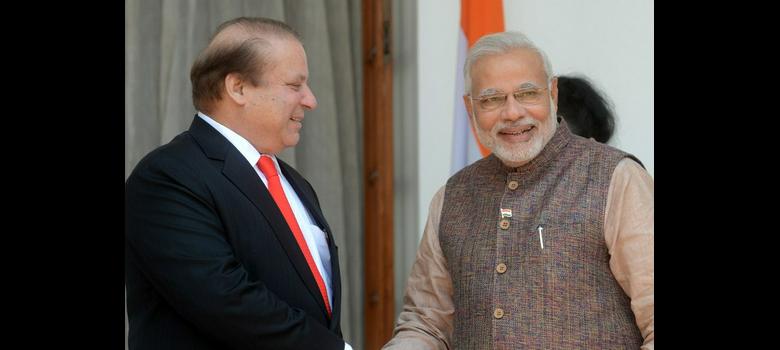
Pakistan Prime Minister Nawaz Sharif on Thursday sent a package of special mangoes from his country through “official channels” to his Indian counterpart Narendra Modi. This move is seen in Indian diplomatic circles as Pakistan’s initial attempt to rectify the damage caused by its High Commissioner Abdul Basit’s meetings with separatist leaders from Kashmir last month. In response to these meetings, India had cancelled foreign-secretary levels talks with Pakistan scheduled for August 25. Meanwhile, there is speculation that Modi and Sharif might conduct bilateral talks on the sidelines of the United Nations General Assembly summit in New York later this month.

via Scroll.in – News. Politics. Culture..

03/09/2014

These photos show what Modi did in Japan when he wasn’t attending to business

All prime ministers enjoy spending time abroad, especially if it is while visiting a particularly friendly ally.

Prime Minister Narendra Modi isn’t exactly the jovial type. Sure, he peppers his speeches with a bit of light humour occasionally, but he doesn’t seem like the kind of person who would enjoy a comedy night on television. So what could possibly make him really happy? The same thing that makes heads of states happy all over the world: leaving their own countries to visit friendly allies.

And by any measure, it seems like Modi managed to have a blast in Japan (even if no nuclear deal was signed). Since he also happens to be the Selfie Era Prime Minister, every moment of this fun journey was documented and promptly tweeted by the prime minister’s official twitter account.

more photos from:  http://scroll.in/article/677092/These-photos-show-what-Modi-did-in-Japan-when-he-wasn’t-attending-to-business

01/09/2014

Japan and India vow to boost strategic ties during summit | Reuters

Japan and India agreed on Monday to strengthen strategic ties as Asia’s second and third biggest economies keep a wary eye on a rising China, and said they would accelerate talks on the possible sale of an amphibious aircraft to India’s navy.

India's Prime Minister Narendra Modi (R) and Japan's Prime Minister Shinzo Abe shake hands before their talks at the state guest house in Tokyo September 1, 2014. REUTERS/Toru Hanai/Files

Japanese Prime Minister Shinzo Abe and his Indian counterpart Narendra Modi also agreed to speed up talks on a so-far elusive deal on nuclear energy cooperation, welcoming what they called “significant progress” in the negotiations.

“The two prime ministers reaffirmed the importance of defense relations between Japan and India in their strategic partnership and decided to upgrade and strengthen them,” Abe and Modi said in a statement after a summit in Tokyo.

Modi, on his first major foreign visit since a landslide election win in May, arrived on Saturday for a five-day trip aimed at capitalizing on a personal affinity with Abe to bolster security and business ties in the face of an assertive China.

In a sign of their warm ties, the two leaders greeted each other with a bear hug when they met on Saturday in Japan’s ancient capital of Kyoto for an informal dinner. Modi is one of three people that Abe follows on Twitter, while the Indian leader admires Abe’s brand of nationalist politics.

“The 21st century belongs to Asia … but how the 21st century will be depends on how strong and progressive India-Japan ties are,” Modi told Japanese and Indian business executives earlier in the day.

“The 18th century situation of expansionism is now visible,” Modi said, referring to incidents such as encroachment of others countries’ territories and intruding in other countries’ seas, in a veiled reference to China, with which India shares a long disputed border.

“Such expansionism would never benefit humanity in the 21st century,” he said.

Sino-Japanese ties have also been chilled by a row over disputed isles, feuds over the wartime past, and mutual mistrust over defense policies as China seeks a bigger regional role and Abe loosens the constraints of Japan’s post-war pacificism.

Abe is keen to expand Japan’s network of security partnerships with countries such as India and Australia to cope with the challenge presented by China.

via Japan and India vow to boost strategic ties during summit | Reuters.

18/08/2014

Modi Sends India’s Soviet-Inspired Planning Commission Packing – India Real Time – WSJ

India’s prime minister used his inaugural Independence Day speech last Friday to cut off an arm of the country’s government that dates back nearly all the way to independence: the powerful, unloved and sometimes irrelevant-seeming Planning Commission.

The body was the creation of Jawaharlal Nehru, India’s first prime minister, who took from the experience of Japan and the Soviet Union the lesson that late-industrializing countries needed to use state intervention to transform their economies from the “commanding heights.” In the words of the 1950 cabinet resolution that created the commission: “The need for comprehensive planning based on a careful appraisal of resources and on an objective analysis of all the relevant economic factors has become imperative.”

Narendra Modi said on Friday that India could do better. The new prime minister said circumstances had changed since the commission’s creation. He said the federal government wasn’t the only driver of economic growth, and that state governments needed to be empowered to innovate. He promised the creation of a new institution that would serve as a platform for exchanging economic-policy ideas within government.

The announcement wasn’t unforeseen. The prime minister serves ex officio as the Planning Commission’s chairman. But Mr. Modi had spent his first months in office leaving the commission’s other full-time seats conspicuously unfilled. As a former chief minister of the western state of Gujarat, Mr. Modi was said at the time of his election this spring to have a strong interest in giving state governments more space to set budget priorities.

Killing the Planning Commission won’t entirely decentralize government spending in India. Federal tax revenue, according to the country’s constitution, is first distributed between the central and state governments by the Finance Commission. The Planning Commission then allocates spending to states along lines laid out in its Five-Year Plan for the economy.

That’s how it’s supposed to work, at least. Critics have accused the Planning Commission of gradually usurping the Finance Commission’s role as chief arbiter between the federal and state governments, all in the service of Five-Year Plans that are meticulously crafted but rarely achieved. The current plan, which covers 2012 to 2017, runs to three volumes and more than 1,000 pages. It covers all and sundry from boosting the manufacturing sector and increasing female literacy to promoting sports medicine and modernizing the powerloom sector.

The Five-Year Plans pervade policy making in India, at least in name if not always in effect. All federal expenditure is classified as either “plan” or “non-plan,” depending on whether it is undertaken in pursuit of the current Five-Year Plan. The Planning Commission occupies a monolithic grayish structure in New Delhi—Yojana Bhawan, or “Planning House”—just down the road from Parliament.

via Modi Sends India’s Soviet-Inspired Planning Commission Packing – India Real Time – WSJ.

Law of Unintended Consequences

continuously updated blog about China & India

ChiaHou's Book Reviews

continuously updated blog about China & India

What's wrong with the world; and its economy

continuously updated blog about China & India