Posts tagged ‘Modi’

15/08/2014

Modi Targets Bureaucrats, Manufacturing and Toilets in Independence-Day Speech – India Real Time – WSJ

In his first Independence Day speech Friday, Indian Prime Minister Narendra Modi listed the issues he plans to focus on as the leader of the world’s largest democracy: bickering bureaucrats, women’s rights, manufacturing jobs, trash and toilets.

“You might say Independence Day is an opportunity to talk about big ideas and make big declarations. But sometimes, when these declarations are not fulfilled, they plunge society into disappointment,”said Mr. Modi, who is the South Asian nation’s first prime minister born after India gained independence from Britain 67 years ago. “That’s why I’m talking about things we can achieve in our time.”

Mr. Modi’s Bharatiya Janata Party was propelled to power by Indians who, hungry for better jobs and a higher standard of living, grew frustrated with slowing growth under the previous Congress-led government. Since coming to power in May, Mr. Modi has made some cautious policy moves, disappointing some of his supporters who had expected immediate and bold change from his administration.

Addressing the nation from the ramparts of New Delhi’s regal Red Fort Friday, Mr. Modi said he plans to set the government in order and stop bureaucratic squabbling, underlining his focus on administrative processes rather than economic overhauls. As “an outsider” to New Delhi, he said, he has been shocked since taking office to find that “there were dozens of governments inside the government,” each with “its own fiefdom.”

“Departments are fighting each other, suing each other in the Supreme Court,” Mr. Modi said. “How can they move the country forward?”

In his nearly hour-long speech delivered largely in Hindi, Mr. Modi reiterated his focus on making India a global manufacturing hub and export powerhouse.

Offering a new slogan in English, “Come, make in India,” Mr. Modi invited the world to come to India to manufacture.

“Sell anywhere in the world but make it here,” he said. “Electricals to electronics, chemicals to pharmaceuticals, automobiles to agro-products, paper or plastic, satellites or submarines — Come, make in India.”

Mr. Modi questioned why India needs to import “every little thing,” and urged the country’s youth to open factories and export goods.

Manufacturing makes up only around 15% of India’s gross domestic product as most of its rapid expansion over the last decades has come from the service sector. During spring elections the BJP said it planned to create millions of new jobs if elected. Economists say one of the best ways India can generate employment is through exports.

While India’s labor costs are among the lowest in the world, it has consistently failed to become an export powerhouse like China and Asia’s other largest economies.

Prime Minister Modi also announced initiatives aimed at modernizing India: a nationwide drive for cleanliness that would boost tourism, a program for parliamentarians to transform villages, one by one, into “model villages,” encouraging politicians and companies to build more toilets so people don’t have to use the outdoors and a push to open bank accounts for all Indians.

Mr. Modi also used his speech to address an issue the new opposition has been demanding discussion on: religious violence. A Hindu nationalist leader accused of not doing enough to stop communal violence in the state of Gujarat in 2002 when he was chief minister there, Mr. Modi Friday urged Indians to stop communal fighting. Just this week, opposition parties accused the BJP of polarizing Indians on religious lines and analysts have blamed Mr. Modi of not addressing recent tensions.

“Who benefits from this poison of communalism? It is an impediment to growth,” Mr. Modi said. “Let us choose peace instead and see how it propels our nation forward.”

via Modi Targets Bureaucrats, Manufacturing and Toilets in Independence-Day Speech – India Real Time – WSJ.

10/08/2014

Modi has realised that India needs to be a regional power before it can be a global one

One of the many pet projects of those inclined more to the right has been turning the dream of “Akhand Bharat“, or Undivided India, into a reality. The Rashtriya Swayamsevak Sangh’s education saffroniser-in-chief, Dinanath Batra, has even written about the subject in his book Tejomay Bharat, which will now be stocked in Gujarat school libraries. “Undivided India is the truth, divided India is a lie,” Batra writes, referring to a vision of the nation that begins as far west as Afghanistan and goes all the way till Burma, including everything in between. “Division of India is unnatural and it can be united again,” Batra suggests.

Of course, no one in the government has spoken of Akhand Bharat and Prime Minister Narendra Modi has never clearly explained his understanding of the concept. There is no indication that the government intends to implement any policy that aims to reinstate this fanciful notion of what India once was and there is no reason to believe there will be.

But the concept could be a rubric by which to understand the Modi government’s approach to foreign policy, particularly in the neighbourhood. From the very get-go Modi announced his intention to reinvigorate ties with India’s neighbours by inviting to his swearing-in ceremony each of the leaders from the South Asian Association for Regional Cooperation — the primary multilateral forum for subcontinental nations.

Just two-and-a-half-months in, the PM has visited two of India’s neighbours, his foreign minister has visited four, and India is set to become part of multilateral organisations that will give it many more opportunities to project itself as a regional powerhouse. This is Akhand Bharat 2.0.

Regional power

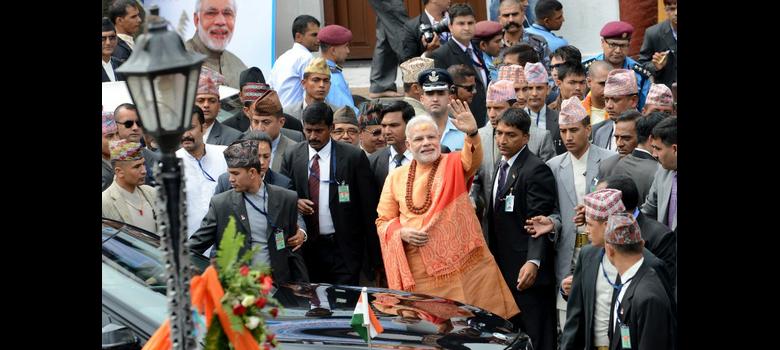
Foreign minister Sushma Swaraj is currently in Myanmar, the fourth neighbourhood country that she has visited in the last three months. But it was the trip made by Modi to Nepal that really sent a statement, since it was the first visit by an Indian prime minister to the country in 17 years. He received an enthusiastic reception.

“All governments that come to power in India feel that we must improve our relationship with the neighbourhood,” said Kanwal Sibal, a former foreign secretary. “But the difference is that, whereas in the past it remained at the level of rhetoric, in this case they are translating it into concrete initiatives. The fact that an Indian PM visited Nepal after 17 years is a testimony to the fact that, despite our professed position about needing a secure neighbourhood, we have actually neglected it… that is changing.”

That message was sent at the very beginning with the invitations handed out to each of the SAARC leaders for Modi’s swearing-in, all of which were accepted — with the exception of Bangladesh’s Sheikh Hasina, but only because she was on another diplomatic visit at the time. The sight of all the leaders in front of Rashtrapati Bhavan, and Modi dedicating his first day in office to bilateral talks with them, sent a very clear signal. The PM made his first foreign visit to Bhutan, a country deeply connected to India but not particularly important in terms of foreign policy.

“It shows that they understand that unless India is a dominant regional power, we can hardly be an extra-regional power or a world power,” said Manoj Joshi, a distinguished fellow at the Observer Research Foundation. “They seem to definitely be working on this understanding, especially because we are facing stiff competition from the Chinese when it comes to projecting power in the neighbourhood.”

Leading South Asia

It’s not just symbolism and rhetoric either. Modi’s visits to Bhutan and Nepal have been accompanied by important agreements, such as a $1 billion line of credit to Kathmandu, as well as the promise of further talks. Discussions with Bangladesh have also indicated progress on key stumbling blocks between the two nations. Modi has also spoken of using the SAARC framework to further cooperation in the neighbourhood. His suggestion of a SAARC space satellite, for example, while criticised by some as a gimmick, certainly sent a message that he is looking beyond the potential disputes towards projects that would allow the countries to work together.

“He has staked his leadership of the region, and this is important,” Sibal said. “There is a gesture to friendship in the neighbourhood, but he has also put across the message that India is leading the region. India is not going to neglect its neighbourhood, and it will take the lead in creating synergies that can benefit all.”

via Scroll.in – News. Politics. Culture..

06/08/2014

Insurance Bill Struggle Pokes Another Hole in the Notion of Modi Magic – India Real Time – WSJ

The new government in New Delhi is struggling this week to get an insurance-industry liberalization bill— an important part of its campaign to revamp the economy—to the floor of the upper house of Parliament.

Opening up the insurance business to more foreign investment was one of the main deregulation measures unveiled in Prime Minister Narendra Modi’s first budget last month.

But already it is bogged down. Mr. Modi’s Bharatiya Janata Party does not control the upper house and other parties want to stall a vote on the bill.

The legislative tussle is a sign of the challenges Mr. Modi faces, despite his party’s landslide electoral victory and the BJP’s lower-house majority, as he tries to push through even modest changes in the way India manages its economy.

Mr. Modi swept to power this spring on a surge of anti-incumbency sentiment and hope that the BJP could break the policy deadlock in the capital. Supporters expected Mr. Modi bring the “achche din,” or good days, back to Asia’s third-largest economy.

But India’s complicated national politics, its decentralized federal system and Mr. Modi’s own desire not to get too far ahead of public opinion in a country long used to large-scale welfare schemes and a heavy state hand in the economy, is likely to slow any change.

The new administration’s national budget, announced in July, was bland and disappointing to many. It did not include the kind of big-bang reforms many optimists had anticipated.

In response to criticism of the budget, India’s new Finance Minister Arun Jaitley told a television news channel that the government is waiting for the right time to implement some changes.

“You don’t do reforms in a manner that the political system is unwilling to accept them,” Mr. Jaitley said during a July interview on Headlines Today. “The more challenging ones, you go on that course in times to come.”

Last week, Mr. Modi’s government blocked an important trade agreement that all 160 members of the World Trade Organization—including India—had agreed to in December. India demanding more freedom ratchet up market-distorting food subsidies.

“This is an inauspicious start for the new Modi government,” said Orrin Hatch, a Republican U.S. senator from Utah and member of the Senate Finance Committee in response to India’s decision.

M. J. Akbar, a BJP spokesman, says the party is happy with its progress. He said the government has focused on dealing with inflation, encouraging growth and reaching out to neighboring countries.

“On the insurance bill, the government has shown complete firmness in pushing it through,” and will use a joint-session of Parliament to vote on it if the upper house refuses, he said.

Still, the gradual deflation of the Modi bubble can be seen in the stock and currency markets. The benchmark Sensex index, has basically been going sideways for the last two months, after a sharp run up as the scale of Mr. Modi’s election win became clear.

The rupee has also been giving up some of this year’s gains against the dollar.

Of course the less excitable analysts and executives have always said the complexity of running the world’s largest democracy means that decision making will remain a slow and often painful process, even with a majority in the lower house of Parliament.

Many of the biggest challenges to improving the lives for India’s 1.2 billion citizens—such as reducing corruption, building modern infrastructure and providing hundreds of millions of good jobs–will take years, if not decades, surmount, even with the right policies and a charismatic leader.

“If a handful of people decide that (the progress so far) is insufficient, we have to ignore them and recognize that the majority of India is both relieved that the return of governance as well as the return of hope,” said the BJP’s Mr. Akbar. “Files are being cleared after ages of stagnation.”

–Prasanta Sahu contributed to this story.

via Insurance Bill Struggle Pokes Another Hole in the Notion of Modi Magic – India Real Time – WSJ.

15/07/2014

In First Meeting, Modi and Xi Discuss Decades-Long Border Disputes – India Real Time – WSJ

In their first one-on-one meeting, Chinese President Xi Jinping and Indian Prime Minister Narendra Modi spoke about finding a resolution to the long-standing boundary dispute between the Asian neighbors, a goal that has eluded the two countries for decades.

In talks lasting 80 minutes, Mr. Modi told Mr. Xi that “it is necessary to resolve the boundary question,” Syed Akbaruddin, a spokesman for India’s foreign ministry, said in a televised interview after the meeting in Brazil on the sidelines of a summit of BRICS countries. Pending that, Mr. Modi said, “peace and tranquility need to be maintained on the border,” according to Mr. Akbaruddin.

Mr. Xi called for “negotiated solutions” to the dispute at an early date, China’s official Xinhua News Agency reported. He also said the two countries “should join hands in setting global rules so as to raise the voice of developing countries,” Xinhua said.

China has reached out to the new Indian administration, led by Mr. Modi, at a time when its ties with other Asian countries including Japan and the Philippines have soured over territorial disputes. The Chinese foreign minister visited New Delhi last month, and Beijing’s premier was the first foreign leader to talk to Mr. Modi after his swearing-in as prime minister earlier this year, following national elections.

Ties between India and China have long been characterized by mistrust, and the sentiment appears to linger. More than seven in 10 Indians are concerned that territorial disputes between China and its neighbors will lead to military conflict, according a Pew Research Center survey published Monday.

Nearly half of all Indians think China’s growing economy is a bad thing for their country, and only 31% of Indians had a favorable view of China, the survey showed. By comparison, 55% of Indians had a favorable view of the U.S. and 43% had a favorable view of Japan.

Tensions between India and China boiled over into a brief war in 1962, following which China gained control of a 14,600-square-mile territory known as Aksai Chin. China claims another 35,000 square miles in Arunachal Pradesh, a state in India’s northeast. Relations worsened last year when India alleged that Chinese troops had crossed into Indian-held territory in the Himalayan region of Ladakh, triggering a weekslong standoff.

On the campaign trail during national elections earlier this year, Mr. Modi promised to be tough on security issues. In a speech in February he warned China against having an “expansionist mindset.” In Mr. Modi’s first few weeks in office, his government has taken steps to boost infrastructure and connectivity on the Chinese border.

Mr. Modi’s China policy remains unclear, as does his ability and willingness to negotiate a border settlement, a process that has gone on for three decades. Special representatives appointed to work out a solution have so far held 17 rounds of talks.

The two countries signed an agreement last October aimed at easing hostilities on the disputed and ill-defined border, known as the Line of Actual Control, including commitments to ensure that patrols don’t escalate into military confrontations. But the agreement failed to impress security analysts in India, who said it was little more than a statement of intentions.

India is also worried about China’s growing influence in South Asia where New Delhi sees itself as the regional power. Mr. Modi has moved to revitalize India’s neighborhood ties, inviting South Asian leaders to his swearing-in and choosing Bhutan for his first foreign visit.  The government is also pushing to close India’s $40 billion trade deficit with China.

via In First Meeting, Modi and Xi Discuss Decades-Long Border Disputes – India Real Time – WSJ.

09/07/2014

World Review | China and India ignore border tensions to forge economic ties

CHINA and India have been attempting to ‘reset’ their bilateral relationship for years.

China and India ignore border tensions to forge economic ties

While the countries stand to gain much from improved cooperation, political animosity and territorial disputes dating back to the 1962 Sino-Indian Border Conflict have undermined progress, writes World Review guest expert Vaughan Winterbottom.

But just weeks after India’s newly-elected Prime Minister Narendra Modi took office, he has set in place plans to forge closer ties with neighbouring China.

This indicates that decades of cool relations may thaw between the world’s two most populated nations and realise Mr Modi’s election promises of reviving a flagging economy.

Early signs, however, indicate that New Delhi will continue its hard-line approach to territorial disputes with China.

Both countries are keen to separate business and politics and, as they pursue different agendas for diversifying their economies, bilateral trade may grow significantly.

In the 1950s, Beijing and New Delhi positioned themselves as leaders of the developing world. They jointly penned the ‘Five Principles of Peaceful Coexistence’ in 1954, a set of lofty doctrines which the two countries’ leaders saw as guiding post-colonial diplomacy.

But in 1962, the neighbours engaged in a fierce, month-long conflict over disputed mountain borders drawn by the British. China came to administer Aksai Chin, which India claims as part of Jammu and Kashmir, while India held Arunachal Pradesh, which China asserts is a region of Southern Tibet.

The 1962 war has had a profound impact on subsequent Sino-Indian ties.

India remembers it as a national humiliation, and has been suspicious of Chinese strategic intentions ever since.

For China, the war is less significant to the national psyche, though India’s continuing to host the Tibetan government in exile is viewed as interfering in Beijing’s internal affairs.

Skirmishes along the Line of Actual Control, a de facto border negotiated by the two countries in 1993 and 1996, continue to this day.

Despite tensions, hopes for a cooperative relationship remain. The two countries inaugurated a ‘Year of Friendship’ in January 2014, and proposed initiatives to boost economic, cultural and people-to-people links.

This year also marks the 60th anniversary of the Five Principles of Peaceful Coexistence. Beijing held a conference in June 2014 to mark the occasion. Both Chinese President Xi Jinping and Indian President Shri Pranab Mukherjee attended. They spoke of the importance of the Principles – and completely ignored the territorial disputes.

Beijing responded enthusiastically to the electoral victory of Narendra Modi in May 2014. However, old sticking points remain: just days before the Five Principles anniversary conference, four Chinese People’s Liberation Army speedboats crossed into the Indian-controlled side of Pangong Lake in Jammu and Kashmir. The boats were pushed back by Indian troops.

On the day of the anniversary conference, China published a new map which shows Arunachal Pradesh as Chinese territory and a large area of Jammu and Kashmir as part of China.

Even assuming these incidents are aberrations on the path to closer ties, early signs from Mr Modi do not suggest a China-policy rethink.

Mr Modi told a rally in Arunachal Pradesh in February 2014, ‘China should give up its expansionist attitude and adopt a development mindset… No power on earth can take away even an inch from India.’

Mr Modi’s National Democratic Alliance plans to spend US$830 million to settle areas close to the contested border in Arunachal Pradesh were announced on June 20. The region’s governor, Nirbhay Sharma, said that without greater settlement along the border, ‘a gradual assimilation of our area by China is on the cards’.

Given Mr Modi’s record of support for India’s territorial claims and his openly nationalistic politics, a Sino-Indian rapprochement is unlikely.

However, Mr Modi has presented himself as a pro-business leader keen to reform India’s stagflating economy.

On this point, he may find common ground with Beijing, which is no stranger to separating economics from politics in its dealings with foreign governments.

Mr Modi has already outlined a vision to turn India into a knowledge-based society with a large service sector.

A positive sign for future economic cooperation between India and China emerged at the end of June 2014 when Mr Modi’s cabinet approved a plan to set up Chinese industrial parks in five Indian states.

In the long run pharmaceuticals, IT, medical equipment and tourism may hold greater promise as export stalwarts.

As China’s economy edges up the value chain, India could move in to pick up the labour-intensive manufacturing slack. Doing so would require tackling India’s bloated bureaucracy, corruption and vested interests in order to free up land and labour. The task defeated former Prime Minister Manmohan Singh.

via World Review | China and India ignore border tensions to forge economic ties.

04/07/2014

BBC News – Indian PM Narendra Modi on maiden Kashmir visit

Prime Minister Narendra Modi is on his first visit to Indian-administered Kashmir amidst a protest shutdown called by separatist groups.

PM Modi flags off the first train from Katra

Mr Modi inaugurated a railway line in the Jammu region before travelling to Kashmir Valley to launch a hydro-power station and chair a security meeting.

Security is tight in the region and checkpoints have been set up to ensure the visit passes off peacefully.

Kashmir has been in the grip of an anti-India insurgency since 1989.

In recent years violence has abated from its peak in the 1990s, but the causes of the insurgency are still far from resolved.

Mr Modi arrived in Jammu on Friday morning from where he flew by a helicopter to Katra town where he flagged off a new train to Delhi.

Katra is the base camp for the Hindu pilgrimage centre of Vaishno Devi and the train will providing a direct link with Delhi.

Millions of pilgrims visit the shrine every year and railway officials say they expect the train will be popular with them.

Meanwhile, the Muslim-majority Kashmir Valley is shut down in response to calls from separatist groups to protest against Mr Modi’s visit.

In the state capital, Srinagar, shops, businesses, offices, schools and banks are closed and there is little traffic on the roads in most parts of the valley.

Mr Modi will later fly to Uri town in north Kashmir to inaugurate a hydro electrical project.

via BBC News – Indian PM Narendra Modi on maiden Kashmir visit.

03/07/2014

Keys to Successful Reform in India – India Real Time – WSJ

India’s new Prime Minister, Narendra Modi, won a decisive mandate from an electorate yearning for effective leadership. His government’s first budget due out next week will be an important indicator of how forcefully Mr. Modi intends to translate this mandate into actions to put India’s economy back on track.

Of course, despite his clear mandate, Mr. Modi will not have a free hand to impose reforms by decree. He is constrained by a democratic system of government and accountability to the electorate. Hence, both the strategy and the specifics of reform will be crucial to making the program a success.

A key priority is to signal greater fiscal discipline. High levels of public deficits and debt, exacerbated by wasteful subsidies and an inefficient tax system, have created many market distortions and contributed to high inflation. Populist sops have also reduced resources available for expenditure on infrastructure, education and other areas that could boost long-term productivity.


The government needs to commit to long-term fiscal discipline. It should move aggressively to reduce fuel subsidies, implement a goods and services tax, and step up the pace of privatization of state enterprises. These measures would not only improve the fiscal position of the government but also enhance overall economic efficiency by shifting the focus away from purely redistributive policies.

It will also be helpful to signal that the government will not look for easy targets, such as foreign firms, to raise revenues by changing the rules whenever convenient. Policy certainty is as important for domestic investors as it is for foreign ones.

via Keys to Successful Reform in India – India Real Time – WSJ.

11/06/2014

Nawaz hopes to resolve unsettled matters with Modi – Pakistan – DAWN.COM

In a letter written to Indian premier Narendra Modi on Wednesday, Prime Minister Nawaz Sharif said he looked forward to working him in harmony to resolve all unsettled matters in the interest of the two nations.

Prime Minister Nawaz Sharif (L) and Indian premier Narendra Modi (R). — File photo

The premier also expressed satisfaction over his visit to India.

“I have returned satisfied with meaningful exchange of thoughts over regional issues and matters of mutual interest,” Sharif said.

“Million of people living in poverty in both countries deserve our foremost attention and their future is integrated with our common economic destiny,” Sharif said.

The premier further said that prosperity could be brought to both nations with concerted efforts.

He also said that he hoped that mutual endeavours by both countries would brighten their futures.

Sharif was invited to Prime Minister Modi’s swearing-in ceremony after the Bharatiya Janata Party (BJP) emerged victorious in the general elections held in the world’s largest democracy during the course of two months. The invitation was accepted after a series of consultations that the premier held with his close aides.

Sharif had also phoned Modi to congratulate him on his party’s win in the elections.

via Nawaz hopes to resolve unsettled matters with Modi – Pakistan – DAWN.COM.

10/06/2014

Indian PM Modi meets with Chinese FM – Xinhua | English.news.cn

Indian Prime Minister Narendra Modi Monday met here with visiting Chinese Foreign Minister Wang Yi, the special envoy of Chinese President Xi Jinping.

INDIA-NEW DELHI-PM-CHINA-WANG YI-MEETING

During the meeting, Wang conveyed greetings and messages from President Xi and Chinese Premier Li Keqiang to Prime Minister Modi.

The Chinese president said in his message that he believes India will obtain greater development and progress under the leadership of Prime Minister Modi.

The Chinese president said that as two important forces in the process of multi-polarization of the world, China and India share far more common interests than differences and that the two countries are long-term strategic cooperative partners rather than adversaries.

The Chinese president pointed out that the dreams of both China and India to build a strong nation and to upgrade the living standards of their people have a lot of commonalities and the two countries should make an in-depth convergence of their development strategy, support each other with their respective strengths, build a close development partnership, and hold hands to realize peaceful development, cooperative development, and inclusive development, in order to benefit their people and enhance peace, stability and prosperity of Asia and the whole world.

Prime Minister Modi said that the important message from President Xi Jinping has given a clear guidance for developing bilateral relations.

Modi said he highly appreciates the achievements in the field of development made by China and personally cherishes a friendly feeling toward China.

Modi said India’s new government is willing to join China to give a clear signal to the world that the two countries are dedicated to common development.

He suggested that the two countries maintain exchange of high- level visits, consolidate strategic trust, and use each other’s strengths to deepen cooperation in the fields of infrastructure, manufacturing, and IT industry.

Modi also said that India and China should develop their resources of two ancient civilizations to enhance cooperation and increase exchanges in humanity.

On the boundary issue, he said the two countries should commonly maintain peace and tranquility on the border areas in order to provide guarantees to the development of bilateral relations.

Foreign Minister Wang said that China and India are now standing at a new historical starting point of developing their relations and in the meantime are faced with important opportunities of their own development.

He said that China is ready to realize convergence with India in the fields of development theories and ideas, exchange and learn from each other in practice and theories of governance.

Wang said China is also willing to realize convergence of development strategies with India and let the “Look East” policy of India meet and confluence with China’s acceleration of opening its western regions.

The two countries should also use their respective strong points to support and supplement each other in their respective development, he said.

Wang said as the two ancient civilizations, China and India should join each other to make new contributions to human civilization and progress. He also suggested that the two countries properly control and manage their boundary problem to seek a mutually acceptable, fair and reasonable solution to the boundary issue.

via Indian PM Modi meets with Chinese FM – Xinhua | English.news.cn.

Enhanced by Zemanta
10/06/2014

India’s Modi calls for greater cooperation with China | Reuters

Indian Prime Minister Narendra Modi urged greater cooperation with China on Monday and said he planned to visit Beijing soon, underlining his administration’s promise to make a new beginning with the country’s giant neighbor.

India's Prime Minister Narendra Modi comes out of a meeting room to receive his Bhutanese counterpart Tshering Tobgay before the start of their bilateral meeting in New Delhi May 27, 2014.   REUTERS/Adnan Abidi

India and China have rapidly expanded commercial relations in recent years but political ties remain difficult, after a dispute over their Himalayan border that led to a war in 1962.

But Modi, who took power last month, is seeking to engage with India’s neighbors, including China. A peaceful and stable neighborhood would help him pursue his economic goals at home.

On Monday, he met Chinese Foreign Minister Wang Yin, who was visiting India as a special envoy of China’s president to build ties with the new administration in New Delhi.

On Sunday, Wang had a meeting with his Indian counterpart, Sushi Sward, that lasted more than three hours. It was the first high-level engagement between the two countries since Modi assumed office.

“The two sides will remain in touch through the diplomatic channel to make necessary arrangements for these visits and for other meetings and exchanges of leaders on the sidelines of multilateral summits,” the Indian foreign office said in a statement after Wang’s meeting with Modi.

It gave no other details. Modi has already invited Chinese President Xi Jin ping to visit New Delhi later this year.

India was once viewed as a rival to China’s economic juggernaut. Both the economies have slowed in the past two years, but India’s slowdown has been dramatic.

Asia’s third-largest economy grew 4.7 percent in the fiscal year that ended in March. That was the second straight year of sub-5 percent growth, the longest slowdown in more than a quarter of a century.

Modi, who last month won the strongest parliamentary majority in the past 30 years on a promise of economic revival and jobs, wants to push infrastructure and skill development – a model followed by China to boost economic growth – to promote a turnaround.

“Scale, skill and speed. If these three strengths we can stress upon, then we can rise to the challenge of competing with China,” he said at a book launch event on Sunday.

via India’s Modi calls for greater cooperation with China | Reuters.

Enhanced by Zemanta
Law of Unintended Consequences

continuously updated blog about China & India

ChiaHou's Book Reviews

continuously updated blog about China & India

What's wrong with the world; and its economy

continuously updated blog about China & India