Posts tagged ‘mumbai’

06/08/2014

Air India Loses Money to Dodge Giant Billboards in Mumbai – Businessweek

In the legion of problems that can beset an airline, here’s a novel one: gigantic billboards.

Super-sized advertisements stand in the flight path of Mumbai’s main airport, forcing departures to climb rapidly on takeoff. But Air India’s daily 15-hour flight to Newark, N.J., which requires a full load of fuel, would be too heavy to clear the billboard with its full load of passengers.

As a result, Air India now leaves 51 passengers off the Boeing (BA) 777-300ER. Flying 15 percent under capacity means losing 100 million rupees ($1.6 million) per month on the route, an Indian aviation minister told legislators on Monday, according to my Bloomberg News colleague, Anurag Kotoky.

Photograph by Dhiraj Singh for Businessweek.com

Airport officials at Chhatrapati Shivaji International have so far removed 13 of the 15 offending billboards in flight paths.

Air India has not reported a profit for eight years and required a government-funded rescue in 2012. United Airlines (UAL) uses a smaller 777-200 for the same route and has not experienced similar problems on departures, a spokeswoman told Bloomberg News.

via Air India Loses Money to Dodge Giant Billboards in Mumbai – Businessweek.

04/08/2014

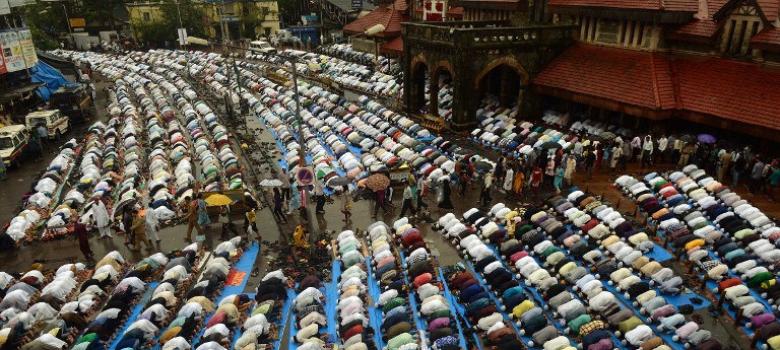
With court ban on illegal mosque loudspeakers, some Mumbai Muslims oppose street prayers too

The performance of religious practices in public spaces has occasionally caused friction in Indian cities. On July 30, the Bombay High Court addressed one particularly vexing source of strain when it asked the city police to take down all illegal loudspeakers attached to mosques in Mumbai and Navi Mumbai.

The court’s directive came in response to a public interest litigation filed by a Navi Mumbai resident against the unauthorised loudspeakers during prayer time at mosques. The court specified that all illegal loudspeakers, whether installed at mosques or at Ganesh or Navratri pandals, should be removed “irrespective of religion, caste or community”.

Even though the loudspeaker issue has been repeatedly politicised in Maharashtra (in 2010, the Shiv Sena had demanded a blanket ban on all mosque loudspeakers after the party was booked for violating noise norms at its Dussehra rally), several Muslim activists came out in support of the court directive.

But the call to prayer being announced on loudspeakers is not the only Muslim practice that some members of other communities complain about. In densely-populated cities like Mumbai, when large numbers of devotees gather to pray their Friday namaz, the congregation often spills out of the mosques and into the streets outside, hindering traffic and pedestrian movements for up to 30 minutes.

For many Muslim activists, this phenomenon is as much of an inconvenience to the public as the loudspeakers. But they believe the government has a greater role to play in helping to solve the problem.

“Nobody really likes to pray namaz outside on the streets, because it inconveniences so many people,” said Ghulam Arif, president of the Qartaba Wisdom Club, a Mumbai-based non-profit organisation that works on social issues. The only reason the practice continues, he said, is because the community is too large to fit into the existing mosques.

“The government could give Muslims the permission to organise Friday prayers in open grounds and maidans near mosques,” said Arif.

The community has been recommending a specific solution to the problem for nearly two decades: allowing mosques to expand by granting them additional floor space index. Increasing FSI  – the ratio of plot size to the height of a building that can be erected on it  –  would mean a greater number of floors to accommodate more worshippers.

via Scroll.in – News. Politics. Culture..

30/07/2014

US official vows to expand India trade, investment – Businessweek

The U.S. secretary of commerce has pledged to help expand investment in India’s infrastructure and to promote trade.

Penny Pritzker spoke Wednesday to business leaders in the Indian financial capital, Mumbai.

She said two-way trade has lagged in recent years but has still expanded by fivefold to $96 billion a year since 2000.

via US official vows to expand India trade, investment – Businessweek.

13/05/2014

India Poll Prospects Drive Auto Shares – India Real Time – WSJ

Shares of most automobile companies in India surged on Tuesday on expectations that the pro-business Bharatiya Janata Party will emerge victorious when national election results are announced Friday.

Maruti Suzuki India Ltd.532500.BY +1.97%, Mahindra & Mahindra Ltd.500520.BY +1.40%, Tata Motors Ltd.500570.BY +0.81%, Ashok Leyland Ltd.500477.BY +1.19% and Hero MotoCorp Ltd.500182.BY +3.17% were trading around their 52-week highs when markets closed Tuesday evening.

“This (share-buying) is mainly sentiment-driven,” said an analyst at a Mumbai-based brokerage, who did not wish to be named.  He expected auto shares to trade even higher if a BJP-led government with a clear majority were to emerge the winners of India’s federal election.

The analyst said investors are hoping that a government led by BJP’s Prime Ministerial candidate Narendra Modi would take strong steps to revive economic growth, increase foreign investment, and boost industrial growth, which would in turn improve market sentiment and demand for new vehicles in India, the world’s sixth-largest car producing market.

via India Poll Prospects Drive Auto Shares – India Real Time – WSJ.

Enhanced by Zemanta
08/05/2014

Website PlateCulture Helps Create Pop-Up Indian Restaurants Across Asia – India Real Time – WSJ

Sunil Dembla arrived at his upscale Bangkok home one recent Tuesday evening to find strangers around his dining room table.

So, he kicked off his shoes and began pouring red wine.

The guests were waiting for the famous chicken biryani, fish tikka and prawn curry made by Mr. Dembla’s wife, Anchaal. In the meantime, the couple’s daughters Neha, 18, and Karina, 14, were chatting with the group like seasoned hostesses.

For on this evening, the Demblas’ Phrom Pong home had become a cozy restaurant — with eight paying customers — thanks to a year-old website called PlateCulture.

Think of it as an Airbnb for foodies in parts of Asia: Keen home chefs open their home to interested diners, who pay a per-head fee for a family-style meal.

Guests, who can book solo or as a group, get the home-cooked cuisine and intimacy of a dinner party, without any work. Hosts get a chance to show off their culinary prowess and open up their homes to prospective friends — as Mrs. Dembla puts it, “expand recipe book and social circle at the same time.”

The Mumbai-born Mrs. Dembla’s menu was traditional Indian, with a few Thai twists added in a salute to her adopted home of Bangkok — for example, her aloo tikki potato croquettes were skewered with stems of fresh lemongrass.

“When we have guests, the food is fancier,” says Mr. Dembla, far from annoyed at coming home to a house full of visitors. “Who can complain about that?”

via Website PlateCulture Helps Create Pop-Up Indian Restaurants Across Asia – India Real Time – WSJ.

Enhanced by Zemanta
24/04/2014

Mumbai Shop Owners: Cut Taxes and Tame Corruption, Please – India Real Time – WSJ

As Mumbai’s traders hit the polls Thursday, many said they voted in favor of lower taxes and against corruption. High income and sales tax, import duty and rising prices have made it tougher to do business, many shop owners said.

Chetan Pishtoi at his plywood store, Sagar Ply, in South Mumbai. Shanoor Seervai/The Wall Street Journal

“In the past, I voted for the Congress,” says Chetan Pishtoi, a plywood-shop owner at Colaba market in South Mumbai, referring to the political party that currently leads India’s national government. “But now my eyes have opened. I see what [Narendra] Modi has done in Gujarat. If he wins, maybe he will do the same for India,” says Mr. Pishtoi, 30 years old.

Mr. Modi, the prime ministerial candidate of the rival Bharatiya Janata Party, is campaigning on the economic strength of the western state of Gujarat, where he is chief minister.

Mr. Pishtoi says food prices rose so much in recent years that he had to give his employees raises. “The public in Mumbai are sleeping hungry and the government hasn’t done anything about it,” Mr. Pishtoi says. Tomatoes and onions, he says, are priced beyond the reach of many.

Raju Lalwani at his men’s clothing store in Mumbai. Shanoor Seervai/The Wall Street Journal

Raju Lalwani, who runs a men’s clothes store, is also concerned about inflation. “Cloth has become so expensive, and even the tailors charge too much for stitching,” Mr. Lalwani says. “If the political party changes, maybe business will improve.”

His shop, Lovely Silk Stores, has been a family-run business for three generations. But the 58-year-old says his children won’t inherit the business. His son is studying to be an accountant, and his daughter is in grade 12.

via Mumbai Shop Owners: Cut Taxes and Tame Corruption, Please – India Real Time – WSJ.

Enhanced by Zemanta
17/04/2014

Non Residents Are Stakeholders in India’s Future Too – India Real Time – WSJ

Conversations in Mumbai are usually about the elections these days – be it at roadside food stalls or in the boardrooms of India’s financial capital.

The stakes, after all, are high: following a period of robust growth, the country’s economy has slowed considerably in the past few years – largely because of (depending on who you talk to) the global crisis, policy paralysis, corruption and such. Inflation too is a massive concern.

The need of the hour, most agree, is a secular, stable and investment-friendly government that helps create prosperity for India’s multitude, and not just for a few seen close to the powerful.

That in essence is also the main topic of discussion some 2000kms to the west of the city – for non-resident Indians in Dubai, a fast growing regional financial hub.

Back in the 70s and 80s, hordes of Indians left the country in search of better opportunities – many of whom came to the oil-producing Middle East countries. The tech boom of the 90s provided them another global opening, though by then economic reforms at home were also taking effect – helping drive growth and creating more and better-paying jobs in the next decade.

Many Indians still look abroad for livelihood, but have increasingly channelled a big chunk of their earnings back home in search of returns. And why not? Even global investors are happily betting on the country’s future.

India topped the global list for remittances in 2013 – receiving some $70 billion, according to a World Bank report last week, underscoring its importance as an important source of foreign exchange. To be sure, remittances last year were “more than the $65 billion earned from the country’s flagship software services exports,” the World Bank noted.

That the country has been among the leading recipients of remittances over the past few years is not surprising, given that some 25 million Indians (variously classified) live abroad and, in several cases, continue to have strong familial ties back home.

The importance of Indians living overseas and their contribution to the country has been recognised on various platforms – such as the Pravasi Bharatiya Divas, which has been held every year since 2003 to “mark the contribution of Overseas Indian community in the development of India,” according to the Ministry of Overseas Indian Affairs.

The ministry says these conventions facilitate the overseas Indian community to engage with the government and people for “mutually beneficial activities”. Simply put, Indians living overseas are increasingly participating more actively back home.

But they – the millions of NRIs – still can’t vote from foreign locations and choose a government of their liking in the country’s general elections.

via Non Residents Are Stakeholders in India’s Future Too – India Real Time – WSJ.

Enhanced by Zemanta
08/04/2014

Singapore Airlines to Start First-Ever A380 Superjumbo Flights into India – India Real Time – WSJ

Singapore Airlines Ltd.C6L.SG +0.68% will be the first commercial carrier to operate Airbus A380 superjumbos into India next month, after authorities there lifted a years-long ban on the world’s biggest jetliner.

The first A380 delivered to Singapore Airlines arrives at the Airbus Delivery Centre in Toulouse Blagnac, southern France, in this file picture taken October 15, 2007. Reuters

Singapore’s flag carrier says starting from May 30 it will deploy the double-decker A380, which seats up to 471 passengers, on daily flights to New Delhi and Mumbai, India’s two largest aviation hubs.

Those flights will replace two existing daily services currently flown by smaller Boeing 777 aircraft that are timed about 90 minutes apart, helping boost cost efficiencies for the airline. Another daily 777 service to both cities will remain unchanged, according to the airline.

Major airlines have been lobbying to fly the A380 into India since the aircraft’s commercial launch more than six years ago. Analysts say it will help alleviate worsening congestion at India’s major international gateways, particularly since the number of passengers is expected to rise in the coming years.

More In Singapore Airlines

Entry of Foreign Airlines Will Benefit Travelers

Tata Set to Take-Off Back into Aviation

Tata Group Charts Return to the Skies

Air India Bets on Frugal Indian Consumer

India prevented the A380’s entry for years because the government feared that foreign carriers would gobble up passenger traffic from state-owned Air India and other domestic carriers using the large planes. None of India’s carriers operate the jumbo jet.

India’s civil-aviation ministry finally lifted the unofficial ban in January, permitting A380 flights to and from New Delhi, Mumbai, Hyderabad and Bangalore as part of efforts to liberalize the aviation sector and revive growth.

Nine of the 10 airlines that currently operate A380s have scheduled flights into India, with at least five having expressed interest in flying the large jet into the country.

via Singapore Airlines to Start First-Ever A380 Superjumbo Flights into India – India Real Time – WSJ.

Enhanced by Zemanta
01/04/2014

The Links Between the Delhi and Mumbai Rape Cases – India Real Time – WSJ

The two crimes were strikingly similar: In both, a young, ambitious woman was gang-raped by a group of impoverished men in one of India’s premier cities.

But their connection didn’t end there.

National outrage at the first case, involving a physiotherapy student who died from her injuries in New Delhi in Dec. 2012, arguably had an impact on how the country reacted to the second, in which a photojournalist in Mumbai was attacked while out on an assignment in an abandoned area of the financial capital.

They are also linked through the law.

The Delhi rape triggered changes to legislation to protect women that were subsequently used to convict the men charged with the attack in Mumbai.

Parts of that toughened up legislation, which made death the maximum penalty for rape in the case of repeat offenders, are also being used, for the first time, against the men guilty of gang-raping the Mumbai photojournalist.

Three of the four men convicted of gang-raping the photojournalist have also been convicted and sentenced to life in prison for gang-raping a telephone receptionist a few weeks earlier at the same location.

This makes them repeat offenders, so eligible for the death penalty, said the public prosecutor when he pressed fresh charges against the men last week in the hope of securing a death sentence for them at a trial court in Mumbai.

In the case of the Delhi victim, the attackers were punished under the previous version of the law, which awarded the death penalty for murder in the rarest of rare cases but set the maximum penalty for rape to a life term of 14 years.

The trial judge in the case in Mumbai allowed the prosecutor to introduce the new charge of repeated offense before sentencing began, but the defense lawyers appealed against the decision in the high court. The defense also challenged the constitutional validity of handing the death penalty to repeat gang-rape offenders.

The Mumbai High Court rejected the defense’s appeal against the fresh charges but refrained from expressing  its view on the “tenability of framing additional charge.”

The judges added that their decision not to interfere in the trial court hearing fresh charges should not be construed as approval.

The High Court judges also observed that sentencing repeat gang-rape offenders to death could bypass the “rarest of rare” criteria, which has long been invoked to prevent judges from using the death penalty too frequently or in an arbitrary manner.

via The Links Between the Delhi and Mumbai Rape Cases – India Real Time – WSJ.

Enhanced by Zemanta
01/04/2014

Dharavi’s once-booming leather industry losing its edge | India Insight

A busy street in Asia’s largest slum Dharavi leads to a quiet lane where Anita Leathers operates its colouring unit. As children play near shops that sell everything from mobile phones and garments to raw meat and sweets, the mood at the leather unit is sombre.

The leather business is one of the biggest contributors to the Mumbai slum’s informal economy, estimated to have an annual turnover of more than $500 million. About 15,000 small-scale industries, spread over an area of 500 acres, deal in businesses such as pottery, plastic recycling and garment manufacturing.

But the leather trade has been hit hard by increasing competition, an influx of cheap Chinese goods, rising raw material costs and labour shortages in recent years, leading to a decline in demand and dimming prospects of the once-flourishing business.

At Anita Leathers, which has been colouring and supplying leather sheets to merchants in Mumbai for more than three decades, annual sales fell from 5 million rupees ($83,000) in 2007 to 500,000 rupees ($8,300) last year. This has forced its owner Babu Rao to put some workers on paid leave.

“In every season our sales are falling, there is no business,” said Rao as he chewed tobacco in his Dharavi office where samples of coloured leather were displayed on the wall. “Even retailers are suffering. If customers come, they will buy bags; if bags are not sold, who will buy leather from us?”

Dharavi has earned its distinction among slums because of the entrepreneurial skills of its estimated 1 million residents. While no official statistics are available for the slum, census data shows India’s slum population grew by a quarter to 65 million between 2001 and 2011. Critics have disputed these numbers.

Leather production was one of the first industries to be established in Dharavi when Muslim tanners migrated from Tamil Nadu to Mumbai in the 19th century. But they had to move to the outskirts because the manufacturing process was considered unsuitable for the growing business centre in south Mumbai, according to a 2010 book RE-Interpreting, Imagining, Developing Dharavi.

Leather manufacturing, polishing, colouring and retail became dominant after tanneries were banned in 1996 because of pollution concerns. Still, most of these businesses are struggling.

Also affecting trade is India’s slowing economic growth, rising interest rates and high inflation, which have weakened consumer sentiment in Asia’s third-largest economy.

via Dharavi’s once-booming leather industry losing its edge | India Insight.

Enhanced by Zemanta
Law of Unintended Consequences

continuously updated blog about China & India

ChiaHou's Book Reviews

continuously updated blog about China & India

What's wrong with the world; and its economy

continuously updated blog about China & India