Posts tagged ‘Narendra Modi’

07/08/2014

The BJP’s real opposition turns out to be a far-Left-far-Right combination

When the final results of the general election were tallied up, it was hard not to marvel at the sheer size of the Bharatiya Janata Party’s victory and the unprecedented defeated delivered to the Indian National Congress. With the BJP emerging not just as the single largest party but also the first since 1984 to cross the halfway mark by itself and the Congress not even having enough seats to automatically be given the Leader of the Opposition post, there were genuine concerns about unbridled majoritarianism. Where would the opposition to the BJP come from?
Since the Congress continues to occupy the muddled middle and has pinned all its hopes on  Rajya Sabha numbers, where it has more seats than the BJP, the answer actually turns out to be an unusual combination of players both to the right and the left of the BJP. From labour law reform to the introduction of further foreign direct investment in insurance, it is BJP-affiliated organisations making common cause with pro-labour and Leftist outfits that have caused the most headaches for the new government.

With the Left and Right managing to converge on swadeshi issues, those who fall more in the pro-market camp within the BJP — many of whom were seen as the intellectual leaders of the campaign that brought Prime Minister Narendra Modi to power — are starting to get disconcerted with  government’s actions.

FDI in insurance

This appears to be the new government’s first big legislative battle, as the opposition parties have attempted to use their superior numbers in the Rajya Sabha to stand in the way of an attempt to increase the foreign direct investment cap in insurance from 26% to 49%. The government can resort to a joint sitting of the houses to bulldoze its legislation through the Parliament, but it is the reaction from trade unions and state insurance companies that has got the BJP concerned.

Crucially, the Bharatiya Mazdoor Sangh, the BJP-affiliated organisation that counts itself as the largest centrally organised trade union in the country, has joined forces with an array of other labour organisations as well as employees of state insurance corporations in threatening to strike if the cap is raised. The communist parties have always been staunch opponents of additional foreign investment. They have now come together with outfits like the BMS to prevent a move that finance minister Arun Jaitley has said is crucial to help reinvigorate economic activity.

Genetically modified crops

Shortly after representatives of the Swadeshi Jagran Manch and the Bharatiya Kisan Sangh met with environment minister Prakash Javadekar, he announced that the government was putting field trials of the genetically modified crops on hold. The news prompted loud howls from many who believe GM crops are important for Indian agriculture to take its next step forward. But it was welcomed by both the Sangh Parivar organisations that had met Javadekar as well as by many on the Left who have sought to halt GM crops for years now.

Swadeshi education

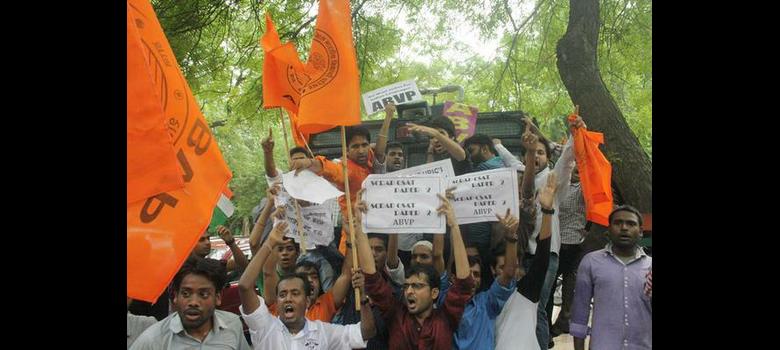
The Akhil Bharatiya Vidya Parishad, the BJP’s Youth Wing, sensed during last year’s Delhi University Student Union elections that opposition to the new Four Year Undergraduate Programme could be a key plank in remaining popular on campus. Incidentally, the FYUP had been opposed by the more left-wing organisations on campus from the very get-go, so the ABVP joined up with them to call for a roll-back of the four-year programme. The agitation quickly became a national issue, and eventually the FYUP was rolled back.

This ABVP-Left combine has now re-emerged in the agitation against the Union Public Service Commission’s Common Scholastic Aptitude Test, which is being fought on grounds that it is biased towards urban students. Yet again, the combined forces have managed to extract a concession from the government — despite opposition from the more reformist sections of the BJP.

Labour law reforms

Trade unions from across the country are meeting this week to try and decide how to approach the issue of labour law reforms, after the Rajasthan government last month passed legislation that made it easier for companies to retrench employees. These unions include both those on the Left, including the Communist Party of India (Marxist)-backed Centre of Indian Trade Unions  as well as the BJP-affiliated Bharatiya Mazdoor Sangh. Any decision to strike or launch a nationwide campaign by these groups could have a significant impact on a government that has insisted it is working primarily for the poor.

Foreign relations

The Modi government’s decision to vote against Israel at a United Nations forum shocked many supporters, who believe that India must be stand with Tel Aviv and remain steadfast against Islamic terrorism. It came as a pleasant surprise to those on the Left, however, who have always pushed India to speak up for those who live under Israeli occupation in Gaza and the West Bank.

The foreign relations convergence of the Left and Right was given a bigger boost after the Modi government decided to stand in the way of the World Trade Organisation’s Bali Package. Although the two factions here are unlikely to work together in pressuring the government to make decisions, particularly in the neighbourhood, the pressure to keep India relatively insulated from the West is likely to gain purchase from both sides.

via Scroll.in – News. Politics. Culture..

06/08/2014

Insurance Bill Struggle Pokes Another Hole in the Notion of Modi Magic – India Real Time – WSJ

The new government in New Delhi is struggling this week to get an insurance-industry liberalization bill— an important part of its campaign to revamp the economy—to the floor of the upper house of Parliament.

Opening up the insurance business to more foreign investment was one of the main deregulation measures unveiled in Prime Minister Narendra Modi’s first budget last month.

But already it is bogged down. Mr. Modi’s Bharatiya Janata Party does not control the upper house and other parties want to stall a vote on the bill.

The legislative tussle is a sign of the challenges Mr. Modi faces, despite his party’s landslide electoral victory and the BJP’s lower-house majority, as he tries to push through even modest changes in the way India manages its economy.

Mr. Modi swept to power this spring on a surge of anti-incumbency sentiment and hope that the BJP could break the policy deadlock in the capital. Supporters expected Mr. Modi bring the “achche din,” or good days, back to Asia’s third-largest economy.

But India’s complicated national politics, its decentralized federal system and Mr. Modi’s own desire not to get too far ahead of public opinion in a country long used to large-scale welfare schemes and a heavy state hand in the economy, is likely to slow any change.

The new administration’s national budget, announced in July, was bland and disappointing to many. It did not include the kind of big-bang reforms many optimists had anticipated.

In response to criticism of the budget, India’s new Finance Minister Arun Jaitley told a television news channel that the government is waiting for the right time to implement some changes.

“You don’t do reforms in a manner that the political system is unwilling to accept them,” Mr. Jaitley said during a July interview on Headlines Today. “The more challenging ones, you go on that course in times to come.”

Last week, Mr. Modi’s government blocked an important trade agreement that all 160 members of the World Trade Organization—including India—had agreed to in December. India demanding more freedom ratchet up market-distorting food subsidies.

“This is an inauspicious start for the new Modi government,” said Orrin Hatch, a Republican U.S. senator from Utah and member of the Senate Finance Committee in response to India’s decision.

M. J. Akbar, a BJP spokesman, says the party is happy with its progress. He said the government has focused on dealing with inflation, encouraging growth and reaching out to neighboring countries.

“On the insurance bill, the government has shown complete firmness in pushing it through,” and will use a joint-session of Parliament to vote on it if the upper house refuses, he said.

Still, the gradual deflation of the Modi bubble can be seen in the stock and currency markets. The benchmark Sensex index, has basically been going sideways for the last two months, after a sharp run up as the scale of Mr. Modi’s election win became clear.

The rupee has also been giving up some of this year’s gains against the dollar.

Of course the less excitable analysts and executives have always said the complexity of running the world’s largest democracy means that decision making will remain a slow and often painful process, even with a majority in the lower house of Parliament.

Many of the biggest challenges to improving the lives for India’s 1.2 billion citizens—such as reducing corruption, building modern infrastructure and providing hundreds of millions of good jobs–will take years, if not decades, surmount, even with the right policies and a charismatic leader.

“If a handful of people decide that (the progress so far) is insufficient, we have to ignore them and recognize that the majority of India is both relieved that the return of governance as well as the return of hope,” said the BJP’s Mr. Akbar. “Files are being cleared after ages of stagnation.”

–Prasanta Sahu contributed to this story.

via Insurance Bill Struggle Pokes Another Hole in the Notion of Modi Magic – India Real Time – WSJ.

06/08/2014

Why Modi’s reference to Buddha’s birthplace was among the highest points of his Nepal visit

Nepal has long been irked by the common misconception that Buddha was from India, even though his accepted birthplace, Lumbini, is across the border.

The Nepalese are so outraged about the Indian appropriation of Buddha, some cable operators blocked Zee TV in the country last year for misidentifying the Enlightened One‘s birthplace.  To correct the record, the country has issued special Rs 100 currency notes proclaiming, “Lumbini: The Birthplace of Lord Buddha.” The controversy has even led a musician named Dhiraj Rai to record an overwrought pop song on the subject.

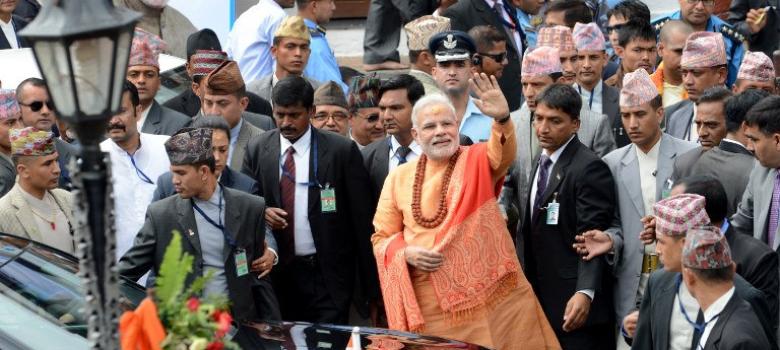
So for many residents of the mountain-kingdom, the highest point of Indian Prime Minister Narendra Modi‘s two-day state visit to their country came during his address to parliament on Sunday, when he referred to Nepal as “the birthplace of Lord Buddha”.

Though the Indian prime minister’s speech to lawmakers included the announcement of a $1 billion line of credit to Nepal and suggested how energy cooperation could be enhanced, the country’s Telegraph Weekly reported the address under the headline, “Indian PM Modi admits Lord Buddha was born in Nepal.”

The Khatmandu Post added more details. “Nepali lawmakers gave a thunderous applause when he mentioned that Buddha was born in Nepal – an issue that rouses deep passion in the country when various quarters of India claim that the former was born in India,” it wrote. “He uttered the word Buddha five times.”

Many Nepalese Twitter users expressed their delight at Modi’s statement.

via Scroll.in – News. Politics. Culture..

30/07/2014

US official vows to expand India trade, investment – Businessweek

The U.S. secretary of commerce has pledged to help expand investment in India’s infrastructure and to promote trade.

Penny Pritzker spoke Wednesday to business leaders in the Indian financial capital, Mumbai.

She said two-way trade has lagged in recent years but has still expanded by fivefold to $96 billion a year since 2000.

via US official vows to expand India trade, investment – Businessweek.

24/07/2014

China plans railway to India, Nepal borders by 2020 | Reuters

China plans to extend a railway line linking Tibet with the rest of the country to the borders of India, Nepal and Bhutan by 2020 once an extension to a key site in Tibetan Buddhism opens, a state-run newspaper reported on Thursday.

Tibetan railway bridge

Tibetan railway bridge (Photo credit: Wikipedia)

China opened the railway to Tibet’s capital Lhasa in 2006, which passes spectacular icy peaks on the Tibetan highlands, touching altitudes as high as 5,000 meters (16,400 feet) above sea level, as part of government efforts to boost development.

Critics of the railway, including exiled Tibetans and rights groups, say it has spurred an influx of long-term migrants who threaten Tibetans’ cultural integrity, which rests on Buddhist beliefs and a traditional herding lifestyle.

The Global Times, published by the ruling Communist Party’s official People’s Daily, said that an extention to Shigatse, the traditional seat of Tibetan Buddhism’s second-highest figure, the Panchen Lama, would formally open next month.

That link is scheduled for its own extension during the 2016-2020 period to two separate points, one on the border of Nepal and the other on the border with India and Bhutan, the newspaper cited Yang Yulin, deputy head of Tibet’s railways, as saying, without providing details.

China has long mooted this plan, but the difficulty and expense of building in such a rugged and remote region has slowed efforts.

Tibet is a highly sensitive region, not just because of continued Tibetan opposition to Chinese control, but because of its strategic position next to India, Nepal and Myanmar.

The Chinese announcement coincides with a drive by India, under its new prime minister Narendra Modi, to consolidate its influence with its smaller neighbors.

via China plans railway to India, Nepal borders by 2020 | Reuters.

15/07/2014

In First Meeting, Modi and Xi Discuss Decades-Long Border Disputes – India Real Time – WSJ

In their first one-on-one meeting, Chinese President Xi Jinping and Indian Prime Minister Narendra Modi spoke about finding a resolution to the long-standing boundary dispute between the Asian neighbors, a goal that has eluded the two countries for decades.

In talks lasting 80 minutes, Mr. Modi told Mr. Xi that “it is necessary to resolve the boundary question,” Syed Akbaruddin, a spokesman for India’s foreign ministry, said in a televised interview after the meeting in Brazil on the sidelines of a summit of BRICS countries. Pending that, Mr. Modi said, “peace and tranquility need to be maintained on the border,” according to Mr. Akbaruddin.

Mr. Xi called for “negotiated solutions” to the dispute at an early date, China’s official Xinhua News Agency reported. He also said the two countries “should join hands in setting global rules so as to raise the voice of developing countries,” Xinhua said.

China has reached out to the new Indian administration, led by Mr. Modi, at a time when its ties with other Asian countries including Japan and the Philippines have soured over territorial disputes. The Chinese foreign minister visited New Delhi last month, and Beijing’s premier was the first foreign leader to talk to Mr. Modi after his swearing-in as prime minister earlier this year, following national elections.

Ties between India and China have long been characterized by mistrust, and the sentiment appears to linger. More than seven in 10 Indians are concerned that territorial disputes between China and its neighbors will lead to military conflict, according a Pew Research Center survey published Monday.

Nearly half of all Indians think China’s growing economy is a bad thing for their country, and only 31% of Indians had a favorable view of China, the survey showed. By comparison, 55% of Indians had a favorable view of the U.S. and 43% had a favorable view of Japan.

Tensions between India and China boiled over into a brief war in 1962, following which China gained control of a 14,600-square-mile territory known as Aksai Chin. China claims another 35,000 square miles in Arunachal Pradesh, a state in India’s northeast. Relations worsened last year when India alleged that Chinese troops had crossed into Indian-held territory in the Himalayan region of Ladakh, triggering a weekslong standoff.

On the campaign trail during national elections earlier this year, Mr. Modi promised to be tough on security issues. In a speech in February he warned China against having an “expansionist mindset.” In Mr. Modi’s first few weeks in office, his government has taken steps to boost infrastructure and connectivity on the Chinese border.

Mr. Modi’s China policy remains unclear, as does his ability and willingness to negotiate a border settlement, a process that has gone on for three decades. Special representatives appointed to work out a solution have so far held 17 rounds of talks.

The two countries signed an agreement last October aimed at easing hostilities on the disputed and ill-defined border, known as the Line of Actual Control, including commitments to ensure that patrols don’t escalate into military confrontations. But the agreement failed to impress security analysts in India, who said it was little more than a statement of intentions.

India is also worried about China’s growing influence in South Asia where New Delhi sees itself as the regional power. Mr. Modi has moved to revitalize India’s neighborhood ties, inviting South Asian leaders to his swearing-in and choosing Bhutan for his first foreign visit.  The government is also pushing to close India’s $40 billion trade deficit with China.

via In First Meeting, Modi and Xi Discuss Decades-Long Border Disputes – India Real Time – WSJ.

11/07/2014

India to Spend $2.2 Billion on Water Supplies, Ganges – Businessweek

Prime Minister Narendra Modi’s new government today pledged 131 billion rupees ($2.2 billion) in spending on water projects to improve supplies and the condition of the Ganges, India’s largest river.

Ganges .. India

Ganges .. India (Photo credit: Nick Kenrick .)

Asia’s third-biggest economy will develop watersheds, build more pumping stations and start to clean the Ganga, blighted by raw sewage along much of its 2,525-kilometer (1,570-mile) route, as India endures a year of “unpredictable” monsoons, Finance Minister Arun Jaitley said.

The government will use 36 billion rupees to improve drinking supplies for about 20,000 villages and small towns affected by arsenic and fluoride contamination, Jaitley told Parliament in the minister’s annual budget speech. About 21.42 billion rupees will be spent on watershed development and 20.37 billion rupees on Ganga upgrades. About 42 billion rupees will go to developing inland waterways in the plan.

via India to Spend $2.2 Billion on Water Supplies, Ganges – Businessweek.

09/07/2014

World Review | China and India ignore border tensions to forge economic ties

CHINA and India have been attempting to ‘reset’ their bilateral relationship for years.

China and India ignore border tensions to forge economic ties

While the countries stand to gain much from improved cooperation, political animosity and territorial disputes dating back to the 1962 Sino-Indian Border Conflict have undermined progress, writes World Review guest expert Vaughan Winterbottom.

But just weeks after India’s newly-elected Prime Minister Narendra Modi took office, he has set in place plans to forge closer ties with neighbouring China.

This indicates that decades of cool relations may thaw between the world’s two most populated nations and realise Mr Modi’s election promises of reviving a flagging economy.

Early signs, however, indicate that New Delhi will continue its hard-line approach to territorial disputes with China.

Both countries are keen to separate business and politics and, as they pursue different agendas for diversifying their economies, bilateral trade may grow significantly.

In the 1950s, Beijing and New Delhi positioned themselves as leaders of the developing world. They jointly penned the ‘Five Principles of Peaceful Coexistence’ in 1954, a set of lofty doctrines which the two countries’ leaders saw as guiding post-colonial diplomacy.

But in 1962, the neighbours engaged in a fierce, month-long conflict over disputed mountain borders drawn by the British. China came to administer Aksai Chin, which India claims as part of Jammu and Kashmir, while India held Arunachal Pradesh, which China asserts is a region of Southern Tibet.

The 1962 war has had a profound impact on subsequent Sino-Indian ties.

India remembers it as a national humiliation, and has been suspicious of Chinese strategic intentions ever since.

For China, the war is less significant to the national psyche, though India’s continuing to host the Tibetan government in exile is viewed as interfering in Beijing’s internal affairs.

Skirmishes along the Line of Actual Control, a de facto border negotiated by the two countries in 1993 and 1996, continue to this day.

Despite tensions, hopes for a cooperative relationship remain. The two countries inaugurated a ‘Year of Friendship’ in January 2014, and proposed initiatives to boost economic, cultural and people-to-people links.

This year also marks the 60th anniversary of the Five Principles of Peaceful Coexistence. Beijing held a conference in June 2014 to mark the occasion. Both Chinese President Xi Jinping and Indian President Shri Pranab Mukherjee attended. They spoke of the importance of the Principles – and completely ignored the territorial disputes.

Beijing responded enthusiastically to the electoral victory of Narendra Modi in May 2014. However, old sticking points remain: just days before the Five Principles anniversary conference, four Chinese People’s Liberation Army speedboats crossed into the Indian-controlled side of Pangong Lake in Jammu and Kashmir. The boats were pushed back by Indian troops.

On the day of the anniversary conference, China published a new map which shows Arunachal Pradesh as Chinese territory and a large area of Jammu and Kashmir as part of China.

Even assuming these incidents are aberrations on the path to closer ties, early signs from Mr Modi do not suggest a China-policy rethink.

Mr Modi told a rally in Arunachal Pradesh in February 2014, ‘China should give up its expansionist attitude and adopt a development mindset… No power on earth can take away even an inch from India.’

Mr Modi’s National Democratic Alliance plans to spend US$830 million to settle areas close to the contested border in Arunachal Pradesh were announced on June 20. The region’s governor, Nirbhay Sharma, said that without greater settlement along the border, ‘a gradual assimilation of our area by China is on the cards’.

Given Mr Modi’s record of support for India’s territorial claims and his openly nationalistic politics, a Sino-Indian rapprochement is unlikely.

However, Mr Modi has presented himself as a pro-business leader keen to reform India’s stagflating economy.

On this point, he may find common ground with Beijing, which is no stranger to separating economics from politics in its dealings with foreign governments.

Mr Modi has already outlined a vision to turn India into a knowledge-based society with a large service sector.

A positive sign for future economic cooperation between India and China emerged at the end of June 2014 when Mr Modi’s cabinet approved a plan to set up Chinese industrial parks in five Indian states.

In the long run pharmaceuticals, IT, medical equipment and tourism may hold greater promise as export stalwarts.

As China’s economy edges up the value chain, India could move in to pick up the labour-intensive manufacturing slack. Doing so would require tackling India’s bloated bureaucracy, corruption and vested interests in order to free up land and labour. The task defeated former Prime Minister Manmohan Singh.

via World Review | China and India ignore border tensions to forge economic ties.

08/07/2014

Indian Budget 2014: Biocon chief wants more R&D incentives, fewer essential drugs – Reuters

India’s $15 billion healthcare industry has taken hits on several fronts in recent years, from slow approvals for drugs in clinical trials to several run-ins with the U.S. Food and Drug Administration over the quality of its generic drugs.

Market growth fell to less than 10 percent last year after the increase in the number of drugs that the government said should be subject to price caps so that poor and middle-class people could afford them (Only 15 percent of India’s 1.2 billion people have health insurance).

Now, with Prime Minister Narendra Modi hinting at a “bitter pill” to rescue India’s economy, the pharma industry wouldn’t want to be at the receiving end of tough decisions; it would be difficult for a business that’s used to making medicine instead of taking it.

via India Insight.

08/07/2014

Indian Railway Budget – Reuters

In his maiden budget, Railway Minister Sadananda Gowda said the bulk of future railway projects will be financed through public-private partnerships and his ministry would seek cabinet approval for allowing foreign direct investment in the state-owned network, excluding passenger services.

India’s railway, the world’s fourth-largest, has suffered from years of low investment and populist policies to subsidise fares. This has turned a once-mighty system into a slow and congested network that crimps economic growth.

The Narendra Modi government pushed through a steep hike in rail passenger and freight fares last month, and expectations were high there would be bold proposals to improve the railways – a lifeline for 23 million Indians every day.

via India Insight.

Law of Unintended Consequences

continuously updated blog about China & India

ChiaHou's Book Reviews

continuously updated blog about China & India

What's wrong with the world; and its economy

continuously updated blog about China & India