Posts tagged ‘Narendra Modi’

29/06/2016

India approves rise in salaries, pension for govt employees – govt source | Reuters

India’s cabinet on Wednesday approved a proposal to revise up salaries and pensions for government employees, an official, privy to the decision, told reporters.

The official declined to be named or identified as he was not authorised to speak to the media.

The move is estimated to benefit nearly 10 million government employees.

Details were not immediately available ahead of a government briefing later.

Source: India approves rise in salaries, pension for govt employees – govt source | Reuters

24/06/2016

Two stumbles forward, one back | The Economist

LAST November, two days after India’s ruling party suffered a drubbing at local polls in the state of Bihar, the government unexpectedly opened a dozen new industries to foreign direct investment (FDI). A gushing official called it “the biggest path-breaking and the most radical changes in the FDI regime ever undertaken”.

On June 20th, two days after Raghuram Rajan, the respected governor of India’s central bank, abruptly announced that he would soon step down, the government covered its embarrassment with another impromptu salute to FDI. The slim package of enticements, amounting to a slight lowering of barriers in some of the same industries, has made India “the most open economy in the world for FDI,” said the office of Narendra Modi, the prime minister.

Hyperbole is not unexpected from a government keen to burnish its liberalising credentials. But it has not lived up to its cheery slogans (“Startup India”, “We Unobstacle”, “Minimum Government, Maximum Governance”). Two years after clinching a sweeping electoral mandate, and with the opposition in disarray, Mr Modi’s reform agenda should be in full swing. Instead, as with previous governments, his ill-focused initiatives have run up against India’s statist bureaucracy.

To be fair, much of what has been done is useful. Corruption has been stemmed, at least at ministerial level. A vital bankruptcy law has been approved. Yet for all the evidence that Mr Modi’s team is doing a better job running the existing economic machinery, it has shown limited appetite for overhauling it.

Pessimists see Mr Rajan’s departure as evidence of a further wilting of ambition. After all, as a former chief economist of the IMF, he is an enthusiastic advocate of structural reform. Then again, at the central bank he has focused chiefly on bringing down inflation. Optimists hope he is being eased out because of his habit of speaking his mind, thereby occasionally contradicting the government line, rather than to pave the way for retrograde policies.

Thanks to a mix of lower oil prices and prudent fiscal policies (and perhaps also flawed statistics) the economy grew by 7.9% in the first quarter, compared with the same period the year before, the fastest pace among big economies. Ministers think further acceleration is possible.

That may prove difficult. India’s public-sector banks, which hold 70% of the industry’s assets, are stuffed with bad loans; the central bank reckons that some 17.7% are “stressed”. That Mr Rajan forced them to disclose this fact will not have endeared him to politically connected tycoons now being badgered to repay the banks. Bank shares rose after he said he was leaving, presumably in the hope that his successor will go easy on them. Rating agencies fret that they will still need recapitalising, blowing a hole in the government’s finances. In the meantime, credit to industry has all but ground to a halt.

India’s overweening bureaucracy is another drag on growth. Copious red-tape and poor infrastructure put India 130th out of 189 countries in the World Bank’s “Ease of doing business” rankings. Getting permits to build a warehouse in Mumbai involves 40 steps and costs more than 25% of its value, compared with less than 2% in rich countries. It takes 1,420 days, on average, to enforce a contract.

A slew of liberalising reforms in 1991, when India was in far worse shape than now, were left unfinished as the economy gradually recovered. Whereas product markets were freed from the “licence Raj”, which no longer dictates how much of what each factory can produce, inputs such as land, labour and capital are still heavily regulated. Having once sought to prise those open, the Modi government now encourages state governments to take the lead with their own reforms.

One result is that there is no proper market for land: businesses that want to set up shop are best off wooing state governments to provide some. Chief ministers with a presidential approach (a model Mr Modi espoused in his previous job running Gujarat) scurry around scouting for plots on behalf of the private sector in a manner that would have seemed familiar to the central planners of yore.

That India is pro-business but not necessarily pro-market is a frequent refrain. “The government wants to create jobs, not the environment in which job-creation flourishes,” says one investor. Special economic zones are set up as sops, sometimes to entice single companies. Even big foreign investors are essentially told what to do: Walmart can only open cash-and-carry stores closed to the general public, Amazon must sell mostly other merchants’ goods rather than its own, and so on.If businesses cannot get things done themselves, even the most energetic politician will struggle to set up enough factories to general public, Amazon must sell mostly other merchants’ goods rather than its own, and so on.

Source: Two stumbles forward, one back | The Economist

24/06/2016

China rejects bending rule for India to join nuclear club | Reuters

China maintains its opposition to India joining a group of nations seeking to prevent the proliferation of nuclear weapons by controlling access to sensitive technology, said the head of the arms control department in China’s Foreign Ministry.

The Nuclear Suppliers Group (NSG) met this week in Seoul, but China said it would not bend the rules and allow India membership as it had not signed the nuclear Non-Proliferation Treaty (NPT), the main global arms control pact.

“Applicant countries must be signatories of the Treaty on the Non-Proliferation of nuclear weapons (NPT),” Wang Qun, the head of arms control department in China’s Foreign Ministry, was quoted as saying in Seoul on Thursday night.

“This is a pillar, not something that China set. It is universally recognized by the international community,” Wang said according to a statement released by the Chinese foreign ministry on Friday.China is leading opposition to a push by the United States to bring India into the NSG which aims to prevent nuclear weapons proliferation by stopping the sale of items that can be used to make nuclear arms.

The issue of India’s membership was not formally discussed at the NSG meeting this week, Wang said on Friday.

The United States, which has a nuclear cooperation deal with India, considers it a nuclear power that plays by the rules and is not a proliferator, and wants to bring Asia’s third largest economy into the 48-member group.

India already enjoys most of the benefits of membership under a 2008 exemption to NSG rules granted to support its nuclear cooperation deal with Washington.

On Friday, on the sidelines of the plenary meeting of the NSG, Wang stressed China considered it important to handle new memberships under a consensus and that there was no move yet to allow a non-NPT state to join.

“International rules will have to be respected, big or small,” Wang told Reuters. “Big like NPT. Small like the rules and procedures of this group.”   “The important question of which we are concerned, is how to deal with the question of participation of countries within the group of non-NPT states. It’s a formidable task.”Indian Prime Minister Narendra Modi raised the issue on Thursday at a meeting with Chinese President Xi Jinping at a regional summit in Tashkent, Uzbekistan, but there was no breakthrough.

One diplomat at the NSG plenary in Seoul said the group’s outgoing chairman, Argentinian diplomat Rafael Grossi, would act as a “facilitator” to continue to search for an accession deal.

Opponents argue that granting India membership would further undermine efforts to prevent proliferation. It would also infuriate India’s rival Pakistan, an ally of China’s, which has responded to India’s membership bid with one of its own.Pakistan joining would be unacceptable to many, given its track record. The father of its nuclear weapons program ran an illicit network for years that sold nuclear secrets to countries including North Korea and Iran.

Source: China rejects bending rule for India to join nuclear club | Reuters

22/06/2016

Cabinet approves auction of mobile phone airwaves – govt source | Reuters

The cabinet approved on Wednesday an auction of mobile phone airwaves, a government source told Reuters.

Earlier this year India’s telecoms ministry had proposed sale of airwaves in the 700 Mhz, 800 Mhz, 900 Mhz, 1800 Mhz, 2100 Mhz, 2300 Mhz and 2500 MHz bands.

India is the world’s second largest mobile phone market by users after China, and a rapid expansion of high-speed 4G services is expected to create demand for additional airwaves.The government is expected to announce details of the auction at a press conference later in the day, the official who did not want to be named, said.

Source: Cabinet approves auction of mobile phone airwaves – govt source | Reuters

21/06/2016

Yoga Takes Over the World on Second International Day of Yoga – India Real Time – WSJ

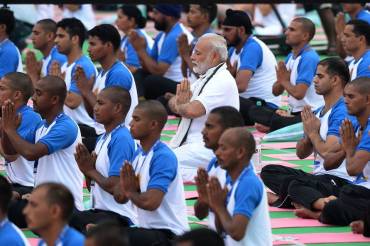
A year after the first International Day of Yoga was celebrated the world over, yoga enthusiasts were back again Tuesday morning lunging forward, raising and stretching their arms, and slowly inhaling and exhaling.

The day was introduced when Indian Prime Minister Narendra Modi successfully lobbied the United Nations to dedicate 24 hours to the ancient discipline in September 2013.This year, Mr. Modi joined thousands of people in the northern Indian city of Chandigarh as they pulled their mats out for a massive demonstration. World over, 173 countries will celebrate the discipline Tuesday.

“We are disconnected from ourselves in today’s times. Yoga helps us reconnect with ourselves,” Mr. Modi said, addressing participants at his event.

On Monday, Mr. Modi also released a set of commermorative postal stamps showing the various steps of the “surya namaskar,” or sun salutation.In India’s capital city, President Pranab Mukherjee conducted a Yoga class at the Rashtrapati Bhavan, his residence-cum-office located in the heart of Delhi.

Images of different Yoga postures were displayed at the headquarters of the United Nations in New York in the build up to Yoga Day.

“Practicing yoga can help raise awareness of our role as consumers of the planet’s resources and as individuals with a duty to respect and live in peace with our neighbours,” said Ban Ki-moon, the UN Secretary-General.

Source: In Pictures: Yoga Takes Over the World on Second International Day of Yoga – India Real Time – WSJ

16/06/2016

Why an Indian Hindu Group Wants a Ministry of Cows – India Real Time – WSJ

Cows have long held a sacred place in India’s society, revered as holy by the country’s predominantly Hindu population. If one group gets its way they might soon have a government department devoted to their interests too.

The cow-protection unit of the right-wing Hindu group Vishva Hindu Parishad (World Hindu Council) is urging Prime Minister Narendra Modi to form a dedicated ministry for the preservation and protection of cows.

“Gou mata (mother cow) is the symbol of life, soul of our culture. She is not being given enough importance,” an official at the Bharatiya Govansh Rakshan Samvardhan Parishad (Indian Cattle Protection and Promotion Council), who didn’t wish to be named, said.

He said the “whole idea is to save the cows from getting killed.” Rearing cows will also increase milk production in the country, he added.

Slaughter of bovines has long been a fraught issue in India, but a renewed push to protect the animals came after a Hindu mob killed a Muslim man in the town of Dadri, 31 miles from New Delhi last September over rumors that he butchered a cow. The murder unleashed a wave of violence and sparked a debate over religious intolerance in the country.

There is no central law on cattle slaughter in India, though various states have introduced their own rules since Mr. Modi took power. A number of states have also tightened restrictions on the consumption of beef.

Minority groups, including around 170 million Muslims, have expressed concern over the clampdown.

The official from the Indian Cattle Protection and Promotion Council said members of his organization plan to meet ministers and members of Mr. Modi’s ruling Bharatiya Janata Party to ask them to take up the issue of a separate cow ministry in the upcoming monsoon session of Parliament, which begins in July.

“Our goal is to restore cows of bharatiya (Hindu) breed back to the country’s economy,” he added.Despite the various bans, India is the world’s largest exporter of beef, according to the U.S. Department of Agriculture. India exported 2.4 million tons of beef last year, compared with 2 million tons by Brazil. India alone accounts for nearly 24% of global beef exports.

India has also ranked first among the world’s milk-producing nations since 1998, according to India’s department of animal husbandry, dairying and fisheries. Milk production in India during the period has gone up from 17 million tons in 1950 to 146.3 million tons till last year, it said.

Source: Why an Indian Hindu Group Wants a Ministry of Cows – India Real Time – WSJ

16/06/2016

India Is Making Progress on Reducing Malnutrition But Now Has a Diabetes Problem – India Real Time – WSJ

While India has dramatically reduced its rate of child malnutrition, a new report points to the increasing burden of diabetes in the world’s second most populous country.

According to the 2016 Global Nutrition Report released Tuesday, India is reducing childhood stunting at double the rate it was a decade ago. Stunting, or low height for age, is caused by insufficient nutrient intake and frequent infections.

“That is highly significant given that India is home to more than one-third of the world’s stunting children,” the study said.

However, the country is facing a new health issue. India has a 9.5% prevalence of diabetes, putting it ahead of the U.K., with 7.8%, and the U.S., with 8.4%, the report showed.

Experts say the high sugar and trans-fat diet Indians consume are a key cause of the growing occurrence of diabetes, which is caused by a deficiency or inability of the body to effectively use insulin. Genetic factors and environmental influences exacerbate the issue.

In April, the WHO said that in India, more men die from diabetes than in any other country. The condition accounted for 2% of all deaths across age groups in India.

As a region, Asia has the highest prevalence of the condition, according to the Global Nutrition Report. Globally, one in 12 people have type 2 diabetes, the report said.“We must stem and tide,” Corinna Hawkes, co-chair of the Global Nutrition Report’s independent expert group said in a statement.

India also has a way to go to reduce stunting. India has the 18th highest prevalence, 38.7% among children under five, of 137 countries included in the Global Nutrition Report. That rate is down from 47.9% recorded a year earlier.

Indian states must set specific targets to help them meet global nutrition goals, while the federal government should devote $6 billion a year to combat nutrition, 13% more than it currently does, the report said.“At current rates of decline, India will achieve the current stunting rates of Ghana or Togo by 2030 and that of China by 2055,” the report said.

Source: India Is Making Progress on Reducing Malnutrition But Now Has a Diabetes Problem – India Real Time – WSJ

15/06/2016

India Police Probe Trade in Human Organs – India Real Time – WSJ

Police in India’s capital Delhi have uncovered a complex network illegally trading in kidneys. Suryatapa Bhattacharya report.

Earlier this month, a woman marched into a police station in India’s capital to file a domestic-abuse complaint and then made another allegation: that her husband was involved in illegal organ-trafficking.

Police said that accusation sparked a probe that had yielded 12 arrests as of Tuesday after authorities said they uncovered a complex nationwide network that was illegally trading in kidneys.

Donors, mostly poor residents of rural areas, were paid about $6,000 to give their kidneys to wealthier people in need of transplants, police said. The recipients paid more than $37,000. Traffickers produced counterfeit documents to make it appear as though the donors and recipients were related, police said. A 1994 law outlawed organ sales but permitted donations between family members.

The suspects—including five middlemen and four people who allegedly sold their own kidneys—were held on suspicion of trafficking in human organs and forgery, police said. They were in custody and couldn’t be reached for comment. It was unclear if they had legal representation.

Most countries prohibit organ selling, in part because of fears the poor and sick will be exploited by unscrupulous brokers.

Source: India Police Probe Trade in Human Organs – India Real Time – WSJ

12/06/2016

Electronics Maker Automates as China Costs Rise – China Real Time Report – WSJ

Regardless of the assurances, I am concerned that we have started down a very slippery slope and in a generation or two we will have personless factories and maybe personless offices.  When that happens where will humans be earning salaries and hence, are going to be buying the stuff the factories will be churning out and who will pay for the offices; and – indeed – what will be done in those offices?

Is anyone in government, whether Chinese, Swedish, Japanese or American, putting their minds to this frightening future?

“A new generation of machines is gradually transforming this electronics factory in China’s manufacturing hub.Inside the sprawling factory, owned by Jabil Circuit Inc.—the world’s third-largest contract manufacturer for companies such as Apple Inc. and Electrolux SA—robotic arms assemble circuit boards as driverless components-laden carts glide nearby. Machines also are starting to replace workers in checking circuit-board assemblies for errors.

“This is the past,” said David Choonseng Tan, an operations director at Jabil, pointing to a line of workers hunched over the assembly line. “And this,” he said, gesturing to a line of machines next to them, “is the future.”

Rapidly changing product models make it challenging for electronics companies like Jabil to automate all aspects of the assembly process, according to John Dulchinos, a vice president at the company. Still, Jabil has increasingly embraced automation and advanced technology, a shift encouraged by the Chinese government as the world’s second-largest economy grapples with labor shortages and high costs that are making neighboring countries like Vietnam increasingly competitive for mass production.

Manufacturers elsewhere in the world are also investing in automation and robotics in an effort to wean themselves off “chasing the needle”—moving to ever-lower-cost countries in pursuit of cheap labor.

In Stockholm, Sweden, roughly 8,000 miles away from China, fuel-cell maker myFC has built a 2,000 square-foot smart factory that will eventually have five robots doing the work of 20 full-time humans. The robots assemble power cards used for portable electronic devices while 3D printers churn out prototypes of new designs.

“We are building one cell, then we can export that to any country, any customer,” says Bjorn Westerholm, chief executive of myFC.

Jabil says that it’s hoping that a key piece of its automation—a boxy white platform it calls Flexi-Auto Cell—can also be redeployed at factories elsewhere in the world. The idea, according to Jabil, is for technology to be able to emulate the worker’s flexibility in switching from one task to another.

Jabil’s vision of manufacturing, however, isn’t one in which machines will replace workers completely, but rather one in which they’re freed up to focus on less-tedious tasks.

“We are not going for a lights-off factory,” says KC Ong, a senior vice president of operations for Jabil. In the factory of the future, “we’ll still have a lot of people.””

Source: Electronics Maker Automates as China Costs Rise – China Real Time Report – WSJ

10/06/2016

Is China Rattled By the India-U.S. Love-In? – India Real Time – WSJ

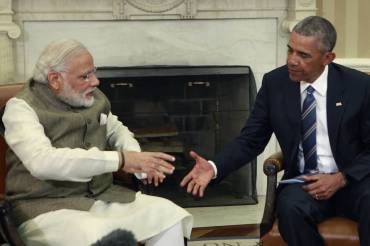
Indian Prime Minister Narendra Modi has made strengthening ties with the U.S. one of his key foreign-policy objectives, as the two countries seek to counterbalance China’s growing footprint in Asia.

In a speech to a joint meeting of the U.S. Congress Wednesday, the conclusion of a three-day trip to the country, Mr. Modi didn’t directly mention China, but said: “In Asia, the absence of an agreed security architecture creates uncertainty.

”A strong India-U.S. partnership can “help ensure security of the sea lanes of commerce and freedom of navigation on seas,” he added.

So is the beefed-up alliance between the two countries making Beijing uncomfortable? The country’s press provides some clues.

Source: Is China Rattled By the India-U.S. Love-In? – India Real Time – WSJ

Law of Unintended Consequences

continuously updated blog about China & India

ChiaHou's Book Reviews

continuously updated blog about China & India

What's wrong with the world; and its economy

continuously updated blog about China & India