Posts tagged ‘National People’s Congress’

21/01/2013

* Ex-minister blames China’s pollution mess on lack of rule of law

SCMP: “China had a chance to avoid environmental disasters some 40 to 30 years ago, the country’s first environmental protection chief has lamented amid worsening air and water pollution.

f43f14c1d2166c7e70fadcc6bb445b27.jpg

But Professor Qu Geping, who has overseen environmental policymaking since the early 1970s, said pollution had run wild as a result of unchecked economic growth under a “rule of men”, as opposed to the rule of law. Their rule imposed no checks on power and allowed governments to ignore environmental protection laws and regulations.

“I would not call the past 40 years’ efforts of environmental protection a total failure,” he said. “But I have to admit that governments have done far from enough to rein in the wild pursuit of economic growth … and failed to avoid some of the worst pollution scenarios we, as policymakers, had predicted.”

Qu, 83, was China’s first environmental protection administrator between 1987 and 1993. He then headed the National People’s Congress environment and resource committee for 10 years.

After three decades of worsening industrial pollution resulting from rapid urbanisation and industrialisation, China has accumulated huge environmental debts that will have to be paid back, Qu said.

He said recently he regretted that some of the very forward-looking strategies – emphasising a more balanced and co-ordinated approach to development and conservation, that were worked out as early as 1983 – were never put into serious practice when China was still at an early stage of industrialisation.

In 1970, premier Zhou Enlai had invited a Japanese journalist to give a lecture to senior government officials on the lessons Japan had learned from a series of heavy metal pollution scandals that killed several hundred people during a period of rapid industrialisation in the 1950s and 1960s, Qu said.

“But looking back, China fell into the same trap again,” he said. “In some cases, the problems are even worse now given the country’s huge population and the vast scale of its economy.”

via Ex-minister blames China’s pollution mess on lack of rule of law | South China Morning Post.

See also: https://chindia-alert.org/economic-factors/greening-of-china/

07/01/2013

* China turns dark page of history, puts end to labour camps

Reform, reform and more reform.

SCMP: “In a clear reversal of a decades-old practice of human rights abuse, China announced on Monday that it would put a stop to the system of “re-education through labour”, more commonly known as labour camps, in 2013.

lab_camp2.jpg

A senior Chinese legal official told the Post that Meng Jianzhu, head of the Communist Party’s Poltiical and Legal Affairs Committee, told a meeting of judicial and legal officials from all over the country on Monday that the Party had decided it would stop the practice of sending people to labour camps within the year.

“The Central Committee has decided, after research, that after approval by the National People’s Congress, to stop using the system of re-educastion through labour this year,” said the official who attended the meeting.

“I feel that Secretary Meng’s comments were filled with a new spirit, that they signal the progress our society has made. ””

via China turns dark page of history, puts end to labour camps | South China Morning Post.

30/12/2012

* Xinhua unveils top 10 domestic events of 2012

Xinhua News Agency on Saturday unveiled its list of the year’s 10 most attention-grabbing events in China.

“The events are as follows, in chronological order:

01 China cuts 2012 GDP growth target

At its annual session in March, the National People’s Congress, China’s parliament, adopted the government work report, in whichgrowth - Ind vs Ch the country lowered its GDP growth target to 7.5 percent this year after keeping it at around 8 percent for seven consecutive years. The change was made in the face of global turbulence and pressing domestic demand for economic restructuring.

02 Medical reform meets three-year target

The State Council in March issued an implementation plan for reforms in the health and medical care sector in the next three years. According to official statistics, as of the end of 2011 the basic medicare insurance system covered over 1.3 billion people in China, more than 95 percent of the total population, marking the realization of the previous three-year target for the 2009-2011 period to form a universal medicare system.


03 Bo Xilai under investigation; Wang Lijun convicted

The Central Committee of the Communist Party of China (CPC) on April 10 decided to suspend Bo Xilai’s membership in the CPC Bo & GuCentral Committee Political Bureau and the CPC Central Committee, as he was suspected of being involved in serious discipline violations in the cases of Wang Lijun and Bogu Kailai. The CPC Central Commission for Discipline Inspection put him under investigation. Bo was later expelled from the CPC and public office and the case was turned over to prosecutors for investigation.
In August, Bogu Kailai was sentenced to death with a two-year reprieve for intentional homicide by the Hefei City Intermediate People’s Court in Anhui Province.

In September, Wang Lijun was sentenced to 15 years in prison for bending the law to selfish ends, defection, abuse of power and bribe-taking by the Chengdu City Intermediate People’s Court.

04 China vigorously protects maritime rights

SoChinaSeaIn response to some foreign countries’ actions infringing upon China’s maritime rights and interests in the South China Sea and East China Sea, China has vigorously launched campaigns to protect its legitimate rights.

Since April, China has dispatched government ships and planes to monitor Huangyan Island in the South China Sea.

Five months later, the Chinese government announced the base points and baselines of the territorial waters of the Diaoyu Islands and their affiliated islets and started continuous patrols in waters around the Diaoyu Islands.

In December, China reiterated its claims in the East China Sea by presenting to the UN Secretariat its Partial Submission Concerning the Outer Limits of the Continental Shelf beyond 200 Nautical Miles in the East China Sea.

05 China’s first female astronaut participates in successful manned space docking mission

In June, China sent three astronauts, including the country’s first female astronaut, Liu Yang, into space for the nation’s manned Liu Yang, China's first female astronaut, waves during a departure ceremony at Jiuquan Satellite Launch Center, Gansu province, June 16space docking mission.

The three astronauts successfully completed an automatic and a manual docking between the Shenzhou-9 spacecraft and the orbiting Tiangong-1 lab module in space before making a safe return to Earth.

06 Manned submersible sets new national dive record

Chinese submersible breaks 7,000m mark Also in June, China’s manned submersible, the Jiaolong, set a new national dive record after reaching 7,062 meters below sea level during its fifth dive in the Mariana Trench in the Pacific Ocean.


07 First aircraft carrier commissioned

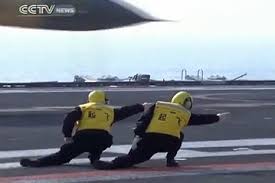
In September, China’s first aircraft carrier, the Liaoning, was delivered to the People’s Liberation Army Navy and put into commission after years of refitting and sea trials. Last month, the country successfully conducted flight landing exercises on the aircraft carrier, where the home-grown J-15 fighter jet made its debut in a landing and take-off exercise.
08 New CPC leadership and new targets

Xi & LiThe CPC convened its 18th National Congress between Nov. 8 and 14, when the Party’s new leadership was elected, including Xi Jinping, who was elected general secretary of the CPC Central Committee. The congress also set new targets for the country such as efforts to complete the building of a moderately prosperous society in all respects.

09 Full coverage of pension scheme

The Ministry of Human Resources and Social Security announced in November that China’s urban and rural pension insurance systems covered 459 million people at the end of October and that as many as 125 million elderly people receive monthly pensions. The State Council had previously decided to make pension insurance available for everyone in urban and rural areas.

10 New CPC leadership rejects extravagance, bureaucracy
The newly-elected leadership of China’s ruling party has pledged to reject extravagance and reduce bureaucratic visits and meetings, in a bid to win the people’s trust and support.

In a meeting of the Political Bureau of the CPC Central Committee on Dec. 4, members vowed to shorten meetings and documents, reject bureaucratism in domestic and overseas visits, reduce road closures for official activities and support more practical content in news reports. The leaders also promised to take the lead in putting these requirements into practice.”

via Xinhua unveils top 10 domestic events of 2012 – Xinhua | English.news.cn.

19/09/2012

# How China is ruled: National People’s Congress

BBC News: ”

Under China’s 1982 constitution, the most powerful organ of state is meant to be the National People’s Congress (NPC), China’s parliament. In truth, it is little more than a rubber stamp for party decisions.

The congress is made up of nearly 3,000 delegates elected by China’s provinces, autonomous regions, municipalities and the armed forces. Delegates hold office for five years, and the full congress is convened for one session each year.

This sporadic and unwieldy nature means that real influence lies within a standing committee of about 150 members elected from congress delegates. It meets every couple of months.

In theory, the congress has the power to change the constitution and make laws. But it is not, and is not meant to be, an independent body in the Western sense of a parliament.

NPC meetings are more about spectacle than power

For a start, about 70% of its delegates – and almost all its senior figures – are also party members. Their loyalty is to the party first, the NPC second.

Independence

What actually tends to happen, therefore, is that the party drafts most new legislation and passes it to the NPC for “consideration”, better described as speedy approval.

The NPC has shown some signs of growing independence over the past decade. In a notable incident in 1999, it delayed passing a law bringing in an unpopular fuel tax. It has also been given greater leeway drafting laws in areas like human rights.

The congress also “elects” the country’s highest leaders, including the state president and vice-president, the chairman of the government’s own Military Affairs Commission and the president of the Supreme People’s Court.

But again, these elections are very different from the Western ideal.”

via BBC News – How China is ruled: National People’s Congress.

See also: https://chindia-alert.org/political-factors/

11/03/2012

* A tale of two (Chinese) regions

China Daily: “China’s economic development over the last 30 years has been “a tale of two regions” — prosperous coastal areas where GDP matches some developed countries and inland areas that have lagged behind. …

In 2011, China laid out a 10-year development plan for the middle and western areas of the country, demarcating 14 impoverished regions and creating development plans for each region. Three of the 14 regions are in southwest China’s Guizhou province, which has a total of 65 counties listed as impoverished.

“When these areas develop, it will help to effectively close the gap with the eastern part of the country,” said Li Zhanshu, secretary of the Guizhou provincial committee of the Communist Party of China and a deputy to the National People’s Congress (NPC), which is meeting now in Beijing.

The gap between the coast and many other parts of China is indeed large. From 1978 to 2011 per capita GDP in coastal Zhejiang province has risen on average 11.6 percent per year to $9,000 in 2011, far above the national average. This figure is about three times the amount for Tibet and Gansu province, in China’s west.

Closing this gap has been a major topic of the current annual NPC session and the concurrent meeting of the Chinese People’s Political Consultative Conference, China’s leading political advisory body.”

via A tale of two regions|Economy|chinadaily.com.cn.

Given China’s success at creating a major ‘municipality’ of Chongqing in 1997 to act as a magnet in the centre of China, we shouldn’t be surprised if in 15 years these impoverished regions start to become more like the coastal regions of China.

Related page: https://chindia-alert.org/prognosis/chinese-challenges/

10/03/2012

* Chinese smokers may be singed by tax hikes

China Daily: “China plans to increase taxes on mid- and low-end cigarettes in a bid to curb expanding tobacco consumption in the country, Minister of Health Chen Zhu said on Friday.

The move follows the tax hike targeting high-end cigarettes in 2009, which hasn’t met the country’s target of easing the rising use of tobacco, Chen said.

“We notice that most of the growing proportion of smokers are young adults, who consume low-end cigarettes and are sensitive to prices. As such, I’m confident that the tax hike will effectively help reduce the number of smokers without affecting fiscal revenue,” Chen said on the sidelines of the plenary sessions of the ongoing National People’s Congress.

The tax charge is “imperative” given the growing health and environmental concerns arising from smoking, Chen said.”

via Smokers may be singed by tax hikes|Economy|chinadaily.com.cn.

Another sign of the maturing of China. Until now, it had not paid much attention to smokers and their health.

Related page: https://chindia-alert.org/political-factors/chinese-tensions/

08/03/2012

* China highlights human rights in criminal procedure law revision

Extracted from Xinhua: “China’s legislature has underlined the principle of “respecting and safeguarding human rights” by explicitly writing it into a draft amendment to the nation’s Criminal Procedure Law.

The draft was submitted Thursday to the ongoing 5th session of the 11th National People’s Congress (NPC) for third reading. …

Since China is in a transition period with prominent incidence of conflicts, the number of criminal cases remains large and severe violent crimes are on increase, Wang Zhaoguo, vice chairman of the Standing Committee of the National People’s Congress (NPC), said. …

China’s criminal justice system should be improved step by step based on the country’s reality, he said, summarizing, “Improvements should be made to keep up with the times without surpassing the present realities or blindly copying any foreign judicial and litigation systems.”

PREVENTING TORTURE OF SUSPECTS

… The draft amendment, for the first time, has made clear that confessions extorted through illegal means, such as torture, and witness testimony and depositions of victims obtained illegally, such as by violence or threats, should be excluded during the trials.

To institutionally prevent extortion of confession by torture, the draft has regulated that suspects be sent to a detention facility for custody after being detained or arrested and be interrogated there. The process of interrogation shall be audio or video-taped. …

“The revisions on ruling out illegal evidence and strictly regulating the procedure of collecting evidence will effectively curb torturing practices,” he went on.

REVIEWING DEATH PENALTY

The draft amendment also specifies the procedures for the Supreme People’s Court to review death penalty cases in order that such cases will be handled “with sufficient care” and “legal oversight” will be strengthened. According to the draft, the supreme court shall issue an order approving or disapproving a death sentence after reviewing it. If the supreme court overrules the death sentence, it may remand the case for retrial or revise the judgement thereof. …

“The proposed revisions will improve the procedure and guarantee the legal oversight necessary before taking somebody’s life,” he said.

LAWYERED UP

A proposed revision allowing the criminal suspect to engage a lawyer as his defense counsel when the police first interrogate him has been widely welcomed by lawyers. Under the current law, a suspect can only have a defense counsel when the case is handed over to prosecutors. Lawyers can only provide legal help for suspects under police investigation. …

DEFINING HOUSE SURVEILLANCE

The draft amendment defines the measure of house surveillance and stipulates the conditions for its application. …

NOTIFYING FAMILY

The draft amendment also strictly limits exceptions to the provisions of notifying family members of the suspect after a coercive measure is adopted.

The current law, while providing that a person’s family be notified within 24 hours of their detention or arrest, also gives two exceptions — one is under the circumstance where the notification may obstruct investigation, and the other is if his or her family can not be reached.

Under the proposed revision, for a person under arrest, the first exception is deleted since “obstruct investigation” is ambiguous.

In cases of detention, the draft amendment regulates that, only when he is involved in crimes of endangering national security and terrorism, the police may not inform his family for fear of hindering investigation.

It also stipulates that, for people under house surveillance in a designated place, their families should be informed within 24 hours after the coercive measure is taken, unless they can not be reached.”

http://news.xinhuanet.com/english/china/2012-03/08/c_131453966.htm

Although some Western human rights campaigners are bound to assert: “not far enough”, the very fact that this issue is being taken into account in the new criminal procedure law revision must be a step in the right direction. In many ways, the Communist Party is demonstrating that it is maturing and slowly but surely getting less fraught about subversion. It is realising that most of the protests are about tangible problems often caused by over zealous or, worse, corrupt local officials and not about challenging the power or authority of the Party.

05/03/2012

* China lowers growth target to 7.5%

(Reuters) – Chinese Premier Wen Jiabao cut his nation’s 2012 growth target to an eight-year low of 7.5 percent and made boosting consumer demand the year’s first priority as Beijing looks to wean the economy off its reliance on external demand and foreign capital. …

“We aim to promote steady and robust economic development, keep prices stable, and guard against financial risks by keeping the total money and credit supply at an appropriate level, and taking a cautious and flexible approach,” Wen said in his annual work report to the National People’s Congress (NPC), China’s annual parliamentary session. …

His annual state-of-the-nation report to parliament dwelled on the institutional and income barriers the government must break to build a more balanced economy that relies less on exports and shares more wealth with hundreds of millions of poor farmers and migrant workers who are reluctant to spend. …

Shifting that balance is a key goal for Wen and Hu, both 69, as they near the end of a decade in power which has seen China become the world’s second-largest economy after the United States, contributing more to global growth than any other nation, while seeing a chasm widen between rich and poor. The number of Chinese billionaires nearly doubled in 2011 to 146 from 2010, Forbes said.

Stability, steady growth and spreading wealth are core justifications for more than 60 years of one-party rule by the Communist Party, which will install a new cohort of leaders by the end of 2012. …

The last year in power for Wen and Hu has shuddered with anxieties about inflation, a feverish property market, local government debt, stubborn inequality and social strains from protesting villages to ethnic tensions in western regions. …

Critics, including prominent policy-advisers, have said the Chinese government can foster healthy long-term growth only by taking on bolder reforms to rein in state-owned conglomerates and other entrenched interests — reforms that ultimately spill into sensitive issues of curbing the party’s own powers.

Wen has stood out among China’s leaders as the most persistent advocate of measured political relaxation, and has cast himself as a passionate advocate for farmers struggling with economic insecurity and land lost to developers.

“We should care more deeply for rural migrant workers and provide more services to them,” he said. “We will place farmland under strict protection.”

http://www.reuters.com/article/2012/03/05/us-china-economy-idUSTRE82400120120305?feedType=RSS&feedName=topNews&utm_source=feedburner&utm_medium=feed&utm_campaign=Feed%3A+reuters%2FtopNews+%28News+%2F+US+%2F+Top+News%29&utm_content=Google+Feedfetcher

05/03/2012

* China hints at new development approach to Tibet

The Hindu: News / International: “Ahead of the third anniversary of the March 14 riots in Tibet, a top official from the region said the government would pay more attention to preserving Tibetan culture to address rising concerns about imbalanced growth.

“If there is no culture, there will be no development,” Na Ceng, a Tibetan adviser to the Chinese People’s Political Consultative Conference (CPPCC), China’s top political advisory body, said in an interview with The Hindu.

“Culture is like the eye of a person. It plays a crucial role,” said Ceng, who in 1943 was recognised as a Tibetan “living Buddha.”

Ceng is among a group of delegates who has pushed forward a proposal for China’s first ever law on the preservation of intangible cultural heritage, during the ongoing annual session of the National People’s Congress (NPC), the country’s top legislative body.

The law, passed by the NPC this week, mandates that regional governments should do more to preserve minority cultures, including oral literature and cultural practices.

Ceng acknowledged that Tibet was facing a huge challenge “in transferring Tibetan Buddhism to the next generation.” “The cultural preservation law can play an important role.” …

Asked about recent protests over a move to expand the introduction of Mandarin Chinese as “a common language” in Tibetan universities, he said it would be ensured that “only Tibetan language” was spoken and taught in religious institutions. In October, hundreds of Tibetan students in the western Qinghai province and in Beijing protested the policy, which has subsequently been suspended.

Ceng, however, said “bilingual education” in schools and colleges, for Tibetan students to learn Mandarin, was a necessity, if Tibet was not to be left behind other regions.

via The Hindu : News / International : China hints at new development approach to Tibet.

China is keenly aware that it needs to resolve the Tibetan issue before it escalates with an increasing number of self-immolations, not only amongst monks but with lay citizens too.

04/03/2012

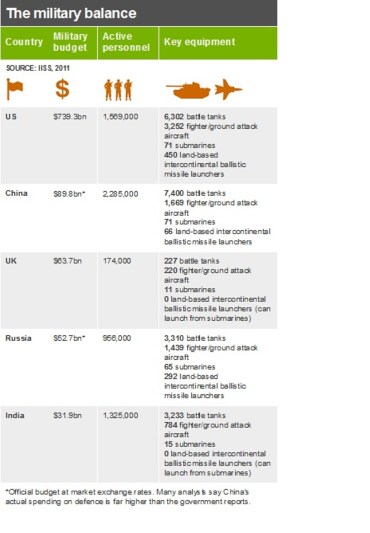
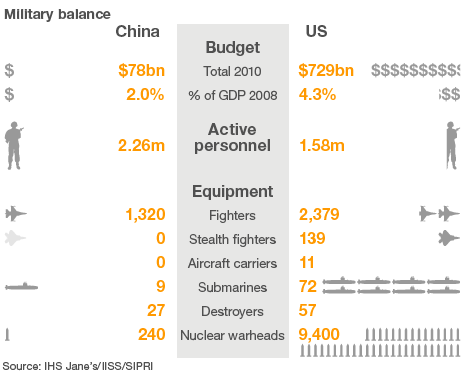
* Chinese defence budget exceeds $100bn (against US budget of over $700bn)


Extract from Xinhua: “China said Sunday it plans to raise its defense budget by 11.2 % to 670 billion yuan (106.4 billion U.S. dollars) in 2012. …

China’s military spending mainly comprises the living expenditures of service people, expenses for training and maintenance, and spending on equipment, he said. The costs for research, experiment, procurement, repair, transport and storage of all weapons and equipment, including new types of weapons, are included in the defense budget that is published every year, the spokesman said.

… Compared to other major countries, China’s military spending is low given its population of 1.3 billion, vast land area and long coastlines, Li said. While China’s military spending amounted to 1.28 % of its GDP in 2011, that of the United States, Britain and other countries all exceed 2 %, said Li. …

By June last year, China had sent a total of 2,044 peace-keeping personnel to 12 peace-keeping zones around the world, and the Chinese navy has sent escort vessels to the Gulf of Aden and waters off the coast of Somalia to protect thousands of commercial vessels from China and other countries, according to Li.”

http://news.xinhuanet.com/english/china/2012-03/04/c_131445012.htm

See also: https://chindia-alert.org/political-factors/geopolitics-chinese/

A significant rise. But still less than 1/7 of US spend, though the latter is expected to halve over the next few years. Also, salary and living expenses for up to 3 million service personnel does cost a pretty penny!


Law of Unintended Consequences

continuously updated blog about China & India

ChiaHou's Book Reviews

continuously updated blog about China & India

What's wrong with the world; and its economy

continuously updated blog about China & India