Posts tagged ‘New Delhi’

28/07/2016

With eye on China, India doubles down on container hub ports | Reuters

Indian conglomerate Adani Group has started building the country’s first transshipment port, conceived 25 years ago, and the government will construct another $4-billion facility nearby to create a shipping hub rivalling Chinese facilities in the region.

New Delhi will grant billionaire Gautam Adani 16 billion rupees ($240 million) in so-called “viability gap” funding to help the new port at Vizhinjam in Kerala win business from established hubs elsewhere in Asia.

Once Vizhinjam is operational the central government will start building the port of Enayam in neighbouring Tamil Nadu, said a senior shipping ministry official. Enayam alone will save more than $200 million in costs for Indian companies every year, he said.India’s 7,500-km (4,700-mile) coastline juts into one of the world’s main shipping routes and Prime Minister Narendra Modi wants to capitalise on that proximity by developing ports that can shift freight on to huge vessels capable of carrying up to 18,000 20-foot containers.

By bringing onshore cargo handling now done at entrepots in Sri Lanka, Dubai and Singapore, Modi’s government expects cargo traffic at its ports to jump by two-thirds by 2021 as India ramps up exports of goods including cars and other machinery.

The lack of an Indian domestic transshipment port forces inbound and outbound containers to take a detour to one of those regional hubs before heading to their final destination.

New Delhi expects the new ports to save Indian companies hundreds of millions of dollars in transport costs, as well as ease concerns over the growing strategic clout in South Asia of rival China, which has invested hundreds of millions of dollars in Sri Lankan ports at Colombo and Hambantota.

Adani wants the Vizhinjam port, which an arm of his Adani Group is building at a cost of around $1 billion, to be operational in 2018. The port lies hard by the Gulf-to-Malacca shipping lane that carries almost a third of world sea freight.

“The port can attract a large share of the container transshipment traffic destined for, or originating from, India which is now being diverted primarily through Colombo, Singapore and Dubai,” said an Adani Group executive who declined to be named.

But officials acknowledge that it would be difficult for the new ports to win international clients unless they offered discounts.”A major part of transshipment is happening at nearby ports. We can win some of that business,” said A.S. Suresh Babu, who heads a government agency set up by Kerala to facilitate the construction of Vizhinjam.

“There’s a viability issue in the first few years. Already the Chinese are operating there. So unless you give some discount you can’t attract these ships. So that’s why the government of India has approved the viability gap funding.”

Source: With eye on China, India doubles down on container hub ports | Reuters

27/07/2016

India orders 4 more maritime spy planes from Boeing worth $1 billion | Reuters

India has signed a pact with Boeing Co for purchasing four maritime spy planes at an estimated $1 billion, defence and industry sources said, aiming to bolster the navy as it tries to check China’s presence in the Indian Ocean.

India has already deployed eight of these long-range P-8I aircraft to track submarine movements in the Indian Ocean and on Wednesday exercised an option for more planes, a defence ministry source said.

“It has been signed,” the source familiar with the matter told Reuters. An industry source confirmed the contract, saying it was a follow-on order signed in New Delhi early on Wednesday.

Source: India orders 4 more maritime spy planes from Boeing worth $1 billion | Reuters

25/07/2016

India urges security forces to exercise restraint in Kashmir | Reuters

India has asked its security forces to exercise restraint in responding to protests in disputed Kashmir and replace pellet guns with non-lethal weapons, its home affairs minister said on Sunday.

Forty six people have been killed and more than 5,000 wounded, including security forces, since protests erupted after the killing of Hizbul Mujahideen commander Burhan Wani on July 8.

Normal life remains paralysed because of the curfew imposed by the government and calls for a shutdown by separatist leaders.

“I appeal to the youth not to resort to stone pelting and I also want to appeal to the security forces not to use pellets. I have told security forces to use maximum possible restraint,” Rajnath Singh said, winding up his two-day visit to Kashmir.

Kashmir has been at the centre of a tussle between New Delhi and Islamabad for decades, as both claim the region in full but rule it in part.

“We don’t need the involvement of a third party to address the situation in Jammu and Kashmir. I want to tell my neighbour that you are yourself a victim of terrorism,” said Singh.

Since they split some 67 years ago, India and Pakistan have fought each other in three wars, two over Kashmir. There has not been a full-blown war since they both tested nuclear weapons in 1998.

Singh on Thursday told lawmakers that India would set up a panel to look for an alternative to pellet guns.More than 300 people have suffered because of pellet guns, including 171 with eye injuries, Kaisar Ahmad, principal of the Government Medical College in Srinagar, told Reuters.

Source: India urges security forces to exercise restraint in Kashmir | Reuters

30/06/2016

India to get over $1 billion from World Bank for Modi’s solar goals | Reuters

The World Bank said on Thursday it would lend India more than $1 billion for its huge solar energy programme, after Prime Minister Narendra Modi sought climate change funds from its visiting head.

Modi is banking on India’s 300 days a year of sunshine to generate power and help fight climate change rather than committing to emission cuts like China.

The World Bank loan is the global lender’s biggest solar aid for any country and comes as India has set a goal of raising its solar capacity nearly 30 times to 100 gigawatts by 2020 and is attracting mega investment proposals from top companies and institutions.

“Prime Minister Modi’s personal commitment toward renewable energy, particularly solar, is the driving force behind these investments,” World Bank President Jim Yong Kim said in a statement released after he met Modi. “The World Bank Group will do all it can to help India meet its ambitious targets, especially around scaling up solar energy.

“India is the largest client of the World Bank, which lent it around $4.8 billion between 2015 and 2016.

Modi’s office said he told Kim about the need for climate change financing for countries like India that are “consciously choosing to follow an environmentally sustainable path”.

India wants the share of non-fossil fuel in total installed power capacity to jump to 40 percent by 2030 from 30 percent currently, but there are challenges including weak finances of state distribution companies forced to sell subsidised power, difficulties hooking up solar projects to grids, and access to affordable capital.

Still India reckons its renewable energy industry could generate business opportunities worth $160 billion this decade, making it a lucrative market that has already attracted big global players such as Japan’s Softbank Corp, Taiwan’s Foxconn, First Solar, Trina Solar Ltd and Finland’s state-controlled utility Fortum Oyj.

German development bank KFW has already agreed to offer India low-interest loans of around 1 billion euro over the next five years to fund roof-mounted solar panels, and the construction of solar energy farms and self-contained solar power facilities not connected to the grid.

Source: India to get over $1 billion from World Bank for Modi’s solar goals | Reuters

29/06/2016

India approves rise in salaries, pension for govt employees – govt source | Reuters

India’s cabinet on Wednesday approved a proposal to revise up salaries and pensions for government employees, an official, privy to the decision, told reporters.

The official declined to be named or identified as he was not authorised to speak to the media.

The move is estimated to benefit nearly 10 million government employees.

Details were not immediately available ahead of a government briefing later.

Source: India approves rise in salaries, pension for govt employees – govt source | Reuters

22/06/2016

Cabinet approves auction of mobile phone airwaves – govt source | Reuters

The cabinet approved on Wednesday an auction of mobile phone airwaves, a government source told Reuters.

Earlier this year India’s telecoms ministry had proposed sale of airwaves in the 700 Mhz, 800 Mhz, 900 Mhz, 1800 Mhz, 2100 Mhz, 2300 Mhz and 2500 MHz bands.

India is the world’s second largest mobile phone market by users after China, and a rapid expansion of high-speed 4G services is expected to create demand for additional airwaves.The government is expected to announce details of the auction at a press conference later in the day, the official who did not want to be named, said.

Source: Cabinet approves auction of mobile phone airwaves – govt source | Reuters

21/06/2016

Yoga Takes Over the World on Second International Day of Yoga – India Real Time – WSJ

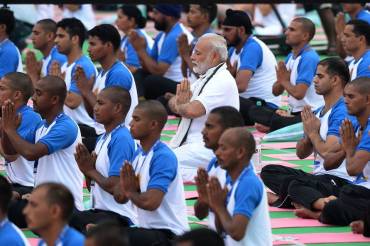
A year after the first International Day of Yoga was celebrated the world over, yoga enthusiasts were back again Tuesday morning lunging forward, raising and stretching their arms, and slowly inhaling and exhaling.

The day was introduced when Indian Prime Minister Narendra Modi successfully lobbied the United Nations to dedicate 24 hours to the ancient discipline in September 2013.This year, Mr. Modi joined thousands of people in the northern Indian city of Chandigarh as they pulled their mats out for a massive demonstration. World over, 173 countries will celebrate the discipline Tuesday.

“We are disconnected from ourselves in today’s times. Yoga helps us reconnect with ourselves,” Mr. Modi said, addressing participants at his event.

On Monday, Mr. Modi also released a set of commermorative postal stamps showing the various steps of the “surya namaskar,” or sun salutation.In India’s capital city, President Pranab Mukherjee conducted a Yoga class at the Rashtrapati Bhavan, his residence-cum-office located in the heart of Delhi.

Images of different Yoga postures were displayed at the headquarters of the United Nations in New York in the build up to Yoga Day.

“Practicing yoga can help raise awareness of our role as consumers of the planet’s resources and as individuals with a duty to respect and live in peace with our neighbours,” said Ban Ki-moon, the UN Secretary-General.

Source: In Pictures: Yoga Takes Over the World on Second International Day of Yoga – India Real Time – WSJ

16/06/2016

India Is Making Progress on Reducing Malnutrition But Now Has a Diabetes Problem – India Real Time – WSJ

While India has dramatically reduced its rate of child malnutrition, a new report points to the increasing burden of diabetes in the world’s second most populous country.

According to the 2016 Global Nutrition Report released Tuesday, India is reducing childhood stunting at double the rate it was a decade ago. Stunting, or low height for age, is caused by insufficient nutrient intake and frequent infections.

“That is highly significant given that India is home to more than one-third of the world’s stunting children,” the study said.

However, the country is facing a new health issue. India has a 9.5% prevalence of diabetes, putting it ahead of the U.K., with 7.8%, and the U.S., with 8.4%, the report showed.

Experts say the high sugar and trans-fat diet Indians consume are a key cause of the growing occurrence of diabetes, which is caused by a deficiency or inability of the body to effectively use insulin. Genetic factors and environmental influences exacerbate the issue.

In April, the WHO said that in India, more men die from diabetes than in any other country. The condition accounted for 2% of all deaths across age groups in India.

As a region, Asia has the highest prevalence of the condition, according to the Global Nutrition Report. Globally, one in 12 people have type 2 diabetes, the report said.“We must stem and tide,” Corinna Hawkes, co-chair of the Global Nutrition Report’s independent expert group said in a statement.

India also has a way to go to reduce stunting. India has the 18th highest prevalence, 38.7% among children under five, of 137 countries included in the Global Nutrition Report. That rate is down from 47.9% recorded a year earlier.

Indian states must set specific targets to help them meet global nutrition goals, while the federal government should devote $6 billion a year to combat nutrition, 13% more than it currently does, the report said.“At current rates of decline, India will achieve the current stunting rates of Ghana or Togo by 2030 and that of China by 2055,” the report said.

Source: India Is Making Progress on Reducing Malnutrition But Now Has a Diabetes Problem – India Real Time – WSJ

08/06/2016

This Is How Many Years Air Pollution Will Cut From Your Life Expectancy in India – India Real Time – WSJ

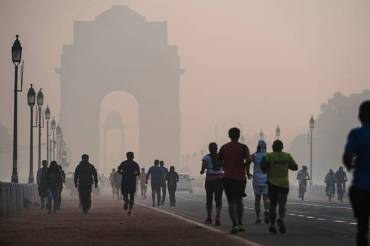
Living in India’s capital city New Delhi could shorten your life by six years because of the intensity of the air pollution there, a new report says.

Inhaling tiny air pollutants reduces the life expectancy of Indians by an average of 3.4 years, with Delhi residents losing 6.3 years, the most of all states, according to a new study by the Indian Institute of Tropical Meteorology.

Those living in West Bengal and Bihar, which have high levels of air pollution, face a reduction in life expectancy of 6.1 years and 5.7 years respectively.

The study, which used data from the latest population census of 2011, found that exposure to particulate matter 2.5 results in 570,000 premature deaths each year with an additional 12,000 caused by exposure to ozone.PM 2.5 is tiny particulate matter that is smaller than 2.5 micrometers in diameter. The air pollutants, originating from dust, soot and smoke, can penetrate deep into the lungs, increasing the risk of heart and lung diseases.

Source: This Is How Many Years Air Pollution Will Cut From Your Life Expectancy in India – India Real Time – WSJ

07/06/2016

Here’s How Indians Are Rating Narendra Modi’s Programs – India Real Time – WSJ

Two years into his five-year term, Indian Prime Minister Narendra Modi is asking his countrymen to rate a series of initiatives undertaken by his government.

Among the top scorers so far: an effort expand and modernize the railways and a program to build more roads. Toward the bottom of the favorability rankings: Mr. Modi’s Clean India campaign, which, among other things, aims to get people to use toilets instead of defecating outside.

Mr. Modi has become known for introducing a series of high-profile initiatives, from Make in India, which seeks to promote manufacturing, to pledges to build scores of so-called smart cities across the country.Of 21,770 respondents who had participated in the online survey on the government’s mygov.in website as of Tuesday morning, 70% gave a five-star rating to the government’s efforts to upgrade the rail system. People are asked to grade programs on a scale of one to five.

In the latest federal budget, the government earmarked $17 billion to improve the state-run railroad. Wi-Fi services are being rolled out at stations. And late last year, a deal was struck with Japan to help build India’s first high-speed rail line between Mumbai and Ahmedabad.

The government’s efforts to build more highways and improve the condition of roadways have also been popular with the people. More than 65% of the respondents to the survey gave these initiatives a five-star rating. The target this year is to build 9,300 miles of highways.People taking the survey also seemed satisfied by the government’s attempts to make electricity more accessible.

One of the worst performing programs, according to the current results of the survey, which is ongoing, is Swachh Bharat Abhiyaan, or the Clean India Mission. Only 33% of the respondents gave it a five-star rating. About 16% gave it score of one or two.

India’s Competitiveness and Prosperity Rankings Rise Under ModiIn October, a year into the program, another national survey also hinted at the public’s disappointment with its impact. More the 70% of those polled in that survey said the availability of public toilets hadn’t improved and their cities hadn’t become cleaner.

Mr. Modi is no stranger to crowdsourcing. He regularly encourages Indians to submit their thoughts for his weekly radio show. Prior to delivering his speech on India’s Independence Day last year, he asked citizens to submit their suggestions on what they’d like to hear him speak about. And they did, in hordes.

Source: Here’s How Indians Are Rating Narendra Modi’s Programs – India Real Time – WSJ

Law of Unintended Consequences

continuously updated blog about China & India

ChiaHou's Book Reviews

continuously updated blog about China & India

What's wrong with the world; and its economy

continuously updated blog about China & India