Posts tagged ‘New Delhi’

19/04/2016

Will Delhi’s Extreme Traffic Restrictions Have an Impact on Air Pollution This Time? – India Real Time – WSJ

Delhi has implemented severe restrictions on which cars are allowed on the road again in hopes of combating the megacity’s horrendous air-pollution problem.

Volunteers remind commuters the reason for restriction placed on vehicle movement in New Delhi, India, Friday, April 15, 2016.

Similar air-clearing measures had mixed results during the peak Winter smog season but this time citizens are hoping for better results.

For the two weeks starting April 15, most cars in the Indian capital will only be allowed on the roads every other weekday. In the so-called odd-even program, cars with license plate numbers that end in odd numbers are allowed on the roads on odd-numbered days and Sundays while cars with even license plate numbers are allowed on even days and Sundays. For the first few days of the plan most offices and schools were closed for a string of national holidays and the weekend, so Monday is the true test of whether the restrictions are working.

Delhi to Revive Odd-Even Restrictions to Battle Pollution “Today is the litmus test for the odd-even plan. Like the last time, we all need to cooperate to make it a success,” Delhi’s Transport Minister Gopal Rai tweeted from his verified account on Monday. There are 2.6 million private cars and almost 5 million motorcycles and scooters registered in Delhi, according to the latest figures from the capital’s Transport Ministry.

There are many exceptions to the regulations, meaning the number of cars on the streets will not be slashed by half. Women driving alone or with children, disabled drivers, emergency services, cars with diplomatic plates and motorcyclists are all exempt from the restrictions as are military vehicles and taxis.

Source: Will Delhi’s Extreme Traffic Restrictions Have an Impact on Air Pollution This Time? – India Real Time – WSJ

18/03/2016

We’re not gonna take it | The Economist

DELHI found itself under siege last month. Young men blocked roads and canals that feed people and water into the city. They looted, set fires and dragged women out of cars to rape them. The protesters, from a relatively privileged group of land-owning peasants called Jats, were agitating to be included in India’s list of “other backward classes”, which guarantees university places and government jobs.

Faced with dry taps, Narendra Modi’s government was eventually forced to concede to the demand.

This is the fury to which Somini Sengupta refers in the subtitle of her sharply observed study of India’s young, “The End of Karma: Hope and Fury Among India’s Young”. The median age in India is 27. Every month between 2011 and 2030, nearly 1m Indians will turn 18. Those coming of age this month were born well after the country started opening up its markets in 1991; they have spent their formative years in a world of optimism and rapid economic growth. But Ms Sengupta calls India “a democracy that makes promises it has no intention of keeping”. Advertisement

By 2030 the majority of Indians will be of working age. This could be what economists call a “demographic dividend”, creating a high worker-to-dependent ratio—or it could be a time bomb. India is producing nowhere near enough jobs for the tens of millions of young people joining the workforce every year.

The argument running through Ms Sengupta’s book, made of seven richly detailed portraits of young Indians, is both simple and beguiling. For centuries Indians born into wretched circumstances have accepted their lot as karma—punishment for misdeeds in past lives. This belief explains the persistence of the caste system, and the remarkable fact that a country that is home to one in three of the world’s poor has not come apart at the seams. But young people no longer accept karma, argues Ms Sengupta. Ideas of aspiration and free will have entered the Indian consciousness. Young Indians today demand the right to shape their own futures. If fury is in ample supply, so is hope.

Yet at every step the young are thwarted. It starts in the womb. A traditional preference for boys means that India has one of the most skewed sex ratios in the world: 1.13 boys for every girl, second only to China. (The ratio in America is 1.05.) One in three children under five is underweight. Nearly two-thirds of food meant for early-childhood feeding programmes is pilfered. A rare bright spot is education: in 2013, 96% of primary-school-age children were enrolled. But here, too, India fails its young. By the age of ten, only 60% of students can complete work at the level of a five-year-old. More than half cannot subtract.

Source: We’re not gonna take it | The Economist

28/02/2016

Delhi Chief Minister Arvind Kejriwal’s visit to Punjab — Kejriwal vows to curb mining mafia in Punjab – The Hindu

Alleging that a “mining mafia” in Punjab was extorting money from owners of stone crushing units, Aam Aadmi Party chief Arvind Kejriwal on Sunday vowed to put an end to the menace “within 24 hours” if his party comes to power in the 2017 Assembly election.

Delhi Chief Minister Arvind Kejriwal addresses the people at Dhilwan in Punjab on Sunday.

“I am shocked to know that legal crusher owners have to pay ‘goonda tax or jizya’ to the mining mafia in Punjab. I vow that within 24 hours of AAP’s coming into power, this will be curbed in the state,” Mr. Kejriwal, who is on a five-day tour of Punjab to reach out to voters ahead of the Assembly elections, said at a rally here.

Members of the business community, including owners of crushing units, on Sunday met Mr. Kejriwal and alleged that no action was being taken against the extortionists. They also claimed that false cases were being registered against them.

Mr. Kejriwal said once voted to power, AAP would set up a commission to review such cases and take action against officials who had lodged them.

Reacting to reports of a large number of posters which had sprung up in Jalandhar questioning his governance record, the Delhi Chief Minister hit out at the Akali Dal saying they had ruined the state during their 10-year rule.

“People know who has ruined his state for about 10 years and who is a failed CM,” he said.

Mr. Kejriwal also claimed that no government could have achieved in 65 years what his government had accomplished in one year in Delhi.

“What we have done in our one year rule in Delhi, I challenge that no state government could have done in the last 65 years. I am confident if Delhi goes to polls today, other parties will not be able to win even a single seat,” he said.

He also met people from different walks of life, including industrialists, advocates, shopkeepers and members of the Christian community.

Earlier, BJP workers led by district president Suresh Bhatia and Municipal Council president Naresh Mahajan, tried to gherao Mr. Kejriwal at Gandhi Chowk, but were stopped by police who resorted to mild lathi-charge, in which one person was injured.

Around 80 protesters were detained later released after the Delhi Chief Minister left, police said.

Earlier in the day, Mr. Kejriwal visited the Golden Temple and Durgiana Mandir in Amritsar.

Talking to media in Amritsar on Saturday night, he said he met various associations of traders who were not “happy” with the ruling government in Punjab because of “rampant corruption” in government departments. Moreover the state government had failed to “support” traders, he alleged.

Source: Delhi Chief Minister Arvind Kejriwal’s visit to Punjab — Kejriwal vows to curb mining mafia in Punjab – The Hindu

23/02/2016

Angry victims heckle Haryana CM after Jat riots kill 19 | Reuters

A political ally of Prime Minister Narendra Modi was shouted down on Tuesday by a crowd angered by rioting in Haryana that destroyed businesses, paralysed transport and cut water supplies to metropolitan Delhi.

Photo

The chief minister of Haryana, Manohar Lal Khattar was heckled by local people in the town of Rohtak after they objected to his comments promising that they would receive compensation.

More than a week of unrest involving the Jat rural caste has challenged the authority of Modi, who was elected in 2014 with the largest majority in three decades but has publicly ignored the outburst of anger over a lack of jobs.

Although Jat leaders reached a deal late on Monday to end more than a week of protests that killed 19 people and injured 170, anger was still boiling among the victims whose livelihoods had been ruined.

Live TV pictures showed Khattar giving up his attempt to address angry people on the street. After retreating indoors to give an impromptu news conference, he repeated his promise of compensation only to be shouted down again.

Soon after Modi won national power, Khattar led his nationalist Bharatiya Janata Party to power in Haryana, a state of 25 million people, for the first time.

TRAIL OF DESTRUCTION

There was a trail of destruction through the town, one of several to be hit by Jat agitation to demand more government jobs and college places, with one Hyundai dealership gutted. Traders who staged an earlier sit-down protest said they had lost everything.

“I had two showrooms on the road; both were first looted and then set on fire. I have nothing left now,” Anil Kumar told Reuters Television.

Kumar appealed to Modi and to chief minister Khattar for compensation: “Are we not humans? Don’t our votes count? Why did they not have any mercy on us? Don’t we pay our taxes?”

Modi has remained silent through the worst social unrest of his 20 months in office. A senior government official said he would give a statement in due course to parliament, which convened for its budget session on Tuesday.

Finance Minister Arun Jaitley next week presents his annual budget. He is expected to announce big hikes in public sector pay that would make it hard to free up funds for investment without borrowing more money.

Thousands of troops were deployed to quell the protests, which flared on Monday near Sonipat when a freight train was torched and, according to reports, police shot dead three protesters. Jats also attacked buses in neighbouring Rajasthan.

Disruption has been huge, with at least 850 trains cancelled, 500 factories closed and business losses estimated at as much as $5 billion by one regional lobby group. India’s largest car maker, Maruti Suzuki, shut two factories at the weekend because its supply of components was disrupted.

The army on Monday retook control of a canal that supplies three-fifths of the water to Delhi, a metropolis with a population of over 20 million. A key sluice gate was reopened, but protesters sought to cut the water supply at another place.

“The canal was damaged by protesters and repair work will have to be done,” Delhi’s Water Resources Minister Kapil Mishra said. “The water crisis will continue for a few more days.”

Source: Angry victims heckle Haryana CM after Jat riots kill 19 | Reuters

20/02/2016

Leaders of Nepal and India mend fences after friction | Reuters

The leaders of Nepal and India have overcome mutual misgivings, India’s foreign secretary said on Saturday, after talks to ease tensions over Nepal’s recently-adopted constitution.

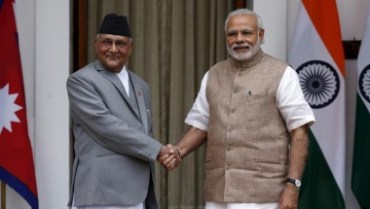
Nepal's Prime Minister Khadga Prasad Sharma Oli (L) shakes hands with his Indian counterpart Narendra Modi during a photo opportunity ahead of their meeting at Hyderabad House in New Delhi, India, February 20, 2016. REUTERS/Adnan Abidi

Prime Minister K.P. Oli visited New Delhi for talks with his Indian counterpart Narendra Modi after a months-long freeze in relations triggered by the grievances of plains dwellers in southern Nepal who have close historical ties to India.

Nepal, which moved from absolute to constitutional monarchy in 1990, made changes to its constitution to ensure greater participation of the Madhesi community in parliament.

But community leaders said the amendments failed to address their central fear that provincial borders would be redrawn in a way that would divide them.

“Our prime minister appreciated the progress made towards consolidation of constitutional democracy in Nepal,” Indian Foreign Secretary Subrahmanyan Jaishankar told a news briefing.

Source: Leaders of Nepal and India mend fences after friction | Reuters

08/02/2016

GDP data to show economy racing, realities less rosy | Reuters

India will release data on Monday showing it remains one of the fastest growing economies in the world, but economists are struggling to reconcile that rosy picture with ground realities like weak exports, investment, and flat corporate order books.

Labourers works at the construction site of a residential building in Mumbai, India, February 4, 2016. REUTERS/Shailesh Andrade

The median estimate from a Reuters poll of economists put GDP annual growth at 7.3 percent in the quarter through December, just below 7.4 percent in July-September.

If the data comes in line with expectations, it would be faster than 6.8 percent growth posted by China in the same quarter.

However, very few economists are ready to take the official data at face value, reckoning that it overestimates the pace of expansion in Asia’s third-largest economy.

“There are inconsistencies between the picture presented by new GDP series and many other tried and trusted real activity indicators,” said Rupa Rege Nitsure, group chief economist, L&T Finance Holdings, Mumbai.

Until a year ago, India was struggling to break out of the longest stretch of below 5 percent growth in a quarter of a century. But a change made a year ago to the method GDP is calculated transformed the lumbering South Asian giant overnight into one of the fastest growing major economies.

Yet, merchandise exports have been falling for the past 13 months. Rural spending is subdued on weak wage growth and two successive droughts.

Corporate order books are flat. While finished goods inventory to sales ratio is showing no improvement, raw material inventory to sales ratio has worsened.

With factories running nearly 30 percent below their capacity, firms are not in a hurry to invest in new plants and machinery. Festering problem of bad loans, meanwhile, has impeded credit flow and delayed full transmission of interest rate cuts.

There are some encouraging signs, however. Robust growth in indirect tax receipts suggest a nascent revival in manufacturing sector. Foreign direct investment is up. Low inflation, thanks largely to a crash in global commodity prices, has helped bolster urban demand.

Source: GDP data to show economy racing, realities less rosy | Reuters

22/01/2016

Prime Minister Narendra Modi flags off Mahanama Express in Varanasi – The Hindu

In his fifth visit to his constituency, Varanasi, after assuming power, Prime Minister Narendra Modi on Friday flagged off a new train, Mahanama Express, connecting the temple town to the national capital through Lucknow. Named after Pandit Madan Mohan Malviya, the founder of the Banaras Hindu University, the train is fully equipped with modern facilities and boasts of bio toilets in every coach and has renovated and refurbished AC-coaches fitted with led screen. The train will run thrice a week and cover the distance from Varanasi to New Delhi in 14 hours.

Prime Minister Narendra Modi interacts with a physically challenged child while distributing assistive devices at a function, in Varanasi on Friday.

Attending the Divyangjan Sashaktikaran Samaroh in Varanasi, Mr. Modi also gave away assisting electronic devices, artificial limbs, tricycles, Braille kits, hearing aids, teaching-learning material kit and other equipment to 9,296 ‘divyangs’ or specially-abled persons.

“When I say let us use the word ‘divyang’ it is about a change in mindset,” Mr. Modi said while reiterating his plea for doing away with the word “viklang” (handicapped) and instead calling the differently-abled as “divyang” (those born with a divine limb/organ).

“Let us not think about what is lacking in a person, let us see what is the extra ordinary quality a person is blessed with,” said Mr. Modi, who personally distributed electronic devices to around a dozen persons.

The PM last visited his constituency in December 2015 along with his Japanese counterpart Shinzo Abe. In his address, Mr. Modi recalled the visit and even praised Mr. Abe for appreciating and mentioning his trip to Varanasi in a speech in Japan. “In one year of this government, 1800 such camps have been held. While in the two decades not even a 100 camps were set up,” Mr. Modi said taking a jibe at previous Congress government’s indifference to the differently-abled. On the way to the function, a bus carrying ‘divyangs’ met an accident injuring around 20 persons. Taking cognizance of the matter, Mr. Modi ordered swift action and officials reached the spot. “Most of the received minor injuries, but some will need to be hospitalized for a few days. The government will make all arrangements for treatment,” Mr. Modi said.

The PM also interacted with ‘divyang’ children who have overcome disabilities relating to speech and hearing with the help of the ADIP (Assistance to Disabled Persons) scheme of the Centre.

“The result of such camps is that middlemen will get eliminated-nut bolts are being tightened and the shops of these middlemen are shutting down. And due to this some people are getting worried but not me. If I am in pained, it is by the plight of the poor in the country,” Mr. Modi said.

Source: Prime Minister Narendra Modi flags off Mahanama Express in Varanasi – The Hindu

06/11/2015

Xiaomi’s Big Bet on Indian Internet Revolution Starts to Pay Off – China Real Time Report – WSJ

The sales are a significant rise compared with the three million phones the company said it sold in its first year of business in India.

Xiaomi aims to sell 80 to 100 million smartphones this year and has been valued by investors at $46 billion. But increasing competition at home, from companies who mimic Xiaomi’s business model of selling high-end phones at low prices, will make it tough to meet its sales target. So the five-year-old startup is setting its hopes on growth in India. Xiaomi found success in China by combining razor-thin profit margins on hardware with glitzy product launches that helped build its fanbase.

The closely-held company needs to prove that it can export its business model to other countries to continue to justify its high valuation.

Xiaomi introduced its first model, the Mi 4i, outside China, at a launch in New Delhi in April. In August, it said it would begin assembling its entry-level Redmi 2 Prime in India.

Xiaomi’s recent success in India shows that its model can work there, said the company’s Vice President Hugo Barra. Since January, sales in the South Asian country increased 45% quarter-over-quarter, on average.

The firm’s Indian office is tweaking Xiaomi’s model of Internet flash sales, designed to boost demand and cut costs. During the company’s sale for the Hindu holiday Diwali, items were sold for as little as a rupee. “Some people bought a Mi TV for one rupee,” Mr. Barra said. One rupee is equal to $0.02. The heavily discounted deals meant that Xiaomi spent nothing on marketing. “This is an idea the India team came up with that you will see reused in other markets,” he said. The company still faces challenges in India.

While Xiaomi says it sold three million phones in its first year in India, market leader Micromax Informatics Ltd. says it sells three million phones a month. While the Chinese company relies mostly on online sales to cut costs, the majority of Micromax’s sales are in brick-and-mortar retail outlets, where most Indians still shop.

It remains unclear how much India can help bolster Xiaomi’s balance sheet. While smartphone sales are booming in India, the market is still tiny.

Xiaomi’s Mr. Barra says the company will slowly add to its catalogue of products in India, which currently includes phones and a handful of accessories like headphones and a fitness tracker. In China, Xiaomi sells everything from water purifiers to power strips.

Next up could be the company’s line of Internet routers, Mr. Barra said, which includes a model with six terabytes of storage.

“We are looking at bringing the router family to India,” he said. But don’t expect the smart bathroom scale to show up in India right away, or even the company’s newest gadget: a cut-price Segway-like device. “We carefully select things that will sell in India in good volumes. We have to be thoughtful and plan carefully.”

Source: Xiaomi’s Big Bet on Indian Internet Revolution Starts to Pay Off – China Real Time Report – WSJ

18/10/2015

Sonia says Modi govt imposing its ideology on people – The Hindu

Congress president Sonia Gandhi on Saturday blamed the Modi government for the growing intolerance to intellectuals and communal tensions in the country. The government, she said, was anti-poor and corporate-friendly.

Congress president Sonia Gandhi at an election rally in Buxar, Bihar on Saturday. Photo: Ranjeet Kumar

“Ever since Narendra Modi came to power, the intellectuals are being harassed and an effort has been made to stoke communal tensions through rumours. The BJP is trying to enforce its own ideology on people. It is shameful,” she said at election meetings at Buxar and Chappra. Her comments refers to the recent lynching of a man at Dadri in Uttar Pradesh and writers returning their Sahitya Academy awards.

“Modiji, Hindu aur Musalmaan apas main ladte nahi, balki unko ladaya jata hai… kyunki communal jhagde band ho gaye toh kuch logo ki dukaandari band ho jayegi, aur yeh BJP se behtar kaun janta hai? [Mr. Modi, Hindus and Muslims don’t clash with each other but they are being pushed to do it … If communal clashes are being stopped, many people’s business will be closed, and who knows this better than the BJP?],” she said.

Ms. Gandhi said the Modi government worked only for big businesses and had no concern for the poor.

She said the Congress would not allow the Goods and Services Tax (GST) Bill to go through the Rajya Sabha as it was against the welfare of the people. “The UPA government wanted the GST law for the development of industry, but we are opposing it now for the welfare of the people,” she said.

“Mr. Modi speaks much but delivers little. Has he delivered on the tall claims made by him during the last Lok Sabha polls,” she asked. When the crowd yelled “no”, she said: “It is high time he understood the pain of the people.”

The government was silent when pulse prices were rising, farmers were committing suicide and unemployment among the youth was rising, she said.

Taking on Mr. Modi for alleging that the Congress had done little in the past 60 years of its regime, Ms. Gandhi said: “When we got freedom, we had nothing; but the Congress government did revolutionary works in education, health and employment in the past 60 years. We maintained the unity and integrity of the country and strengthened democracy.”

Source: Sonia says Modi govt imposing its ideology on people – The Hindu

09/09/2015

Modi Tells Nervous Business Leaders the Global Shakeup Is India’s Time to Shine – India Real Time – WSJ

Prime Minister Narendra Modi called Indian business leaders to his official residence Tuesday to discuss how to bulwark the country as China’s slowdown continues to send shock waves through the global economy.

In the three-hour summit, executives and economists ran through a long-standing wish list that includes investing more in infrastructure, expediting government clearances and lowering capital costs. Some executives suggested an interest-rate cut was overdue from the central bank, and that domestic companies should be given more protection from inexpensive imports.

“We have to be cautious, while we take some bold steps on the economy to increase growth,” Rana Kapoor, chief executive of Yes Bank Ltd., told reporters after leaving the meeting. “At the same time, you have to make sure that India has a soft landing after the severe impact of the yuan devaluation.” There has been a jump in foreign direct investment in India this year. But the executives told Mr. Modi that local companies need to see long-delayed improvements in economic management before they can ramp up capital spending. “Domestic investment is at a standstill, and that’s largely because there is no demand,” said Jyotsna Suri, president of the Federation of Indian Chambers of Commerce and Industry.

Mr. Modi reiterated that the world-wide turbulence is an opportunity to highlight India’s resilient growth, vast domestic market and government policies geared toward promoting investment, Finance Minister Arun Jaitley said.

Source: Modi Tells Nervous Business Leaders the Global Shakeup Is India’s Time to Shine – India Real Time – WSJ

Law of Unintended Consequences

continuously updated blog about China & India

ChiaHou's Book Reviews

continuously updated blog about China & India

What's wrong with the world; and its economy

continuously updated blog about China & India