Posts tagged ‘Nitish Kumar’

03/10/2016

How has India changed a year after Dadri beef lynching? – BBC News

It has been a year since a Muslim man in northern India was lynched over rumours that his family had slaughtered a cow and eaten beef.

Hindus consider cows to be sacred, and for many, eating beef is taboo. The slaughter of cows is also banned in many Indian states.But Mohammad Akhlaq’s death sparked widespread outrage and contributed to changing the social and political discourse of the country. The BBC’s Ayeshea Perera looks at some of the most significant things that happened in India following his death.

The ‘intolerance’ furore

Image copyright AFP: The government began to be haunted by allegations of intolerance

Perhaps the largest fallout of Mohammad Akhlaq’s death in Uttar Pradesh state was the accusation of “intolerance” that began to haunt Prime Minister Narendra Modi’s ruling Hindu nationalist BJP.

Critics of the BJP have often accused it of being Hindu majoritarian in its outlook and of being hostile to ethnic and religious minorities, particularly Muslims. And this incident only strengthened those voices.

The fact that Mr Modi did not immediately condemn the incident, choosing to remain silent even as state party leaders jumped to the defence of the accused, caused even more anger.

It prompted an unprecedented movement by writers and poets who had been celebrated by the government – they started returning their prestigious Sahitya Akademi awards to protest at intolerance in India. More than 40 writers from all across the country returned their awards and were soon joined by a group of film makers who said they would not be “guilty of flattening diversity” in the country.

Leading writer Nayantara Sehgal, a niece of India’s first prime minister Jawaharlal Nehru, wrote that “… India’s culture of diversity and debate is now under vicious assault… The prime minister remains silent about this reign of terror. We must assume he dare not alienate evil-doers who support his ideology.

“But “intolerance” was not limited to returning awards – it found its way into popular discourse as well. Bollywood superstar Amir Khan also created a furore when he expressed concern over the “growing intolerance” in India. He was later joined by fellow star Shah Rukh Khan who said he “respected” people returning awards to protest against intolerance.

Later, the arrest of a student leader from India’s prestigious Jawarhalal Nehru University on sedition charges over a rally condemning the hanging of a man convicted of attacking the Indian parliament also sparked cries of “intolerance” on a massive scale.

The BJP loses Bihar
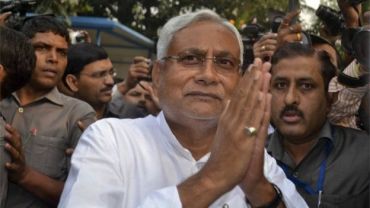
Image copyright AP: Nitish Kumar led an alliance which defeated PM Narendra Modi’s BJP in the Bihar polls

A second outcome that can be linked back to the Dadri killing is that the BJP went on to lose state elections in the neighbouring northern state of Bihar – a poll it was widely expected to win.Incumbent chief minister Nitish Kumar, who was on his second term, had already suffered a crushing defeat to Mr Modi’s party in the 2014 parliamentary elections, and another “Modi wave” was expected to sweep the state elections as well.

But in a masterstroke, Mr Kumar and his allies positioned themselves as a “secular” alliance, in direct opposition to the “communal” BJP.

The fact that Mr Modi and BJP party chief Amit Shah raised the sensitive issue of cow slaughter and consumption of beef during election rallies in the state also did not seem to help.

When Mr Kumar’s party won, it was called a “historic verdict” and hailed as proof that running a poll campaign along religious and ethnic lines would not bring results.

The rise of cow protection vigilante groups

Image copyright MANSI THAPLIYAL: These self styled cow protectors created headlines after they lay in wait for and then badly beat up a number of truck drivers transporting cattle for slaughter

The death of Mr Akhlaq seemed to put new focus on “cow protection” groups who took it upon themselves to ensure that cattle would not be slaughtered or consumed.

Mostly members of militant Hindu groups like the Bajrang Dal, Vishwa Hindu Parishad (World Hindu Council) and Shiv Sena, these self-styled cow protectors created headlines after they lay in wait for and then beat up a number of truck drivers transporting cattle for slaughter.

In another attack, two Muslim woman were beaten up after they were accused of carrying beef. And most significantly, in an incident which led to massive caste unrest, four low-caste Dalit men trying to skin a dead cow were thrashed by vigilantes in the western state of Gujarat.A video of the incident went viral and led to huge protests and an uproar in parliament.

After again being accused of silence, Mr Modi used a radio address almost a full month later to criticise vigilante attacks, saying such people made him “angry”, and any attacks must be investigated.

Eating as an act of defiance

Beef fry is an essential part of the diet in south India’s Kerala stateThe right to eat beef became another huge talking point in

Source: How has India changed a year after Dadri beef lynching? – BBC News

18/10/2015

Top African leaders to meet PM Modi in his trademark jacket

PM Narendra Modi has not only gained prominence across world for giving a personal touch in his diplomatic efforts but he is also famous for his impeccable dress sense. Prime Minister will take the diplomatic skills to new level when he will host a dinner for top African leaders later this month.

Top African leaders to meet PM Modi in his trademark jacket

According to a report in The Times of India, All of the 42 heads of state and government, who are attending the 3rd India-Africa Forum Summit, from Egyptian President Abdel Fattah el-Sisi to South African counterpart Jacob Zuma, will attend the dinner wearing Modi’s trademark jacket. They are specially designed by government agencies.

The bundi waistcoat that PM Modi made his own accessory will be at the heart of his latest bit of sartorial diplomacy. The sleeveless jackets will be available in several brilliant colours.

The African leaders will also be wearing unique ‘ikkat kurta’ (no pyjamas) being gifted to them by the government during their visit to India.

A senior African diplomat said to TOI that he was really impressed with the attention PM Modi was giving to the summit despite his hectic campaigning for Bihar elections.

Source: Top African leaders to meet PM Modi in his trademark jacket

23/09/2015

Prime Minister Popularity and Voter Optimism Have Soared in India Under Modi, U.S. Think-Tank Survey Shows – India Real Time – WSJ

In the sixteen months since Prime Minister Narendra Modi won a landslide victory in national elections, he has faced policy setbacks, parliamentary roadblocks and electoral failure. These appear to have had little impact on support for him.

A new report by the U.S.-based think tank Pew Research Center says Mr. Modi remains overwhelmingly popular among Indians. Among those surveyed, 87% said they have a favorable opinion of Mr. Modi. Unpacking that statistic gives Mr. Modi greater reason to celebrate. His popularity is the highest among two crucial demographic groups: 18 to 29 year olds and rural Indians. Nine out of 10 people in each category gave the leader of the world’s largest democracy a thumbs up.

Mr. Modi’s undented approval ratings come at a time when his appeal among investors and analysts has lost some of its sheen. India-watchers complain big policy pronouncements have been few and slow to come, limiting India’s growth potential. Far from sharing that pessimism, a majority of Indians are upbeat about their country’ economic prospects, the survey showed. More than half of the respondents said they were happy with the direction of their country, up from 29% in 2013, toward the end of the Congress party’s decade-long tenure when the economic was stuttering and corruption scandals dogged the government. More than 90% of those surveyed by Pew said they had faith in government, up from 70% two years ago. These findings raise key political questions.

Some strategists wonder why, given his once-in-a-generation mandate, Mr. Modi hasn’t pushed for tougher, more-disruptive measures to accelerate growth. His government recently backtracked on a policy that would have made it easier to acquire land for infrastructure and industry because of protests by opponents in Parliament and fear of a backlash from rural voters.

Others argue Mr. Modi is playing the long game, seeking to build on his popularity to consolidate more political power at state and local levels rather than risking it at an early stage on controversial policies. Leaders of his Bharatiya Janata Party say they are planning for at least two five-year terms under Mr. Modi’s premiership during which they hope their party, whose political authority has grown sporadically since its inception in 1980, will achieve the kind of dominance Congress enjoyed in the decades after India won independence from British colonial rule in 1947.

Such a strategy – and Pew’s data – explains why Mr. Modi is the BJP’s star campaigner. In the state of Bihar where elections are scheduled to begin next month, the BJP has not announced a candidate for chief minister, the person who would run the state if the party won. Instead, posters and hoardings are plastered with Mr. Modi’s face. To be sure, the Bihar polls won’t be easy. Caste allegiances play an important role in the vote and the incumbent regional leader, Nitish Kumar, is seen as an effective leader for development. A recent opinion poll by the Hindi-language ABP News channel and Nielsen showed the BJP and Janata Dal (United)-led alliances are neck and neck.

Source: Prime Minister Popularity and Voter Optimism Have Soared in India Under Modi, U.S. Think-Tank Survey Shows – India Real Time – WSJ

05/09/2012

* Who will be next Indian Prime Minister?

Reuters: “With the Congress-led coalition government more than halfway through its five-year term, the political temperature is heating up in the world’s largest democracy. The question on everyone’s minds is — who’s going to be the next prime minister?

Photo

A recent Nielsen survey had showed Gujarat chief minister Narendra Modi was the top choice for the post, ahead of Congress party scion Rahul Gandhi and Bihar chief minister Nitish Kumar.

But last week’s conviction of a Bharatiya Janata Party (BJP) lawmaker in the Gujarat riots is a blow to Modi, and the political fallout from the case may have dented his hopes of sitting in the prime minister’s chair.

Senior party leader Lal Krishna Advani had earlier stoked controversy by blogging about the possibility of a “non-Congress, non-BJP prime minister” after the 2014 elections.

It’s not just internal party dynamics, the BJP’s allies are also giving Modi sleepless nights. Janata Dal (U) leader Nitish Kumar has made it clear he won’t be happy if Modi is projected as the BJP candidate.

And what about the Congress? Incumbent Manmohan Singh seems to be out of the reckoning and several senior Congress leaders have hinted at the elevation of Rahul Gandhi.

But that’s easier said than done. A political crisis over suspected corruption in the allocation of coal blocks has put the government on the back foot. Its performance in this year’s Uttar Pradesh state elections, often a barometer of success at the national level, wasn’t good enough to stave off regional rivals. What was more painful — its main campaigner was Rahul Gandhi and his ‘magic’ did not work.

With the Congress-led coalition government more than halfway through its five-year term, the political temperature is heating up in the world’s largest democracy. The question on everyone’s minds is — who’s going to be the next prime minister.”

via India Insight.

Law of Unintended Consequences

continuously updated blog about China & India

ChiaHou's Book Reviews

continuously updated blog about China & India

What's wrong with the world; and its economy

continuously updated blog about China & India