

One of the many pet projects of those inclined more to the right has been turning the dream of “Akhand Bharat“, or Undivided India, into a reality. The Rashtriya Swayamsevak Sangh’s education saffroniser-in-chief, Dinanath Batra, has even written about the subject in his book Tejomay Bharat, which will now be stocked in Gujarat school libraries. “Undivided India is the truth, divided India is a lie,” Batra writes, referring to a vision of the nation that begins as far west as Afghanistan and goes all the way till Burma, including everything in between. “Division of India is unnatural and it can be united again,” Batra suggests.
Of course, no one in the government has spoken of Akhand Bharat and Prime Minister Narendra Modi has never clearly explained his understanding of the concept. There is no indication that the government intends to implement any policy that aims to reinstate this fanciful notion of what India once was and there is no reason to believe there will be.
But the concept could be a rubric by which to understand the Modi government’s approach to foreign policy, particularly in the neighbourhood. From the very get-go Modi announced his intention to reinvigorate ties with India’s neighbours by inviting to his swearing-in ceremony each of the leaders from the South Asian Association for Regional Cooperation — the primary multilateral forum for subcontinental nations.
Just two-and-a-half-months in, the PM has visited two of India’s neighbours, his foreign minister has visited four, and India is set to become part of multilateral organisations that will give it many more opportunities to project itself as a regional powerhouse. This is Akhand Bharat 2.0.
Regional power
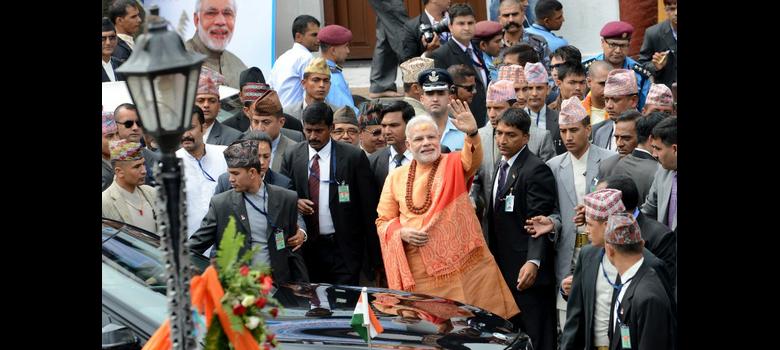
Foreign minister Sushma Swaraj is currently in Myanmar, the fourth neighbourhood country that she has visited in the last three months. But it was the trip made by Modi to Nepal that really sent a statement, since it was the first visit by an Indian prime minister to the country in 17 years. He received an enthusiastic reception.
“All governments that come to power in India feel that we must improve our relationship with the neighbourhood,” said Kanwal Sibal, a former foreign secretary. “But the difference is that, whereas in the past it remained at the level of rhetoric, in this case they are translating it into concrete initiatives. The fact that an Indian PM visited Nepal after 17 years is a testimony to the fact that, despite our professed position about needing a secure neighbourhood, we have actually neglected it… that is changing.”
That message was sent at the very beginning with the invitations handed out to each of the SAARC leaders for Modi’s swearing-in, all of which were accepted — with the exception of Bangladesh’s Sheikh Hasina, but only because she was on another diplomatic visit at the time. The sight of all the leaders in front of Rashtrapati Bhavan, and Modi dedicating his first day in office to bilateral talks with them, sent a very clear signal. The PM made his first foreign visit to Bhutan, a country deeply connected to India but not particularly important in terms of foreign policy.
“It shows that they understand that unless India is a dominant regional power, we can hardly be an extra-regional power or a world power,” said Manoj Joshi, a distinguished fellow at the Observer Research Foundation. “They seem to definitely be working on this understanding, especially because we are facing stiff competition from the Chinese when it comes to projecting power in the neighbourhood.”
Leading South Asia
It’s not just symbolism and rhetoric either. Modi’s visits to Bhutan and Nepal have been accompanied by important agreements, such as a $1 billion line of credit to Kathmandu, as well as the promise of further talks. Discussions with Bangladesh have also indicated progress on key stumbling blocks between the two nations. Modi has also spoken of using the SAARC framework to further cooperation in the neighbourhood. His suggestion of a SAARC space satellite, for example, while criticised by some as a gimmick, certainly sent a message that he is looking beyond the potential disputes towards projects that would allow the countries to work together.
“He has staked his leadership of the region, and this is important,” Sibal said. “There is a gesture to friendship in the neighbourhood, but he has also put across the message that India is leading the region. India is not going to neglect its neighbourhood, and it will take the lead in creating synergies that can benefit all.”
via Scroll.in – News. Politics. Culture..


 CHINDIA ALERT: You'll be living in their world, very soon