Posts tagged ‘Oil Prices’

26/08/2016

China’s Oil Industry Destined for Big Changes – China Real Time Report – WSJ

China’s largest oil fields are the stuff of Communist Party folklore, but today they’re potent symbols of the challenges facing China’s energy industry.
Significant falls in the first half of this year at China’s biggest-producing oil fields — Daqing, Shengli, and Changqing — have solidified a moment anticipated by the global energy industry: Oil production in China is in long-term decline.

The turnabout is jarring for an industry that has long held huge political sway in China. The “Daqing Spirit”– meaning hard work in the face of challenges — has long been celebrated by top leaders. The companies have been held up as critical to fueling China’s economic rise.

The London-based consultancy Energy Aspects compiled data from China’s oil fields. It shows just how great a toll the plunge in crude prices has taken on overall domestic production.
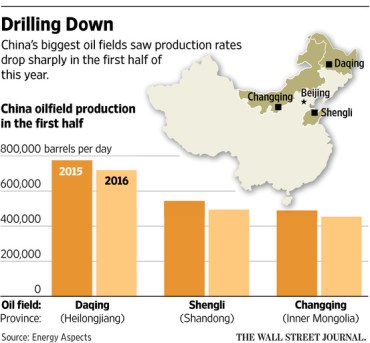
China’s three biggest oil fields experienced production declines of between 7-9% in the first half, according to Energy Aspects. That far outpaced China’s production decline as a whole. Small gains from output in the Xinjiang region and elsewhere haven’t been enough to compensate.

The declines are important, Energy Aspects said in a recent report, “because it symbolizes a significant shift in thinking” by Chinese officials. While the government has a long-held goal of limiting imports — and protecting jobs in places like Daqing — by keeping production high, leaders seem to have realized that track was both unsustainable and expensive.

With global crude prices under $50 per barrel, many aging wells at big oil fields in China lose money with each barrel they pump. Shutting off the taps at home helps to stem losses when cheaper oil can be purchased from overseas.

So what does it mean?In short, the assets that long served as the cornerstone for revenue for companies such as PetroChina are drying up. If China’s energy giants want to be more profitable–as outside investors and China’s government are pressuring them to do–they’re going to need to look to diversify revenue.

That’s likely to include a mix of initiatives, say Chinese executives and analysts. One part of the drive might be trying to secure new oil production overseas. That would mean a renewed push for outbound deals. Big discoveries in Brazil and elsewhere appear particularly attractive to China.

The other path to future growth is more complicated. For example, China’s oil companies are keen to learn how to boost sales and profits at the thousands of retail gas stations across China. Earning more money from sales of Snickers bars or cigarettes would make them somewhat less vulnerable to the vicissitudes of global oil prices.

The bottom line: China’s oil industry, like the economy as a whole, is destined for big changes. Many of those in the coming years will involve a greater global role for the oil giants — PetroChina, Sinopec, and Cnooc — than they currently have today.

The bigger global footprint is inevitable, says one person with ties to China’s top oil executives, as production at home begins to dwindle. The international revenues are needed to stave off a domestic slowdown.

“We are coming. We are coming,” he said.

Source: China’s Oil Industry Destined for Big Changes – China Real Time Report – WSJ

17/09/2015

How Modi’s Win Helped Boost India’s Ranks of Millionaires – India Real Time – WSJ

The ranks of the millionaires grew at a faster rate in India than anywhere else around the globe in 2014 thanks to the election of Prime Minister Narendra Modi and falling oil prices, according to a report on worldwide wealth.

After only marginal growth in 2013, India’s tally of high-net-worth individuals increased by 26.3% in 2014 compared with the previous year and with 17.5% in China and 8.2% in the U.S. over the same period, the data from consultants Capgemini and RBC Wealth Management, said.

High-net-worth individuals are defined as those with investible assets of more than $1 million.

The report says that the election of “a popular reform-minded prime minister” in May 2014 “had a positive effect on the economy and equity markets, boosting [high-net-worth-individual] gains.” More In Narendra-Modi

Mr. Modi’s win “helped to boost investor confidence and contributed to strong performance in the stock market,” the report’s authors said.

“Lower oil prices helped reduce the country’s budget deficit and retail inflation fell considerably,” they added. Still, in absolute numbers of very wealthy, India continues to lag behind. It had 1,975,000 people with $1 million to invest in 2014, compared with 4,682,000 in the U.S. and Canada and 8,901,000 in China.

The Asia Pacific region as a whole though, including India and China, had a higher number of millionaires than North America in 2014.

Source: How Modi’s Win Helped Boost India’s Ranks of Millionaires – India Real Time – WSJ

14/03/2015

China’s greener energy efforts help global carbon emissions stall after almost 40 years of gains | South China Morning Post

China burned less coal and generated more electricity from renewable sources last year, which helped halt the rise in global carbon dioxide emissions in the energy sector.

China burned less coal last year and generated more electricity from renewable sources to help halt the global rise in  carbon dioxide emissions. Photo: Reuters

Emissions of carbon dioxide were flat at 32.3 billion tonnes last year, as they were in 2013, the International Energy Agency (IEA)  reported yesterday.

It ended steady gains over the past four decades except in years with an economic downturn.

“This is both a welcome surprise and a significant one,” IEA chief economist Fatih Birol said in a statement.

“This gives me even more hope that humankind will be able to work together to combat climate change, the most important threat facing us today.”

The IEA, which is based in France, and advises governments of developed nations, said the halt in emissions growth was linked to greener patterns of energy consumption in China – the top carbon emitter ahead of the United States – and in developed nations.

“In China, [last year] saw greater generation of electricity from renewable sources, such as hydropower, solar and wind, and less burning of coal,” it said.

via China’s greener energy efforts help global carbon emissions stall after almost 40 years of gains | South China Morning Post.

20/02/2015

China chocolate market seen growing to $4.3 billion by 2019: Hershey | Reuters

(Reuters) – Chocolate sales in China should grow to $4.3 billion by 2019, up nearly 60 percent from $2.7 billion in 2014 and driven by demand from the growing urban population, a senior Hershey officer forecast on Wednesday.

A Hershey's chocolate bar is shown in this photo illustration in Encinitas, California January 29, 2015. REUTERS/Mike Blake

The increase projected by Hershey International president Bert Alfonso reflects the chocolate industry‘s continued bet on growing emerging market consumption, despite recent indications of slowing demand in fast-growing Asian markets.

Hershey (HSY.N), which has been making chocolate for more than a century, expects to benefit from this demand boom, Alonso said in a webcast heard by Reuters of the Consumer Analyst Group of New York conference.

He projected the company’s China sales would grow by 35 percent to $450 million in 2015. Based on that figure, chocolate sales in China made up around 4.5 percent of Hershey’s $7.4 billion in total revenue in 2014.

The growth comes as Hershey integrates pro

via China chocolate market seen growing to $4.3 billion by 2019: Hershey | Reuters.

11/02/2015

Chinese Companies Named and Shamed on List of Deforestation ‘Powerbrokers’ – China Real Time Report – WSJ

Foshan Saturday Shoes , headquartered in southern China, might not be a Fortune 500 company. But on Wednesday, it and 29 other Chinese companies landed on a different kind of powerhouse list.

Launched by research group the Global Canopy Programme, the so-called “Forest 500” list aims to chart out the 500 companies, countries and investors that play the biggest role in what they term the “global deforestation economy.” Together, the group said, those 500 control the global supply chains of commodities such as timber, palm oil and beef that together account for more than $100 billion in trade.

It’s not just appetite for exotic timbers or plain old plywood that’s landed China a particularly prominent role in that ranking, said the Global Canopy Programme’s Mario Rautner. From demand for soybeans to land-intensive cattle and their sundry byproducts, the country is one of the most important driving forces helping raze trees and clear land overseas, he said.

Foshan Saturday Shoes scored a 1 out of a 0-5 ranking measuring adherence to various sustainability initiatives and reporting and transparency, among other factors, with 0 being the lowest score possible. Chinese dairy giant Mengniu also scored a 1, as did food processing company COFCO.  Mengniu and COFCO didn’t immediately respond to a request for comment. A representative for Foshan Saturday Shoes said he didn’t see any connection the company had to deforestation and wasn’t in a position to comment on it.

The list aims to evaluate how well the ranked companies are doing in the fight against deforestation. Among countries that import heavily from tropical forest regions – accounting for 35% of global leather imports from such areas, for example – China scores conspicuously poorly, he said, behind neighbors such as Japan, India and Korea. The study examined public procurement policies, governance and commitment to reducing deforestation.

Inclusion on the list by itself isn’t necessarily indicative of their contribution to deforestation, Mr. Rautner said. “We’re not saying these 500 are causing deforestation directly,” he said. “They are powerbrokers.” For example, various multinationals’ performance was praised, depending on their participation in initiatives such as the Consumer Goods Forum, a corporate alliance that has resolved to try and achieve zero net deforestation by 2020.

via Chinese Companies Named and Shamed on List of Deforestation ‘Powerbrokers’ – China Real Time Report – WSJ.

05/02/2015

Falling oil prices pull India’s budget out of the fire | Reuters

Falling oil prices have been a major windfall for India: Just weeks ago it faced failing to meet fiscal deficit targets, but can now expect a budget that not only hits its targets, but also provides extra cash to support reform.

India's Finance Minister Arun Jaitley gestures during the session 'India's Next Decade' in the Swiss mountain resort of Davos January 23, 2015. REUTERS/Ruben Sprich

The coming budget for fiscal 2015/16 (April-March), which will be unveiled on Feb. 28, is widely seen as a test of Prime Minister Narendra Modi‘s ability to lead economic reform.

Fortunately for Modi, the economic climate has handed him a chance to pass that test with flying colours: Budget planners are optimistic that he will set Asia’s third-largest economy on a path for growth of 7 percent to 8 percent over the next two years.

“The situation is far better now than in December,” said one finance ministry official, who spoke to Reuters despite a ban on contact with the media in the secrecy-shrouded run-up to the presentation of the annual budget. “The budget will deliver on Modi’s promise of better days for the economy.”

The halving of global oil prices since mid-2014 has allowed the Modi government to raise diesel and petrol fuel taxes and cut diesel prices by 25-30 percent – a windfall gain for households as well as businesses, and dampening inflationary pressures in the economy.

via Falling oil prices pull India’s budget out of the fire | Reuters.

19/12/2014

What could happen in China in 2015? | McKinsey & Company

It seemed harder to prepare my “look ahead” this year. On reflection, I believe this is because political and economic leaders in China have clear plans and supporting policies that they are sticking to. You can debate the pace at which actions are being taken, but not really the direction in which the country is traveling. This means a number of the themes I highlighted for this year will remain relevant in 2015:

Improving productivity and efficiency will remain the key to maintaining profitability for many companies, given lower economic growth (overall and at a sector level) and the impact of producer price deflation on multiple sectors.

The impact of technology as it eliminates jobs in services and manufacturing will become even greater (but still not in government).

As a result, the government will keep a sharper focus on net job creation and the quality of those new positions. Companies will hire even more information technologists to keep up in the race to exploit technology better than their competitors.

The push to lower pollution, and now carbon emissions, will lead to even greater investment in domestic solar and wind farms, boosting the global position of Chinese producers.

High-speed-rail construction will continue domestically and increasingly abroad, as Chinese companies become the builder of choice for high-speed rail globally.

Beyond these, there are several additional themes that will be important in 2015. I describe them below.

via What could happen in China in 2015? | McKinsey & Company.

14/12/2014

With Oil Prices Falling Venezuela Needs China More Than Ever – Businessweek

Venezuelan President Nicolás Maduro had a Plan B in the event the Organization of Petroleum Exporting Countries declined to back his country’s proposal to cut output to boost prices.

Downtown Caracas, Venezuela

The day after OPEC’s Nov. 27 decision to maintain production at current levels, a move that drove oil prices to new lows, a somber-looking Maduro went on national television to tell the Venezuelan people he was dispatching Finance Minister Rodolfo Marco Torres to Beijing. Torres spent the first week of December in China, during which he tweeted photos of his meetings with Chinese officials and bankers.

via With Oil Prices Falling Venezuela Needs China More Than Ever – Businessweek.

21/11/2014

China Stocks Up on Oil While It’s Cheap; Tanker Companies Profit – Businessweek

With oil prices off about 30 percent since June, China is importing record amounts of crude to build up a strategic reserve. Cheap fuel is giving tanker companies their best profits in years.

via China Stocks Up on Oil While It’s Cheap; Tanker Companies Profit – Businessweek.

Law of Unintended Consequences

continuously updated blog about China & India

ChiaHou's Book Reviews

continuously updated blog about China & India

What's wrong with the world; and its economy

continuously updated blog about China & India