Posts tagged ‘Peak oil’

26/08/2016

China’s Oil Industry Destined for Big Changes – China Real Time Report – WSJ

China’s largest oil fields are the stuff of Communist Party folklore, but today they’re potent symbols of the challenges facing China’s energy industry.
Significant falls in the first half of this year at China’s biggest-producing oil fields — Daqing, Shengli, and Changqing — have solidified a moment anticipated by the global energy industry: Oil production in China is in long-term decline.

The turnabout is jarring for an industry that has long held huge political sway in China. The “Daqing Spirit”– meaning hard work in the face of challenges — has long been celebrated by top leaders. The companies have been held up as critical to fueling China’s economic rise.

The London-based consultancy Energy Aspects compiled data from China’s oil fields. It shows just how great a toll the plunge in crude prices has taken on overall domestic production.
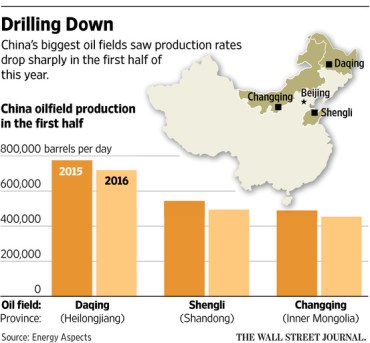
China’s three biggest oil fields experienced production declines of between 7-9% in the first half, according to Energy Aspects. That far outpaced China’s production decline as a whole. Small gains from output in the Xinjiang region and elsewhere haven’t been enough to compensate.

The declines are important, Energy Aspects said in a recent report, “because it symbolizes a significant shift in thinking” by Chinese officials. While the government has a long-held goal of limiting imports — and protecting jobs in places like Daqing — by keeping production high, leaders seem to have realized that track was both unsustainable and expensive.

With global crude prices under $50 per barrel, many aging wells at big oil fields in China lose money with each barrel they pump. Shutting off the taps at home helps to stem losses when cheaper oil can be purchased from overseas.

So what does it mean?In short, the assets that long served as the cornerstone for revenue for companies such as PetroChina are drying up. If China’s energy giants want to be more profitable–as outside investors and China’s government are pressuring them to do–they’re going to need to look to diversify revenue.

That’s likely to include a mix of initiatives, say Chinese executives and analysts. One part of the drive might be trying to secure new oil production overseas. That would mean a renewed push for outbound deals. Big discoveries in Brazil and elsewhere appear particularly attractive to China.

The other path to future growth is more complicated. For example, China’s oil companies are keen to learn how to boost sales and profits at the thousands of retail gas stations across China. Earning more money from sales of Snickers bars or cigarettes would make them somewhat less vulnerable to the vicissitudes of global oil prices.

The bottom line: China’s oil industry, like the economy as a whole, is destined for big changes. Many of those in the coming years will involve a greater global role for the oil giants — PetroChina, Sinopec, and Cnooc — than they currently have today.

The bigger global footprint is inevitable, says one person with ties to China’s top oil executives, as production at home begins to dwindle. The international revenues are needed to stave off a domestic slowdown.

“We are coming. We are coming,” he said.

Source: China’s Oil Industry Destined for Big Changes – China Real Time Report – WSJ

01/09/2014

India Outpacing China’s Oil Demand – India Real Time – WSJ

India’s oil demand has grown faster than China’s so far this year, highlighting slowing energy demand in the world’s most populous country and fueling expectations that India may pick up the slack over the medium-to-long term. The pace of India’s demand also reflects optimism about India’s economic growth under Prime Minister Narendra Modi.

In absolute terms China is Asia’s largest oil consumer, having burned 10.76 million barrels a day of oil and accounting for 12.1% of global oil consumption in 2013, according to BP PLC. The second-largest oil consumer in Asia is Japan, though its oil consumption has been declining as its economy has matured.

India ranks third at 3.7 million barrels a day and accounted for about 4.2% of global oil consumption in 2013.

India’s oil demand has shown steady growth through July at an average of 3%, or 101,000 barrels a day. China’s oil demand has declined at an average of 0.6%, or 62,000 barrel a day, in the same period, Barclays PLC analyst Miswin Mahesh said.

Indian oil demand growth has “organic, domestic, economic activity-linked factors still driving it,” he said. Mr. Mahesh expects the south Asian country’s oil demand to accelerate to 210,000 barrels a day next year, spurred by healthy construction activity, government-financed industrial projects and strong growth in car purchases.

China’s oil-demand growth, on the other hand, remains uncertain, with a large portion of its imports this year going into strategic stockpiling instead of consumption. Its oil demand fell into negative territory in July and its oil imports declined for the first time this year.

“This surprise drop in crude imports further supported our view that [China’s] full-year oil demand could be weaker than current market expectations,” Thomas C. Hilboldt, head of Asia Pacific oil research at HSBC Holdings PLC said last week.

The disparity of the demand drivers in India and China is also telling.

The bulk of oil demand in both countries is for diesel, the most widely consumed liquid fuel in Asia. China’s diesel consumption has shown a sharp decline because of its industrial slowdown, while India’s diesel demand rose sharply in the last few months because of power shortages and delayed monsoon rains.

Despite this, the extent to which Indian energy demand can compensate for China’s decline remains doubtful.

Markets are looking for the next emerging-market economy to take over as China moves into its post-industrial phase. Yet India has a fundamentally different economic structure and growth model, Janet Kong, head of market analysis at BP Singapore’s trading division pointed out last week.

“It’s very much a service-oriented economy…not relying on a lot of infrastructure investments or manufacturing,” she said.

The manufacturing sector in India has underperformed for many years, contributing to about 15% of gross domestic product and 12% of employment, compared with 25% or more of GDP in countries like China, Malaysia, Thailand and Vietnam, according to the Asian Development Bank’s 2014 report. Meanwhile, China is transitioning from an industrial economy dependent on exports to focus more on domestic consumption.

via India Outpacing China’s Oil Demand – India Real Time – WSJ.

Law of Unintended Consequences

continuously updated blog about China & India

ChiaHou's Book Reviews

continuously updated blog about China & India

What's wrong with the world; and its economy

continuously updated blog about China & India