Posts tagged ‘Percentage’

13/09/2016

China’s Industrial Output, Retail Sales Accelerate in August – China Real Time Report – WSJ

China’s economy strengthened in August, with a slew of data, from factory production to retail sales, beating estimates Tuesday. The improved performance is a fresh sign that stepped-up government spending and strong property sales are helping to stabilize growth in the world’s second-largest economy.

As for the numbers themselves, as reported by the government, industrial output rose 6.3% last month from a year earlier. Investment in buildings and other fixed assets outside rural households climbed a better-than-expected 8.1% year over year in the first eight months of 2016, while retail sales grew 10.6% in August from a year ago.

Economists generally cheered the numbers, but wondered how long the better times would last. Following are excerpts from economists’ views on the latest data, edited for length and style:Better-than-expected data out of China today raise hopes that policymakers’ efforts to reverse the slide in investment growth are seeing some success. Stronger industrial activity last month appears to have been partly driven by a recovery in investment spending, especially in the state sector. The delayed impact of earlier policy easing means that a stronger second half of this year is likely. The latest evidence of a pick-up suggests that recent concerns that policy easing had failed to provide any noticeable boost to the economy were likely somewhat premature.  Julian Evans-Pritchard, Capital EconomicsToday’s data suggest that the downside risk for third quarter GDP is significantly reduced. Investment in manufacturing industry increased only 3% in Jan-Aug, while investment in services picked up to 11.2%, showing economic rebalancing continues to take place. The uptick in industrial output is consistent with the rebound in the August official manufacturing PMI. However, the divergence of PMI performance between large corporates and small- and medium-size enterprises remains a concern.

Louis Lam and David Qu, ANZ ResearchWe expect investment to remain under pressure for the rest of the year because of slower real estate construction and spare capacity in key sectors. But with industrial profits recovering recently, and investment also up in August, the downward pressure should diminish. Meanwhile, export momentum should improve along with global trade, while we expect consumption to hold up. In all, while further stimulus is necessary to reach the government’s GDP growth target of at least 6.5% this year, the outlook has improved slightly after the August data.  Louis Kuijs, Oxford EconomicsChina needs to nurture an initial economic stabilization with continued fiscal support. Today’s data show economic growth seems to have stabilized a little last month, but it is not on a solid footing yet.  Measures such as tax cuts and increased government spending can not only help spur growth but also help restructure the economy by boosting consumption. Fiscal expenditures rose 10% in August from a year earlier, much faster than July’s 0.3% increase.  Liu Xuezhi, Bank of Communication
Source: Economists React: China’s Industrial Output, Retail Sales Accelerate in August – China Real Time Report – WSJ

18/06/2016

The great crawl | The Economist

LATE last month a black-and-white photograph of a professor from Beijing Jiaotong University spread on social media. His image was edged by a black frame, like those displayed at funerals in China, and trimmed with white flowers of mourning. Though Mao Baohua is still very much alive, he had angered netizens enough to depict him as dead. His crime? To suggest that Beijing should follow the likes of London and Stockholm, by charging drivers 20-50 yuan ($3-7.50) to enter the capital’s busiest areas in the hope of easing traffic flow in the gridlocked city.

Most Chinese urbanites see buying a vehicle as a rite of passage: a symbol of wealth, status and autonomy, as it once was in America. Hence their outrage at any restraint on driving. Since car ownership is more concentrated among middle- and high-income earners in China than it is in richer countries, any attack on driving is, in effect, essentially aimed at the middle class, a group the Communist Party is keen to keep on side. That makes it hard to push through changes its members dislike.

Since 2009 officials in Beijing and the southern city of Guangzhou have repeatedly aired the idea of introducing congestion charges. Netizens have fought back, accusing their governments of being lazy, brutal and greedy. Many also gripe that the policy would be “unfair” because the fee would have less impact on the super-rich. Complaints about the inequality of congestion charging echo those made in London and other cities before they launched such schemes. But the party, nervous of being accused of straying from socialism, is particularly sensitive to accusations that it is favouring the wealthiest.

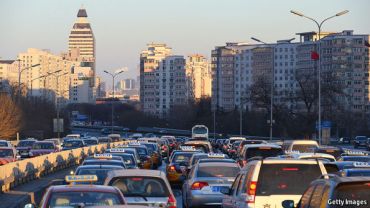
Because of such objections, city governments have not pushed their proposals very hard. But that is now changing in Beijing, where officials face a dilemma. Traffic jams in the city and appalling air pollution—30% of which comes from vehicle fumes, by official reckoning—may end up causing as much popular resentment as any surcharge. The local government is trying to work out how close it is to this tipping point. It is conducting surveys to “pressure test” how people would react to a congestion fee, says Yuan Yue of Horizon, China’s biggest polling company (the results will not be made public). It is likely that a concrete plan for a congestion charge will be announced soon. Beijing’s environmental and transport departments (not usual partners) are collaborating on a draft. State media have recently published a flurry of articles about this, not all in favour.

Public opinion is not the only challenge a congestion scheme faces. The urban planners who conceived Beijing’s layout, and that of other Chinese cities, never imagined that so many people would want to drive. The capital now has 3.6m privately owned cars: the number per 1,000 people in Beijing has increased an astonishing 21-fold since 2000, according to our sister company, the Economist Intelligence Unit (see chart).

On most days large tracts of the capital are now bumper to bumper amid a cacophony of car horns. Beijingers have the longest average commute of any city in China, according to data collected by Baidu, a Chinese search engine. The problem is not confined to Beijing. The capital has higher vehicle ownership than any other Chinese city, but car use is rising rapidly across the country. Many second- and third-tier cities are already clogged.

Beijing’s congestion scheme would be the first outside the rich world, where a handful of cities now charge drivers to enter a designated area. (Singapore has a different form of road pricing, with tolls on individual arterial roads.) Such measures have been credited with reductions in downtown car-use, improved traffic flow and greater use of public transport. They have also cut pollution, including emissions of the tiny PM2.5 particles that are particularly dangerous to health and abundant in Beijing’s air.

Transport planners reckon a congestion zone would have similar effects in Beijing, and complement existing attempts to restrict car use. In 2008, after Beijing staged the Olympic games, the city launched the current system whereby each car is banned from the urban core one workday per week, depending on the last digit of its licence plate. Beijing is now one of 11 Chinese cities with similar restrictions.

But some drivers choose to pay the 100 yuan fine, which is far higher than the congestion charge that Beijing is now mulling (around the sums suggested by Professor Mao). People also drive without plates, or buy second cars, to bypass the rules. In 2011 the capital introduced a lottery for obtaining new licence plates (six other cities do this). In Beijing the scheme has slowed the increase in car ownership, but not enough to cut congestion; some residents use vehicles registered elsewhere. Also in 2011 the capital raised parking fees, hoping to deter drivers. But people often park on pavements and traffic islands instead, usually with impunity.

Source: The great crawl | The Economist

10/06/2016

For India’s surging economy, small is beautiful | Reuters

For Rohan Sharma, business has never been better. Sales at his autoparts company in Gujarat are booming and the order book has almost doubled in the past year.

His Bhagirath Coach & Metal Fabricators has just invested nearly $120,000 in new machinery and plans to spend up to $1.2 million this year to expand capacity.

That’s an encouraging sign for Asia’s third-largest economy, where stressed balance sheets at big firms and heavy reliance on bank credit, which has dried up following a surge in troubled loans, have stymied efforts to revive private investment.

Sharma does not face such constraints. He says his firm is debt-free and relies mainly on internal resources to fund capacity expansion.

A survey from the Reserve Bank of India shows he is not alone. The annual study of nearly 240,000 unlisted small- and medium-sized enterprises (SMEs) found they are saving their way to growth, helping transform India into the world’s fastest-growing large economy in the past two years.

India has more than 45 million SMEs, accounting for nearly 40 percent of gross domestic product. Most are unlisted, and their earnings growth has outpaced listed companies for the past three years.

“We never allowed exuberance to get the better of hard business logic,” Sharma said.

Sales at smaller private firms grew 12 percent in 2014/15, the central bank survey showed. Sales at listed big companies rose 1.4 percent over the same period.

Operating profit of the unlisted firms grew an annual 16.6 percent in the year, three times the pace at listed companies, and they increased their gross savings.

While higher expenses halved net profit growth at private firms, they still grew at double-digit pace. In contrast, listed companies struggled with shrinking profits.

Debt-laden big listed firms, meanwhile, are still reluctant to undertake new investments, and foreign firms can find India’s labyrinthine regulations overwhelming.

Also, infrastructure and resources needed for complex manufacturing, like roads, skilled labour and consistent power supply, is often lacking.

That led to a contraction in capital spending in the January-March quarter. Despite that, strong consumer spending helped power economic growth of 7.9 percent, the fastest rate among the world’s major economies.

Source: For India’s surging economy, small is beautiful | Reuters

28/01/2016

Grossly Deceptive Plans (GDP) | The Economist

ON JANUARY 19th China declared that its gross domestic product had grown by 6.9% in 2015, accounting for inflation—the slowest rate in a quarter of a century.

It was neatly within the government’s target of “around 7%”, but many economists wondered whether the figure was accurate. Online chatter in China about dodgy GDP numbers was fuelled a week later by the arrest of the man who had announced the data: Wang Baoan, the head of the National Bureau of Statistics. The country’s anti-graft agency accused him of “serious disciplinary violations”, a euphemism for corruption. But beyond all the (justifiable) doubts about the figures lies another important question. That is: why does China have a GDP target at all?

It is the only large industrial country that sets one. Normally central banks declare specific goals for things like inflation or unemployment. The idea that a government should aim for a particular rate of output expansion, and steer the economy to achieve that, is unusual. In the case of China, which is trying to wean its economy off excessive reliance on GDP-boosting (but often wasteful and debt-fuelling) investment, it is risky. It is inconsistent with the government’s own oft-repeated mantra that it is the quality of growth that matters, not the quantity.

In the past, setting a target may not have made much difference. For all but three of the years between 1992 and 2015, China’s growth was above target, often by a big margin. A rare period when targets seemed to affect the way officials tried to manage the economy was from 2008 to 2009, when growth fell sharply (see chart). It would be hard to argue that targets themselves have been responsible for China’s overall (impressive) record of growth in recent decades.

Now, however, the economy is slowing. This is inevitable: double-digit growth is no longer achievable except at dangerous cost (total debt was nearly 250% of GDP in the third quarter of 2015). But the government is worried that the economy may slow too fast, and that this could cause a destabilising surge in unemployment. So it has been ramping up investment again, and goading local governments to do the same by setting a high growth target.

For a while there were signs that the leadership itself had doubts about the merits of GDP target-setting. In 2013 Xinhua, an official news agency, decried what it called the country’s “GDP obsession”. By the next year, 70 or so counties and cities had scrapped their targets. In 2015 Shanghai joined them, becoming the first big city to break with orthodoxy (each level of government sets its own GDP target, often higher than the national one). Liu Qiao of the Guanghua School of Management at Peking University says the central government ought to follow suit.

Last year there were hints that it might. The prime minister, Li Keqiang, said the government would not “defend [the target for 2015] to the death”. And in October, talking about the government’s work on a new five-year economic plan (which will run from 2016 to 2020), President Xi Jinping avoided mentioning a number. That raised expectations that targets might at least be downplayed, if not abandoned.

They have not been, however. An outline of the five-year plan, unveiled in November, contained the usual emphasis on growth. And Mr Xi appeared to change his tune, saying expansion must average at least 6.5% a year until 2020. Many economists believe that will require yet more debt-inducing stimulus. A GDP target for this year is all but certain to be announced, as usual, at the annual session of the legislature in March (when the five-year plan will also be adopted). It will probably be higher than 6%. Speculation that the government might set a target range in order to give itself more policymaking flexibility (as the IMF and the World Bank have urged) has ebbed. In December some national legislators complained that local governments were busting their debt ceilings because there was “still too much emphasis on GDP”.

So why is there still a target? The reasons are political. In a country so large, central leaders are always fearful of losing their grip on far-flung bureaucrats: setting GDP targets is one means by which they believe they can evaluate and control those lower down. Local officials are also judged by environmental standards, social policies and what the Communist Party calls “virtue”—that is, being uncorrupt and in tune with the party’s latest interpretation of Marxist doctrine. But GDP is usually the most important criterion, having the attraction of being (roughly) measurable.

Source: Grossly Deceptive Plans | The Economist

26/08/2015

The World Struggles to Adjust to China’s ‘New Normal’ – China Real Time Report – WSJ

China’s leaders have warned their people they need to accommodate a “new normal” of economic growth far slower than the rate that propelled the economy into the world’s second-largest in the past two decades. As WSJ’s James T. Areddy and Lingling Wei report:

Now, the rest of the world also needs to get used to the new normal: a China in the midst of a tectonic shift in its giant economy that is rattling markets world-wide.

The slowdown deepening this year is part of a bumpy transition away from an era when smokestack industries, huge exports and massive infrastructure spending—underpinned by trillions in state-backed debt—powered China’s seemingly unstoppable rise. Today, debt has swelled to more than twice the size of the economy, and some of those industries, such as construction and steel, are reeling.

Instead of them, China is pushing services, consumer spending and private entrepreneurship as new drivers of growth that rely less on debt and more on the stock market for funding.

via The World Struggles to Adjust to China’s ‘New Normal’ – China Real Time Report – WSJ.

30/08/2014

India posts highest GDP growth figures in over two years

GDP up by 5.7 per cent in April-June quarter

India’s Gross Domestic Product increased by 5.7 per cent in the April-June quarter, up from 4.6% in the previous quarter. Growth in this quarter was the highest since March 2012, and it was sparked by a boost in the manufacturing and service sectors. However, economists said that this rebound could be temporary and stifled by poor monsoon rains and rising food inflation.

via Scroll.in – News. Politics. Culture..

30/07/2014

China’s 1 Percent vs. America’s 1 Percent – Businessweek

A new study by Peking University’s Social Science Research Center pulls back the curtain a bit on China’s überwealthy. The richestpercent of Chinese households control more than a third of the country’s wealth, according to the July 26 study.

Most of that is tied up in real estate. In 2012, the study says, real estate accounted for 70 percent of all household wealth in China. (The bottom quarter of households, tellingly, control just 1 percent of China’s wealth.) The outsize reliance on real estate as an investment vehicle for both individuals and enterprises is troubling, given widespread concerns about a property bubble. In June, apartment prices fell in 55 of China’s 70 largest cities, according to China’s National Bureau of Statistics. In the southeastern city of Hangzhou, property prices dipped 1.7 percent that month.

But how do China’s rich stack up against America’s? The U.S. Internal Revenue Service analyzes income, not household net wealth, and in 2012, America’s richest 1 percent took home 19.3 percent of household income. But incomes rose almost 20 percent for the top 1 percent, whereas they inched up just 1 percent for the bottom 99 percent.

via China’s 1 Percent vs. America’s 1 Percent – Businessweek.

04/07/2014

Budget 2014: Wishlist from healthcare sector | India Insight

Prime Minister Narendra Modi’s government has its work cut out if it wants to transform the country’s health system and provide a universal health insurance programme.

India has just 0.7 doctors per 1,000 people, and 80 percent of this workforce is in urban areas serving 30 percent of the population, according to industry lobby group NATHEALTH.

Less than 25 percent of the population has access to any form of health insurance. And India’s public and private expenditure on health is around 4 percent of its GDP, the lowest among BRICS countries.

India is seeing a rise in lifestyle diseases and is on its way to become the world’s diabetes capital with more than 60 million diabetics, a number that the Research Society for the Study of Diabetes in India (RSSDI) estimates will cross 85 million in 2030, or nearly 8 percent of the population today.

India Insight spoke to stakeholders in the healthcare sector about their wishlist for the budget. Edited excerpts:

Dr. Jitendra B. Patel, President, Indian Medical Association

“Impetus has to be given to preventive aspect of treatment. Safe drinking water and sanitation are the two important things which are to be addressed immediately. Primary care should be given more budget than secondary care. For a developing country like India, corporate culture is not going to help the people. We have to serve the poor people.

“Also, the ratio of doctors must increase. For that, more and more medical colleges are the need of the hour.”

via Budget 2014: Wishlist from healthcare sector | India Insight.

Law of Unintended Consequences

continuously updated blog about China & India

ChiaHou's Book Reviews

continuously updated blog about China & India

What's wrong with the world; and its economy

continuously updated blog about China & India