Posts tagged ‘Pew Research Center’

21/12/2015

Panda power | The Economist

THE feeding frenzy for the pandas comes at nightfall. People furtively approach them, pouring bags of old clothes down their gullets.
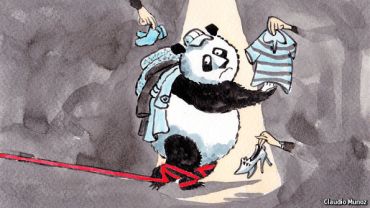
By day, the trucks arrive to clean the bears out, leaving them empty for the next big meal. The pandas are plastic. They are large, bear-shaped receptacles, designed to entice people to donate their unwanted garments to those in need.

First deployed in 2012, there are now hundreds around Shanghai, often placed by entrances to apartment buildings. They swallowed about a million items of clothing last year. The procession of donors feeding trousers to pandas is impressive. But they usually do so under cover of darkness. Charitable giving is not yet a middle-class habit. Many people still feel awkward about it, despite their growing prosperity. China’s GDP per person is about one-seventh of America’s.

But in 2014 Chinese gave 104 billion yuan ($16 billion) to charity, about one-hundredth of what Americans donated per person (see chart). This is partly a legacy of attitudes formed during Mao’s rule, when the party liked to present itself as the source of all succour for the poor (to suggest otherwise was deemed counter-revolutionary). Even until more recent years the party was reluctant to encourage charities, worried that they might show up its failings.

The middle classes have worries too—that giving large amounts to charity may draw unwanted attention to their wealth. They do not want to fuel the envy of the have-nots or encourage tax collectors to pay them closer attention.

The top 100 philanthropists in China gave $3.2 billion last year, according to Hurun Report, a wealth-research firm based in Shanghai. That was less than the amount given by the top three in America.

In 2008 when a powerful earthquake hit the south-western province of Sichuan—the deadliest in China in more than 30 years—it seemed that one positive outcome would be a boom in charitable giving. Volunteers poured into the devastated region and donations filled the coffers of aid organisations. Problems soon arose, however. Embarrassed that private relief efforts were proving more effective than official ones, the government reined in citizen-led organisations.

Source: Panda power | The Economist

23/09/2015

Prime Minister Popularity and Voter Optimism Have Soared in India Under Modi, U.S. Think-Tank Survey Shows – India Real Time – WSJ

In the sixteen months since Prime Minister Narendra Modi won a landslide victory in national elections, he has faced policy setbacks, parliamentary roadblocks and electoral failure. These appear to have had little impact on support for him.

A new report by the U.S.-based think tank Pew Research Center says Mr. Modi remains overwhelmingly popular among Indians. Among those surveyed, 87% said they have a favorable opinion of Mr. Modi. Unpacking that statistic gives Mr. Modi greater reason to celebrate. His popularity is the highest among two crucial demographic groups: 18 to 29 year olds and rural Indians. Nine out of 10 people in each category gave the leader of the world’s largest democracy a thumbs up.

Mr. Modi’s undented approval ratings come at a time when his appeal among investors and analysts has lost some of its sheen. India-watchers complain big policy pronouncements have been few and slow to come, limiting India’s growth potential. Far from sharing that pessimism, a majority of Indians are upbeat about their country’ economic prospects, the survey showed. More than half of the respondents said they were happy with the direction of their country, up from 29% in 2013, toward the end of the Congress party’s decade-long tenure when the economic was stuttering and corruption scandals dogged the government. More than 90% of those surveyed by Pew said they had faith in government, up from 70% two years ago. These findings raise key political questions.

Some strategists wonder why, given his once-in-a-generation mandate, Mr. Modi hasn’t pushed for tougher, more-disruptive measures to accelerate growth. His government recently backtracked on a policy that would have made it easier to acquire land for infrastructure and industry because of protests by opponents in Parliament and fear of a backlash from rural voters.

Others argue Mr. Modi is playing the long game, seeking to build on his popularity to consolidate more political power at state and local levels rather than risking it at an early stage on controversial policies. Leaders of his Bharatiya Janata Party say they are planning for at least two five-year terms under Mr. Modi’s premiership during which they hope their party, whose political authority has grown sporadically since its inception in 1980, will achieve the kind of dominance Congress enjoyed in the decades after India won independence from British colonial rule in 1947.

Such a strategy – and Pew’s data – explains why Mr. Modi is the BJP’s star campaigner. In the state of Bihar where elections are scheduled to begin next month, the BJP has not announced a candidate for chief minister, the person who would run the state if the party won. Instead, posters and hoardings are plastered with Mr. Modi’s face. To be sure, the Bihar polls won’t be easy. Caste allegiances play an important role in the vote and the incumbent regional leader, Nitish Kumar, is seen as an effective leader for development. A recent opinion poll by the Hindi-language ABP News channel and Nielsen showed the BJP and Janata Dal (United)-led alliances are neck and neck.

Source: Prime Minister Popularity and Voter Optimism Have Soared in India Under Modi, U.S. Think-Tank Survey Shows – India Real Time – WSJ

03/04/2015

Hindus to be world’s 3rd largest population by 2050, says Pew Research Centre’s religious report – The Hindu

The world population of Hindus will grow rapidly between now and 2050, based on a relatively high expansion rate and the youth profile of this community. The largest global growth, however, will be among Muslims, outpacing the growth of every other religion’s population.

Hindus will become the world’s third largest population by 2050 while India will overtake Indonesia as the country with the largest Muslim population, according to a new study.

This was a key result of an in-depth study on “The Future of World Religions: Population Growth Projections, 2010-2050,” by the Pew Research Center, which sought to explain “Why Muslims Are Rising Fastest” in terms of the community’s higher fertility – 3.1 children per woman – and the fact that 34 per cent of Muslims are below the age of 15 years.

The Pew growth projections report says that India would retain a Hindu majority but would also have the largest Muslim population of any country in the world, surpassing Indonesia.

Worldwide, the Hindu population is projected to rise by 34 per cent over the period, from a little over 1 billion to nearly 1.4 billion, roughly keeping pace with overall population growth, the report noted.

By 2050, Hindus will be third, making up 14.9 per cent of the world’s total population, followed by people who do not affiliate with any religion, accounting for 13.2 per cent, the report said.

People with no religious affiliation currently have the third largest share of the world’s total population.

The Hindu population’s fertility rate, at 2.4 children per woman, is second to the Muslim figure, but ranks above Jewish and Buddhist fertility, respectively at 2.3 and 1.6 children per woman.

Further, 30 per cent of Hindus are below the age of 15, which is lower than the corresponding number for Muslims, while at the other end of the age spectrum seven per cent of Muslims were above 60 years old in 2010 and the figure for Hindus was eight per cent.

The Pew study found that Muslims would nearly double their numbers in Europe to more than ten per cent by 2050 and would outnumber Christians worldwide by 2070, according to the forecast of the growth of religions around the world.

In North America, the Hindu share of the population was expected to nearly double in the decades ahead, the report’s authors said, up from 0.7 per cent in 2010 to 1.3 per cent in 2050, when migration is included in the projection models.

However, without including migration effects the Hindu share of the region’s population would remain “about the same.”

via Hindus to be world’s 3rd largest population by 2050, says Pew Research Centre’s religious report – The Hindu.

18/09/2014

Chinese Views of India: Culturally Rich but Backward – China Real Time Report – WSJ

From China’s side of the Himalayas, the view of India isn’t always that great.

“This place is like China from 20 years ago. It’s much, much worse than I’d imagined,” said Tony Jiang, 29, an employee at an electronics-parts maker in Hangzhou visiting New Delhi this week.

Reshma Patil, an Indian journalist who spent more than three years based in Beijing reporting on China for the Hindustan Times newspaper, writes in a recently published book that Chinese she met tended to view India as poor and unsanitary.

In “Strangers Across the Border: Indian Encounters in Boomtown China,” Ms. Patil argues that ties between the two countries are hampered by their citizens’ mutual ignorance of each other.

A survey by the Pew Research Center published this year found that 30% of Chinese have a “favorable” view of India and 55% an “unfavorable” one. By contrast, 50% of Chinese have a favorable view of the U.S., according to Pew. Just 8% of Chinese hold a favorable view of Japan.

More Chinese are getting first-hand knowledge by visiting India as tourists or on business trips.

But the numbers are still small. India’s Ministry of Tourism says that about 175,000 Chinese tourists visited India in 2013, a 46% increase from around 120,000 in 2010. Tourism experts say China’s newly affluent prefer traveling to Europe, the U.S. and Southeast Asia.

India Real Time interviewed some Chinese visitors to India to get their impressions of the country as the two nations focus on bolstering ties that have long been strained by territorial disputes. Chinese President Xi Jinping arrived in India on Wednesday for a three-day trip aimed at deepening economic relations.

For some Chinese, the allure of India is its cultural heritage, especially its connection to Buddhism.

Mario Tang, a 26-year-old store manager from Shanghai who traveled across north India, said he came to see India’s centuries old history — against the advice of family and friends.

“My parents thought I was crazy. Most people I know think India is a poor, dirty, backward place,” Mr. Tang said.

He found it magical. “India is one of my favorite places on the planet,” he said. He visited Buddhist holy sites and even took a dip in the Ganges, India’s sacred river. He said Indians he spoke to seemed happy, something he attributed to “the power of belief and culture.”

Di Wenjie, a 32-year-old Chinese magazine editor who has visited India several times, said the country is “beyond imagination and full of color.” She says she studied meditation and yoga and plans to come again soon.

Others take a dimmer view.

“We didn’t have high hopes coming here,” said Mr. Jiang, the electronics-company employee, who was visiting Delhi for a trade fair. “Our impression was that Indian people are dirty and disorderly,” he said, while working on his laptop at a Starbucks in the center of the Indian capital this week.

Mr. Jiang also questioned Indians’ dedication to their jobs. “Indians are still eating breakfast at 10 a.m. Then they go home by 5 to 6 p.m.,” he said. “This is why this country is developing so, so slowly.”

His colleague, Ray Zhang, 28, said that his experience in New Delhi had been “terrible.” But he said he wouldn’t rule out returning to India to see the sights. “I’ve heard a lot about the Taj Mahal,” he said.

via Chinese Views of India: Culturally Rich but Backward – China Real Time Report – WSJ.

13/12/2013

Guess What? The U.S. and China Don’t Trust Each Other Much – Businessweek

And the Chinese trust Americans even less. That’s the conclusion of the U.S.-China Security Perceptions Survey (PDF) released on Dec. 11 by the Carnegie Endowment for International Peace and the Beijing-based research organization China Strategic Culture Promotion Association (CSCPA). “There is a low level of strategic trust between the United States and China, which could make bilateral relations more turbulent,” warns the survey.

A tourist wearing a face mask visits Tiananmen Square in Beijing on Nov. 23

Working with the Pew Research Center and the Research Center for Contemporary China at Peking University, as well as the Kissinger Institute on China and the United States at the Woodrow Wilson International Center for Scholars, the Carnegie-CSCPA survey canvassed the general public and elites in government, business, academia, the military, and the media last year. In the U.S., it surveyed 1,004 adults among the general public and 305 elites. In China, it canvassed 2,597 adults in urban areas and 358 elites.

The tendency among the general public to label the other country an outright enemy was encouragingly low; only 15 percent of Americans and 12 percent of Chinese believe that. Notable, however, was the comparative lack of trust shown by Chinese elites, with 27 percent viewing the U.S. as a foe, compared with just 2 percent of American elites saying that about China.

via Guess What? The U.S. and China Don’t Trust Each Other Much – Businessweek.

25/09/2013

Growing Concerns About Pollution And Public Health In China

BusinessWeek: “Recently, I was invited to the Beijing apartment of a Chinese friend in his mid-20s. An attentive host, he brought out a tray of washed grapes, but looked dubious when I was about to simply eat one. Because the grapes were almost surely sprayed with too many pesticides—and perhaps other dangerous chemicals—he explained that it was foolish to eat them directly and urged me to peel each grape first.

Growing Concerns About Pollution And Public Health In China

His reflexive wariness about food grown or packaged in China is hardly unique among college-educated Beijing residents. Some 38 percent of Chinese respondents told a recent Pew Research Center poll (PDF) that food safety is a “very big problem” in China. That’s up significantly from 2008, when only 12 percent of respondents agreed.

The Pew research team, which conducted 3,226 face-to-face interviews this spring, uncovered rising levels of concern about sundry public health issues in China. Fully 47 percent of respondents rated air pollution a “very big problem,” and 40 percent said the same of water pollution. That’s up from 31 percent and 28 percent, respectively, in 2008. Poll respondents who were younger (under age 30), wealthy, and living in cities were the most likely to express worry about food safety and product safety.”

via Growing Concerns About Pollution And Public Health In China – Businessweek.

See also: https://chindia-alert.org/2013/07/31/china-to-invest-375-billion-on-energy-conservation-pollution-paper/

Law of Unintended Consequences

continuously updated blog about China & India

ChiaHou's Book Reviews

continuously updated blog about China & India

What's wrong with the world; and its economy

continuously updated blog about China & India