Posts tagged ‘Prakash Javadekar’

07/04/2015

India launches air quality index to give pollution information – BBC News

India has launched its first air quality index, to provide real time information about pollution levels.

The index, announced by Prime Minister Narendra Modi, will initially monitor air quality in 10 cities.

Last year the Environmental Preference Index ranked India 174 out of 178 countries for air quality.

The rising and health-endangering pollution has been mainly blamed on a huge increase in vehicles, particularly diesel-driven cars, on Indian roads.

Polluting industries, open burning of refuse and leaves, massive quantities of construction waste and substantial loss of forests have also led to high pollution levels in cities.

A World Health Organization (WHO) survey last year found that 13 of the most polluted 20 cities in the world were in India. The capital, Delhi, was the most polluted city in the world, the survey said.

It is a leading cause of premature death in India, with about 620,000 people dying every year from pollution-related diseases, says the WHO.

On Monday, Mr Modi said India “has to take the lead in guiding the world on thinking of ways to combat climate change”.

via India launches air quality index to give pollution information – BBC News.

21/01/2015

India’s Tiger Population: Reading Between the Lines – India Real Time – WSJ

India this week cheered figures that showed it now has the largest tiger population in the world.

A 30.5% jump in the big cat headcount since the last census in 2011 means there are now 2,226 tigers in India – that’s 70% of all the tigers in the world.

“That is a huge success story,” Environment and Forests Minister Prakash Javadekar said. “We must be proud of our legacy and we must be proud of our efforts.”

But what the minister didn’t say was that the rate of tiger poaching has been increasing over the same time, according to figures from the Wildlife Protection Society of India.

The government says that between 2011 and 2014, there were 274 tiger deaths. Most of them –192 — lost to poaching or unexplained causes.   Authorities said poaching caused 83 of the total number of tiger deaths and acknowledged that they have not identified causes for 109 other deaths.

The WPSI says that those figures are an underestimate. According to data it has compiled, 110 tigers were killed by poachers between 2011 and 2014. Even that may be understating the actual number, says Tito Joseph, program manager at WPSI. “Because of demand for tiger products from other countries, we can only assume that some cases go undetected,” Mr. Joseph said. Those deaths that are unexplained could be as a result of poaching, he added.

via India’s Tiger Population: Reading Between the Lines – India Real Time – WSJ.

07/12/2014

India plans 5-fold increase in clean energy – Businessweek

India said Friday it was optimistic the world would reach an agreement to curb climate change, but said its actions would be focused on boosting its renewable power capacity five-fold rather than on cutting carbon emissions.

With hundreds of millions still mired in poverty and without access to electricity, India cannot afford to reduce greenhouse gas emissions at the expense of economic growth, Environment Minister Prakash Javadekar said before leaving this weekend for U.N. climate talks in Lima, Peru.

“Our growth cannot be compromised,” Javadekar said. “Poverty needs to be eradicated immediately. Poor people have aspirations. We must fulfill them. We must give them energy access. We cannot and nobody can question on this.”

He said he was optimistic industrialized nations would agree to shoulder more of the burden to reduce greenhouse gas emissions, given that they had been polluting with fossil fuels for decades before developing nations.

“That is the just regime,” he said.

The recent U.S.-China pact announcing new targets for fossil fuel use marked a positive step toward establishing this sort of equality, he said. In that pact, the U.S. said it would aim to bring down its per-capita emissions from about 20 tons while allowing China to raise its 8-9 tons per capita so that both reach a level of about 12 tons by 2030.

“They have accepted the differentiated responsibility and the need of time for growth,” Javadekar said.

India had already pledged to reduce its emissions intensity — how much carbon dioxide it produces divided by its GDP — rather than promising to cut overall emissions. However, Indian officials and scientists say it could easily go beyond the target set in 2009 of cutting emissions intensity by 20-25 percent below 2005 levels by 2020.

India’s preference for the per-capita emissions calculation also ignores the fact that around 400 million Indians still have no access to electricity at all, while hundreds of millions more are lucky to get a couple of hours a day. Experts worry that as India’s population continues to grow beyond 1.2 billion and more people become wealthy, its share of global emissions will skyrocket.

via India plans 5-fold increase in clean energy – Businessweek.

10/11/2014

Who’s Who in Narendra Modi’s New Cabinet in India – India Real Time – WSJ

In his first Cabinet reshuffle late Sunday, India’s Prime Minister Narendra Modi expanded the number of ministers in his government from 44 to 65.

That takes him just six shy of his predecessor Manmohan Singh’s coterie before his Congress party was ousted in national elections earlier this year by Mr. Modi’s Bharatiya Janata Party that campaigned with a mantra for “minimum government, maximum governance.”

The enlargement nudges up the number of women ministers to eight from seven and gives key posts to members of parliament from states that are due for local elections in the coming months.

Here are the main moves, promotions, demotions and new arrivals in the modified Cabinet.

Major Cabinet Minister Moves

Suresh Prabhu becomes railway minister replacing Sadananda Gowda. Mr. Prabhu, 61, a former member of the Shiv Sena party, resigned from the regional party to join the Bharatiya Janata Party on Sunday. A chartered accountant by profession and also a law graduate, Mr. Prabhu served as a cabinet minister in the previous BJP-led National Democratic Alliance for six years, handling key portfolios such as power, heavy industries and public enterprises and environment and forests among others. Mr. Prabhu has often been described by many as that “un-common whiff of much needed fresh air on the horizon of Indian public life,” according to his official website.

Manohar G. Parrikar is the new defense minister. Mr. Parrikar quit as Goa’s Chief Minister last week and takes charge of the defense ministry from Arun Jaitley.

A technocrat-turned-politician, Mr. Parrikar joined the BJP in 1988 and went on to become the chief minister of Goa for the first time in 2000. During his time as chief minister, he was credited with improving the western state’s infrastructure  overseeing the construction of major bridges, building bus stands and improving the road network across the state. “Known to be a man of action and principles, Mr. Parrikar is known as Mr. Clean in Goa,” his website said. As the new defense minister, Mr. Parrikar faces the daunting task of closing the country’s pending defense deals.

Arun Jaitley was relieved of the defense portfolio but was given an additional charge of information and broadcasting ministry previously held by Prakash Javadekar. Mr. Jaitley also continues as the head of the finance and corporate affairs ministries. A lawyer by profession, the BJP leader is known to be media-savvy.

Dr. Harsh Vardhan was deprived of his health and family welfare ministry in the shuffle and shifted to a low-key science and technology, Earth sciences ministry. Dr. Vardhan ran for the post of Delhi chief minister in elections in December but was beaten to the position by Aam Aadmi Party leader Arvind Kejriwal who stepped down only a few weeks in to the job.

Prime Minister Modi remains in charge of Personnel, Public Grievances and Pensions, the Department of Atomic Energy Department of Space; all important policy issues and all other portfolios not allocated to any minister, according to the press information bureau.

more on Cabinet Ministers and Ministers of State …

via Who’s Who in Narendra Modi’s New Cabinet in India – India Real Time – WSJ.

15/09/2014

With eye on China, Modi’s India to develop disputed border region | Reuters

India has eased restrictions on building roads and military facilities along its disputed border with China, as the new government seeks to close the gap on its neighbor’s superior transport network and take a stronger stance on Beijing.

Indian environment minister Prakash Javadekar told Reuters he had relaxed environmental rules within 100 km (62 miles) of the contested border in remote Arunachal Pradesh in order to speed up construction of some 6,000 km of roads.

The move, which also allows for the construction of army stations, arms depots, schools and hospitals in the sparsely populated Himalayan region, was announced days before Chinese President Xi Jinping visits India on Sept. 17-18.

“This is about defense preparedness,” said Javadekar. “On the Chinese side of the border, not only have they built good roads, they are building up their railway network. Our army faces problems because of the bad quality of roads,” he added.

Work on the roads will start in the coming months.

via With eye on China, Modi’s India to develop disputed border region | Reuters.

07/08/2014

The BJP’s real opposition turns out to be a far-Left-far-Right combination

When the final results of the general election were tallied up, it was hard not to marvel at the sheer size of the Bharatiya Janata Party’s victory and the unprecedented defeated delivered to the Indian National Congress. With the BJP emerging not just as the single largest party but also the first since 1984 to cross the halfway mark by itself and the Congress not even having enough seats to automatically be given the Leader of the Opposition post, there were genuine concerns about unbridled majoritarianism. Where would the opposition to the BJP come from?
Since the Congress continues to occupy the muddled middle and has pinned all its hopes on  Rajya Sabha numbers, where it has more seats than the BJP, the answer actually turns out to be an unusual combination of players both to the right and the left of the BJP. From labour law reform to the introduction of further foreign direct investment in insurance, it is BJP-affiliated organisations making common cause with pro-labour and Leftist outfits that have caused the most headaches for the new government.

With the Left and Right managing to converge on swadeshi issues, those who fall more in the pro-market camp within the BJP — many of whom were seen as the intellectual leaders of the campaign that brought Prime Minister Narendra Modi to power — are starting to get disconcerted with  government’s actions.

FDI in insurance

This appears to be the new government’s first big legislative battle, as the opposition parties have attempted to use their superior numbers in the Rajya Sabha to stand in the way of an attempt to increase the foreign direct investment cap in insurance from 26% to 49%. The government can resort to a joint sitting of the houses to bulldoze its legislation through the Parliament, but it is the reaction from trade unions and state insurance companies that has got the BJP concerned.

Crucially, the Bharatiya Mazdoor Sangh, the BJP-affiliated organisation that counts itself as the largest centrally organised trade union in the country, has joined forces with an array of other labour organisations as well as employees of state insurance corporations in threatening to strike if the cap is raised. The communist parties have always been staunch opponents of additional foreign investment. They have now come together with outfits like the BMS to prevent a move that finance minister Arun Jaitley has said is crucial to help reinvigorate economic activity.

Genetically modified crops

Shortly after representatives of the Swadeshi Jagran Manch and the Bharatiya Kisan Sangh met with environment minister Prakash Javadekar, he announced that the government was putting field trials of the genetically modified crops on hold. The news prompted loud howls from many who believe GM crops are important for Indian agriculture to take its next step forward. But it was welcomed by both the Sangh Parivar organisations that had met Javadekar as well as by many on the Left who have sought to halt GM crops for years now.

Swadeshi education

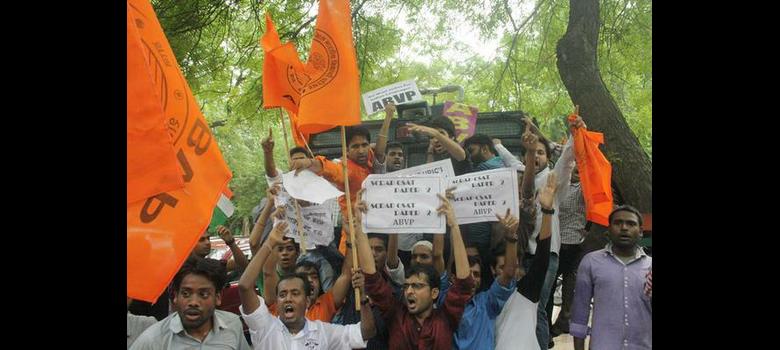
The Akhil Bharatiya Vidya Parishad, the BJP’s Youth Wing, sensed during last year’s Delhi University Student Union elections that opposition to the new Four Year Undergraduate Programme could be a key plank in remaining popular on campus. Incidentally, the FYUP had been opposed by the more left-wing organisations on campus from the very get-go, so the ABVP joined up with them to call for a roll-back of the four-year programme. The agitation quickly became a national issue, and eventually the FYUP was rolled back.

This ABVP-Left combine has now re-emerged in the agitation against the Union Public Service Commission’s Common Scholastic Aptitude Test, which is being fought on grounds that it is biased towards urban students. Yet again, the combined forces have managed to extract a concession from the government — despite opposition from the more reformist sections of the BJP.

Labour law reforms

Trade unions from across the country are meeting this week to try and decide how to approach the issue of labour law reforms, after the Rajasthan government last month passed legislation that made it easier for companies to retrench employees. These unions include both those on the Left, including the Communist Party of India (Marxist)-backed Centre of Indian Trade Unions  as well as the BJP-affiliated Bharatiya Mazdoor Sangh. Any decision to strike or launch a nationwide campaign by these groups could have a significant impact on a government that has insisted it is working primarily for the poor.

Foreign relations

The Modi government’s decision to vote against Israel at a United Nations forum shocked many supporters, who believe that India must be stand with Tel Aviv and remain steadfast against Islamic terrorism. It came as a pleasant surprise to those on the Left, however, who have always pushed India to speak up for those who live under Israeli occupation in Gaza and the West Bank.

The foreign relations convergence of the Left and Right was given a bigger boost after the Modi government decided to stand in the way of the World Trade Organisation’s Bali Package. Although the two factions here are unlikely to work together in pressuring the government to make decisions, particularly in the neighbourhood, the pressure to keep India relatively insulated from the West is likely to gain purchase from both sides.

via Scroll.in – News. Politics. Culture..

13/06/2014

Defence projects along LAC to get quick green nod – The Times of India

The ponderous elephant will now try to catch up with the fleet-footed dragon. The Narendra Modi government has decided to fast-track clearances for roads and other military infrastructure projects along the 4,057-km Line of Actual Control (LAC) with China, signalling that environmental clearances will not needlessly hamper national security objectives.

Pangong Lake - Ladakh

Pangong Lake – Ladakh (Photo credit: -AX-)

“Construction of roads within 100-km of LAC will be given fast-track approvals under the new policy being formulated,” environment minister Prakash Javadekar said after meeting defence secretary R K Mathur and other top officials on Thursday.

“Delays in defence projects were happening due to the case-to-case decision-making process. We are evolving policy-based solutions. The new policy will ensure faster clearances without compromising environmental issues,” he added.

via Defence projects along LAC to get quick green nod – The Times of India.

Law of Unintended Consequences

continuously updated blog about China & India

ChiaHou's Book Reviews

continuously updated blog about China & India

What's wrong with the world; and its economy

continuously updated blog about China & India