Posts tagged ‘President of the People’s Republic of China’

19/11/2014

Putin Loses His Grip on Central Asia as China Moves In – Businessweek

As President Vladimir Putin strains to keep Ukraine within Russia’s grasp, he may be losing his grip on another part of his would-be empire: the former Soviet republics of Central Asia, which are increasingly turning toward China for investment and trade.

Russia's President Vladimir Putin and Tajik President Emomali Rakhmon meet on the sidelines of an informal summit of the regional security group in 2013

In the latest sign of its growing economic ties with the region, China is planning a $16.3 billion fund to finance railways, roads, and pipelines across Central Asia, reviving the centuries-old Silk Road trade route between China and Europe. President Xi Jinping first proposed the idea last year during a visit to Kazakhstan, the region’s wealthiest country.

Beijing has plenty of reasons to spend big in Central Asia. Improved infrastructure would help link China to European markets and give China increased access to the region’s rich natural resources. Kazakhstan is a major oil producer, while neighboring Kyrgyzstan has large mineral deposits and Turkmenistan produces natural gas.

At the same time, the planned construction would give an economic boost to adjoining areas of western China where Beijing is trying to quell a separatist insurgency, says Sarah Lain, a researcher at the Royal United Services Institute in London. As it has in Africa, China is likely to bring Chinese workers into Central Asia to do much of the construction.

During much of the 19th century, the Russian and British empires vied for control of Central Asia, a rivalry dubbed the “Great Game.” But the predominantly Muslim region, which also includes the countries of Tajikistan, Turkmenistan, and Uzbekistan, was annexed by the Soviet Union after the Bolshevik revolution and has remained close to Moscow in the post-Soviet era.

Putin has sought to maintain those ties—for example, by inviting Kazakhstan and Kyrgyzstan to join a customs union with Moscow. But with the Russian economy in a deep slump, he can’t match the big money that China is offering. Indeed, Russia’s economic malaise is clobbering some Central Asian economies, spurring them to seek help from China.

via Putin Loses His Grip on Central Asia as China Moves In – Businessweek.

19/11/2014

Narendra Modi Is in Fiji. This Shows Why – India Real Time – WSJ

Pristine beaches, blue skies,  it’s not hard to imagine why Indian Prime Minister Narendra Modi would want to stop by the island nation of Fiji after a hectic few days at the G-20 summit in Australia.

But there’s another reason Mr. Modi has made the newly-minted South Pacific democracy his final port of call during a three-nation tour that concludes Thursday: China.

In 2012, there was an influx of Chinese investors and companies expressing and registering their interest in setting up businesses in Fiji, according to Investment Fiji’s annual report for the year.

Chinese investors accounted for 20% of the projects registered by foreign companies in Fiji in 2012, while Indian investment accounted for 10%, the report said.

China has tried to raise its profile across the South Pacific over the past decade. The 12 South Pacific island nations that make up the region are much less populous than other parts of Asia, but have vast fishing grounds and potentially large deep-sea mineral deposits.

Chinese companies have bought stakes in Fiji’s largest gold mine and invested in its bauxite industry. Foreign direct investment by Chinese companies in Fiji accounted for around 37% of the value of projects registered this year, compared with just 2.9% in 2009.

Trade figures from Fiji’s Bureau of Statistics show that India lags far behind. In 2013, China exported $27.29 million in goods to Fiji, compared to $4.76 million imported to the island from India.

via Narendra Modi Is in Fiji. This Map Shows Why – India Real Time – WSJ.

19/11/2014

Xi Jinping Visits Tasmania, Is Given (Authentic) Lavender-Filled Teddy Bear – China Real Time Report – WSJ

What does one give to China’s visiting head of state as a keepsake to mark the occasion? Angela Merkel went with an old map that had a less-than-politically correct interpretation of China’s borders. Vladimir Putin presented an example of Russia’s cutting-edge consumer technology. Nahendra Modi handed over a bound copy of the Bhagavad Gita, a sacred Hindu text, in Chinese.

Alighting from his flight to Hobart, the capital of the Australian state of Tasmania, schoolchildren presented President Xi Jinping with a lavender stuffed teddy bear (at 48 seconds). Mr. Xi didn’t appear surprised or puzzled by why he was bring presented with potpourri. Then again, Bobbie Bear is a minor celebrity in China, and has done more than anyone to put Tasmania on the map for Chinese tourists.

Mr. Xi didn’t get to visit Bridestowe Lavender Estate which produces the bears – and where he would have been limited to buying one bear only, a measure taken by the farm’s management late last year to ensure sufficient supply to satisfy the busloads of Chinese tourists. Factories in China have produced knock-offs in numbers that far exceed the farm’s own production capacity, says owner Robert Ravens, which means a visit to Tasmania is the only way to be sure the bear you buy is real.

For Tasmania, Bridestowe holds potential of what China – hungry for clean and healthy produce, and with tourists increasingly willing to travel off the beaten track – can do for a struggling economy.

On Monday, Australian Prime Minister Tony Abbott announced at a dinner for the Chinese first couple at Parliament House that Bridestowe Lavender Estate had won the inaugural Australia-China Achievement Award for entrepreneurship. The award went to the farm for its “pro-active and innovative market entry into China and promoting Tasmania as a destination for Chinese tourists.”

Mr. Xi and his wife’s taking custody of Bobbie rounds out a busy schedule of cuddling as many Australian marsupials as possible. And while Bobbie might not have the same novelty value as Australia’s menu of unique fauna, it’s likely the only one the first couple will be taking home with them.

via Xi Jinping Visits Tasmania, Is Given (Authentic) Lavender-Filled Teddy Bear – China Real Time Report – WSJ.

07/11/2014

China, Japan set aside isle row, paving way for leaders to meet | Reuters

China and Japan agreed on Friday to work on improving ties and signaled willingness to put a bitter row over disputed islands on the back burner, paving the way for their leaders to meet at an Asian-Pacific summit next week.

The agreement, ahead of an expected ice-breaking chat between Japanese Prime Minister Shinzo Abe and Chinese President Xi Jinping at the gathering in Beijing, signals a thaw in ties between the world’s second- and third-biggest economies.

Relations have been soured over the past two years by the territorial row, regional rivalry and the bitter legacy of Japan’s wartime occupation of China.

Abe said the two sides were making final arrangements for one-on-one talks, although neither he nor China’s foreign ministry confirmed that the talks were set.

“Both Japan and China are coming to the view that it would benefit not just the two countries but regional stability if a summit is held,” he told a TV program.

via China, Japan set aside isle row, paving way for leaders to meet | Reuters.

20/09/2014

Modi Uses Another International Visit to Raise His Local Profile – India Real Time – WSJ

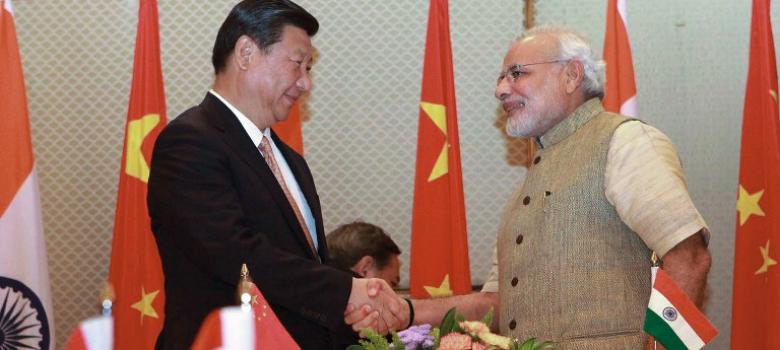
Prime Minister Narendra Modi’s meetings with Chinese President Xi Jinping this week once again showed that Mr. Modi is a master of media management.

The summit of the heads of the world’s two most-populous countries produced mixed results. A lot of agreements were signed, but the $100 billion in Chinese investment pledges that some local media had predicted did not materialize. And just as the leaders were shaking hands, there was an embarrassing faceoff between Chinese and Indian troops along the countries’ disputed boundary.

That didn’t stop India’s prime minister from again using photo opportunities and body language to broadcast his confidence, an impression that is likely to remain long after local media stop discussing the border tension and whether China had promised enough money.

Indians watching the visit wouldn’t have missed some of the symbolism. Mr. Xi flew into Mr. Modi’s home state, on the Indian prime minister’s birthday. Mr. Xi wore an  Indian vest that Mr. Modi gave him. Video of the two showed Mr. Modi walking in front of Mr. Xi at one event and swinging on a swing with him. At one point it even looked like Mr. Xi was carrying an umbrella for Mr. Modi.

Reuters Xi Jinping looked like he was carrying an umbrella for Narendra Modi during a recent visit to Gujarat.

The Indian prime minister has used the same charisma in photo ops during other international summits, most recently in Japan where he gave Prime Minister Shinzo Abe a big bear hug and later performed a solo on traditional Japanese drums.

All of this has been beamed into Indian homes and marks a major change from the demeanor of the country’s previous prime minister, Manmohan Singh, who was soft- spoken and slow-moving.

Mr. Modi’s multimedia skills are one of the things that made him prime minister.  Whether it is his controversial selfies, the sight of hundreds of supporters wearing Modi masks, campaign speeches delivered through hologram, his stylish outfits or his willingness to put on almost any kind of regional headwear, Mr. Modi knows how to make an impression.

via Modi Uses Another International Visit to Raise His Local Profile – India Real Time – WSJ.

18/09/2014

Trade, investment hopes as China’s Xi visits India – Businessweek

Chinese President Xi Jinping landed in the Indian prime minister‘s home state of Gujarat on Wednesday for a three-day visit expected to focus on India’s need to improve worn out infrastructure and reduce its trade deficit.

Xi was greeted on the tarmac by state officials carrying fringed umbrellas to guard him from the sun in Gujarat’s main financial city of Ahmedabad.

Prime Minister Narendra Modi is expected to court Chinese business and seek investment to upgrade creaky infrastructure, banking on China’s track record at building highways, railways, and industrial zones. India is also eager to address the imbalance in their annual trade, which now totals around $65 billion but is skewed toward imports of Chinese electrical equipment and parts.

Modi and the Gujarat government are staging a lavish welcome for Xi, with billboards across Ahmedabad showing a smiling Modi and Xi. A banquet dinner was being held Wednesday night on the banks of the Sabarmati River in Ahmedabad. Modi was also celebrating his 64th birthday.

Xi has been equally effusive in expressing excitement for the visit.

China-India relations have become one of the most dynamic and promising bilateral relations in the 21st century,” Xi wrote in an article published Wednesday in The Hindu newspaper.

via Trade, investment hopes as China’s Xi visits India – Businessweek.

18/09/2014

Chinese Views of India: Culturally Rich but Backward – China Real Time Report – WSJ

From China’s side of the Himalayas, the view of India isn’t always that great.

“This place is like China from 20 years ago. It’s much, much worse than I’d imagined,” said Tony Jiang, 29, an employee at an electronics-parts maker in Hangzhou visiting New Delhi this week.

Reshma Patil, an Indian journalist who spent more than three years based in Beijing reporting on China for the Hindustan Times newspaper, writes in a recently published book that Chinese she met tended to view India as poor and unsanitary.

In “Strangers Across the Border: Indian Encounters in Boomtown China,” Ms. Patil argues that ties between the two countries are hampered by their citizens’ mutual ignorance of each other.

A survey by the Pew Research Center published this year found that 30% of Chinese have a “favorable” view of India and 55% an “unfavorable” one. By contrast, 50% of Chinese have a favorable view of the U.S., according to Pew. Just 8% of Chinese hold a favorable view of Japan.

More Chinese are getting first-hand knowledge by visiting India as tourists or on business trips.

But the numbers are still small. India’s Ministry of Tourism says that about 175,000 Chinese tourists visited India in 2013, a 46% increase from around 120,000 in 2010. Tourism experts say China’s newly affluent prefer traveling to Europe, the U.S. and Southeast Asia.

India Real Time interviewed some Chinese visitors to India to get their impressions of the country as the two nations focus on bolstering ties that have long been strained by territorial disputes. Chinese President Xi Jinping arrived in India on Wednesday for a three-day trip aimed at deepening economic relations.

For some Chinese, the allure of India is its cultural heritage, especially its connection to Buddhism.

Mario Tang, a 26-year-old store manager from Shanghai who traveled across north India, said he came to see India’s centuries old history — against the advice of family and friends.

“My parents thought I was crazy. Most people I know think India is a poor, dirty, backward place,” Mr. Tang said.

He found it magical. “India is one of my favorite places on the planet,” he said. He visited Buddhist holy sites and even took a dip in the Ganges, India’s sacred river. He said Indians he spoke to seemed happy, something he attributed to “the power of belief and culture.”

Di Wenjie, a 32-year-old Chinese magazine editor who has visited India several times, said the country is “beyond imagination and full of color.” She says she studied meditation and yoga and plans to come again soon.

Others take a dimmer view.

“We didn’t have high hopes coming here,” said Mr. Jiang, the electronics-company employee, who was visiting Delhi for a trade fair. “Our impression was that Indian people are dirty and disorderly,” he said, while working on his laptop at a Starbucks in the center of the Indian capital this week.

Mr. Jiang also questioned Indians’ dedication to their jobs. “Indians are still eating breakfast at 10 a.m. Then they go home by 5 to 6 p.m.,” he said. “This is why this country is developing so, so slowly.”

His colleague, Ray Zhang, 28, said that his experience in New Delhi had been “terrible.” But he said he wouldn’t rule out returning to India to see the sights. “I’ve heard a lot about the Taj Mahal,” he said.

via Chinese Views of India: Culturally Rich but Backward – China Real Time Report – WSJ.

18/09/2014

Despite the Xi-Modi bromance, Indians and Chinese don’t actually like each other

One in two Indians thinks China is a major threat.

In the last two days alone, Chinese President Xi Jinping has called India an ancient, magic, enchanting, and beautiful land. And Indian Prime Minister Narendra Modi has reciprocated with syrupy adjectives, reminding visiting journalists how ancient Chinese technology was responsible for sugar being called cheeni in India.

The pictures of the two leaders’ bonhomie on Wednesday went even further. By the time you get to the sight of Modi and Xi sitting on a swing by the Sabarmati, most would imagine that India and China are steadfast allies who support each other through thick and thin.

Which is why it might be worth pointing out that we don’t actually like each other very much, and that Indians and Chinese people have very different intentions for the bilateral relationship. And it’s not just about the trade deficit and the border disputes. Ordinary Indians and Chinese people simply aren’t sure whether they like each other.

via Scroll.in – News. Politics. Culture..

17/09/2014

Is China’s promised $100 billion India investment more dangerous than its border policy?

Experts believe that China deliberately uses trade as part of its geo-strategic arsenal.

The script is almost predictable. Right before meetings of Indian and Chinese heads of state, something happens on the border to remind everyone that sentiment between the two countries is not exactly neighbourly. Last year it was a standoff in Daulat Beg Oldi about infiltration by the Chinese army. This year, with everyone excited at China’s promise to pump $100 billion into India, there’s another incursion by the Chinese into Demchok in Ladhak.

Chinese President Xi Jinping arrives in India today and will visit Ahmedabad on Prime Minister Narendra Modi’s birthday. But Chinese troops have also been reported to have moved 500 meters into Indian territory.

Beijing’s approach seems to be sweet-talking – this time taking the form of foreign direct investment – coupled with regular pinpricks that remind India that they have the stronger position on the border.

But could the proposed investment be as much of a threat to India as the border dispute?

Trading places

India’s total trade with China was around $65 billion in 2013-’14. Of that, only $14 billion were Indian exports heading into China, leaving India with a trade deficit of $36 billion. If oil imports are included, Chinese imports are responsible for nearly half of India’s overall trade deficit. This is a great many Indian eggs in one Chinese basket.

For many economists, this isn’t a problem. It’s simply the way efficient markets ought to function, with India buying the goods it needs from the most competitive seller. “The more competitive the trading partner, the more India should buy from it, and the bigger should be the bilateral trade deficit,” wrote commentator Swaminathan Aiyar last year. “China is the most competitive exporter of all, so India should run its biggest trade deficit with this country.”

Yet India does feel the need to reduce the trade deficit with China. Answering a question in the Lok Sabha earlier this year, minister of state for commerce Nirmala Sitharaman admitted that the balance of trade was heavily in China’s favour and that India was taking steps to address this.

“With a view to reducing the trade deficit with China, efforts are being made to diversify the export basket,” Sitharaman said.

via Scroll.in – News. Politics. Culture..

16/09/2014

Xi’s India visit highlights changing power dynamic – Businessweek

Chinese President Xi Jinping’s trip to India this week highlights subtle shifts in the regional power dynamic that are bringing warmer ties between the two Asian giants, challenging China’s traditional relationship with Pakistan, and opening a new chapter in Beijing’s ongoing competition for influence with arch-rival Japan.

Xi is due in New Delhi on Wednesday for a three-day visit focused on trade, investment and the resolution of decades-old border disputes. With the world’s second-largest economy and a proven track record at building highways, railways, and industrial zones, China has much to offer India as it seeks to upgrade its creaky infrastructure.

The visit is the latest sign of easing suspicions between the two huge countries — which between them have 2.6 billion people — dating from a month-long border war in 1962 that left around 2,000 soldiers dead. That conflict ended in a standoff with both sides accusing the other of occupying its territory.

Xi’s visit “will definitely enhance the bilateral political mutual trust,” Chinese Assistant Foreign Minister Liu Jianchao told reporters in Beijing last week.

While ties have been steadily growing for years, they’ve been given a major boost under new Indian Prime Minister Narendra Modi, who’s signaled he wishes to pursue a more vigorous foreign policy. Xi is the first Chinese head of state to visit in eight years, while the country’s prime minister, Li Keqiang, made India his first overseas visit shortly after taking office last year.

“Good relations with India are a key part of China’s regional strategy and Xi’s visit creates the opportunity for direct face-to-face communication on the problems that still exist, such as the border issue,” said Zhao Gancheng, Director of the Asia-Pacific Center of the Shanghai Institute for International Studies.

via Xi’s India visit highlights changing power dynamic – Businessweek.

Law of Unintended Consequences

continuously updated blog about China & India

ChiaHou's Book Reviews

continuously updated blog about China & India

What's wrong with the world; and its economy

continuously updated blog about China & India