Posts tagged ‘prime minister of india’

07/11/2014

India vs. China: The Battle for Global Manufacturing – Businessweek

With its chronic blackouts, crumbling roads, and other infrastructure woes, India should have no appeal for John Ginascol. A vice president at Abbott Laboratories (ABT), Ginascol is responsible for ensuring that the company’s food-products factories run smoothly worldwide. He can’t afford surprises when it comes to electricity, water, and other essentials. “People like me,” he says, “dream of having existing, good, reliable infrastructure.”

Yet Abbott has just opened its first plant in India, and Ginascol says there haven’t been any nightmares so far. In October the company began production at a $75 million factory in an industrial park in the western state of Gujarat. The factory is producing Similac baby formula and nutritional supplement PediaSure, which Abbott plans to sell to the growing Indian middle class. The plant will employ about 400 workers by the time it’s fully up and running next year. As for India’s infrastructure, Ginascol has no complaints. The officials in charge of the park “were able to deliver very good, very reliable power, water, natural gas, and roads,” he says. “Fundamentally, the infrastructure was in place.”

Indian Prime Minister Narendra Modi is hoping other executives will be similarly impressed with the ease of manufacturing in his country. Before Modi took charge in New Delhi, he headed the state government in Gujarat, and during his 13 years in power there he made the state an industrial leader. Manufacturing accounts for 28 percent of Gujarat’s economy, compared with 13 percent for the country as a whole, and a touch less than the 30 percent figure for manufacturing titan China.

via India vs. China: The Battle for Global Manufacturing – Businessweek.

18/09/2014

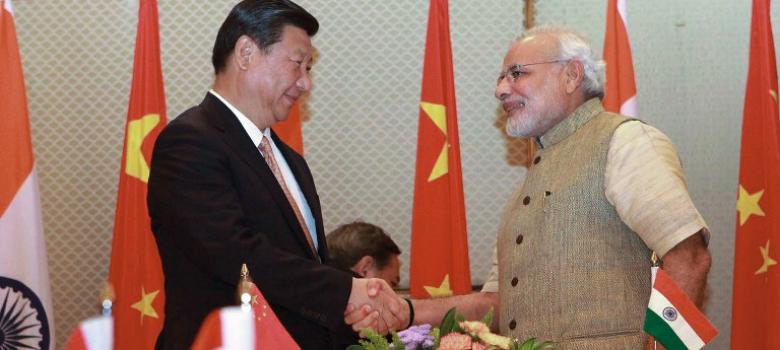
Despite the Xi-Modi bromance, Indians and Chinese don’t actually like each other

One in two Indians thinks China is a major threat.

In the last two days alone, Chinese President Xi Jinping has called India an ancient, magic, enchanting, and beautiful land. And Indian Prime Minister Narendra Modi has reciprocated with syrupy adjectives, reminding visiting journalists how ancient Chinese technology was responsible for sugar being called cheeni in India.

The pictures of the two leaders’ bonhomie on Wednesday went even further. By the time you get to the sight of Modi and Xi sitting on a swing by the Sabarmati, most would imagine that India and China are steadfast allies who support each other through thick and thin.

Which is why it might be worth pointing out that we don’t actually like each other very much, and that Indians and Chinese people have very different intentions for the bilateral relationship. And it’s not just about the trade deficit and the border disputes. Ordinary Indians and Chinese people simply aren’t sure whether they like each other.

via Scroll.in – News. Politics. Culture..

17/09/2014

Could India Edge Out China? – Businessweek

China’s President Xi Jinping is due to arrive in India tomorrow, and for a change he’s the one with an economy heading in the wrong direction, not Indian Prime Minister Narendra Modi. After several dismal years, growth in India is rebounding, and the stock prices of companies selling to Indian consumers are benefiting from the surge in optimism that accompanied Modi’s landslide election victory in May. Britannia Industries (BRIT:IN), the Kolkata-based maker of cookies and other food products, is up 55 percent so far this year and today hit a 52-week high. “The Indian consumption story is back,” Credit Suisse analysts Neelkanth Mishra and Ravi Shankar wrote in a report published today.

Electronic ticker boards at the National Stock Exchange in Mumbai, India

Meanwhile, China is struggling as the troubled banking system and property markets put a damper on the economy. Hit by a slump in the property market, the Chinese economy expanded at an annual rate of 6.3 percent in August, a dramatic slowdown from the 7.4 percent growth in July and nowhere close to the government’s target of 7.5 percent. So far this year, the area of new property under development has declined 14.4 percent. The data from last month “made depressing reading,” Bloomberg economist Tom Orlik wrote in a report published yesterday.

The role reversal could lead to a world-turned-upside-down moment as early as 2016. That’s when India, always the laggard, may pull ahead of China and became the fastest-growing of Asia’s giants. India is likely to enjoy 7.2 percent growth in 2016, says Rajeev Malik, senior economist in Singapore with CLSA, compared with China’s 7.1 percent. Given the structural problems Xi faces and the slack Modi inherited, “China has to slow down, and India can do much better,” he says.

India has suffered from a chronically high inflation rate, but there are signs that pressure is easing, albeit slowly. Consumer prices last month rose 7.8 percent, a slight improvement from July’s 7.96 percent. Yesterday, the government reported wholesale prices rose 3.74 percent in August. That’s the best result in five years.

via Could India Edge Out China? – Businessweek.

04/09/2014

India and Japan Are a Perfect Fit – India Real Time – WSJ

Indian Prime Minister Narendra Modi’s visit to Japan will generate headlines for the big deals that he does (or doesn’t) conclude with his Japanese counterpart Shinzo Abe. These include civil nuclear cooperation, high-speed rail construction and defense ties.

However, the bilateral relationship ultimately depends on thousands of smaller commercial deals. If the two leaders set the tone and clear away obstacles, the India-Japan partnership can become the driver of Asia’s growth. Mr Modi said on this visit that Japan and India bear a ‘huge responsibility’ to define the path of Asian growth in the 21st century.

The two powers are complementary on several levels, but primarily in the economic realm. Japan has the largest growth problem in the world while India has the largest development problem.

There is no clearer example of this than India’s need for new roads, railways and ports. The Reserve Bank of India has defined India’s key economic problem as a supply-side deficit; demand is abundant, at times rampant, but supply responses are reduced by the unavailability and cost of capital, alongside logistics bottlenecks. The result is higher inflation and lower growth.

Japan can provide the solution in the form of capital and technology. Tokyo is a partner in the $90 billion Delhi-Mumbai Industrial Corridor which will create new “smart cities,” seven of which have started construction. Some 100 more are planned nationwide. This initiative has already yielded the Delhi Metro, built under budget and within schedule with Japanese loans and rolling stock.

via India and Japan Are a Perfect Fit – India Real Time – WSJ.

15/08/2014

Modi Targets Bureaucrats, Manufacturing and Toilets in Independence-Day Speech – India Real Time – WSJ

In his first Independence Day speech Friday, Indian Prime Minister Narendra Modi listed the issues he plans to focus on as the leader of the world’s largest democracy: bickering bureaucrats, women’s rights, manufacturing jobs, trash and toilets.

“You might say Independence Day is an opportunity to talk about big ideas and make big declarations. But sometimes, when these declarations are not fulfilled, they plunge society into disappointment,”said Mr. Modi, who is the South Asian nation’s first prime minister born after India gained independence from Britain 67 years ago. “That’s why I’m talking about things we can achieve in our time.”

Mr. Modi’s Bharatiya Janata Party was propelled to power by Indians who, hungry for better jobs and a higher standard of living, grew frustrated with slowing growth under the previous Congress-led government. Since coming to power in May, Mr. Modi has made some cautious policy moves, disappointing some of his supporters who had expected immediate and bold change from his administration.

Addressing the nation from the ramparts of New Delhi’s regal Red Fort Friday, Mr. Modi said he plans to set the government in order and stop bureaucratic squabbling, underlining his focus on administrative processes rather than economic overhauls. As “an outsider” to New Delhi, he said, he has been shocked since taking office to find that “there were dozens of governments inside the government,” each with “its own fiefdom.”

“Departments are fighting each other, suing each other in the Supreme Court,” Mr. Modi said. “How can they move the country forward?”

In his nearly hour-long speech delivered largely in Hindi, Mr. Modi reiterated his focus on making India a global manufacturing hub and export powerhouse.

Offering a new slogan in English, “Come, make in India,” Mr. Modi invited the world to come to India to manufacture.

“Sell anywhere in the world but make it here,” he said. “Electricals to electronics, chemicals to pharmaceuticals, automobiles to agro-products, paper or plastic, satellites or submarines — Come, make in India.”

Mr. Modi questioned why India needs to import “every little thing,” and urged the country’s youth to open factories and export goods.

Manufacturing makes up only around 15% of India’s gross domestic product as most of its rapid expansion over the last decades has come from the service sector. During spring elections the BJP said it planned to create millions of new jobs if elected. Economists say one of the best ways India can generate employment is through exports.

While India’s labor costs are among the lowest in the world, it has consistently failed to become an export powerhouse like China and Asia’s other largest economies.

Prime Minister Modi also announced initiatives aimed at modernizing India: a nationwide drive for cleanliness that would boost tourism, a program for parliamentarians to transform villages, one by one, into “model villages,” encouraging politicians and companies to build more toilets so people don’t have to use the outdoors and a push to open bank accounts for all Indians.

Mr. Modi also used his speech to address an issue the new opposition has been demanding discussion on: religious violence. A Hindu nationalist leader accused of not doing enough to stop communal violence in the state of Gujarat in 2002 when he was chief minister there, Mr. Modi Friday urged Indians to stop communal fighting. Just this week, opposition parties accused the BJP of polarizing Indians on religious lines and analysts have blamed Mr. Modi of not addressing recent tensions.

“Who benefits from this poison of communalism? It is an impediment to growth,” Mr. Modi said. “Let us choose peace instead and see how it propels our nation forward.”

via Modi Targets Bureaucrats, Manufacturing and Toilets in Independence-Day Speech – India Real Time – WSJ.

14/08/2014

War of Words Erupts Between India and Pakistan – India Real Time – WSJ

An all-to-familiar war of words has erupted between India and Pakistan, threatening to undo efforts to bridge the gap between the estranged neighbors, who have fought three wars since independence from Britain 67 years ago.

The latest rhetorical salvo was fired Wednesday by India’s foreign ministry, which said “mere denials or selective approaches toward terrorism” by Pakistan wouldn’t assuage Indian concerns about what it sees as backing from Islamabad for Islamic terror attacks on Indian soil.

This week’s bickering started when Indian Prime Minister Narendra Modi, on a visit to the disputed state of Jammu and Kashmir on Tuesday, said Pakistan, too weak to fight a conventional war, was using terror groups to wage a “proxy war against India.”

Pakistan’s Foreign Ministry the next day denounced Mr. Modi’s criticism as “baseless rhetoric.”

“It would be in the larger interest of the regional peace that instead of engaging in a blame game, the two countries should focus on resolving all issues through dialogue,” Pakistan’s foreign ministry said.

It wasn’t supposed to be like this. When Indian Prime Minister Narendra Modi invited his Pakistani counterpart, Nawaz Sharif to Delhi for his swearing-in ceremony, it ignited hope for better relations between the estranged neighbors.

The two countries’ foreign secretaries are scheduled to meet in Islamabad on Aug. 25 to “look at the way forward” in the bilateral relationship. But the current spat could cast a shadow over the meeting.

That poses a problem. Deep-rooted suspicion between India and Pakistan has stymied attempts at achieving greater economic integration and better connectivity in the region. Relations between India and Pakistan, a close ally of neighbouring China, also have a major impact on regional stability.

via War of Words Erupts Between India and Pakistan – India Real Time – WSJ.

06/08/2014

Why Modi’s reference to Buddha’s birthplace was among the highest points of his Nepal visit

Nepal has long been irked by the common misconception that Buddha was from India, even though his accepted birthplace, Lumbini, is across the border.

The Nepalese are so outraged about the Indian appropriation of Buddha, some cable operators blocked Zee TV in the country last year for misidentifying the Enlightened One‘s birthplace.  To correct the record, the country has issued special Rs 100 currency notes proclaiming, “Lumbini: The Birthplace of Lord Buddha.” The controversy has even led a musician named Dhiraj Rai to record an overwrought pop song on the subject.

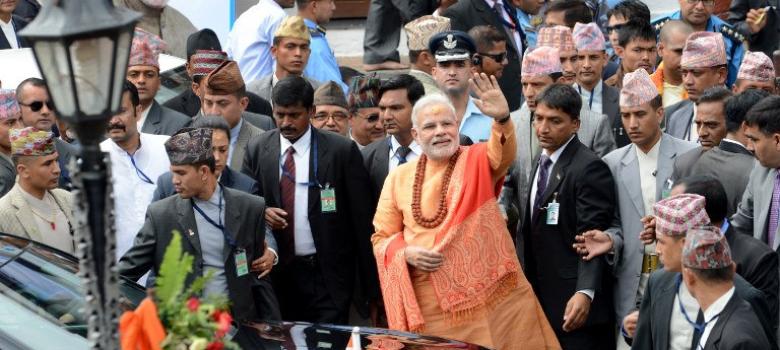
So for many residents of the mountain-kingdom, the highest point of Indian Prime Minister Narendra Modi‘s two-day state visit to their country came during his address to parliament on Sunday, when he referred to Nepal as “the birthplace of Lord Buddha”.

Though the Indian prime minister’s speech to lawmakers included the announcement of a $1 billion line of credit to Nepal and suggested how energy cooperation could be enhanced, the country’s Telegraph Weekly reported the address under the headline, “Indian PM Modi admits Lord Buddha was born in Nepal.”

The Khatmandu Post added more details. “Nepali lawmakers gave a thunderous applause when he mentioned that Buddha was born in Nepal – an issue that rouses deep passion in the country when various quarters of India claim that the former was born in India,” it wrote. “He uttered the word Buddha five times.”

Many Nepalese Twitter users expressed their delight at Modi’s statement.

via Scroll.in – News. Politics. Culture..

06/06/2014

Timeline: Indian Prime Minister Visits to the U.S. – India Real Time – WSJ

Indian Prime Minister Narendra Modi, who took office just last month, has accepted an invitation from President Barack Obama to visit Washington D.C. in September.

If the visit happens as scheduled, he will be the latest leader of the world’s largest democracy to visit the world’s second largest democracy.

The relationship goes both ways. U.S. Presidents going back to Dwight D. Eisenhower have made visits to India. Click here to see the list of U.S. presidents who have made the trek to South Asia.

While most Indian Prime Ministers had official visits to the United States, six Indian premiers–including Lal Bahadur Shastri and H.D. Deve Gowda–did not visit the states while they were in office.

Here is a list of some of the trips made by prime ministers according to the U.S. Department of State.

Jawaharlal Nehru: The first prime minister of independent India went to the U.S. in 1949 and then in 1956 at which time he visited Washington D.C. and Pennsylvania.

Indira Gandhi:  Ms. Gandhi visited the U.S. three times during her years in office. Her first visit was in 1966 when Lyndon B. Johnson was the president. Her second visit came in 1971 and her final visit was in 1982.

Indira Gandhi, left, stood next to Richard Nixon during an official ceremony during her visit to the U.S. in November 1971. Agence France-Presse/Getty Images

Morarji Desai: Mr. Desai went to the U.S. in 1978 visiting New York, San Francisco and Omaha.

Morarji Desai. Keystone/Hulton Archive/Getty Images

Rajiv Gandhi: Mr. Gandhi visited the U.S. two times in 1985 and once in 1987. He was assassinated two months after his 1987 visit.

Rajiv Gandhi addressed a crowd during election campaign rally at Faizabad in Uttar Pradesh. Agence France-Presse/Getty Images

P.V. Narasimha Rao: Mr. Rao–who is credited for starting to open India’s economy– visited the U.S. twice during his four years in office. He met President George H.W. Bush during a U.N. Security Council Summit in New York in 1992.  He visited again two years later to address a joint meeting of the U.S. Congress.

P.V. Narasimha Rao, left, with Hillary Clinton. Douglas E. Curra/Agence France-Presse/Getty Images

Inder Kumar Gujral:  Though Mr. Gujral served as India’s prime minister for less than a year, he found time to visit New York where he met President Bill Clinton at the U.N. General Assembly in 1997.

Inder Kumar Gujral. Sena Vidanagama/Agence France-Presse/Getty Images

Atal Bihari Vajpayee: Mr. Vajpayee—the last prime minister from Mr. Modi’s Bharatiya Janata party–visited the U.S. four times during his five years in office, twice in 2001 and once each in 2002 and 2003.

Atal Bihari Vajpayee, right, posed for photographs with George W. Bush in New York, Sept. 24, 2003. Luke Frazza/Agence France-Presse/Getty Images

Manmohan Singh: Mr. Singh was the prime minister for close to ten years until last month. He visited the U.S. on no less than seven occasions.

via Timeline: Indian Prime Minister Visits to the U.S. – India Real Time – WSJ.

Enhanced by Zemanta
19/05/2014

The Twin Deficits That Threaten Modi’s India – Businessweek

For Narendra Modi, getting elected as prime minister of India is the easy part. Now comes dealing with the twin deficits—in the national budget and in foreign trade—that endanger the world’s largest democracy.

Opposition leader and India's next prime minister Narendra Modi greets supporters during a visit to seek his mother's blessings in Gandhinagar, the western Indian state of Gujarat on May 16

Overnight poll results show that Modi’s opposition Bharatiya Janata Party and its allies scored the biggest Indian election win in 30 years. “Voters tired of sluggish economic growth and corruption handed a historic defeat to the Gandhi dynasty that has dominated politics since the country’s founding,” Bloomberg News reported today.

In April, the International Monetary Fund issued a 66-page report on India that highlighted the challenges facing India. The report notes that India is not the only Group of 20 country with high budget deficits, nor is it the only one with high trade deficits. What’s unusual is that it’s high in both.

Despite notable progress in shrinking both deficits, India remains vulnerable to a crisis of confidence among global investors, the IMF report says. Advanced economies are vulnerable to rapid fiscal deterioration, the report says, when they have debt-to-GDP ratios above 80 percent of GDP and persistent deficits in the current account, the broadest measure of trade in goods and services. Emerging economies such as India’s are vulnerable even at lower debt levels, the report says, citing work by Harvard economists Kenneth Rogoff and Carmen Reinhart.

via The Twin Deficits That Threaten Modi’s India – Businessweek.

Enhanced by Zemanta
26/08/2012

* India coal scandal: Hundreds protest against PM Singh

BBC News: “Police in the Indian capital Delhi have baton-charged hundreds of anti-corruption protesters angered by the government’s sale of coalfields without open bidding.

An auditors’ report last week said the mis-selling cost India $33bn (£20bn).

Police also used water cannon and tear gas to turn back protesters trying to reach the house of Indian Prime Minister Manmohan Singh

Opposition calls for Mr Singh to resign have deadlocked parliament.

In the report last week, government auditors said private companies had made “windfall gains” by the allocation of coal mining rights from 2005-9 in a process that “lacked transparency”. India is one of the largest producers of coal in the world.

The main opposition Bharatiya Janata Party (BJP) says Mr Singh should quit because he was head of the coal ministry at the time of the sales.

The call has left parliament deadlocked since Tuesday. The Congress-led government insists there was no wrongdoing.”

via BBC News – India coal scandal: Hundreds protest against PM Singh.

Law of Unintended Consequences

continuously updated blog about China & India

ChiaHou's Book Reviews

continuously updated blog about China & India

What's wrong with the world; and its economy

continuously updated blog about China & India