Posts tagged ‘Pyongyang’

08/02/2016

Gong Xi Fa Cai! What to expect in China’s Year of the Monkey – SCMP

The Year of the Monkey is expected to be another turbulent year for the world’s second largest economy. Here, SCMP reporters gaze into their crystal balls for what might lie ahead.

An installation celebrates the Year of the Monkey at Ditan Park in Beijing. Photo: EPA

POLITICS: Political jockeying and more crackdowns

The Communist Party will be focused on preparations for a new leadership team, to be unveiled at the 19th Party Congress next year. Apart from President Xi Jinping (習近平) and Premier Li Keqiang (李克強), the rest of the Politburo Standing Committee will have reached retirement age. The new appointments will be keenly observed for clues as to who Xi intends to succeed him.

Two of Xi’s signature campaigns – the drives against corruption and in favour of frugality in public life – are likely to continue to reshape the nation.

– Cary Huang

DIPLOMACY: Conflicts and tensions to escalate

Following Xi’s maiden presidential visit to the Middle East, Beijing is expected to increase its role as a broker in the region’s conflicts. Beijing has already hosted representatives from Syria and Afghanistan for talks. But other than calling for dialogue, China’s options are limited, partly because it does not want to be seen as interfering in the internal affairs of other nations.

With the Beijing-led Asian Infrastructure Investment Bank having just started operations, China is expected to boost its economic diplomacy by funding infrastructure projects overseas.

Tensions in the South China Sea are also expected to rise, as China is likely to continue building structures in the disputed waters. How the United States and China handle the issue – especially the Pentagon’s deployment of warships within 12 nautical miles of Chinese-controlled islands – will be the biggest concern.

– Teddy Ng

DEFENCE: Band(s) of Brothers?

The top priority of the military will be to rebuild morale and its integrity following its restructuring into five theatre commands. Xi set the tone this month by visiting Jinggangshan, the cradle of the communist revolution in China. The Eastern Theatre Command’s land force quickly followed his lead and visited Gutian in Fujian (福建) province, where the Red Army pledged obedience to the party in 1929, and saluted the party flag. Other commands are expected to make similar displays of fidelity.

It will be a bumpy road: the old ways of managing operations, carrying out orders through personal connections and using favoured contractors, has been upended. Xi wants to turn the PLA into a fighting force that meets international standards, with all the efficiencies and accountability that entails.

– Minnie Chan

ECONOMY: Pandora’s Box to open?

There’s actually little disagreement between billionaire investor George Soros and Beijing decision-makers over China’s economic prospects in 2016 – both agree growth will be lower in 2016 than that of 2015. Where they disagree is on how much and how quickly.

One thing is for sure, China will never admit an economic “hard-landing”, though investors may find plenty of evidence for one – from factory closures to rising unemployment and financial strains.

– Zhou Xin

UNEMPLOYMENT: What’s the real picture?

Of all of China’s official economic indicators, the registered urban jobless rate is possibly the least reliable. The rate, released quarterly, has barely ever moved from 4.1 per cent in recent years, regardless of the economic cycle. Another jobless rate compiled by the statistics agency, which is increasingly being cited by the premier, claims a level of about 5 per cent.

Neither of these official rates are likely to change much throughout 2016.

– Zhou Xin

A-shares: Beware the bear!

The mainland’s stock market, after witnessing a sharp fall at the beginning of 2016, is expected to continue a bear run in the Year of Monkey amid a crisis of confidence.

A depreciating yuan, the imminent launch of the new initial public offering (IPO) mechanism and a bleak outlook for corporate earnings are set to exacerbate weak sentiment with millions of retail investors suffering paper losses following a market rout last year.

Local investors are increasingly betting on a further downturn in the A-share market.

Corporate earnings are likely to stay flat in 2016 despite Beijing’s increased efforts to navigate a transition to a consumer-led growth.

– Daniel Ren

Consumption: Bittersweet for retailers

Online stores are continuing to take business from their brick-and-mortar counterparts.

While overall consumption growth is expected to further slow in 2016, bringing problems for both sectors, shopping malls and big stores face their own particular woes.

Hypermarkets could see custom slow, but business at smaller formats such as mini-marts and convenience stores should remain stable.

People will continue to spend more on tourism, leisure, food and health-related products.

Domestic brands will continue to gain ground on foreign ones.

Women will continue to take a greater role in driving spending. Consulting firm Mintel found more than half of Chinese mothers control the family budget and that women are more willing to try new products and experiences than men.

– Mandy Zuo

E-commerce: Click, click, click to buy, buy, buy

The personal computer era is over. Mobile-commerce, which enables people to buy everything from anywhere via the internet, is dominating the online sector and this trend shows no sign of stopping.

Retail on WeChat, the most popular social media platform, is expected to grow steadily. The mobile platform is also becoming an important tool of advertising and communication for businesses.

Online to offline (O2O) business will continue to boom as mainlanders show growing interest and loyalty in professional home services such as home cleaning and massage.

With growing demand from mainland consumers for prime goods overseas, fiercer competition is expected in cross-border business. Internet giants, entrepreneurs and small businesses will flock to the sector, which the Ministry of Commerce projects will grow an average 30 per cent in the next few years.

– Mandy Zuo

P2P lending: More closures, collapses and runaway owners

The long-awaited regulations reining in peer-to-peer lending are expected to bring an industry shakeup that will knock out a significant number of players.

Industry data showed the number of P2P lending platforms dropped a second consecutive month to 2,566 at the end of January from 2,595 in December.

The draft rules, released by the China Banking Regulatory Commission at the end of 2015, define P2P lending platforms as internet financing intermediaries and forbid them from selling wealth management and other financial products that attract investors with promises of high returns.

– Kwong Man-ki

Tourism: Slowdown, what slowdown?

Despite the economic slowdown, the depreciation of the yuan and turmoil in the stock markets, Chinese tourists passed a milestone last year – making a record 120 million outbound trips and spending US$104.5 billion to make China the world’s leading source of tourists.

The boom is expected to continue this year, thanks to a relaxation in visa policies in more countries as well as a strong yuan against the euro and yen.

– Laura Zhou

Childbirth: More buns in the oven

The Year of the Monkey is traditionally regarded an auspicious year for giving birth, so it will prove popular with people planning families. Some of those may have delayed their plans from the Year of the Goat, which is decidedly inauspicious.

More of the newborns are likely to be second children, as parents seek to benefit from the new policy allowing all couples to have two children.

– Zhuang Pinghui

URBANISATION: Millions to relocate

Urbanisation will maintain its pace with millions relocating, most of them rural residents.

They will continue to move to cities near rivers, railway lines and coastlines and more of them will be migrating with spouses and children.

The policy of issuing residence permits to migrants and granting urban household registrations to rural residents are helping them to access public services and integrate in urban life.

– Zhuang Pinghui

ENVIRONMENT: More smoggy days?

As the new five-year plan period (2016-2020) begins, cities will need to set targets on how to improve water and air quality. But whether much can be done to reduce smog problems – especially in heavily polluted city clusters near Beijing and Shanghai – depends largely on how determined local governments are to slash overcapacity in heavy industries.

At the end of 2015, Beijing’s persistent smog pushed the city authorities to pledge better management of small-scale coal burning. If other cities follow suit, the move could impact China’s environmental footprint.

– Li Jing

http://www.scmp.com/news/china/policies-politics/article/1910019/kung-hei-fat-choy-what-expect-chinas-year-monkey

14/12/2015

‘Spice-Girl Diplomacy:’ North Korean Girl Band’s Beijing Shows Abruptly Cancelled – China Real Time Report – WSJ

The Moranbong band’s shows at China’s National Center for the Performing Arts have been cancelled “due to some reasons,” an employee at the venue told China Real Time Saturday night.

A person who had a ticket to one of the band’s invitation-only shows confirmed that he received a cancellation notice late Saturday afternoon. Short hair, glittery miniskirts, electronic pop music and perhaps even the theme song from the 1976 Hollywood hit “Rocky” were expected to grace the stage of Beijing’s top music hall Saturday night as the Moranbong band was set to kick off three days of shows in the Chinese capital.

The group — which was accompanied by an army orchestra, the State Merited Chorus – arrived in Beijing on Thursday and was expected to stay until next Tuesday on what the North Korean official news agency KCNA described as a “friendship visit” to China.

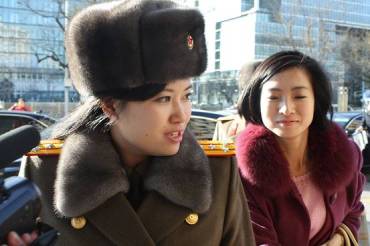
Zuma Press China’s state-run media lit up with news reports on the group’s visit in recent days, with the official Xinhua News Agency publishing a slideshow showing the women arriving in Beijing dressed in military-style frocks and fur hats. It was unclear Saturday evening whether the band was still in Beijing.

Japan’s Kyodo News Service reported that band members were seen at Beijing’s Capital International Airport and had flown back to Pyongyang late Saturday afternoon. But no updates were forthcoming from Xinhua and other Chinese state-run media. The visit was to have been the group’s first overseas tour — although no one, it seemed, knew how to obtain a ticket.

Neither the concert venue nor China’s foreign ministry was able to provide instructions on buying a ticket when asked by China Real Time this week. A ticket agent at the National Centre for the Performing Arts said before Saturday’s cancellations that the performances were being treated as a national-level foreign affairs activity and that the concert hall was responsible only for providing the venue. “We don’t have a single ticket on hand; we even don’t know yet which room will be offered for the performance,” the ticket agent said.

Chinese foreign ministry spokeswoman Hua Chunying said Friday that she had no details on the show or its audience — and had not been invited herself. ”This performance is not organized by the foreign ministry so I have no more information to offer,” she said at a regular briefing. “As for where to buy the tickets, I have no information. I myself have no ticket to the performance.”

Some speculated that the tour was being organized by another official organ, the International Department of the Chinese Communist Party’s Central Committee. Neither that department nor the North Korean Embassy responded to requests for comment. China has long been North Korea’s economic and diplomatic lifeline. Yet the traditional alliance between the two has come under strain in recent years, particularly after Pyongyang conducted its third nuclear test in 2013 and North Korean forces seized a Chinese fishing boat later that year.

Even so, both countries have played up their ties again since this fall when senior Chinese official Liu Yunshan stood alongside Mr. Kim at a military parade in Pyongyang to mark the 70th anniversary of North Korea’s ruling Workers’ Party. Mr. Liu, who is a member of the Standing Committee of the Chinese Communist Party, also passed along to Mr. Kim a letter from Xi Jinping in which the Chinese president called for closer relations.

Whether Moranbong’s short-lived visit to Beijing was intended to show a further warming of ties between China and North Korea — also known as the Democratic People’s Republic of Korea, or DPRK — remains open to debate. Asked Friday about the group, Ms. Hua called the tour “a major event showing the friendship between the DPRK and China.” “We believe it contributes to our mutual understanding and the sound and sustainable development of bilateral ties,” she added.

Zhang Yushan, a researcher at the Jilin Social Science Academy who studies North and South Korea, cautioned against reading too much into the visit. “This spice-girl diplomacy doesn’t really mean China and North Korea’s relations really will become warmer,” he said. This week, a top United Nations official called for the Security Council to refer North Korea to the International Criminal Court over “gross human rights violations.” China called a vote to stop the meeting, although it failed to halt it. “North Korea was seeking help from China”, Mr. Zhang of the move. “We are both very practical.”

Members of the Moranbong Band are believed to have been selected by Kim Jong Un himself. The group has become the most well-known girl band in North Korea since its debut in 2012. In addition to anthems urging listeners to “support our supreme commander with arms,” Moranbong’s repertoire also includes a surprising number of foreign pieces, including the “Rocky” theme song

Source: ‘Spice-Girl Diplomacy:’ North Korean Girl Band’s Beijing Shows Abruptly Cancelled – China Real Time Report – WSJ

24/09/2013

China bans several weapon-related North Korea exports

BBC: “China says it has banned the export to North Korea of several weapon-related technologies which could be used in the development of nuclear weapons.

File photo: North Korean soldiers parade with missiles and rockets during a mass military parade in Pyongyang, North Korea, 27 July 2013

China’s Commerce Ministry published the list, which includes components for nuclear explosive devices and rocket systems, on Monday.

It said the move would help implement UN resolutions on North Korea, and would be effective immediately.

Analysts say the ban shows China taking a firmer line against its ally.

The list includes technology in nuclear, missile, chemical and biological fields.

It says the restrictions are developed in accordance with several UN Security Council resolutions on North Korea.

China is North Korea’s only ally and its major trading partner.

Western powers have previously criticised China for not rigorously enforcing UN sanctions imposed on North Korea because of its nuclear programme, the BBC’s Martin Patience in Beijing reports.

However, relations between Beijing and Pyongyang have been seriously strained in recent months, our correspondent adds.

In March, China supported a UN Security Council resolution tightening sanctions against North Korea, in response to Pyongyang’s third nuclear test in February.”

via BBC News – China bans several weapon-related North Korea exports.

14/05/2013

* A shift in Chinese strategy on North Korea?

Wonder if North Korea is finally getting the message, that if it does not change its ways, its only friend, China, will be forced to abandon it.

07/05/2013

* Bank of China closes account of key North Korean bank

China responds to US-initiated action action North Korea.

SCMP: “Bank of China has shut the account of North Korea’s main foreign exchange bank, which was hit with US sanctions in March after Washington accused it of helping finance Pyongyang’s nuclear weapons programme.

Chinese Bank of China

Chinese Bank of China (Photo credit: epSos.de)

The state-run Foreign Trade Bank had been told its transactions had been halted and its account closed, Bank of China, the country’s biggest foreign exchange bank, said in a brief statement on Tuesday. It gave no reason for the closure and the bank declined to comment further.

The closure is the first significant, publicly announced step taken by a Chinese entity to curb its dealings with North Korea in the wake of international pressure to punish Pyongyang over its banned nuclear and ballistic missile programmes.

“I think it is indeed a very noteworthy action,” said Zhang Liangui, a North Korea expert at China’s Central Party School, adding Bank of China was probably concerned about its reputation and thus closed the account.

“In taking this action I think there are political considerations as well as considerations about its own interests.”

The US sanctions prohibit any transactions between US entities or individuals and the Foreign Trade Bank.

Japan has followed suit while Australia is expected to do the same soon. Washington has also urged the European Union to impose sanctions on the Foreign Trade Bank and has raised the issue with China, although Beijing has not commented publicly on the bank.

Experts have said Washington’s move was designed to make foreign banks that do business in the United States think twice about dealing with the Foreign Trade Bank, in much the same way that banks have become wary about having ties with financial institutions in sanctions-hit Iran.

China is North Korea’s traditional ally and its biggest trading partner. It is unclear how much of the US$6 billion in annual bilateral trade goes through the Foreign Trade Bank.

Among China’s other large banks, a spokesman at China Construction Bank said the bank did not do any business with the Foreign Trade Bank. Industrial and Commercial Bank of China and Agricultural Bank of China were not immediately available for comment.

China has become increasingly frustrated with North Korea in recent months. It agreed to new UN sanctions after Pyongyang conducted its third nuclear test in February.

Those sanctions, announced on March 7, target the North’s attempts to ship and receive cargo related to its nuclear and missile programmes and tighten financial curbs, including the illicit transfer of bulk cash.

The UN measures did not address the Foreign Trade Bank. Washington imposed its own sanctions several days later.”

via Bank of China closes account of key North Korean bank | South China Morning Post.

16/04/2013

* China’s freeway to North Korea: A road to nowhere

Reuters: “A new stretch of China’s G12 expressway arcs toward the northernmost tip of North Korea, connecting one of the world’s most vibrant economies to probably its most stagnant. It is a symbol of China’s long-term goal of building economic ties with its unpredictable neighbor.

A woman stands in a gift shop in central Rason city, part of the special economic zone northeast of Pyongyang, in this August 30, 2011 file photo. REUTERS-Carlos Barria-Files

But the thin traffic along a highway lined with fallow fields in China’s Jilin province, two years after it was finished, shows how far there is to go and why plans for high-speed rail links to Chinese cities along the border look misplaced.

The problem for Beijing is twofold: getting Pyongyang to buy into the idea of economic reform and the reluctance of Chinese businessmen to venture into one of the world’s riskiest investment destinations.

While China is frustrated with Pyongyang over its threats to wage war on South Korea and the United States, its efforts to build economic links with North Korea from places like Jilin help explain why Beijing is unlikely to crack down hard on the reclusive state.

Since then-Premier Wen Jiabao went to North Korea in 2009 – just months after Pyongyang’s second nuclear test – China has sought to stabilize the Korean peninsula by stepping up its effort to steer the North toward economic reform. China is not about to give up that goal even though it’s under U.S. pressure to get tough after North Korea’s third nuclear test, on February 12.

“It’s not even shepherding anymore. It’s more of just inundating North Korea with all of these influences from the Chinese side where the idea is to essentially corrupt them, show them what it tastes like to make money,” said John Park, a North Korea expert at the Massachusetts Institute of Technology and the Harvard Kennedy School.”

via Insight: China’s freeway to North Korea: A road to nowhere | Reuters.

Law of Unintended Consequences

continuously updated blog about China & India

ChiaHou's Book Reviews

continuously updated blog about China & India

What's wrong with the world; and its economy

continuously updated blog about China & India