Posts tagged ‘Samajwadi Party’

13/10/2016

Is this the world’s most oversubscribed school? – BBC News

The VidyaGyan Leadership Academy, a boarding school in India‘s Uttar Pradesh state, is offering an elite education for pupils drawn from the rural poor.

There are about 200 places on offer each year – but such is the appetite for families to get a better life for their children, there are 250,000 applications.

The school, set up by the Shiv Nadar Foundation, is completely free, and offers the type of education usually available only to the very wealthy.

Roshni Nadar Malhotra, a businesswoman and trustee of the foundation, says the school has been modelled on India’s private schools, which put students on the pathway to top universities and high-flying careers.

Roshni Nadar Malhotra wants the school to produce a more meritocratic generation of leaders for India

But the VidyaGyan school is open only to the very clever and very poor – which she describes as the “top of the bottom of the pyramid”.

No-one can even apply u
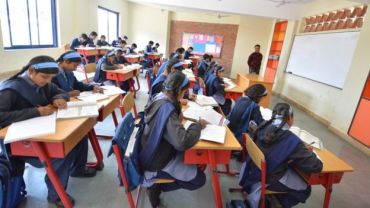
Unless their family income is below the equivalent of £1,500 per year, and the school carries out checks to make sure that better-off families are not trying to get in.

“Most of India is rural, there is a huge population in India not being tapped for their excellence. They have no access to great universities,” says Ms Malhotra, who is chief executive officer of the HCL technology company.

A performer from Uttar Pradesh prepares to take part in a festival

“We wanted to see if we could have an admissions system that was truly meritorious.”

The admissions system operates on an epic scale.

After the initial 250,000 applications, Ms Malhotra says, about 125,000 turn up to take a written test.

The drop-out rate is a reflection of the tough lives of these families, who might struggle to travel to a local test centre or be stopped by bad weather.

The school’s ambition is for its students to compete anywhere in the world

Based on the results, there is a shortlist of about 6,000 students, who then take another set of tests. There are also visits to the homes of applicants.

This sifting process produces an intake of 200 pupils, boys and girls, who are taught, clothed, fed and housed by the school.

These children from the poorest rural families, a deliberate mix of religions and castes, then receive a high-cost education, exposing them to ideas and opportunities.

It is an intensive process, designed to create a “stepping stone” to top universities in India or abroad.
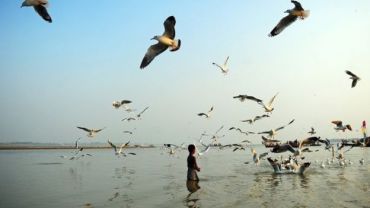
The school has been founded to help clever poor pupils from Uttar Pradesh

It has become such a phenomenon that there are now coaching academies dedicated to training people for the test.

So far the school has cost the foundation £59m – and Ms Malhotra says there have been questions about whether the money would have been better spent on teaching basic literacy to much bigger numbers of young people.The final intake of 200 pupils stands compared with Uttar Pradesh’s population of about 200 million.

But Ms Malhotra says the distinct purpose of the school is to create a leadership academy focusing on providing a chance for disadvantaged youngsters to compete with India’s elite.

These are the children of poor, uneducated farmers, and she wants them to be equipped to reach the top in politics, business or sport.

The school is intended to provide a stepping stone to top universities

And she says there is a “ripple effect” on the home villages of these pupils, as they see their young people being able to go to a top university in India or in Europe or the United States.

“When students get into a great university, it’s a huge aspirational lift for their village. These students become beacons of hope.”

There are also expectations of paying back to their local communities. In the summer, when they go home, they have to carry out a socially useful project, such as providing cleaner water, clearing away rubbish or finding a safer way of cooking.

“It’s about getting their hands dirty and finding out how to solve problems,” says Ms Malhotra.
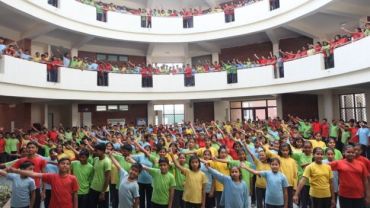
Once pupils are accepted, everything in the school is free for families

The school’s first graduates have left with “stellar results”, but she also wants them to be equipped to compete with international students anywhere.

“It’s not just about getting in, they need to be able to survive. All of a sudden you’re thrown in with other highly competitive students from all over the world.”

It will be some time before it is possible to see if they become India’s future leaders, she says. “But they’re on their way.”

Source: Is this the world’s most oversubscribed school? – BBC News

08/08/2016

India’s Controversial Cow Protection Group Conducts Cattle Census – India Real Time – WSJ

A group concerned about the safety of India’s cows has embarked on a controversial and ambitious mission this month: counting all the cattle in the state of West Bengal.

“Our aim is to save the cow mother,” said Subrata Gupta, president of the Bengal branch of Cow Development Cell, which used to be associated with Prime Minister Narendra Modi’s ruling Bharatiya Janata Party.

The group will use the data to protect the state’s cows, many of which are being illegally exported to Bangladesh and Pakistan for slaughter, said Mr. Gupta.

The status of cows — an animal deeply revered in Hinduism – is a divisive issue in the country. Critics say conservative Hindu groups, emboldened by the BJP’s power in New Delhi, are eating away at the country’s secular roots by trying to ban beef consumption.

Over the weekend Mr. Modi spoke out against self-styled vigilantes who say they are trying to protect cows. He urged state governments to punish them when they use cow protection as a rationalization for hate crimes.

Cow slaughter is already illegal in many Indian states–including Uttar Pradesh where a Muslim man was killed by a mob last year following rumors he had slaughtered a cow for food.

The eastern state of West Bengal, however, allows the killing of cows during the Islamic religious festival of Eid.

Around 6,000 volunteers from Mr. Gupta’s group are going door-to-door across state to record how many cows each household owns. The group wants to finish the survey before Sept. 12, when Muslims will celebrate Eid.

“Thousands of cows are being smuggled across India’s border into Bangladesh, where they will be slaughtered,” said Mr. Gupta of the Cow Development Cell which has groups apprehending cattle trucks, even though it has no legal authority to do so.

He said activists from the group freed about 40,000 animals last month.

The BJP recently broke ties with Mr. Gupta’s Cow Development Cell.

“It was an all-India decision that a separate cell for cow development is not needed,” said Dilip Ghosh, president of the BJP in West Bengal.

That hasn’t stopped Mr. Gupta and his army of self-styled cow protectors who say they will release the results of the cow census on Sept. 15.

Source: India’s Controversial Cow Protection Group Conducts Cattle Census – India Real Time – WSJ

03/12/2013

Confusion over Indian election symbols used for millions of illiterate voters | The Times

A curious contest is heating up among India’s political parties as the country prepares for the biggest democratic exercise in history when 714 million voters go to the polls in the spring.

Parties are fighting to secure the right to symbols they hope will appeal to hundreds of millions of India’s illiterate voters.

For decades, when Indians have entered the polling booth they have been presented not just with a list of parties and candidates, but also a variety of household items sketched on the ballot paper to help the 1 in 4 voters who cannot read.

For the ruling Congress Party it is an open palm. For India’s main opposition party, the BJP, it is a blossoming lotus flower.

Whistles, coconuts, walking sticks, nail clippers, cauliflowers and toothbrushes have all been used as political symbols upon which illiterate voters can press a thumb print to mark their choice of party.

The Rashtriya Ulama Council uses a kettle, while the Republican Party of India uses a refrigerator. The Aadarshwadi Congress Party uses a batsman at the crease.

However, in India’s vibrant and chaotic democracy, some popular symbols such as the elephant or clock are often claimed by several parties, leading to squabbles over which one has the right to use them.

A foretaste of the turmoil ahead was offered this week, when two parties in the Delhi assembly elections, due to be held tomorrow, clashed over the right to use the bicycle, a perennial favourite.

Only after intervention by election officials did the parties grudgingly agree to a compromise deal under which the Samajwadi Party (SP) will fight under the banner of the glass tumbler, while the Jammu and Kashmir Panthers Party (JKPP) will plump for the instant camera.

Adding to potential confusion among voters, in another nearby constituency, Ballimaran, the SP is fighting under the symbol of the cup-and-saucer while the JKPP is running under the ceiling fan.

via Confusion over Indian election symbols used for millions of illiterate voters | The Times.

21/10/2013

Photo gallery: A walk through Mayawati’s Dalit park | India Insight

On a hot Tuesday afternoon, I walked into the recently reopened Dalit park in Noida, outside New Delhi. This is the park built by Mayawati, the 57-year-old former chief minister of Uttar Pradesh, as a memorial to the class of people long known in India as “untouchables.” A Dalit herself, Mayawati is a symbol of what traditionally oppressed classes and castes in India can do with their lives.

Of course, Mayawati has been accused by her political opponents of wasting money — lots of it. She seems like an easy target, especially when she has commissioned statues of herself. For a senior Congress politician, erecting one’s own statue was an act of ‘megalomania’. But the symbolism that this structure seeks to attach itself with — asserting Dalit identity and acknowledging “sacrifices” made by people of backward classes — is hard to miss.

The high central chamber of the Dalit park, which is a short drive into Uttar Pradesh from Delhi, draws heavily on Buddhist architecture. It houses statues of B. R. Ambedkar, who helped draft India’s Constitution; Kanshi Ram, founder of the Bahujan Samaj Party that Mayawati now heads; and the former chief minister herself with her ubiquitous handbag, an uncommon thing for a living politician to do.

The 40-metre-high structure is surrounded by 20 sculptures of elephants, 10 on either side. The remaining complex, built at a cost of nearly 7 billion rupees ($113 million), includes bronze statues of Ambedkar and other “pioneers of social transformation,” and replicas of the Ashoka Chakra.

“The Dalits fought like anybody else in the struggle against the British. She is underscoring it that it is this part of history that you have not talked about for the last 65 years,” said Sohail Hashmi, a Delhi-based historian.

The park was inaugurated by Mayawati two years ago. But when the Samajwadi Party came to power last year, led by Akhilesh Yadav, a probe was ordered into alleged irregularities in its construction. The investigation is still on but Yadav threw open the park on Oct. 2, Mahatma Gandhi’s birthday, a decision that caused controversy of its own.

Spread over some 80 acres, the “Rashtriya Dalit Prerna Sthal” (or the national Dalit memorial)  is located on the banks of the Yamuna river.

One of the 4,000 visitors to visit the park in the week since it was reopened was Rajiv Prasad.

“I wanted to witness the history and achievements of our people. The history of the oppressed people that has been written gives us self-confidence. If money has been spent on this, it’s good,” said the college principal from Bihar, born in Azamgarh district of Uttar Pradesh.

Neeraja Choudhury, a political analyst, said there probably are better ways to assert the identity of India’s so-called backward classes.“If I were to do it, I would certainly go in for Dalit education because the largest group of illiterates in the world is Dalit girls. Seven hundred crores would have gone a long way in building those high quality institutions to bring about educational revolution for Dalits.”

via Photo gallery: A walk through Mayawati’s Dalit park | India Insight.

See also: https://chindia-alert.org/prognosis/indian-challenges/

26/08/2013

Sonia says food bill is ‘big message’, Mulayam calls it poll gimmick

Times of India: “Declaring Congress’s goal to “wipe out hunger and malnutrition”, Sonia Gandhi asked all political parties on Monday to set aside differences and support the Food Security Bill so that a “big message” could be sent out about India’s capabilities.

English: Sonia Gandhi, Indian politician, pres...

English: Sonia Gandhi, Indian politician, president of the Indian National Congress and the widow of former Prime Minister of India, Rajiv Gandhi. Français : Sonia Gandhi, une femme politique indienne, présidente du parti du congrès indien, et veuve de Rajiv Gandhi, ancien premier ministre de l’Inde. (Photo credit: Wikipedia)

Opening the Congress innings on the debate in Lok Sabha on food bill, she rejected questions over whether the country had resources to implement the landmark measure.

“It is time to send out a big message that India can take responsibility of ensuring food security for all Indians … our goal is to wipe out hunger and malnutrition all over the country,” Gandhi said about her pet agenda.

Making a strong pitch for smooth passage of the landmark legislation, the UPA chairperson said the measure is a historic opportunity to provide food security to tens of millions of people in the country which will end the problem of hunger once for all.

She sought to dismiss questions over whether the ambitious scheme could be implemented. “The question is not whether we have enough resources or not and whether it would benefit the farmers or not. We have to arrange resources for it. We have to do it,” she said in the House where Prime Minister Manmohan Singh was present.

Gandhi said farmers and agriculture have always remained priority of the UPA.

Agreeing that reforming public distribution system (PDS) was a must for the food law, Gandhi noted that there was basic need to remove the leakages to ensure that benefits of the food bill reached the intended beneficiary.

Gandhi said the Congress had made a commitment to the nation in the 2009 election manifesto to bring forward such a legislation. It is one in a series of various rights promised and provided by UPA like Right to Information Act, Right to Education Act, Right to Work Act and Right to Forest Produce Act.

Poll gimmick

Contending that the Food Security Bill was being brought with an eye on elections, UPA’s outside supporter Samajwadi Party on Monday demanded that the measure be kept in abeyance till chief ministers are consulted as it would put additional burden on states.

SP chief Mulayam Singh Yadav raised a number of questions over the bill in Lok Sabha and said it would badly hurt farmers as there was no guarantee in the provisions that all the produce would be bought by the government.

“It is clearly being brought for elections … Why didn’t you bring this bill earlier when poor people were dying because of hunger? Every election, you bring up a measure. There is nothing for the poor,” he said participating in the debate on the bill.”

via Sonia says food bill is ‘big message’, Mulayam calls it poll gimmick – The Times of India.

Law of Unintended Consequences

continuously updated blog about China & India

ChiaHou's Book Reviews

continuously updated blog about China & India

What's wrong with the world; and its economy

continuously updated blog about China & India