Posts tagged ‘Shinzō Abe’

19/11/2014

Why India is doing better than most emerging markets | The Economist

INVESTORS have fallen out of love with emerging markets. Since the start of last year emerging-market stocks have trailed their rich-world peers. Currencies are falling. Worst-hit is the Russian rouble, which has fallen by 30% against the dollar this year. The currencies of other biggish emerging markets, such as Brazil, Turkey and South Africa, have also weakened. For such economies growth is harder to come by. The IMF recently cut its forecasts for emerging markets by more than for rich countries. But India is a notable exception to the general pessimism. Its stockmarket has touched new highs. The rupee is stable. And the IMF nudged up its 2014 growth forecast for India to 5.8%. That figure is still quite low: growth rates of 8-9% have been more typical. But in comparison with others it is almost a boom. Why is India doing better than most emerging markets?

In part optimism about India owes to its newish government. In May Narendra Modi’s Baratiya Janata Party (BJP) won a thumping victory in elections on a pro-growth platform. Since then the BJP has strengthened its position in some key states. So far reform has been piecemeal. Procedures for government approvals have been streamlined. The powers of labour inspectors have been curbed. Civil servants now work harder. That has been enough to sustain hopes of further and bigger reforms. Yet much of the continued enthusiasm about India is down to luck. The currents that sway the global economy presently—the dollar’s strength; slowdown in China; aggressive money-printing in Japan; stagnation in the euro zone and falling oil prices—are less harmful to India than to most emerging markets.

Start with the dollar, which has been buoyed by a resilient American economy and the prospect of interest-rate increases by the Federal Reserve. Past episodes of rising interest rates and dollar strength (for instance in the early 1980s or mid-1990s) have not been kind to emerging markets. Bond yields rise and currencies fall as capital is drawn back to America. India has a bit less to fear from such a rush to the exits; its bond markets are tricky for foreigners to enter in the first place. India is also less harmed by slowdown in China, as only around 5% of its exports go there. It is not part of China’s supply-chain, which takes in much of South-East Asia. Nor is it a big exporter of industrial commodities, as Brazil is. And a weaker yen in response to quantitative easing by the Bank of Japan hurts Asia’s manufacturing exporters more than service-intensive India. The misery in the euro zone is of greater concern to Europe’s trading partners in Turkey and Russia than to faraway India. And the fall in crude-oil prices that hurts oil exporters, such as Russia and Nigeria, is a boon to a big oil importer like India. Indeed the deflation that is stalking large parts of the world is helpful to India, which has suffered from high inflation.

India is not impervious to bad news. Some of its recent economic data have looked a little soggy. Exports slumped in October. Car sales have fallen for two consecutive months and there is little sign yet of a meaningful recovery in business investment. This explains, in part, why there have been growing calls (including from the finance minister) for the central bank to cut interest rates soon in response to a drop in consumer-price inflation. The troubles in other emerging markets ought to counsel caution. Any sign that policymakers might be ditching discipline in favour of quick fixes might see India fall from investors’ favour. But for the time being, it is riding high.

via The Economist explains: Why India is doing better than most emerging markets | The Economist.

19/11/2014

Summitry: The Chinese order | The Economist

FOR the past week China’s state media have conveyed an almost imperial choreography playing out in the Great Hall of the People, in Zhongnanhai, the Chinese leaders’ compound next to the Forbidden City in Beijing, and at Yanqi Lake just outside the capital. Every day, on television and in newspapers, President Xi Jinping (above, right) is portrayed receiving lines of grateful world leaders. And every day he is seen arranging prosperity, ordering peace or, in an agreement with Barack Obama, America’s president, (above, left) on carbon emissions, even saving the planet. It escaped no visitor that not since Mao Zedong has a Chinese leader conducted foreign affairs with such eye-catching aplomb. Yet this was not only Mr Xi’s moment, but also China’s—a diplomatic coming-out party of sorts.

On several fronts, a country known for a somewhat reactive diplomacy has made the running. China was host this week to the Asia-Pacific Economic Co-operation—APEC, a regional trade gathering that rarely makes waves. Yet in quick succession China declared free-trade agreements with South Korea and Australia, two sizeable Asian economies, all but signed. It announced a breakthrough with America by promising at last to eliminate tariffs on information-technology products. And to the delight of Asian leaders and of Vladimir Putin, president of Russia (reviled in the West but made welcome in Beijing), Mr Xi announced $40 billion in investments to cement a new commercial “Silk Road” that will run overland through Central Asia and Russia eventually to Europe and by sea through South-East Asia to the Middle East and Africa.

Most strikingly, on November 11th Mr Xi urged APEC’s 21 members to move towards a Free Trade Area of the Asia-Pacific (FTAAP). The commitment to “study” the idea over the next two years is in effect to launch it, and for all that an eventual FTAAP is unlikely to be notable for its high standards, the announcement was intended to stand in contrast to the predicament of the 12-nation Trans-Pacific Partnership, sponsored by America, which remains bogged down in negotiations between America and Japan despite earlier hopes of a breakthrough announcement at APEC.

On security matters, Mr Xi appeared to be making the running, too. There had been a “meeting of minds”, according to Benigno Aquino, president of the Philippines, over disputed reefs in the South China Sea. Most striking, though, was an agreement for China to resume high-level contacts with Japan. China has rationed these, and in 2012 began actively challenging Japan’s control of the Senkaku islands (known as the Diaoyu islands to China) in the East China Sea; ties had been frozen entirely since Japan’s prime minister, Shinzo Abe, visited Tokyo’s Yasukuni shrine last December. The shrine, honouring Japan’s war dead, has militarist overtones.

Yet on November 7th China and Japan announced a four-point agreement to reduce tensions (see article). The signal agreement was later sealed when Mr Xi met Mr Abe for the first time as president. Admittedly, the withering handshake and puckery expression he offered Mr Abe lent the impression of a dog owner obliged to pick up another pooch’s turd.

That breakthrough was downplayed in state media, perhaps because Chinese ultranationalists might perceive in it a climbdown from China’s hard line over the islands, and towards Japan in general. But given much more prominence was the summit between the Chinese and American presidents, their second full one after that at Sunnylands in California in 2013. Again, there were welcome breakthroughs in co-operation. One was the agreement on information technology, which should now clear the way for a World Trade Organisation pact on IT products. Another was that both sides agreed to find common confidence-building and other measures to help avoid misunderstandings or accidental military confrontations on or above the East China Sea and South China Sea, where the United States shadows China’s increasingly assertive military presence.

But the biggest surprise was the agreement on greenhouse gases. China and America are the two biggest polluters, together accounting for 44% of global carbon emissions. Without their commitment to cut emissions, any global target is meaningless. On November 12th Mr Obama announced a “historic” agreement in which America will cut emissions by 26-28% by 2025, compared with 2005 levels, while China promises its emissions will peak around 2030. It gives a big boost to getting a global deal on carbon emissions at a crucial gathering in Paris next year. For China, a huge guzzler of coal, setting a date for emissions to peak is a first, even though it is five years later than the Americans would have liked. To bring down emissions after 2030, it aims for a big growth in nuclear power and for a fifth of its electricity to come from non-fossil fuels.

via Summitry: The Chinese order | The Economist.

19/11/2014

China and Japan: Out of the deep freeze | The Economist

AFTER Japan’s prime minister worshipped at Tokyo’s Yasukuni shrine last December, China declared Shinzo Abe to be beyond the pale; principles are principles. But Chinese ones are, well, nothing if not adaptable, and on November 10th President Xi Jinping met Mr Abe for the first time. A “four-point agreement” comes as a welcome signal that tensions between Asia’s two biggest powers might, at least for now, begin to ease.

The thorn in the side of relations is Japan’s Senkaku islands, which China claims and calls the Diaoyus. Chinese aircraft and coastguard vessels have greatly raised tensions from 2012 onwards, by making incursions around the Senkakus. So it is progress that Japan and China now acknowledge “the emergence of tense situations” there. For the first time Japan has referred to the Senkakus in a document with China. Chinese analysts claim a diplomatic victory. Even if obliquely, Japan acknowledges a dispute over sovereignty, Huang Dahui of Renmin University argues. Yet the wording also left ample room for Japanese diplomats to insist that they have not acknowledged any such thing.

The negotiations seem mostly about avoiding the hard issues. On Yasukuni, it beggars belief to think the Japanese promised Mr Abe would not visit the shrine where high-ranking war criminals are honoured. The joint statement says that Japan and China will overcome “political difficulties” in the spirit of “squarely facing history” (a favourite Communist Party phrase). China believes that means Mr Abe will stay away. Mr Abe and his right-wing supporters may think differently.

Most welcome is a commitment to set up crisis-management mechanisms in the crowded seas and skies around the Senkakus. For months both sides’ armed forces have seen the need for such a step, says Noboru Yamaguchi, a retired Japanese general. Yet the details remain unclear.

Now the two countries’ ministries can resume their connections, though exchanges are likely to remain fraught. As if to underscore the challenges, this week Mr Abe brought up with Mr Xi a fresh diplomatic complaint, about Chinese coral poachers hunting near Japan’s distant Ogasawara islands. As for the Senkaku islands and waters, will China withdraw incursions by its coastguard cutters? That would be the most genuine proof of a Chinese desire to lower the temperature.

via China and Japan: Out of the deep freeze | The Economist.

10/11/2014

Xi Jinping’s Ice-Cold Handshake With Japan’s Shinzo Abe – China Real Time Report – WSJ

Well, it’s a start.

Photo

After years of tensions over disputed territory, disputed history and visits to a certain shrine, China and Japan drew closer to establishing a more functional diplomatic relationship with a handshake on Monday between Chinese President Xi Jinping and Japanese Prime Minister Shinzo Abe at the Asia-Pacific Economic Cooperation summit in Beijing.

As the video above suggests, the encounter was a tad on the chilly side, with Mr. Xi apparently refusing to return his counterpart’s greeting and looking throughout the photo op as if he’d rather be shaking hands with one of the goats that are said to be stripping the aforementioned disputed Diaoyu/Senkaku islands of their scant vegetation.

As WSJ’s Yuka Hayashi reports, however, a subsequent sit-down between the two leaders appears to have been somewhat more productive:

Speaking to reporters shortly after the meeting, Mr. Abe said, “I believe Japan and China took the first step toward improving our relationship as we go back to the principle of mutually beneficial strategic relations.”

The meeting, in Beijing’s Great Hall of the People, lasted just short of 30 minutes. It followed weeks of intense, behind-the-scenes negotiations, as officials from Asia’s two biggest economies sought to arrange for Messrs. Abe and Xi to get together on the sidelines of the Asia Pacific Economic Cooperation forum.

…“I am aware that our neighbors in Asia and many countries beyond had been hoping to see dialogue between Japanese and Chinese leaders,” Mr. Abe said. “We were able to respond to such wishes and begin taking steps toward repairing our ties.”

China and Japan had earlier issued a surprise announcement that they planned a gradual resumption of diplomatic and security dialogues, though each side translated the text of the agreement in ways that made it look like the other had folded. That subtle sniping continued on Monday, when China’s official Xinhua news agency emphasized that the meeting between Messrs. Xi and Abe came “at the request of the Japanese side” — a message Mr. Xi’s expression during Monday’s handshake helped reinforce.

It wasn’t the first time onlookers have felt a chilly blast when the prime minister of Japan met China’s president. In November 2010, for example. then-Prime Minister Naoto Kan met then-Chinese President Hu Jintao. The meeting saw a few arms-length handshakes exchanged. Mr. Kan read out his greetings to Mr. Hu from a memo. A Chinese fishing trawler had collided with a Japan coast guard boat that September near disputed islands, known as Senkaku in Japan and Diaoyu in China.

via Watch: Xi Jinping’s Ice-Cold Handshake With Japan’s Shinzo Abe – China Real Time Report – WSJ.

10/11/2014

China, Vietnam willing to handle maritime issues through dialogue | Reuters

China and Vietnam have agreed to handle maritime disputes through dialogue, Chinese state media reported on Monday, months after ties between the two countries hit a three-decade low in a row over a Chinese oil rig in disputed waters.

Photo

The two Communist neighbors must respect each other and focus on long-term interests, President Xi Jinping said, according to the official Xinhua news agency.

Sino-Vietnamese relations have been advancing continuously since the two nations established diplomatic relations, despite some twists and turns,” he said.

Vietnamese President Truong Tan Sang said his country was ready to “properly deal with maritime issues through friendly consultation so that the issues will not affect its relations with China”, according to Xinhua.

via China, Vietnam willing to handle maritime issues through dialogue | Reuters.

07/11/2014

Foreign policy: Showing off to the world | The Economist

THE factories have closed down for a few days, and millions of cars have been ordered off the roads. Clear blue skies appearing over a usually smog-choked Beijing always mean one thing: a big event is about to get under way.

From November 10th President Xi Jinping will welcome world leaders to this year’s Asia-Pacific Economic Co-operation (APEC) summit. Not since the Olympics in 2008 have so many leaders gathered in the capital, and they will include the heads of the United States, Russia and Japan. It is a defining moment for Mr Xi’s foreign policy. Having established himself at home as China’s most powerful leader since Deng Xiaoping, he now seems to want to demand a bigger, more dominant and more respected role for China than his predecessors, Deng included, ever dared ask for.

Respect begins by putting on a good face to guests. Chinese bullying over disputed maritime claims has done much to raise tensions in the region. But now Mr Xi appears to be lowering them. In particular, China’s relations with Japan have been abysmal. The government has treated Japan’s prime minister, Shinzo Abe, with both venom and pettiness, implying he is a closet militarist. The relationship had sunk to such a low that it will count as notable progress if Mr Xi shakes Mr Abe’s hand—even if he does little more—at the summit.

On November 11th and 12th, Mr Xi will host a state visit in Beijing for Barack Obama. It is the second summit with the American president, following one at Sunnylands in California in 2013. It will be a good show, with a scenic walk and all that. But the substance appears less clear. At the time of Sunnylands, there was much Chinese talk of a “new type of great-power relationship” with America. Yet since it implies a diminished role for America, at least in Asia, Mr Obama does not seem inclined to go along. The two men appear likely to co-operate in a few areas, including climate change, trade and investment. They will agree to a bit more communication over respective military movements in and over the seas near China. But hopes that cordiality at Sunnylands might lead the relationship to blossom may come to little.

In truth, Mr Xi does not have much respect left for Mr Obama; the Chinese dismiss him as weak-willed in foreign policy. And so much of Mr Xi’s ambition lies elsewhere. Above all, the dream is to return China to its rightful place in a world in which, according to Bonnie Glaser of the Centre for Strategic and International Studies, a Washington think-tank, “China will be at the centre, and every other nation will have to consider China’s interests.”

This attitude is most familiar to China’s neighbours in the South China Sea and East China Sea. China has upset the Philippines by grabbing a disputed reef; Vietnam, by moving an oil rig into contested waters; Japan, by challenging its control over uninhabited islets; and even South Korea which, though on good terms, was concerned along with others when China declared an “Air Defence Identification Zone” over the East China Sea, demanding that planes inform it when entering it.

Yet Mr Xi has also courted friends under the catchphrase of “peaceful development”. He has pushed multilateral initiatives, including a new Asian Infrastructure Investment Bank, which many of China’s neighbours, including India, have signed up to. A New Development Bank has also been set up with fellow “BRICs”—Brazil, Russia, India and South Africa.

One of Mr Xi’s playmates is President Vladimir Putin. China and Russia have a history of mutual distrust, but Mr Xi’s first trip abroad as president, in March 2013, was to Moscow. Since then the two countries have struck a long-stalled gas deal and, according to Kommersant, a Russian newspaper, a pact on cyber-security. China backs Russia’s pro-Syrian stand in the UN Security Council and has refused to condemn Russia’s territorial incursions in Crimea and eastern Ukraine—though it loves to preach non-interference.

A strong thread that binds the two countries is American dominance in international affairs. “No country”, said Mr Xi at a security summit earlier this year to which Mr Putin was invited, “should attempt to dominate regional security affairs or infringe upon the legitimate rights…of other countries.” Mr Xi did not name America, but a month earlier Mr Obama had in Tokyo emphasised that America’s security pact with Japan extended to the Japan-controlled Senkaku islands, which China claims and calls the Diaoyu.

Is Mr Xi’s foreign policy succeeding? Only in parts. China’s maritime assertiveness has pushed some neighbours closer to Japan and America. But for long China will remain Asian nations’ biggest trading partner. It is busy pursuing regional and bilateral trade agreements while an American-led trade initiative, the Trans-Pacific Partnership, is bogged down. At APEC Mr Xi will seek to build on those economic relationships. And, given China’s heft, by and large he will succeed.

via Foreign policy: Showing off to the world | The Economist.

07/11/2014

China, Japan set aside isle row, paving way for leaders to meet | Reuters

China and Japan agreed on Friday to work on improving ties and signaled willingness to put a bitter row over disputed islands on the back burner, paving the way for their leaders to meet at an Asian-Pacific summit next week.

The agreement, ahead of an expected ice-breaking chat between Japanese Prime Minister Shinzo Abe and Chinese President Xi Jinping at the gathering in Beijing, signals a thaw in ties between the world’s second- and third-biggest economies.

Relations have been soured over the past two years by the territorial row, regional rivalry and the bitter legacy of Japan’s wartime occupation of China.

Abe said the two sides were making final arrangements for one-on-one talks, although neither he nor China’s foreign ministry confirmed that the talks were set.

“Both Japan and China are coming to the view that it would benefit not just the two countries but regional stability if a summit is held,” he told a TV program.

via China, Japan set aside isle row, paving way for leaders to meet | Reuters.

15/09/2014

China on track to develop Indian railways as Xi heads to South Asia | Reuters

China will pledge to invest billions of dollars in India’s rail network during a visit by President Xi Jinping this week, bringing more than diplomatic nicety to the neighbors’ first summit since Narendra Modi became prime minister in May.

China's President Xi Jinping attends a meeting with Venezuela's President Nicolas Maduro at Miraflores Palace in Caracas in this July 20, 2014 file photo. REUTERS/Jorge Silva/Files

The leaders of Asia’s three biggest economies – China, India and Japan – have crisscrossed the region this month, lobbying for strategic influence, building defense ties, and seeking new business opportunities.

Beijing’s bid to ramp up commercial ties in India comes despite a territorial dispute that has flared anew in recent years, raising concerns in New Delhi, where memories of a humiliating border war defeat in 1962 run deep.

It follows a pledge by Japan to invest $35 billion in India over the next five years – including the introduction of bullet trains – and a drive to deepen security ties during talks earlier this month between Modi and Prime Minister Shinzo Abe in Tokyo.

India and China are expected to sign a pact that will open the way for Chinese participation in new rail tracks, automated signaling for faster trains and modern stations that India’s British-built rail system desperately needs, having barely added 11,000 km of track in the 67 years since independence.

China, which added 14,000 km of track in the five years to 2011, is also pushing for a share of the lucrative high-speed train market in India, which it says would be cheaper than Japanese proposals.

“India has a strong, real desire to increase its cooperation with China and other countries to perfect and develop its rail system, and has concrete cooperation ideas,” Assistant Chinese Foreign Minister Liu Jianchao told reporters ahead of Xi’s trip.

“India is considering building high-speed railways, and China has a positive attitude towards this.”

China’s consul general in Mumbai, Liu Youfa, told the Times of India last week that Chinese investment in the modernization of India’s railways could eventually touch $50 billion.

Beijing is looking to invest another $50 billion in building India’s ports, roads and a project to link rivers, part of an infrastructure push that Modi has said is his top priority to crank up economic growth.

Chinese investment will also help narrow a trade deficit with India that hit $31 billion in 2013.

via China on track to develop Indian railways as Xi heads to South Asia | Reuters.

04/09/2014

Japan PM Abe appoints China-friendly lawmakers to key posts | Reuters

Japanese Prime Minister Shinzo Abe picked two veteran lawmakers with friendly ties to China for top party posts on Wednesday in an apparent signal of hope for a thaw in chilly ties with Beijing and a summit with Chinese leader Xi Jinping.

Japan's Prime Minister Shinzo Abe walks into the Prime Minister's official residence in Tokyo September 3, 2014.  REUTERS/Yuya Shino

The change in executives in Abe’s Liberal Democratic Party (LDP) is part of a broad leadership rejig, including a cabinet reshuffle, aimed at strengthening party unity and polishing Abe’s image 20 months after he surged back to office.

In a move welcomed by Tokyo stock market players, Abe drafted Yasuhisa Shiozaki, 63, a proponent of an overhaul of Japan’s Government Pension Investment Fund (GPIF), to head the ministry of labor, health and welfare, which oversees GPIF.

The fund is finalizing plans to boost the weighting of domestic stocks in its portfolio.

Abe also gave women almost a third of the posts in his 18-minister cabinet to show his commitment to promoting women as part of his “Abenomics” growth strategy.

But he retained core cabinet members such as Chief Cabinet Secretary Yoshihide Suga, Finance Minister Taro Aso, 73, Economics Minister Akira Amari, 65, and Foreign Minister Fumio Kishida, 57, signaling policy continuity.

Abe’s new line-up faces a number of challenges, including how to repair ties with China that have been frayed by rows over disputed territory and Japan’s wartime history, and whether to go ahead with a planned sales tax rise next year despite signs the economy is faltering.

via Japan PM Abe appoints China-friendly lawmakers to key posts | Reuters.

03/09/2014

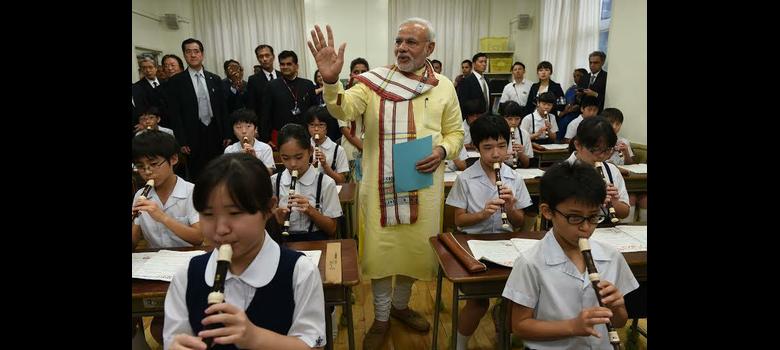
These photos show what Modi did in Japan when he wasn’t attending to business

All prime ministers enjoy spending time abroad, especially if it is while visiting a particularly friendly ally.

Prime Minister Narendra Modi isn’t exactly the jovial type. Sure, he peppers his speeches with a bit of light humour occasionally, but he doesn’t seem like the kind of person who would enjoy a comedy night on television. So what could possibly make him really happy? The same thing that makes heads of states happy all over the world: leaving their own countries to visit friendly allies.

And by any measure, it seems like Modi managed to have a blast in Japan (even if no nuclear deal was signed). Since he also happens to be the Selfie Era Prime Minister, every moment of this fun journey was documented and promptly tweeted by the prime minister’s official twitter account.

more photos from:  http://scroll.in/article/677092/These-photos-show-what-Modi-did-in-Japan-when-he-wasn’t-attending-to-business

Law of Unintended Consequences

continuously updated blog about China & India

ChiaHou's Book Reviews

continuously updated blog about China & India

What's wrong with the world; and its economy

continuously updated blog about China & India