Posts tagged ‘South Asian Association for Regional Cooperation’

14/02/2015

PM Modi sending top diplomat to Pakistan in thawing of ties | Reuters

Prime Minister Narendra Modi is sending his top diplomat to Pakistan as part of a regional tour, the first top-ranking visit since Modi broke off talks last year over the disputed region of Kashmir.

Prime Minister Narendra Modi (L) talks to his Pakistani counterpart Nawaz Sharif (R) during the closing session of 18th South Asian Association for Regional Cooperation (SAARC) summit in Kathmandu November 27, 2014.  REUTERS/Niranjan Shrestha/Pool/Files

The sign of a thaw in ties comes weeks after a visit to India by U.S. President Barack Obama.

The United States has long privately encouraged dialogue between India and Pakistan hoping that better ties between the nuclear-armed neighbours could lead to cooperation in other areas such as Afghanistan.

Modi called his Pakistani counterpart, Nawaz Sharif, early on Friday to wish his country luck in the World Cup cricket tournament beginning this weekend and to tell him that new Foreign Secretary Subrahmanyan Jaishankar will soon visit Islamabad as well as other regional capitals.

Sharif told Modi he welcomed the proposed visit of the Indian envoy to discuss all issues of common interest, the Pakistani foreign office said in a statement.

In Washington, the U.S. State Department welcomed the move.

via PM Modi sending top diplomat to Pakistan in thawing of ties | Reuters.

15/12/2014

China Breaks India Monopoly on Nepal Economy as Investment Grows – Businessweek

In the dusty outskirts of Kathmandu, south of the Himalayan mountain range that holds the world’s highest peaks, Chinese engineers in orange hard hats oversee construction of Nepal’s first eight-lane highway.

Highway Construction

The $45 million upgrade of a road circling the Nepalese capital is one of dozens of projects helping China challenge India’s dominance in a country that is sandwiched between them. Until recently, the Himalayas served as a natural barrier that prompted Nepal to trade more across its flat border with India.

“China is growing in importance,” Ram Sharan Mahat, Nepal’s Finance Minister, said in a Dec. 4 interview in Kathmandu. “Because of new trade horizons and the cheap pricing of Chinese goods, Chinese trade vis-a-vis Nepal is growing.”

via China Breaks India Monopoly on Nepal Economy as Investment Grows – Businessweek.

02/12/2014

South Asia’s hydro-politics: Water in them hills | The Economist

IT IS a thrill trekking beside the upper Marsyangdi river in northern Nepal. On view are spectacular waterfalls and cliffs, snowy Himalayan peaks, exotic birds and butterflies. But just where tourists and villagers delight in nature, hydropower engineers and economists have long been frustrated; in such torrents they see an opportunity that for too long has been allowed to drain away.

Himalayan rivers, fed by glacial meltwater and monsoon rain, offer an immense resource. They could spin turbines to light up swathes of energy-starved South Asia. Exports of electricity and power for Nepal’s own homes and factories could invigorate the dirt-poor economy. National income per person in Nepal was just $692 last year, below half the level for South Asia as a whole.

Walk uphill for a few hours with staff from GMR, an Indian firm that builds and runs hydropower stations, and the river’s potential becomes clear. An engineer points to grey gneiss and impossibly steep cliffs, describing plans for an 11.2km (7-mile) tunnel, 6 metres wide, to be blasted through the mountain. The river will flow through it, before tumbling 627 metres down a steel-lined pipe. The resulting jet—210 cubic metres of water each second—will run turbines that at their peak will generate 600MW of electricity.

The project would take five years and cost $1.2 billion. It could run for over a century—and produce nearly as much as all Nepal’s installed hydropower. Trek on and more hydro plants, micro to mighty, appear on the Marsyangdi. Downstream, China’s Sinohydro is building a 50MW plant; blasting its own 5km-long tunnel to channel water to drive it. Nearby is a new German-built one. Upstream, rival Indian firms plan more. They expect to share a transmission line to ill-lit cities in India.

GMR officials in Delhi are most excited by another river, the Upper Karnali in west Nepal, which is due to get a 900MW plant. In September the firm and Nepal’s government agreed to build it for $1.4 billion, the biggest private investment Nepal has seen.

Relations between India and Nepal are improving. Narendra Modi helped in August as the first Indian prime minister in 17 years to bother with a bilateral visit. Urged by him, the countries also agreed in September to regulate power-trade over the border, which is crucial if commercial and other lenders are to fund a hydropower boom. Mr Modi was back in Kathmandu for a summit of the South Asian Association for Regional Co-operation, on November 26th and 27th. Governments think the normally rudderless body could find a purpose in energy integration—though the talks were poisoned by poor relations between Pakistan and India. Another big Indian hydro firm agreed with Nepal’s government, on November 25th, to build a 900MW hydro scheme, in east Nepal, known as Arun 3. Research done for Britain’s Department for International Development suggests four big hydro projects could earn Nepal a total of $17 billion in the next 30 years—not bad considering its GDP last year was a mere $19 billion.

All Nepal’s rivers, if tapped, could feasibly produce about 40GW of clean energy—a sixth of India’s total installed capacity today. Add the rivers of Pakistan, Bhutan and north India (see map) and the total trebles.  Bhutan has made progress: 3GW of hydro plants are to be built to produce electricity exports. The three already generating produce 1GW out of a total of 1.5GW from hydro. These rely on Indian loans, expertise and labour.

Why a Himalayan cross-border hydropower rush now? In Nepal projects were once scuppered by local politics, a ten-year civil war, suspicion of India and a lack of regulation that put off creditors. Slowly, such problems are being tackled. The war ended in 2006. It helps, too, that the terms of the projects look generous to the host. For Upper Karnali, GMR will set aside 12% of electricity production, free, for Nepali consumers. It will also give Nepal a 27% stake in the venture. After 25 years of operation the plant will be handed to Nepal.

A second reason, says Raghuveer Sharma of the International Finance Corporation (part of the World Bank), was radical change that opened India’s domestic power market a decade ago. Big private firms now generate and trade electricity there and look abroad for projects. India’s government also presses for energy connections over borders, partly for the sake of diplomacy. There has even been talk of exporting 1GW to Lahore, in Pakistan—but fraught relations between the two countries make that a distant dream.

via South Asia’s hydro-politics: Water in them hills | The Economist.

28/11/2014

Narendra Modi woos Saarc nations, pledges slew of investments to counter China – The Times of India

India pledged a slew of regional investments at Saarc summit this week, seeking to counter China’s growing economic inroads into its backyard as it remains embroiled in bitter rivalry with Pakistan.

Prime Minister Narendra Modi said South Asia‘s largest economy would fund regional infrastructure, health facilities and even a communications satellite, and promised to free up its markets to exporters in smaller countries in the region.

Modi, who won a landslide election victory in May, has made clear that boosting India’s influence in its immediate neighbourhood is a key strategic priority for his government.

Critics say the previous Congress party government began to take relationships for granted, allowing economic giant China — which shares a border with four of India’s neighbours — to step into the breach.

But the failure of the South Asian Association for Regional Cooperation (Saarc) to make any significant progress during a two-day meeting underscored the scale of the challenge New Delhi faces.

Cross-border trade among the eight Saarc nations — Afghanistan, Bangladesh, Bhutan, India, Nepal, the Maldives, Pakistan and Sri Lanka — still accounts for less than five percent of total commerce in the region.

“Indians want to keep South Asia as their exclusive sphere of influence,” said Sreeram Chaulia, dean of the Jindal School of International Affairs in Delhi.

“To do that… we need to play the economic game and we need to play the connectivity game better. We have been protectionist, and that is not good,” he said, welcoming Modi’s pledge to help smaller nations reduce their trade deficits with India.

Leaders signed just one agreement, on energy cooperation, at a summit that was overshadowed by the rivalries between India and Pakistan, leading host country Nepal’s Prime Minister Sushil Koirala to say that Saarc had fallen short of expectations.

Nepal, long under the political influence of New Delhi, has benefited hugely from China’s bounty over the last decade, getting much-needed new roads and other infrastructure. Even the venue where the leaders met was built with Chinese money.

It is among several Saarc nations including Pakistan and Sri Lanka that reportedly support full membership for China, which currently enjoys observer status in the regional grouping.

India has resisted promoting its regional rival to full membership status, which comes with the power to veto agreements.

Frustrated by the slow pace of progress towards regional cooperation, it has also sought to woo its neighbours outside the Saarc framework.

via Narendra Modi woos Saarc nations, pledges slew of investments to counter China – The Times of India.

27/11/2014

South Asia Summit Nearing Failure as India, Pakistan Bicker – Businessweek

South Asian leaders overseeing a quarter of the world’s people struggled to agree on how to ease trade barriers in the region as India and Pakistan continued a decades-long row over a disputed border.

Pakistani Prime Minister Nawaz Sharif

Indian Prime Minister Narendra Modi was scheduled to meet every regional leader except Pakistani Prime Minister Nawaz Sharif for a one-on-one meeting during a gathering in Nepal starting today. Leaders of the South Asian Association for Regional Cooperation, or SAARC, last held a summit in 2011.

Failure to agree on cross-border travel and electricity supply would risk derailing Modi’s plan to turn the bloc into a regional force that can counter China’s growing influence. Chinese leaders have promised to invest part of a $40 billion Silk Road fund on infrastructure in South Asia.

via South Asia Summit Nearing Failure as India, Pakistan Bicker – Businessweek.

27/11/2014

China looms over South Asian summit in the Himalayas | Reuters

When eight South Asian leaders gather for a summit in Kathmandu on Wednesday, they will meet in a conference center donated by China to its cash-strapped Himalayan neighbor Nepal 27 years ago.

Prime Minister Narendra Modi watches a guard of honour upon his arrival for the 18th South Asian Association for Regional Cooperation (SAARC) summit in Kathmandu November 25, 2014. REUTERS/Navesh Chitrakar

In the decades since it built the modernist brick and glass hall, China has massively stepped up its presence in South Asia, supplying ports, power stations and weapons.

China’s advance has been aided by bickering between India and Pakistan that stymies almost all attempts at integration in a region that is home to a fifth of the world’s population but has barely any shared roads, fuel pipes or power lines.

India’s Prime Minister Narendra Modi has not welcomed Beijing’s renewed suggestion its status be raised from “observer” in the South Asian Association for Regional Cooperation (SAARC), in which India is presently the only major power.

SAARC summits bring together leaders from Afghanistan, Bangladesh, Bhutan, India, the Maldives, Nepal, Pakistan and Sri Lanka.

Modi’s hope of using the group as a counterweight to China is unlikely to gain traction at the two-day Kathmandu meeting, with officials saying Pakistan is blocking deals to increase transport and energy connections.

Pakistan mooted the idea of upgrading China’s and South Korea’s status in the organization at a meeting of SAARC foreign ministers on Tuesday. It was quickly rebuffed by India.

via China looms over South Asian summit in the Himalayas | Reuters.

25/11/2014

Nepal to ink India power deal during Modi visit – Businessweek

Nepal’s government is signing an agreement Tuesday with an Indian company to build a hydroelectricity plant that will export power to India and also boost supplies in the energy starved Himalayan nation.

The inking of the deal with Indian company Satluj Jal Vidyut Nigam Ltd. to build the 900 megawatt Arun III hydropower station will coincide with Indian Prime Minister Narendra Modi‘s visit to Nepal for a South Asian regional summit.

The $1.04 billion project is expected to begin producing electricity in 2020. More than three quarters of its output will be exported to India, said Ghanashyam Ojha, external affairs official at the Investment Board Nepal.

The Arun III agreement, which was endorsed by Nepal’s Cabinet late Monday, comes just two months after a similar deal with another Indian company.

They are the two biggest private foreign investments in Nepal, and put India ahead of neighboring China, which has long shown interest in developing Nepal’s power industry.

In September, Nepal signed an agreement with Indian company GMR to build the $1.15 billion Upper Karnali Hydro power plant.

via Nepal to ink India power deal during Modi visit – Businessweek.

25/11/2014

India-Pakistan Sparring Opens Door for China in South Asia – Businessweek

For a senior Afghan diplomat sitting in India’s capital, it’s easy to explain how a region with a quarter of the world’s people can account for only five percent of global trade.

Narendra Modi and Xi Jinping

“India and Pakistan need to overcome their problems,” M. Ashraf Haidari, deputy chief of mission at Afghanistan’s embassy in New Delhi, said in an interview ahead of this week’s meeting of the South Asian Association for Regional Cooperation, or SAARC. “Summits happen, leaders come, there’s all this consensus and declarations announced. But unfortunately it doesn’t happen in reality.”

As leaders of eight SAARC countries meet in Nepal this week for the first time since 2011, Indian Prime Minister Narendra Modi has more reasons than ever to turn the bloc into a regional force to counter China’s growing influence in South Asia. Doing so will require him to overcome differences with Pakistani leader Nawaz Sharif.

So far, things aren’t looking good. Modi’s government scrapped talks with Pakistan in August, which was followed by the worst border fighting between the countries in a decade. At the same time, China has promised SAARC nations part of a $40 billion Silk Road fund to finance infrastructure investments.

“SAARC won’t be able to counter China’s influence,” said Nishan de Mel, executive director and head of research at Colombo-based Verite Research Pvt., a policy research group. “China tends to have an approach that isn’t too demanding and isn’t politically difficult for the partner country and where the partner country will tend to see benefits quite quickly. India’s approach tends to be more hard-nosed.”

via India-Pakistan Sparring Opens Door for China in South Asia – Businessweek.

10/08/2014

Modi has realised that India needs to be a regional power before it can be a global one

One of the many pet projects of those inclined more to the right has been turning the dream of “Akhand Bharat“, or Undivided India, into a reality. The Rashtriya Swayamsevak Sangh’s education saffroniser-in-chief, Dinanath Batra, has even written about the subject in his book Tejomay Bharat, which will now be stocked in Gujarat school libraries. “Undivided India is the truth, divided India is a lie,” Batra writes, referring to a vision of the nation that begins as far west as Afghanistan and goes all the way till Burma, including everything in between. “Division of India is unnatural and it can be united again,” Batra suggests.
Of course, no one in the government has spoken of Akhand Bharat and Prime Minister Narendra Modi has never clearly explained his understanding of the concept. There is no indication that the government intends to implement any policy that aims to reinstate this fanciful notion of what India once was and there is no reason to believe there will be.

But the concept could be a rubric by which to understand the Modi government’s approach to foreign policy, particularly in the neighbourhood. From the very get-go Modi announced his intention to reinvigorate ties with India’s neighbours by inviting to his swearing-in ceremony each of the leaders from the South Asian Association for Regional Cooperation — the primary multilateral forum for subcontinental nations.

Just two-and-a-half-months in, the PM has visited two of India’s neighbours, his foreign minister has visited four, and India is set to become part of multilateral organisations that will give it many more opportunities to project itself as a regional powerhouse. This is Akhand Bharat 2.0.

Regional power

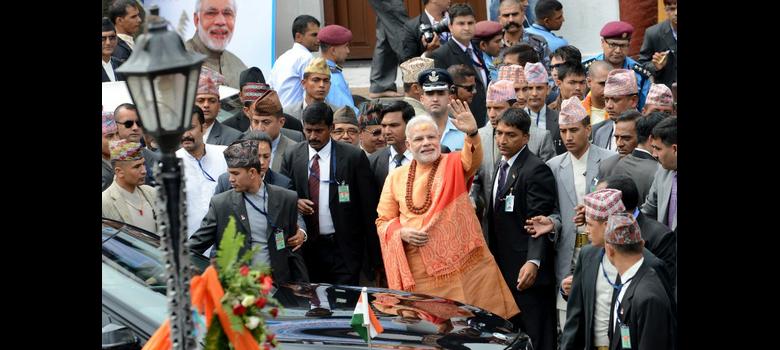
Foreign minister Sushma Swaraj is currently in Myanmar, the fourth neighbourhood country that she has visited in the last three months. But it was the trip made by Modi to Nepal that really sent a statement, since it was the first visit by an Indian prime minister to the country in 17 years. He received an enthusiastic reception.

“All governments that come to power in India feel that we must improve our relationship with the neighbourhood,” said Kanwal Sibal, a former foreign secretary. “But the difference is that, whereas in the past it remained at the level of rhetoric, in this case they are translating it into concrete initiatives. The fact that an Indian PM visited Nepal after 17 years is a testimony to the fact that, despite our professed position about needing a secure neighbourhood, we have actually neglected it… that is changing.”

That message was sent at the very beginning with the invitations handed out to each of the SAARC leaders for Modi’s swearing-in, all of which were accepted — with the exception of Bangladesh’s Sheikh Hasina, but only because she was on another diplomatic visit at the time. The sight of all the leaders in front of Rashtrapati Bhavan, and Modi dedicating his first day in office to bilateral talks with them, sent a very clear signal. The PM made his first foreign visit to Bhutan, a country deeply connected to India but not particularly important in terms of foreign policy.

“It shows that they understand that unless India is a dominant regional power, we can hardly be an extra-regional power or a world power,” said Manoj Joshi, a distinguished fellow at the Observer Research Foundation. “They seem to definitely be working on this understanding, especially because we are facing stiff competition from the Chinese when it comes to projecting power in the neighbourhood.”

Leading South Asia

It’s not just symbolism and rhetoric either. Modi’s visits to Bhutan and Nepal have been accompanied by important agreements, such as a $1 billion line of credit to Kathmandu, as well as the promise of further talks. Discussions with Bangladesh have also indicated progress on key stumbling blocks between the two nations. Modi has also spoken of using the SAARC framework to further cooperation in the neighbourhood. His suggestion of a SAARC space satellite, for example, while criticised by some as a gimmick, certainly sent a message that he is looking beyond the potential disputes towards projects that would allow the countries to work together.

“He has staked his leadership of the region, and this is important,” Sibal said. “There is a gesture to friendship in the neighbourhood, but he has also put across the message that India is leading the region. India is not going to neglect its neighbourhood, and it will take the lead in creating synergies that can benefit all.”

via Scroll.in – News. Politics. Culture..

21/05/2014

India Invites Pakistan to Narendra Modi’s Swearing-In – India Real Time – WSJ

Interestingly, China, another close neighbour has NOT been invited!

“In a surprise gesture, India has invited the leader of Pakistan—its neighbor and arch-enemy—to attend the swearing-in ceremony of a new prime minister.

The leaders of other South Asian nations are being invited, too, including Afghanistan, Sri Lanka, Nepal, Bhutan, Maldives and Bangladesh, according to a spokeswoman for the Bharatiya Janata Party, which dominated India’s recent parliamentary election. But all eyes will be on Pakistan, which has fought three wars with India since the two nations gained independence from the colonial British in 1947.

As of Tuesday afternoon, Pakistan hadn’t yet received its invitation, according to Pakistan’s foreign ministry.

Traditionally, swearings-in have been attended mainly by family members and Indian government figures. India’s next prime minister, Narendra Modi of the BJP, is scheduled to be sworn in at a ceremony on May 26. The invitations have been sent by India’s Ministry of External Affairs.

According to the BJP spokeswoman, Nirmala Sitharaman, invitations have been sent to all members of the South Asian Association for Regional Cooperation, or SAARC. The organization’s purpose is to work toward peace and strengthened economic ties in the region.

“We are looking forward to having a good relationship in our neighborhood and we want to build goodwill,” Ms. Sitharaman told The Wall Street Journal.

Mr. Modi, a Hindu nationalist leader, is expected to pursue a muscular foreign policy. In the past, he has criticized the rival Congress party’s stance on territorial disputes with China and on border skirmishes with Pakistan.  His party, the BJP, won 282 of the 543 elected seats in Parliament this month. The Congress party, which previously led the national government, won only 44 seats—its worst tally in party history.

After winning the elections, Mr. Modi, who has served as the chief minister of Gujarat for more than a decade, was congratulated by Pakistan Prime Minister Nawaz Sharif. Mr. Sharif came to power in Pakistan in the elections held last year.

India and Pakistan have a tense and fragile relationship. The invitation to attend the swearing-in comes only two days after Indian security forces said they were in pursuit of alleged militants in the state of Jammu and Kashmir, where India and Pakistan regularly skirmish.”

via India Invites Pakistan to Narendra Modi’s Swearing-In – India Real Time – WSJ.

Enhanced by Zemanta
Law of Unintended Consequences

continuously updated blog about China & India

ChiaHou's Book Reviews

continuously updated blog about China & India

What's wrong with the world; and its economy

continuously updated blog about China & India