NY Times: “China does not want to control all of the South China Sea, says Wu Shicun, the president of a government-sponsored research institute here devoted to that strategic waterway, whose seabed is believed to be rich in oil and natural gas. It wants only 80 percent.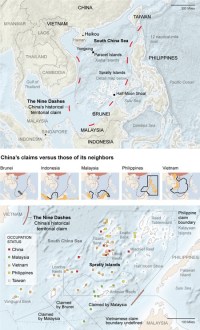
Mr. Wu is a silver-haired politician with a taste for European oil paintings and fine furniture. He is also an effective, aggressive advocate for Beijing’s longstanding claim over much of the South China Sea in an increasingly fractious dispute with several other countries in the region that is drawing the United States deeper into the conflict.
China recently established a larger army garrison and expanded the size of an ostensible legislature to govern a speck of land, known as Yongxing Island, more than 200 miles southeast of Hainan. The goal of that move, Mr. Wu said, is to allow Beijing to “exercise sovereignty over all land features inside the South China Sea,” including more than 40 islands “now occupied illegally” by Vietnam, the Philippines and Malaysia.
In the past several weeks, China has steadily increased its pressure, sending patrols with bigger ships and issuing persistent warnings in government-controlled newspapers for Washington to stop supporting its Asian friends against China.
The leadership in Beijing appears to have fastened on to the South China Sea as a way of showing its domestic audience that China is now a regional power, able to get its way in an area it has long considered rightfully its own. Some analysts view the stepped-up actions as a diversion from the coming once-a-decade leadership transition, letting the government show strength at a potentially vulnerable moment.
…
The Obama administration, alarmed at Beijing’s push, contends that the disputes should be settled by negotiation, and that as one of the most important trade corridors in the world, the South China Sea must enjoy freedom of navigation. The State Department, in an unusually strong statement issued this month intended to warn China that it should moderate its behavior, said that Washington believed the claims should be settled “without coercion, without intimidation, without threats and without the use of force.”
Washington was reacting to what it saw as a continuing campaign on the South China Sea after Beijing prevented the Association of Southeast Asian Nations, at its summit meeting in Cambodia in July, from releasing a communiqué outlining a common approach to the South China Sea.
The dispute keeps escalating. On July 31, the 85th anniversary of the founding of the People’s Liberation Army, the Chinese Defense Ministry heralded the occasion by announcing “a regular combat-readiness patrol system” for the waters in the sea under China’s jurisdiction.
The government then said it had launched its newest patrol vessel: a 5,400-ton ship. It was specifically designed to maintain “marine sovereignty,” said People’s Daily, the Communist Party’s leading newspaper.””
via Beijing Reasserts Its Claims in South China Sea – NYTimes.com.


 CHINDIA ALERT: You'll be living in their world, very soon