Posts tagged ‘South China Sea’

18/11/2012

* Southeast Asia calls for talks with China on sea dispute

S E Asia may be joining hands to call China to the discussion table; but China really dislikes being pressured and much prefers one-to-one dialogue and bi-lateral agreements.

Reuters: “Southeast Asian nations displayed a rare show of unity on Sunday against China’s sweeping maritime claims, calling for the first formal talks with Beijing over a sea dispute that has raised tensions and exposed deep divisions in the region.

(L - R)Singapore Prime Minister Lee Hsien Loong, Thailand Prime Minister Yingluck Shinawatra, Vietnam Prime Minister Nguyen Tan Dung, Cambodia Prime Minister Hun Sen and the Sultan of Brunei Hassanal Bolkiah hold hands during the opening ceremony of the 21st ASEAN (Association of Southeast Asian Nations) and East Asia summits in Phnom Penh November 18, 2012. REUTERS-Samrang Pring

As Chinese Premier Wen Jiabao arrived in Cambodia for meetings with Southeast Asian leaders, the 10-member Association of Southeast Asian Nations (ASEAN) appeared determined to avoid a repeat of an embarrassing breakdown of talks in July over competing claims in the mineral-rich South China Sea, its biggest security challenge.

Cambodia’s Prime Minister Hun Sen will tell Wen that ASEAN wants to begin talks on a binding Code of Conduct, aimed at reducing the chance of naval flashpoints, as soon as possible, ASEAN Secretary General Surin Pitsuwan told reporters.

“Prime Minister Hun Sen himself will be discussing with the PM of China tonight and delivering this consensus on the ASEAN side,” Surin said.

“They would like to see the commencement of the discussion as soon as possible because this is an issue of interest, concern and worry of the international community.”

China’s assertive claims in the South China Sea have sown deep divisions within the bloc at a time when military spending in the region is surging and the United States refocuses attention on Asia – a “pivot” that President Barack Obama will reinforce on his visit to the summit on Monday in Cambodia’s capital, Phnom Penh.

Chinese ally Cambodia has used its powers as ASEAN chair this year to restrict discussion of the issue, in line with Beijing’s view that the disputes should be discussed on a bilateral basis. China has said it is willing to discuss the Code of Conduct when the “time is right.”

Diplomats said the Philippines, a close U.S. ally, had invited fellow Southeast Asian claimant states Vietnam, Brunei, and Malaysia to separate talks in Manila to be held later this year or early next year.

“We are trying to make that happen, hopefully in Manila,” Philippine Foreign Secretary Albert del Rosario told reporters.

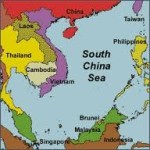
The other members of ASEAN include Cambodia, Laos, Myanmar, Thailand, Singapore and Indonesia, none of which have claims on the South China Sea.

One Philippine diplomat said the meeting was aimed at resolving issues among the claimant states, such as overlapping economic zones. He voiced frustration with China for delaying the start of talks with ASEAN over the Code of Conduct.

“ASEAN has done its part,” the diplomat said. “Now it is up to China to also come up with its own because when we formally sit down we will present our position to them. In fact we have already written it.””

via Southeast Asia calls for talks with China on sea dispute | Reuters.

See also: 


18/10/2012

* Feuds in the Pacific over islands: it’s not simply a case of China against everyone else

Unfortunately for China, its recent military posturing has obscured the fact that territorial claims in the South China Sea is not only between China and its neighbours but endemic.

WorldTimes: “When it comes to feuds in the Pacific over islands and what lies beneath, it’s not simply a case of China against everyone else. Depending on the dispute, it’s also South Korea vs. Japan, Japan vs. Taiwan, Taiwan vs. Vietnam, Vietnam vs. Cambodia and numerous other permutations — for many of the same reasons supposedly behind China’s actions. Resource grab. Patriotic posturing. Historical baggage (mostly to do with Japan’s brutal occupation of most of East Asia before and through World War II). Referring to the South China Sea, former ASEAN secretary general Rodolfo Severino, who now heads Singapore’s Institute of Southeast Asian Studies, wrote recently that “all claimants feel their footholds are essential to what they consider their national interests … This clash of national interests … makes it most difficult even to appear to be making compromises on national integrity or maritime regimes and, thus, almost impossible to resolve [the] disputes.””

Read more: http://world.time.com/2012/08/19/why-asias-maritime-disputes-are-not-just-about-china/#ixzz29dhhV78F

10/10/2012

* Russia further delays delivery of Admiral Gorshkov to India

It would seem a mini-arms race is on between India and China.  Although India already has two aircraft carriers, one is being retired and the other undergoing a five-month refit.  Fortunately, there is no known marine based territorial dispute between India and China, Curiously, India has been getting its carriers from Russia’s obsolete fleet and China from Ukraine’s retired fleet!

Times of India: “Russia delayed delivery of a trouble-plagued aircraft carrier for at least a year on Friday, a blow to India’s efforts to quickly build up naval strength as increasingly assertive Asian rival China expands its maritime reach.

INS Vikramaditya is anchored at Sevmash factory in northern city of Severodvinsk

Originally built as the Admiral Gorshkov in the Soviet Union, the $2.3 billion aircraft carrier is being reconditioned and was due to be ready this year, but problems with the ship’s boilers have pushed the delivery date back several times.

“We believe the handover of the ship will take place in the fourth quarter of 2013,” Russian defence minister Anatoly Serdyukov said at a joint news conference with his Indian counterpart in New Delhi.

Defence minister AK Antony said he had conveyed “serious concern” at the delays to Serdyukov.

The bilateral meeting precedes a visit by Russian President Putin to New Delhi on November 1.

The ship is to be renamed as Vikramaditya and the success of the order is seen as an important test of defence ties between Russia, the world’s second-largest arms exporter, and its biggest customer.

India, a big buyer of Soviet Union weaponry, still relies on Russia for 60 percent of its arms purchases, but has diversified its suppliers in recent years. Israel is now the No. 2 seller, and countries like the United States and France also increasing their presence.

“I myself expressed serious concern about the delay,” Antony said, adding that the issue had been raised several times. He said he was putting pressure on both sides to finish work on the biolers as soon as possible, but said he had not discussed penalising Russia so far.

India is closely watching the Chinese navy’s newly assertive stance in the South China Sea and in a dispute with Japan over contested islands that have raised tensions in East Asia this year.

India bought its first, British-built aircraft carrier in the 1960s, which was decommissioned in 1997. Another ex-British carrier, the INS Viraat, is in operation but is reaching the end of its useful service.”

via Russia further delays delivery of Admiral Gorshkov to India – The Times of India.

21/09/2012

* China’s Xi seeks to reassure Southeast Asia on sea dispute

Reuters: “China’s leader-in-waiting Xi Jinping sought to reassure Southeast Asian leaders on Friday that his country wanted only peaceful relations with them, following months of growing tensions over the strategically located South China Sea.

China's Vice President Xi Jinping listens to U.S. Secretary of Defense Leon Panetta (not pictured) in a meeting at the Great Hall of the People in Beijing, September 19, 2012. REUTERS/Larry Downing

Speaking at the opening of a trade fair in southern China for Association of Southeast Asian Nations (ASEAN) members, Vice President Xi said China’s own prosperity could only be guaranteed by having good relations with its neighbors.

“The more progress China makes in development and the closer its links with the region and the world, the more important it is for the country to have a stable regional environment and a peaceful international environment,” Xi said.

“Having gone through numerous vicissitudes in modern times, we are deeply aware of the importance of development and how valuable peace is,” he added, according to state media.

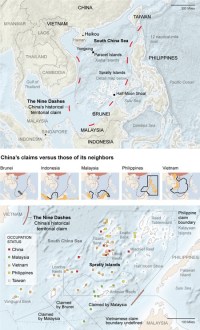
Beijing’s assertion of sovereignty over a vast stretch of the South China Sea has set it directly against Vietnam and the Philippines, while Brunei, Taiwan and Malaysia also lay claim to other parts of the region, making it Asia’s biggest potential military troublespot.

At stake are potentially massive offshore oil reserves. The seas also lie on key shipping lanes.

Vietnam Prime Minister Nguyen Tan Dung is one of the ASEAN leaders attending the trade fair, held in the city of Nanning.

Xi said China – currently also involved in a dispute with Japan over a group of uninhabited islets in the East China Sea -wanted the peaceful resolution for its diplomatic arguments.”

via China’s Xi seeks to reassure Southeast Asia on sea dispute | Reuters.

See also: https://chindia-alert.org/political-factors/geopolitics-chinese/

12/08/2012

* Beijing Reasserts Its Claims in South China Sea

NY Times: “China does not want to control all of the South China Sea, says Wu Shicun, the president of a government-sponsored research institute here devoted to that strategic waterway, whose seabed is believed to be rich in oil and natural gas. It wants only 80 percent.

Mr. Wu is a silver-haired politician with a taste for European oil paintings and fine furniture. He is also an effective, aggressive advocate for Beijing’s longstanding claim over much of the South China Sea in an increasingly fractious dispute with several other countries in the region that is drawing the United States deeper into the conflict.

China recently established a larger army garrison and expanded the size of an ostensible legislature to govern a speck of land, known as Yongxing Island, more than 200 miles southeast of Hainan. The goal of that move, Mr. Wu said, is to allow Beijing to “exercise sovereignty over all land features inside the South China Sea,” including more than 40 islands “now occupied illegally” by Vietnam, the Philippines and Malaysia.

In the past several weeks, China has steadily increased its pressure, sending patrols with bigger ships and issuing persistent warnings in government-controlled newspapers for Washington to stop supporting its Asian friends against China.

The leadership in Beijing appears to have fastened on to the South China Sea as a way of showing its domestic audience that China is now a regional power, able to get its way in an area it has long considered rightfully its own. Some analysts view the stepped-up actions as a diversion from the coming once-a-decade leadership transition, letting the government show strength at a potentially vulnerable moment.

The Obama administration, alarmed at Beijing’s push, contends that the disputes should be settled by negotiation, and that as one of the most important trade corridors in the world, the South China Sea must enjoy freedom of navigation. The State Department, in an unusually strong statement issued this month intended to warn China that it should moderate its behavior, said that Washington believed the claims should be settled “without coercion, without intimidation, without threats and without the use of force.”

Washington was reacting to what it saw as a continuing campaign on the South China Sea after Beijing prevented the Association of Southeast Asian Nations, at its summit meeting in Cambodia in July, from releasing a communiqué outlining a common approach to the South China Sea.

The dispute keeps escalating. On July 31, the 85th anniversary of the founding of the People’s Liberation Army, the Chinese Defense Ministry heralded the occasion by announcing “a regular combat-readiness patrol system” for the waters in the sea under China’s jurisdiction.

The government then said it had launched its newest patrol vessel: a 5,400-ton ship. It was specifically designed to maintain “marine sovereignty,” said People’s Daily, the Communist Party’s leading newspaper.””

via Beijing Reasserts Its Claims in South China Sea – NYTimes.com.

20/07/2012

* ASEAN to claim common ground on South China Sea, but no communiqué

Reuters: “Southeast Asian states have reached a “common position” on the disputed South China Sea, but will not resurrect a joint communiqué aborted after unprecedented discord over the issue at a summit last week, Indonesia’s Foreign Minister said on Friday.

Marty Natalegawa sought to put a positive gloss on two days of shuttle diplomacy that failed to rally members of the Association of Southeast Asian nations (ASEAN) behind a belated, face-saving communiqué.

They had failed to agree the customary end-of-summit joint statement last Friday for the first time in the bloc’s 45-year history. The divisions follow a rise in incidents of naval brinkmanship involving Chinese vessels in the oil-rich waters that has sparked fears of a military clash.

Natalegawa told Reuters the 10 members had agreed on the components of an ASEAN “instrument” that would be issued by chair Cambodia later on Friday and would detail what was agreed upon during last week’s ASEAN Regional Forum in Phnom Penh, including the maritime dispute.

“We are trying so that other decisions made by the foreign ministers will be formulated in a different instrument for follow up,” Natalegawa told Reuters.

“The non-existence of a joint communiqué is behind us,” he said, adding that the customary communiqué was aborted last week because one of the four paragraphs relating to the South China Sea in the 132-paragraph draft could not be agreed on.

Disputes over how to address the increasingly assertive role of China – an ally of several ASEAN states – in the strategic waters of the South China Sea has placed the issue squarely as Southeast Asia’s biggest potential military flashpoint.

China has territorial claims over a huge area covering waters that Vietnam and the Philippines say they also have sovereignty over. All three countries are eager to tap possibly huge offshore oil reserves.

The failure to issue the communiqué and the bitter rows behind closed doors over what words to use and what to exclude have been a huge embarrassment for a 10-member bloc planning to form an EU-style economic community by 2015.

The row illustrated how Southeast Asian nations have been polarized by China’s rapidly expanding influence in the region and the economic dependence on Beijing that some of ASEAN’s poorer states now have, among the Cambodia, this year’s chair.”

via ASEAN to claim common ground on South China Sea, but no communiqué | Reuters.

19/07/2012

* ONGC to Continue Exploration in South China Sea

WSJ: “India’s state-run Oil & Natural Gas Corp. will continue to explore for oil and gas offshore Vietnam in the South China Sea, ignoring objections from China.

ONGC Videsh Ltd., the overseas investment arm of ONGC, has accepted Vietnam’s proposal to stay invested in Block 128 as Hanoi has offered additional data that can help to make future exploration economically feasible and discovering hydrocarbons commercially viable, a senior executive with the company said Thursday.”

via ONGC to Continue Exploration in South China Sea – WSJ.com.

See also: https://chindia-alert.org/prognosis/and-india/

10/05/2012

* U.S. plans 10-month warship deployment to Singapore

Strait of Malacca from globe at Field Museum

Strait of Malacca from globe at Field Museum (Photo credit: Wikipedia)

Reuters: “The first of a new class of U.S. coastal warships will be sent to Singapore next spring for a roughly 10-month deployment, the Navy said on Wednesday, spotlighting a move that may stir China’s fears of U.S. involvement in South China Sea disputes.

Deployment of the shallow-draft ship “Freedom” will help refine crew rotations, logistics and maintenance processes to maximize the classs value to U.S. combat commanders, Rear Admiral Thomas Rowden, the Navys director of surface warfare, told reporters.”Well be deploying the ship for about 10 months in the spring of next year” to Singapore, he said in a teleconference. “In the meantime, were prepping her for success in the execution of that deployment.

“Singapore is strategically located along the Strait of Malacca, the chief link between the Indian and Pacific Oceans through which flows about 40 percent of world trade. The government has discussed hosting up to four such U.S. “Littoral Combat Ships,” or LCS, on a rotational basis at its naval facilities. Both countries have said the deployment stops short of a basing agreement.”

via U.S. plans 10-month warship deployment to Singapore | Reuters.

It takes two to tango. So it is with the US trying to ‘surround’ China with alliances or naval exercise with Australia, India, Philippines and with Singapore.  In the meanwhile, China is holding exercises or reaffirming military alliances with Russia and Thailand (see other post).

Related articles and posts:

08/05/2012

* China’s first deep-water rig to drill in South China Sea

Xinhua: “The first deep-water drilling rig developed in China will be put into service in

 the South China Sea on Wednesday, the countrys largest offshore oil producer said Monday.

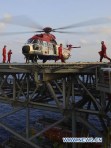
The sixth-generation semi-submersible CNOOC 981 will begin operations in a sea area 320 kilometers southeast of Hong Kong at a water depth of 1,500 meters, China National Offshore Oil Corp. It will be the first independent deep-water oil drilling by a Chinese company, marking “a substantial step” made by the country’s deep-sea oil industry, CNOOC said. About 70 percent of oil and gas reserves in the resource-rich South China Sea is contained in 1.54 million square km of deep-water regions, or sea areas with depths of over 300 meters. However, most of China’s current offshore oil exploration is conducted less than 300 meters below the surface.

The South China Sea is estimated to have 23 billion to 30 billion tonnes of oil and 16 trillion cubic meters of natural gas, accounting for one-third of Chinas total oil and gas resources.”

via Chinas first deep-water rig to drill in South China Sea – Xinhua | English.news.cn.

Another instance of China continuing to reduce reliance on Western hi-tech.
 
Related post:
03/05/2012

* Unease Mounting, China and U.S. to Open Military Talks

NY Times: “Limited military talks between China and the United States — an arena in which the two sides view each other with mounting unease — open here on Wednesday as a prelude to a wider-ranging economic and strategic dialogue between Secretary of State Hillary Rodham Clinton and Treasury Secretary Timothy F. Geithner and their Chinese counterparts.

Secretary of State Hillary Clinton and Treasur...

Secretary of State Hillary Clinton and Treasury Secretary Timothy Geithner listen as President Barack Obama addresses the opening session of the first U.S.-China Strategic and Economic Dialogue at the Ronald Reagan Building and International Trade Center in Washington on July 27, 2009. (Photo credit: Wikipedia)

Military talks are a prelude to an economic and strategic dialogue. China is increasingly suspicious of what it views as stepped-up spying by American planes and ships along its coast, and the United States is disquieted by China’s growing array of weaponry, analysts on both sides say. The two nations have been unable to agree on a serious agenda for military talks despite an escalation of tensions as China presses territorial claims in the East and South China Seas and the United States fortifies longstanding alliances from Australia to the Philippines.

The meetings, known as the Strategic and Economic Dialogue, will be limited to a one-day session on Wednesday that will cover two subjects, cyberwarfare and maritime issues, Obama administration officials said.”

via Unease Mounting, China and U.S. to Open Military Talks – NYTimes.com.

Law of Unintended Consequences

continuously updated blog about China & India

ChiaHou's Book Reviews

continuously updated blog about China & India

What's wrong with the world; and its economy

continuously updated blog about China & India