

The VidyaGyan Leadership Academy, a boarding school in India‘s Uttar Pradesh state, is offering an elite education for pupils drawn from the rural poor.

There are about 200 places on offer each year – but such is the appetite for families to get a better life for their children, there are 250,000 applications.
The school, set up by the Shiv Nadar Foundation, is completely free, and offers the type of education usually available only to the very wealthy.
Roshni Nadar Malhotra, a businesswoman and trustee of the foundation, says the school has been modelled on India’s private schools, which put students on the pathway to top universities and high-flying careers.

Roshni Nadar Malhotra wants the school to produce a more meritocratic generation of leaders for India
But the VidyaGyan school is open only to the very clever and very poor – which she describes as the “top of the bottom of the pyramid”.
No-one can even apply u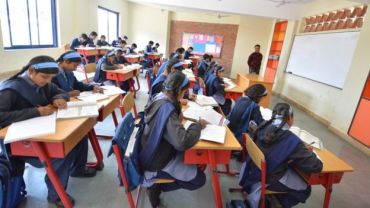
Unless their family income is below the equivalent of £1,500 per year, and the school carries out checks to make sure that better-off families are not trying to get in.
“Most of India is rural, there is a huge population in India not being tapped for their excellence. They have no access to great universities,” says Ms Malhotra, who is chief executive officer of the HCL technology company.

A performer from Uttar Pradesh prepares to take part in a festival
“We wanted to see if we could have an admissions system that was truly meritorious.”
The admissions system operates on an epic scale.
After the initial 250,000 applications, Ms Malhotra says, about 125,000 turn up to take a written test.
The drop-out rate is a reflection of the tough lives of these families, who might struggle to travel to a local test centre or be stopped by bad weather.

The school’s ambition is for its students to compete anywhere in the world
Based on the results, there is a shortlist of about 6,000 students, who then take another set of tests. There are also visits to the homes of applicants.
This sifting process produces an intake of 200 pupils, boys and girls, who are taught, clothed, fed and housed by the school.
These children from the poorest rural families, a deliberate mix of religions and castes, then receive a high-cost education, exposing them to ideas and opportunities.
It is an intensive process, designed to create a “stepping stone” to top universities in India or abroad.

The school has been founded to help clever poor pupils from Uttar Pradesh
It has become such a phenomenon that there are now coaching academies dedicated to training people for the test.
So far the school has cost the foundation £59m – and Ms Malhotra says there have been questions about whether the money would have been better spent on teaching basic literacy to much bigger numbers of young people.The final intake of 200 pupils stands compared with Uttar Pradesh’s population of about 200 million.
But Ms Malhotra says the distinct purpose of the school is to create a leadership academy focusing on providing a chance for disadvantaged youngsters to compete with India’s elite.
These are the children of poor, uneducated farmers, and she wants them to be equipped to reach the top in politics, business or sport.
The school is intended to provide a stepping stone to top universities
And she says there is a “ripple effect” on the home villages of these pupils, as they see their young people being able to go to a top university in India or in Europe or the United States.
“When students get into a great university, it’s a huge aspirational lift for their village. These students become beacons of hope.”
There are also expectations of paying back to their local communities. In the summer, when they go home, they have to carry out a socially useful project, such as providing cleaner water, clearing away rubbish or finding a safer way of cooking.
“It’s about getting their hands dirty and finding out how to solve problems,” says Ms Malhotra.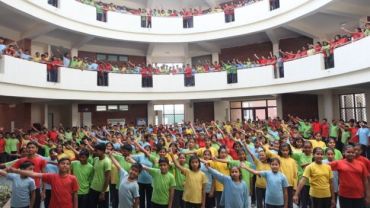
Once pupils are accepted, everything in the school is free for families
The school’s first graduates have left with “stellar results”, but she also wants them to be equipped to compete with international students anywhere.
“It’s not just about getting in, they need to be able to survive. All of a sudden you’re thrown in with other highly competitive students from all over the world.”
It will be some time before it is possible to see if they become India’s future leaders, she says. “But they’re on their way.”
Source: Is this the world’s most oversubscribed school? – BBC News

 CHINDIA ALERT: You'll be living in their world, very soon