Posts tagged ‘Sustainable Development’

12/11/2015

Five myths about the Chinese economy – McKinsey Quarterly

A widely held Western view of China is that its stunning economic success contains the seeds of imminent collapse. This is a kind of anchoring bias,1 which colors academic and think-tank views of the country, as well as stories in the media. In this analysis, China appears to have an economy unlike others—the normal rules of development haven’t been followed, and behavior is irrational at best, criminal at worst.

There’s no question, of course, that China’s slowdown is both real and important for the global economy. But news events like this year’s stock-market plunge and the yuan’s devaluation versus the dollar reinforce the refrain, among a chorus of China watchers, that the country’s long flirtation with disaster has finally ended, as predicted, in tears. Meanwhile, Chinese officials, worried about political blowback, are said to ignore advice from outside experts on heading off further turmoil and to be paranoid about criticism.

My experience working and living in China for the past three decades suggests that this one-dimensional view is far from reality. Doubts about China’s future regularly ebb and flow. In what follows, I challenge five common assumptions.

  1. China has been faking it

A key tenet of the China-meltdown thesis is that the country has simply not established the basis for a sustainable economy. It is said to lack a competitive, dynamic private-enterprise structure and to have captured most of the value possible from cheap labor and heavy foreign investment already.

Clearly, China lacks some elements of a modern market economy—for example, the legal system falls short of the support for property rights in advanced countries.2 Nonetheless, as China-economy scholar Nicholas Lardy recently pointed out, the private sector is vibrant and tracing an upward trend line. The share of state-owned enterprises in industrial output continues to drop steadily, from 78 percent in 1978 to 26 percent in 2011.3 Private industry far outstrips the value added in the state sector, and lending to private players is growing rapidly.

In fact, much of China’s development model mirrors that of other industrializing and urbanizing economies in Asia and elsewhere. The high savings rate, initial investments in heavy industries and manufacturing, and efforts to guide and stabilize a rapidly industrializing and urbanizing economy, for example, resemble the policies that Japan, South Korea, and Taiwan followed at a similar stage of their development. This investment-led model can lead to its own problems, as Japan’s experience over the past 20 years indicates. Still, a willingness to intervene pragmatically in the market doesn’t imply backwardness or economic management that’s heedless of its impact on neighboring economies and global partners.

Furthermore, China’s reform initiatives4 since 2013 are direct responses to the structural changes in the economy. The new policies aim to spur higher-value exports, to target vibrant emerging markets, to open many sectors for private investors, and to promote consumption-led growth rooted in rising middle-class incomes. Today, consumption continues to go up faster than GDP, and investors have recently piled into sectors from water treatment to e-commerce. These reforms are continuing at the same time China is stepping up its anticorruption drive, and the government hasn’t resorted to massive investment spending (as it did in 2008). That shows just how important the reforms are.

  1. China’s economy lacks the capacity to innovate

Think tanks, academics, and journalists alike maintain that China has, at best, a weak capacity to innovate—the lifeblood of a modern economy. They usually argue as well that the educational system stomps out creativity.

My work with multinationals keen on partnering with innovative Chinese companies suggests that there’s no shortage of local players with a strong creative streak. A recent McKinsey Global Institute (MGI) study describes areas where innovation is flourishing here.5 Process innovations are propelling competitive advantage and growth for many manufacturers. Innovation is at the heart of the success of companies in sectors adapting to fast-changing consumer needs, so digital leaders like Alibaba (e-commerce) and Xiaomi (smartphones) are emerging as top global contenders. Heavy investment in R&D—China ranks number two globally in overall spending—and over a million science and engineering graduates a year are helping to establish important beachheads in science- and engineering-based innovation. (See “Gauging the strength of Chinese innovation.”)

  1. China’s environmental degradation is at the point of no return

To believe this, you need to think that the Chinese are content with a dirty environment and lack the financial muscle to clean things up. OK, they got things wrong in the first place, but so did most countries moving from an agrarian to an industrial economy.

In fact, a lot that’s good is happening. Start with social activism. A documentary on China’s serious air-pollution problems (Under the Dome), by Chai Jing—a former journalist at China Central Television (CCTV), the most important state-owned broadcaster—was viewed over 150 million times in the three days after it was posted online, in March 2015. True, the 140-minute video, which sharply criticizes regulators, state-owned energy companies, and steel and coal producers, was ultimately removed. But the People’s Daily interviewed Chai Jing, and she was praised by a top environmental minister.

China is spending heavily on abatement efforts, as well. The nation’s Airborne Pollution Prevention and Control Action Plan, mandating reductions in coal use and emissions, has earmarked an estimated $277 billion to target regions with the heaviest pollution.6That’s just one of several policy efforts to limit coal’s dominance in the economy and to encourage cleaner energy supplies. My interactions with leaders of Chinese cities have shown me that many of them incorporate strict environmental targets into their economic master plans.

  1. Unproductive investment and rising debt fuels China’s rapid growth

To believe this, you would have to think, as many skeptics do, that the Chinese economy is fundamentally driven by overbuilding—too many roads, bridges, and buildings.7 In fact, as one economist has noted, this is a misperception created by the fact that the country is just very big. An eye-popping statistic is illustrative: in 2013, China consumed 25 times more cement than the US economy did, on average, from 1985 to 2010. But adjusted for per-capita consumption and global construction patterns, China’s use is pretty much in line with that of South Korea and Taiwan during their economic booms.8

China’s rising debt, of course, continues to raise alarms. In fact, rather than deleveraging since the onset of the financial crisis, China has seen its total debt quadruple, to $28.2 trillion last year, a recent MGI study found.9 Nearly half of the debt is directly or indirectly related to real estate (prices have risen by 60 percent since 2008). Local governments too have borrowed heavily in their rush to finance major infrastructure projects.

While the borrowing does border on recklessness, China’s government has plenty of financial capacity to weather a crisis. According to MGI research, state debt hovers at only 55 percent of GDP, substantially lower than it is in much of the West. A recent analysis of China’s financial sector shows that even in the worst case—if credit write-offs reached unprecedented levels—only a fairly narrow segment of Chinese financial institutions would endure severe damage. And while growth would surely slow, in all likelihood the overall economy wouldn’t seize up.10

Finally, the stock-market slide is less significant than the recent global hysteria suggests. The government holds 60 percent of the market cap of Chinese companies. Moreover, the stock market represents only a small portion of their capital funding. And remember, it went up by 150 percent before coming down by 40.

Rumors drive the volatility on China’s stock exchange, often in anticipation of trading by state entities. The upshot is that the direct impact on the real economy will most likely be some reduction in consumer demand from people who have lost money trading in shares.

  1. Social inequities and disenfranchised people threaten stability

On this one, I agree with the bears, but it’s not just China that must worry about this problem. While economic growth has benefited the vast majority of the population, the gap between the countryside and the cities is increasing as urban wealth accelerates. There’s also a widening breach within urban areas—the rich are growing richer.11

Urban inequality and a lack of access to education and healthcare are not problems unique to China. People here and in the West may find fruitful opportunities to exchange ideas because the pattern across Western economies is similar. Leaders of the central government have suggested policies to improve income distribution and to create a fair and sustainable social-security system, though implementation remains a matter for localities and varies greatly among them.

In short, China’s growth is slower, but weighing the evidence I have seen, the sky isn’t falling. Adjustment and reform are the hallmarks of a stable and responsive economy—particularly in volatile times.

From: http://www.mckinsey.com/Insights/Winning_in_Emerging_Markets/Five_myths_about_the_Chinese_economy?cid=other-eml-alt-mkq-mck-oth-1511

01/06/2015

Pranab in Sweden, key pacts to be signed – The Hindu

President Pranab Mukherjee on Sunday arrived here on the first leg of his five-day state visit to Sweden and Belarus, the first ever by any Indian head of State, during which a number of key agreements on sustainable development, scientific research are likely to be signed.

Sweden's Crown Princess Victoria and Prince Daniel receive President Pranab Mukherjee at Arlanda airport, north of Stockholm.

On his arrival, Mr. Mukherjee was received by Crown Princess Victoria at the Arland airport. Later, he was received at the Royal Mews by the King Carl XVI Gustaf and Queen Silvia from where he was taken on a horse-drawn cortege to the Royal Palace, where the traditional welcoming ceremony took place.

Earlier in New Delhi, he was given a ceremonial send-off at Rashtrapati Bhavan by Prime Minister Narendra Modi, Vice President Hamid Ansari, Delhi Lieutenant Governor Najeeb Jung, External Affairs Minister Sushma Swaraj, Finance Minister Arun Jaitley and the three Service Chiefs.

During his three-day State visit in Sweden, the President will meet Prime Minister Stefan Lofven, the Speaker of the Swedish Parliament, and the Leader of Opposition, Anna Kinberg Batra besides number of meetings with the King and the Queen. The visit will focus on innovation, sustainable development, urban development and scientific research with both countries exploring ways to enhance mutual exchange in the areas of trade and science.

via Pranab in Sweden, key pacts to be signed – The Hindu.

26/01/2014

* Poverty relief to become priority for poor counties – Xinhua | English.news.cn

The Chinese government seems to appreciate the management axiom that “you don’t manage what you don’t measure”. When implemented, this new ruling should be good for the poor as well as ensure that some local authorities don’t jack up their debt any further to increase their GDP.

“Chinese officials in poverty-stricken counties can stop worrying too much about regional GDP figures from now on, as the central authorities have moved to make poverty relief the priority for their work.

The country will reform the evaluation system for officials from poor counties by prioritizing the work of poverty reduction rather than the regional GDP, according to a guideline released Saturday jointly by the Central Committee of the Communist Party of China and the State Council, the Cabinet.

GDP figures will no longer be a standard for counties with fragile ecology or where development is restricted by the government to ensure sustainable growth, the guideline said.

\”The country will take improving the livelihood of people in poverty and reducing poor population as major indicators\” to guide officials in poor regions to put their work priority on poverty relief, it said.

Chinese leaders have recently set new standards for local officials, stressing that their performance cannot be simply based on regional GDP growth rates, but should include resource and environmental costs, debt levels and work safety.”

via Poverty relief to become priority for poor counties – Xinhua | English.news.cn.

Enhanced by Zemanta
13/12/2013

China’s reformed govt assessment hailed as landmark |Politics |chinadaily.com.cn

China\’s official evaluation system has abandoned GDP-obsessed assessments and puts more emphasis on public well-being and the environment.

\”It\’s a historical turning point that shows solid steps to deepen reform,\” said Wang Yukai, professor with the Chinese Academy of Governance, who believes the new system will help CPC members do a better job.

Gross regional product and its growth will no longer be the main determinants of local administrators\’ success or failure, according to a circular on improving evaluation of local authorities, released on Monday.

The GDP growth has been the major index for assessing local performance for many years and has led to blind pursuit of growth by some local authorities at the cost of the environment and residents\’ livelihoods.

The document issued by the Organization Department of the Communist Party of China (CPC) Central Committee, gives greater emphasis to indices related to the waste of resources, environmental protection, excess capacity and production safety. Evaluation of scientific innovation, education, culture, employment, social insurance and health should all be encouraged, it said.

The new assessment regime will make use of indices of sustainable economic development, quality of life, social harmony and ecological protection, said Xie Chuntao, a professor at the Party School of the CPC Central Committee.

The circular echoes a key reform decision made by the CPC Central Committee last month, part of which vowed to improve the evaluation system.

via China’s reformed govt assessment hailed as landmark |Politics |chinadaily.com.cn.

21/06/2012

* All eyes on China’s green leap forward

New Scientist: “TWENTY years ago this week, the United Nations’ Earth Summit closed in Rio de Janeiro having forged landmark agreements on climate change and biodiversity. Next week, delegates from around the world will meet again in Rio for a new Conference on Sustainable Development, dubbed Rio+20. How far have things advanced in the interim?

On the face of it, the picture is dispiriting. Annual global carbon dioxide emissions have risen by over 50 per cent, and the demise of the Kyoto protocol has halted co-ordinated action on climate change. And while the Convention on Biological Diversity is still in force, it has not prevented rampant habitat destruction.

With global co-operation proving hard to secure, progress now depends heavily on the unilateral actions of individual countries. The US tops the priority list, just as it did at the original Earth Summit – but it has been joined there by China. The Asian giant’s extraordinary economic growth has come at enormous environmental cost: it is now among the world’s largest polluters, and its natural resources have been massively exploited in recent years.

Despite this, China’s appetite for resources still falls well short of the west’s on a per capita basis, and its people do not generally enjoy the prosperity, health and life satisfaction common to the world’s richest billion inhabitants. It has become the received wisdom that nothing approaching global parity can possibly be achieved without utterly gutting the planet. The implication? That the lives of 6 billion of the world’s residents are, and must remain, “nasty, brutish and short”.

We now have a first sense that this picture is not true to life. Much discussion revolves around GDP, but this is a poor measure of sustainable development. Pick a metric that emphasises citizen well-being in combination with the environment, such as the Happy Planet Index, and the pecking order is turned on its head, with countries such as Costa Rica topping the league (see “What is wealth on a happy planet?”).

Such measures are for the moment informal. But the World Bank has for some time been plugging away at its own tweaked index, which would offset the environmental damage caused by a nation’s industry against its productivity. It has been slow going, due to political resistance and the difficulties of pricing up “natural capital”.

This is where China’s role becomes most surprising – and promising. It is setting out on a huge green experiment that could provide lessons far afield (see “China leads the march for the green economy”). Even as its economy booms, it is sharply reducing its “carbon intensity” – CO2 emissions per unit of GDP – and deploying new economic models to price natural resources.

Such models are routinely scorned in the west as the products of ivory-towered wishful thinking, and their adoption deemed unthinkably risky. Yet China, acting largely out of economic self-interest, and perhaps with a longer-term vision than beleaguered western democracies can muster, is forging ahead.

All this does not expiate China from its environmental sins. But its experiment offers the west scope to learn from its experience. Our representatives at Rio+20 should pay close attention.”

via All eyes on China’s green leap forward – opinion – 14 June 2012 – New Scientist.

02/04/2012

* China to deepen reforms to drive growth: vice premier

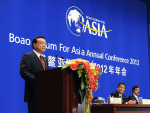
Xinhua: “Chinese Vice Premier Li Keqiang said Monday that China will deepen reforms and opening-up to remove obstacles on its course to transfer growth mode and drive economic and social development.

Li made the remarks when delivering a keynote speech at the opening ceremony of the Boao Forum for Asia Annual Conference 2012, which runs from Sunday to Tuesday in Boao, a scenic town in south China’s island province of Hainan. “Faced with the profound changes in international and domestic landscapes, we must let reforms and opening-up continue to lead the way in removing the institutional obstacles that hamper the shift of the growth model,” Li said. Noting that the country has entered a critical stage of reform, Li said China will deepen reform of the fiscal sector, taxation, finance, pricing, income distribution and enterprises.

The country will endeavor to make breakthroughs in key areas and key links, and bring into better play the markets role in resource allocation and advance institutional, technological and management innovation so as to increase the internal driving force and dynamism of development, Li said. Li said the country will adopt an even more proactive opening-up strategy and attach equal importance to export and import so as to boost balanced development of foreign trade and raise the level of an open economy. “China is dedicated to creating an open, transparent, fair, competitive and predictable marketplace and legal environment,” Li said, adding that more efforts will be made to step up intellectual rights protection to promote development of all enterprises in China during its course to transform growth mode.

More than 2,000 government, business and academic leaders from around the globe attended the meeting, which this year adopts the theme “Asia in the Changing World: Moving toward Sound and Sustainable Development.””

via China to deepen reforms to drive growth: vice premier – Xinhua | English.news.cn.

This declaration of reform by the Premier-to-be reaffirms the current Premier’s call for reform posted earlier. So this means the new leadership is fully behind the outgoing leadership.

Related post: https://chindia-alert.org/2012/03/14/premier-wen-says-china-needs-political-reform-warns-of-another-cultural-revolution-if-without/

Law of Unintended Consequences

continuously updated blog about China & India

ChiaHou's Book Reviews

continuously updated blog about China & India

What's wrong with the world; and its economy

continuously updated blog about China & India