Posts tagged ‘Taiwan’

18/10/2012

* Feuds in the Pacific over islands: it’s not simply a case of China against everyone else

Unfortunately for China, its recent military posturing has obscured the fact that territorial claims in the South China Sea is not only between China and its neighbours but endemic.

WorldTimes: “When it comes to feuds in the Pacific over islands and what lies beneath, it’s not simply a case of China against everyone else. Depending on the dispute, it’s also South Korea vs. Japan, Japan vs. Taiwan, Taiwan vs. Vietnam, Vietnam vs. Cambodia and numerous other permutations — for many of the same reasons supposedly behind China’s actions. Resource grab. Patriotic posturing. Historical baggage (mostly to do with Japan’s brutal occupation of most of East Asia before and through World War II). Referring to the South China Sea, former ASEAN secretary general Rodolfo Severino, who now heads Singapore’s Institute of Southeast Asian Studies, wrote recently that “all claimants feel their footholds are essential to what they consider their national interests … This clash of national interests … makes it most difficult even to appear to be making compromises on national integrity or maritime regimes and, thus, almost impossible to resolve [the] disputes.””

Read more: http://world.time.com/2012/08/19/why-asias-maritime-disputes-are-not-just-about-china/#ixzz29dhhV78F

23/05/2012

* Taiwan spies increase in carrier threat

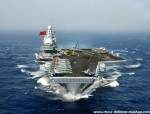
Hong Kong Standard: “Taiwan’s intelligence chief said Beijing plans to build two aircraft carriers to go with the first one in its fleet, a refitted former Soviet carrier currently undergoing sea trials.

“Indeed, the Chinese communists have decided to build two aircraft carriers on their own,” Tsai Teh-sheng, head of the National Security Bureau, told lawmakers. Construction is expected to start next year and in 2015, with the warships, which would be conventionally powered, to be delivered in 2020 and 2022. Tsai said Beijing has conducted six sea trials of its first carrier since the middle of last year, and that Taiwan expects it to go into service before the end of this year. Initially it may simply be used for training purposes but it can be sent for battles when necessary in the future,” he said. The ship’s sea trials have sparked international concern about the mainlands widening naval reach amid growing regional tensions over maritime disputes and a US campaign to assert itself as a Pacific power.”

via Taiwan spies increase in carrier threat – The Standard.

05/04/2012

# Deciphering Chinese names

Chiang Kaishek with Muslim General Ma Fushou a...

There are around 100 common Chinese surnames and, apart from possibly Ma (), there is no religious or regional clustering. The colloquial for ‘the public’ is lao bai xing, which literally means “old hundred surnames”. The surname Ma, more often than not, is used by Muslim Chinese; and is thought to be derived from the Prophet Mohammed.

Traditionally, for many centuries, most Chinese families followed the standard practice of using three mono-syllabic words for their names, such as Sun Yatsen, father of modern China.
Maybe surprisingly, Dr Sun is revered in both the Peoples’ Republic and Taiwan. Both have huge memorials to him. The photo courtesy –
http://hcyip.wordpress.com/tag/nanjing-massacre/ – is of the mainland memorial.

The first, Sun (), is the family or clan name. After all what is most important, your antecedents, of course rather than you yourself – back to the collective mindset of Chinese.

The second, Yat, is the ‘generation name’. It is given by the parents to each of the siblings. So, all of Yatsen’s brothers and sisters would have Yat plus another word as their name. And, indeed, all his paternal first cousins. In some families, the boys and girls may have variants of this name.

If the family is conforming to old traditions, then the middle name (the generation name) is taken from a poem specially composed for the family, with each generation taking a successive word from the poem. Typically, the poem will be about something noble and aspirational, such as: “World peace, national unity; Social harmony, family prosperity”. So, the first generation’s middle name will be world, the next peace and so forth. Of course, in most families, long before they reach the eighth generation, some successor would have thought to create his own couplet to be more modern and so the cycle restarts.

The third, sen, is the personal name and can be any word in the Chinese vocabulary. Having said that, some words are regarded as more masculine and others more feminine.

Just to confuse everyone, some families use the second name as the personal name and third as the generation name. So, for example, Sun Yatsen’s wife Madam Sun was named Soong Chingling and her two sisters were Soong Ailing and Soong Meiling. Although Sun and Soong sound similar, Soong is a differnt name altogether () incidentally, Meiling was Chiang Kaishek‘s wife, Madame Chiang.

Despite being a feudal society until recent times, women kept their names after marriage. So the wife of the disgraced leader Bo


Xilai is Gu Kailai; rarely – but confusingly – called Bogu Kailai.
In places like Singapore and Hong Kong sometimes married women, esp business women, would keep their maiden name along with the husband’s surname, making it four names. Sort of like the British ‘double-

barrelled‘ surnames such as the actress Helene Bonham Carter.

Most Chinese who live in Hong Kong, Singapore, Taiwan and other enclaves of Chinese emigrees tend to keep to the traditional way of naming.

Her Excellency Wu Yi, Vice Premier of the Peop...

But since the revolution in 1949 and especially since the Cultural Revolution in the 70s, many mainland Chinese have stopped using the generation name and use just one name after the surname such as Madame Wu Yi, retired senior leader who led China into the WTO and who managed the SARS crisis of early 2000s.

This causes huge problems for the authorities as, it is not uncommon, at roll call in school, several kids would raise their hands– for example – to Wang Ta (= Wang senior). The authorities are encouraging parents to revert to a middle name when naming their children.

Law of Unintended Consequences

continuously updated blog about China & India

ChiaHou's Book Reviews

continuously updated blog about China & India

What's wrong with the world; and its economy

continuously updated blog about China & India