Posts tagged ‘Tencent Holdings’

16/06/2016

In China, One Nail House Doesn’t Get Hammered – China Real Time Report – WSJ

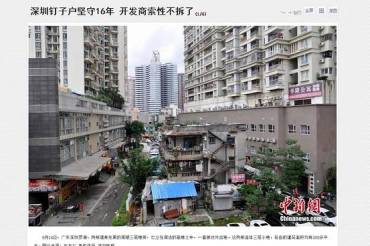
Standoffs between developers and property owners in China are usually grim affairs almost always ending the same way: demolition. One holdout in the southern city Shenzhen is scoring a rare–but perhaps mixed–victory after fending off the bulldozers for more than a dozen years.

Developer Shenzhen Xiafeilong Real Estate has given up knocking down a three-story building belonging to unidentified owners in the city’s Luohu district, according to state-owned China News Service.

Photographs online show the water-stained facade of the three-story building, juxtaposed against newer high-rise apartments that are more than 20-stories high.

Resistance by homeowners to development usually draws sympathy from ordinary Chinese, who often complain that local governments in their zeal for growth and revenues favor developers and ignore property rights. Holdouts like the Shenzhen building have become popular symbols of resistance, known as “nail houses”  because they stick out like nails from a flat surface, such as a razed construction site for example.

“The fact that the government decides you’re going to move and the price you’re going to accept as compensation results in nail houses. It’s a form of negotiation tactic, or sometimes, an act of civil disobedience,” said Michael Cole, a property market observer and founder of real estate website Mingtiandi.com.

Xiafeilong, the developer, couldn’t be reached for comment, nor could the owner or owners of the nail house, who weren’t identified in media reports or in a government statement on the matter.

The three-story building appears to be mostly for residential use, with a computer repair shop at a corner storefront, according to photos and media accounts. A female employee answering the phone at the computer repair shop said she wasn’t aware of any demolition plans or faced any pressure to move.

China News Service said the landlord and the developer spent years on legal battles after they couldn’t agree on compensation for the demolition in 2000.

Xiafeilong initially wanted to build a high-rise apartment and offered the owner an apartment in the new development as compensation, according to Shenzhen Business News. The owner demurred as he wanted cash compensation or another home in a nearby complex, the Shenzhen Business News said in a 2014 article.

In 2013, the space around the nail house became a car park for residents in the surrounding residential towers, China News Service said. The Shenzhen government’s Internet Information Office, in a posting on its official social media account, said the developer realized that the nail house “did not impact its main development, so it simply stopped asking.

”Unlike previous nail-house standoffs, support online was more mixed. Some praised the outcome. “This shows that Shenzhen is civilized, unlike other places,” said a web user on the comments section following pictures of the nail house hosted by Tencent Holdings.

Others, however, saw it as an example of the landlord’s bad timing or greed. Prices for apartments and land in Shenzhen have soared by more than 60% on a year-over-year basis in recent months.

“The nail-house owner has a heart which not content like a snake that wants to swallow an elephant,” said another web-user. “Why could other parties come to an agreement but not you?

”A hotpot restaurant owner in a nearby building said it’s a blow to the neighborhood. “It would be better to demolish the building and build something modern so that it can drive more economic development in the area. Right now it’s an eyesore,” said the shop owner, who declined to give his name.

The government’s Internet Information Office gave its own assessment, citing an unidentified–and perhaps fictitious–web user: “The owner of the nail-house weeps in the toilet.”

Source: In China, One Nail House Doesn’t Get Hammered – China Real Time Report – WSJ
23/02/2016

‘Weird’ new buildings banned in Chinese cities| Society

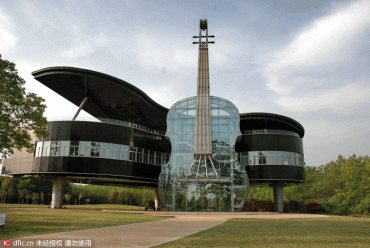
Cities will not be allowed to build more “oversized, xenocentric, weird” buildings devoid of cultural tradition in the future, according to a new directive from the central government.

The State Council, or the cabinet, and the Communist Party of China Central Committee issued the directive on Sunday. It says buildings should be “suitable, economic, green and pleasing to the eye.”

Cities have built some unusually shaped buildings to create memorable skylines in recent years, but many have drawn criticism. Here is one of sixteen very weird buildings in China!'Weird' new buildings banned in Chinese cities

See the other fifteen at:

Source: ‘Weird’ new buildings banned in Chinese cities[12]| Society

27/01/2015

China’s Top 100 Brands: The Private Sector Reigns Supreme – China Real Time Report – WSJ

China’s top brand is no longer a state-owned company, nor is it e-commerce giant Alibaba Group Holding Ltd.BABA +0.85% It’s technology player Tencent Holdings TCEHY +3.45%.

In a ranking of the top 100 most valuable Chinese brands by research from agency Millward Brown and media company WPP, Tencent,  China’s largest online-games and social-networking company, ranked No. 1 with a brand value of $66 billion, ahead of No. 2 Alibaba’s $59 billion. Tencent’s WeChat and QQ messaging services propelled it to the top of the list, said Doreen Wang, global head of Millward Brown’s BrandZ division.

Tencent’s rise unseats state-owned telecom giant China Mobile, which has held the top spot since the ranking’s launch in 2010. It also marks a sea change for China’s private-sector companies, which now account for 47% of the value of the top 100 brands. To calculate rankings, Millward Brown and WPP analyze financial data of listed companies’ brands, pairing it with survey data from more than two million consumers in over 30 countries.

China’s state-owned enterprises have long dominated China’s list of leading companies. In 2010, of the top 50 Chinese brands identified in the report, state-owned companies occupied a third of the list and accounted for an estimated 70-75% of the $280 billion total combined value of the top 50.

Today, it’s a different story. In the past year, the government as has pushed private sector reforms and talked about the need to let market forces play a “more decisive” role in the economy. Alibaba’s public listing last year also contributed to the jump in value for market-driven brands, Millward Brown said, adding that technology brands have also for the first time surpassed financial institutions, becoming the highest valued sector in the rankings, representing 23% of the top 100’s value. Search giant Baidu Inc.BIDU -1.66% ranked No. 5, behind China Mobile and Industrial & Commercial Bank of China Ltd.

Tencent now ranks fifth in the world for global technology leaders’ brand value, according to MIllward Brown. Google Inc. is No. 1 with $158.8 billion, with Apple Inc. holding the No. 2 spot, followed by International Business Machines Corp.and Microsoft Corp.

Yet, even with Alibaba’s record-setting IPO and Tencent’s various successes, Chinese brands haven’t gained global recognition, said Ms. Wang. Only 22% of consumers surveyed outside of China could recognize a Chinese brand in 2014, a slight rise from 20% the year earlier. Chinese brands need to clarify what they stand for and need to ensure that they can satisfy needs beyond the Chinese market for them to gain more recognition, said Ms. Wang. “They need to consider what kind of benefit they bring to global consumers,” she said.

via China’s Top 100 Brands: The Private Sector Reigns Supreme – China Real Time Report – WSJ.

10/02/2014

THE WORLD’S TOP 10 MOST INNOVATIVE COMPANIES IN CHINA

From: http://www.fastcompany.com/most-innovative-companies/2014/industry/china

THERE’S A STUBBORN MEME THAT CLAIMS CHINA HAS NO CULTURE OF INNOVATION. IN ACTUALITY, IT’S SHAPING GLOBAL BUSINESS TRENDS, MOST NOTABLY IN SOCIAL MEDIA. MAMMOTH NETWORKS SUCH AS TENCENT‘S WECHAT, FOR EXAMPLE, ARE NOT SIMPLY FACEBOOK COPYCATS–THEY’VE SPARKED THE MESSAGING WARS OCCURRING ON AMERICAN SOIL AMONG APPS LIKE SNAPCHAT AND KIK, AND CONTRIBUTE BILLIONS TO THE WORLD’S RICHEST COUNTRY.

BY FAST COMPANY STAFF

1. XIAOMI

For launching low-cost, high-quality smart TVs and -phones to steal market share from industry stalwarts.

2. BEIJING GENOMICS INSTITUTE

For making DNA sequencing mass-market.

3. CHINA’S LUXURY BRANDS

For greeting its booming middle and upper classes with distinctly native offerings.

4. HAIER

For letting its 80,000 employees self-organize and oust ineffective leaders—a bold approach to innovating the fridge and microwave business.

5. TENCENT

For pummeling the Chinese social-networking competition and sending chills through Silicon Valley with a 10-terabyte storage offer.

6. GEAK

For making wearable tech closer to vogue with a ring that syncs to phones and shares contacts via fist bump.

7. PHANTOM

For clearing the air in Beijing homes with the app-controlled EcoTower. .

8. BAIDU

For moving from search to smart cameras, giving users their own Internet-enabled monitoring devices.

9. YY

For letting anyone become a star in the world’s most-crowded country.

10. COOTEK

For tapping into user demand for faster typing.

Enhanced by Zemanta
Law of Unintended Consequences

continuously updated blog about China & India

ChiaHou's Book Reviews

continuously updated blog about China & India

What's wrong with the world; and its economy

continuously updated blog about China & India